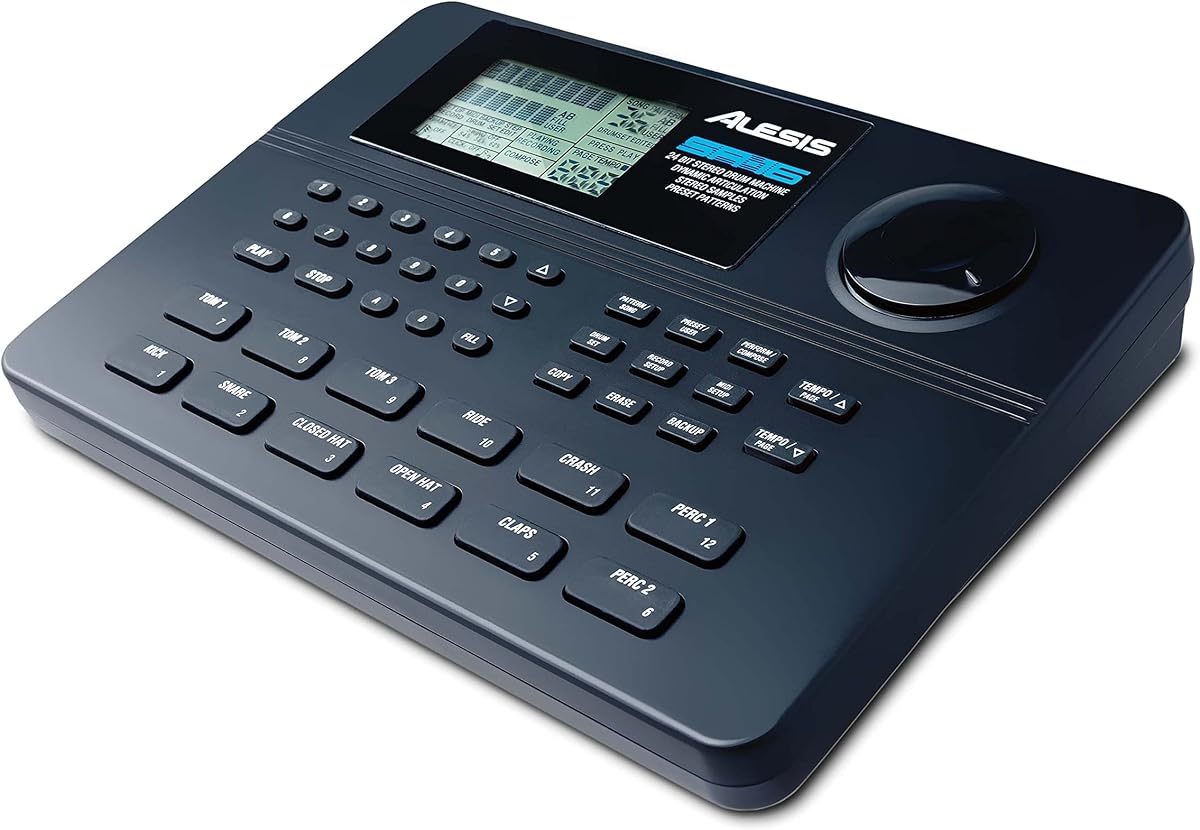
Alesis SR-16 Standalone Drum Machine
4.4Editor score
Twelve velocity-sensitive drum pads
233 assignable professional sounds
Complete MIDI and DAW connectivity
Fifty preset and fifty user kits
Explore the best digital drum machine options for beatmaking, live performance, sampling, and studio production, comparing features, ratings, workflows, and
A digital drum machine gives musicians a portable source of rhythm, sound design, and arrangement ideas, whether they are producing at home, tracking in a studio, or performing live. The right model depends on the sounds you want, the controls you prefer, and how much complexity the workflow should offer.
This guide compares ten leading options using their published specifications, features, connectivity, and customer ratings. It covers classic rhythm machines, compact grooveboxes, sample-centered instruments, hybrid analog and digital models, and a foot-controlled pedal for hands-free performance.
Each selection highlights a different way to make beats, from immediate pattern programming to deep sample manipulation and live triggering. Ratings and product details reflect the supplied information, while prices and availability can change, so readers should confirm current listings before buying.
4.4Editor score

4.8Editor score

4.4Editor score
This side-by-side comparison highlights the principal differences in sound source, sequencing, sampling, performance controls, and connectivity among ten digital drum machines for studio and live use.


The Alesis SR-16 is a classic standalone drum machine with a 4.4 customer rating and a feature set aimed at songwriters, live performers, and remix engineers. Its defining strength is the combination of twelve velocity-sensitive pads, 233 professional sounds, and an interface that supports both hands-on triggering and step-based programming.
We may earn a commission when you buy through this link, at no additional cost to you.
The sound library covers a substantial range of acoustic and electronic drums, while Dynamic Articulation adds variation according to how the pads are played. Sound stacking, step editing, stereo samples, reverb, and ambience give users several ways to shape a pattern, and the ability to assign sounds to any pad supports custom kit creation.
Connectivity is a major advantage for a budget-oriented model. Complete MIDI support allows it to work with keyboards, computers, DAWs, and electronic drum kits, while four stereo output pairs provide more routing flexibility than many compact rhythm machines. The trade-offs are its age and a workflow that lacks the sample editing, touch displays, and deep modulation found in newer instruments.
This is a strong recommendation for musicians who want a dependable rhythm machine without spending heavily. It suits basic studio composition, electronic kit triggering, and practical live use. Those wanting extensive sample import, visual sequencing, or advanced sound manipulation may prefer a newer model, but the SR-16 delivers a convincing mix of playable drums, programming tools, and connectivity.
The twelve pads respond to strike velocity, helping programmed parts and live performances reflect changes in emphasis. Dynamic Articulation expands that sense of variation without requiring the user to build every subtle articulation from scratch.
Full MIDI support and multiple stereo output pairs make the unit practical alongside computers, DAWs, electronic drums, and external processing. It can function as a focused rhythm source rather than an isolated practice device.
We may earn a commission when you buy through this link, at no additional cost to you.
The Roland TR-8S combines classic Roland rhythm-machine character with modern sampling, and its 4.8 rating makes it one of the strongest-rated selections here. It appeals to producers who want recognizable TR drums while also needing the freedom to import, process, and layer personal sounds.
We may earn a commission when you buy through this link, at no additional cost to you.
Circuit models drawn from the 808, 606, 909, 707, and 727 families provide a strong historical foundation. The SD card slot accepts mono or stereo samples, and the editing controls allow decay, tuning, start point, speed, and direction to be adjusted. Kits can mix authentic TR voices with samples, creating a useful bridge between heritage drum programming and modern sound design.
The effects are particularly important to the instrument's identity. Options include rim-shot delay, kick overdrive, filters for toms and cymbals, and precision reverb on selected sounds. Instrument and master effects are stored with each kit, so carefully configured sounds remain ready for performance. The free TR-EDITOR adds visual control and organizational tools for a more expansive workflow.
The TR-8S is a compelling all-around choice for beatmakers, live performers, and anyone who values both classic analog-style rhythm sounds and sample flexibility. It may demand more study than a simple groovebox, but its sound range, editing depth, and strong rating make it an especially satisfying center of a home or stage setup.
Authentic circuit-modeled TR sounds establish a familiar tonal center, while the SD card workflow lets users introduce entirely different material. Mixing both approaches within one kit makes it easy to move from historically informed patterns to more experimental sounds.
Storing instrument and master effects with each kit preserves the complete sonic setup. That is valuable in live use because a saved kit recalls not just its sounds but also the processing choices that shaped them.
We may earn a commission when you buy through this link, at no additional cost to you.
The Korg Volca Drum is a compact percussion synthesizer with a 4.4 rating, built-in speaker, and a 16-step sequencer. Rather than imitate a conventional drum machine with a large preset library, it focuses on synthesizing percussion and turning a small set of steps into varied, dynamic patterns.
We may earn a commission when you buy through this link, at no additional cost to you.
Its six-part DSP engine and waveguide resonator are designed to produce a wide range of drum sounds with a distinctive synthetic character. Active Step allows selected steps to be replaced, while Slice divides a step for rapid rolls and intricate subdivisions. Two randomization functions can change sounds and settings, making them useful for breaking out of repetitive patterns.
Dynamics and articulation receive careful attention. Accent supports 16 levels, allowing performers to vary emphasis across a pattern, and choke groups determine how parts interrupt one another. These features make the small sequencer more expressive than its step count might initially suggest, although the compact 16-step format is less accommodating for long arrangements than the larger sequencers in this list.
The Volca Drum is ideal for mobile beatmaking, live experimentation, and anyone who prefers a small instrument with a built-in sound source. It also works well as a DAW sound module or a source of unusual percussion textures. Users needing extensive sample editing, long song arrangement, or many simultaneous parts should look toward a more advanced sampler or sequencer.
Active Step, Slice, and per-part choke behavior expand the possibilities of a 16-step layout. Randomization can also provide immediate changes when a user wants to preserve the core groove while varying its details.
The integrated speaker and portable design make the Volca Drum easy to carry into rehearsal spaces, classrooms, or small stages. It can produce and audition ideas without requiring a computer, amplifier, or separate sound module.
We may earn a commission when you buy through this link, at no additional cost to you.
The Yamaha DTX Multi Pad is a large sound repository presented as a drum pad, with a 4.3 customer rating. Its defining advantage is numerical variety: 1,061 drum, percussion, and effect sounds are joined by 216 keyboard sounds, creating a broad palette for performances and production.
We may earn a commission when you buy through this link, at no additional cost to you.
Mute and layer functions help users isolate or combine parts, while the sequencer and preset loops provide ready-made foundations for grooves. A 64MB Flash-ROM area stores user samples, allowing selected material to be integrated with the internal library rather than relying exclusively on factory sounds.
The format is more specialized than the compact grooveboxes in this guide. Its multi-pad concept is intended for users comfortable dividing a kit or performance set across multiple physical pads. That can be excellent for live triggering, but it differs from the screen-based sequencing and sample chopping offered by devices such as the Akai MPC Sample or Elektron Digitakt II.
The Yamaha is a good fit for drummers, producers, and educators who want many drum and percussion choices available from one hardware instrument. It may be less compelling for a minimalist setup focused on compact grooves, yet its sheer range makes it a practical melodic percussion source with meaningful room for custom samples.
The combination of 1,061 drum, percussion, and effect sounds with 216 keyboard tones gives users far more starting material than most compact machines. That range can reduce the need for additional sound sources when assembling arrangements.
Mute and layer controls make it possible to isolate individual sounds or combine them during live use. Preset loops and the sequencer provide immediate musical structure, while Flash-ROM supports a more personal library.
We may earn a commission when you buy through this link, at no additional cost to you.
The Akai MPC Sample delivers a 4.8 rating and a focused approach to portable sampling, sequencing, and beat production. It condenses the familiar MPC workflow into a compact, battery-powered device with sixteen responsive pads, a color display, internal speaker, microphone, and rechargeable battery.
We may earn a commission when you buy through this link, at no additional cost to you.
Standalone operation is the model's defining advantage. Users can record, edit, and play back without a computer or DAW, using microSD storage for saved material. Over 100 factory kits provide immediate sounds, while Instant Sample Chop Mode, real-time timestretch and repitch, internal resampling, and effects support a fast route from raw audio to a finished groove.
Four onboard effects processors offer 60 effect types, including FlexBeat, Color Compressor, vinyl and tape emulations, and a master compressor with retro coloration. The control layout is designed for rapid hands-on work, while the 2.4-inch display provides the visual feedback needed for chopping and sample management.
Connectivity is impressive for a portable unit. It offers stereo line input and output, headphone output, MIDI connections, sync output, USB-C audio and MIDI, smart-device sampling, and file transfer. It is a compelling choice for finger drummers, DAWless creators, indie producers, and performers who want a self-contained sampling hub rather than a simple fixed-pattern drum machine.
The rechargeable battery, built-in speaker, microphone, and microSD storage create a complete portable workflow. Samples can be recorded, chopped, processed, and sequenced wherever the instrument is being used.
Real-time timestretch, repitch, chopping, resampling, and 60 effect types reduce the friction between capturing an idea and shaping it into a usable beat. The large factory-kit selection also provides a fast starting point when inspiration needs to be immediate.
We may earn a commission when you buy through this link, at no additional cost to you.
The EP–133 K.O. II is a compact sampler, drum machine, and sequencer with a 4.7 rating. Building on the PO-33 K.O! concept, the updated K.O. II doubles the memory to 128MB, adds advanced sampling, redesigns the sequencer, and provides a broad selection of punch-in and master effects.
We may earn a commission when you buy through this link, at no additional cost to you.
Its sequencer organizes work into four groups with up to 99 patterns in each group. Patterns can be changed in real time to explore combinations, while the Commit button captures a musical moment for later development. This makes the device unusually direct for arranging a beat, adding a verse, introducing a break, or testing variations without entering a conventional linear menu structure.
Sampling is equally central. Users can record through the line input or built-in microphone, sample and resample voices, synths, and vinyl, and work with 999 sample slots. The OS 2.0 update adds resampling, chopping, a pumping sidechain, Song Mode for tracks up to 9,801 bars, increased polyphony, and expanded MIDI support.
The K.O. II is a particularly compelling choice for experimental producers and mobile creators who value immediacy over a large display. Its four-track sequencer, stereo and mono voice options, 16 stereo voices, 6 master effects, and 12 punch-in effects create a remarkably dense toolkit. It is also useful for live performance, where the multifunctional fader and real-time controls encourage improvisation.
The built-in microphone and line input make it simple to gather sounds from voices, instruments, records, or surroundings. Resampling and chopping then turn that raw material into new rhythmic and melodic layers.
Four pattern groups and the Commit function support fast, intuitive song building. Song Mode expands those foundations into longer arrangements, making the unit useful for ideas that need more structure than a single looping pattern.
We may earn a commission when you buy through this link, at no additional cost to you.
The Korg drumlogue is a hybrid drum machine built around three sound engines: analog, digital, and a multi engine that includes open-source user oscillators, noise, and VPM. Its 3.6 rating is the lowest among the listed products, but the specification set reveals a specialized instrument designed for hands-on hybrid synthesis.
We may earn a commission when you buy through this link, at no additional cost to you.
Front-panel knobs give direct control over tuning and attenuation for common drum parts, while dedicated volume controls support live mixing. The sequencer contains 11 parts and 64 steps, and combining Loop and Chain functions allows patterns to be joined into larger performances or songs. This structure is more musically expansive than a simple one-screen step sequencer.
Effects are unusually flexible. Reverb and delay can be assigned per part or applied at the master level, while third-party effects become available through the Multi engine and can run simultaneously. Connectivity includes stereo and four assignable outputs, USB-C for controllers and sample loading, audio input for processing other instruments, DIN MIDI, and Audio Sync.
The drumlogue is most appropriate for musicians who want a hardware instrument to feel like a synthesis system rather than a conventional preset drum machine. Its strengths include analog-style sound generation, direct panel control, live mixability, and the ability to process outside audio. The lower rating may reflect the learning curve or narrower appeal, so prospective buyers should consider how comfortable they are with a specialized workflow.
Analog, digital, and Multi approaches can be used independently or combined. This variety supports familiar drum synthesis alongside experimental oscillators and modulation-based sound generation.
Dedicated volume knobs and direct parameter access make it easier to adjust a kit while performing. Per-part and master effects, multiple outputs, and audio input further support integration into a larger live or studio signal chain.
We may earn a commission when you buy through this link, at no additional cost to you.
The Behringer LM DRUM Classic combines a hybrid sampling drum machine with headphones and an auxiliary cable, creating a ready-to-use package for immediate setup. Its 5.0 customer rating is the highest numerical rating among the products covered, though ratings alone do not reveal how closely its specialized workflow will suit a particular musician.
We may earn a commission when you buy through this link, at no additional cost to you.
The instrument uses 16 sampling voices and a 64-step sequencer with poly-meter, step-repeat, note-repeat, real-time triggering, track mute, and track solo. Autofill and Rand controls can help generate material or variation, while the dedicated MIDI, USB, Sync, and sequencing buttons provide direct access to the major functions.
Routing is the most unusual feature. Sixteen independent analog outputs allow each voice or part to be recorded and processed separately, and an integrated FX bus provides a Wave Designer and dual-mode analog filter with per-voice assignment. MIDI In/Out/Thru, USB 2.0 Type B, Sync In/Out, multiple audio outputs, an audio input, and a headphone connection support studio and live integration.
The LM DRUM Classic is a strong recommendation for producers who want to treat the drum machine like a modular multi-part sound source. Its per-track outputs are particularly valuable for detailed mixing, resampling, or external processing. Beginners seeking a simple portable groovebox may find the feature set daunting, but advanced users gain substantial routing and control flexibility.
Independent analog outputs allow parts to be routed into separate processing chains or recorded as multi-track audio. That makes the machine useful for detailed mixing and large studio configurations.
The bundle includes Turnstile Audio headphones and a 10-foot auxiliary cable. It reduces the need to source basic monitoring accessories before experimenting with the drum machine at home.
We may earn a commission when you buy through this link, at no additional cost to you.
The Elektron Digitakt II is a 16-track drum computer and sampler built for detailed sequencing, modulation, and full-song production. Its 4.4 rating reflects a balanced feature set, while its premium positioning makes it most appropriate for producers who want a capable centerpiece rather than a basic rhythm box.
We may earn a commission when you buy through this link, at no additional cost to you.
Each of the 16 audio tracks can handle stereo or mono samples or MIDI. A 128-step Elektron sequencer provides ample pattern space, and three assignable LFOs on every track allow parameters to move over time. Effects include delay, reverb, chorus, bit reduction, sample reduction, and overdrive, allowing a sound and its behavior to be shaped together.
The filter selection adds substantial tonal range. Users can choose from a base-width filter, a Multi-mode filter, low-pass 4, comb, EQ, and legacy low-pass or high-pass options. Four trig modes, a Euclidean sequence generator, and Song Mode support everything from generated rhythms to composed arrangements that are created, edited, and played within the device.
This is an excellent recommendation for advanced producers, live sample performers, and anyone who wants detailed control over every track. The depth comes with a learning requirement, and a simpler model may be more effective for basic drum programming. For those ready to learn the Elektron workflow, however, the combination of sampling, MIDI, modulation, effects, and arrangement tools is exceptionally versatile.
Three assignable LFOs on each track can animate parameters without external automation. This makes evolving rhythms, shifting tones, and changing textures easier to keep inside the instrument.
A 128-step sequencer supports detailed pattern work, while Song Mode organizes material into complete compositions. The combination makes the Digitakt II useful both for quick loop production and more involved arrangement.
We may earn a commission when you buy through this link, at no additional cost to you.
The Singular Sound BeatBuddy takes a different approach to the digital drum machine category by placing a full rhythm instrument in a pedal format. Its 4.5 rating reflects a specialized product for guitarists, solo performers, and live looping musicians who want to control a beat with their feet.
We may earn a commission when you buy through this link, at no additional cost to you.
Two foot switches provide hands-free start, stop, and pattern-changing control, allowing a performer to focus on another instrument. The LCD screen includes a visual metronome that helps players maintain timing and work with complex signatures, adding a learning aid that a purely audible rhythm track would not provide.
Content is a major strength. More than 200 songs span 24 genres, and 10 ultra-realistic drum kits provide ready-made starting points. Storage supports 3.2 million songs and 300 drum sets, with the ability to download new content or create custom material for a particular performance.
The pedal is ideal for musicians who would rather not operate a tabletop unit during a set. Its compact, ultra-lightweight design, 9V power, and 100mA consumption suit rehearsal, home practice, studio work, and gigs. It is less appropriate for someone seeking editable drum pads or detailed synthesis, but for hands-free live accompaniment, it offers a distinctive and practical solution.
The pedal format allows patterns to be started, stopped, and changed without taking attention away from a guitar, keyboard, or other instrument. That makes it especially useful for solo performances and live looping.
The built-in visual metronome provides feedback that can be easier for some players to follow than sound alone. It also supports practice with complex time signatures and helps players develop a steadier sense of pulse.
We may earn a commission when you buy through this link, at no additional cost to you.
The most useful digital drum machine is the one whose sounds, controls, sequencing method, and connectivity align with the way you make music. These factors matter more than a long specification list because every model places a different balance between immediacy and depth.
Some drum machines rely on curated factory sounds, some behave like synthesizers, and others place sampling at the center of the workflow. The Alesis SR-16 offers 233 assignable sounds, the Roland TR-8S combines classic TR circuit models with imported samples, and the Korg Volca Drum uses a six-part DSP engine. Sample-oriented choices include the Akai MPC Sample, EP–133 K.O. II, and Digitakt II, while the Korg drumlogue and Behringer LM DRUM Classic emphasize hybrid synthesis. Select the sound engine that matches the material you actually want to make rather than assuming one library is universally better.
Look beyond the step count and consider how patterns are edited, arranged, repeated, and performed. The Volca Drum uses a compact 16-step sequencer with Active Step, Slice, accent, choke, and randomization tools. The drumlogue offers 11 parts and 64 steps with Loop and Chain functions, the LM DRUM Classic supports 64 steps and advanced repetition and poly-meter options, and the Digitakt II extends to 128 steps with Song Mode. More steps are not automatically better, but they become important when arrangements, fills, and live variation need substantial space.
Consider whether the instrument will be programmed at a desk, played from a stand, or triggered by an electronic drummer. Velocity-sensitive pads, physical faders, front-panel knobs, and clear displays change how naturally an instrument responds during live use. The Alesis has twelve velocity-sensitive pads, the EP–133 K.O. II emphasizes its multifunctional fader, and the drumlogue provides dedicated panel controls and part-level mixing. The BeatBuddy takes a radically different route by moving performance control into a lightweight foot pedal.
Sample capability includes more than importing a file. Check storage capacity, editing tools, resampling, chopping, timestretch, pitch adjustment, and how samples integrate with the sequencer. The EP–133 K.O. II includes 128MB, 999 slots, resampling, and chopping, while the Akai MPC Sample offers Instant Sample Chop Mode, real-time timestretch and repitch, and internal resampling. The TR-8S permits mono and stereo imports with editable start points, speed, direction, decay, and tuning. Larger storage and deeper tools matter when personal sounds are central to the creative process.
The right connections prevent a new machine from becoming an isolated accessory. MIDI support can coordinate with DAWs, keyboards, and electronic drum kits; USB can transfer files or carry audio and MIDI; sync helps align the drum machine with other sequencers. Audio inputs allow external sounds to be sampled or processed, while multiple outputs support multi-track recording. The SR-16 offers four stereo output pairs, the drumlogue has stereo plus four assignable outputs, and the LM DRUM Classic provides 16 independent analog outputs for detailed routing.
Effects can determine whether a basic pattern sounds finished, polished, or full of character. The TR-8S offers instrument-specific effects and stores them with each kit, the Digitakt II includes six types per track alongside three LFOs, and the Korg drumlogue provides per-part and master reverb and delay. The EP–133 K.O. II has six master and 12 punch-in effects, while the MPC Sample includes four processors and 60 effect types. Look for effects that are easy to access and understand, as a deep but cumbersome processing system may be less useful in live performance.
A portable instrument can change how often you practice and create. The Volca Drum and EP–133 K.O. II include built-in speakers, while the MPC Sample adds a rechargeable battery, internal microphone, and microSD storage. Larger tabletop models may provide more controls but require a stable surface and separate monitoring. The BeatBuddy is exceptionally compact because its controls are foot-operated. Also consider power requirements, included accessories, and whether the layout remains comfortable in the space where you intend to use it.
An approachable instrument can be more valuable than one with exceptional features if its complexity becomes a barrier. The Volca Drum and BeatBuddy are relatively direct choices for quick grooves, while the TR-8S, drumlogue, LM DRUM Classic, Digitakt II, and MPC Sample offer deeper workflows. Beginners should look for useful factory content, logical navigation, and guidance, while experienced users may value modulation, routing, and sound editing more. Reading the manual and watching workflow demonstrations before choosing can prevent an expensive mismatch.
Begin by selecting a kit that suits the style of music you want to make, then audition individual sounds on pads and in a simple repeating pattern. Adjust tuning, envelope, effects, and mix settings before building elaborate arrangements. Saving useful kits early creates a library you can return to without repeating the same decisions during a session.
Build a basic groove first and add only the elements needed to establish its identity. Use velocity, accents, fills, and pattern variation to create movement, then use effects and per-part routing to shape the final sound. When incorporating a DAW, confirm clock and MIDI settings, route audio as required, and record the drum machine output only after the timing and signal path feel stable.
Protect the instrument by keeping it in a padded case and away from moisture, direct heat, and impact. Clean the controls and display with a soft dry cloth, avoid abrasive liquids, and use the correct power supply or documented battery type. Save important samples and projects regularly, maintain clear storage organization, and back up original audio files on a separate device before destructive edits.
A conventional drum machine is designed primarily around drum sounds, pads, and step patterns, while a digital percussion synthesizer creates rhythm through synthesis methods and often provides unusual or abstract sounds. The Korg Volca Drum sits closer to the synthesizer end of the spectrum, although it still provides familiar sequencing and performance functions.
Most models in this guide offer MIDI or USB connectivity that can support DAW integration. The Roland TR-8S and Alesis SR-8S are particularly practical when connected to a DAW, while the Akai MPC Sample adds a standalone workflow and USB-C audio/MIDI connectivity. Exact routing depends on the chosen connection and DAW configuration.
Yes, especially when they offer velocity-sensitive pads, programmable variations, reliable outputs, and quick controls. The Alesis SR-16 suits hands-on triggering, the Roland TR-8S stores performance-ready kits, and the BeatBuddy provides hands-free foot control for guitarists and solo performers. Practice mode changes and backup sounds remain important before using any unfamiliar machine on stage.
A beginner may prefer a model with clear controls, immediate patterns, and limited menus. The Volca Drum offers approachable step sequencing and randomized variation, while the BeatBuddy is especially simple for a performer who wants the machine to manage accompaniment. Newer samplers can also be welcoming when their factory kits and guided workflows match the user's musical interests.
An electronic kit provides physical playing, while a drum machine offers repeatable patterns, precise editing, storage, and additional sounds. A drum machine can complement an electronic kit by handling repeats, backing grooves, or sampled textures, and many models can also trigger or be controlled by MIDI-compatible equipment.
It becomes important when personal or unusual sounds are central to the desired music. The TR-8S, MPC Sample, EP–133 K.O. II, and Digitakt II support user samples, but their editing depth differs. Users who mainly want curated factory grooves may find the built-in libraries sufficient, while producers building a distinctive sound may prioritize import, chopping, resampling, and file management.
Yes, and many models are designed specifically for standalone operation. The Akai MPC Sample includes a rechargeable battery, built-in microphone, speaker, and microSD storage, while the Volca Drum and EP–133 K.O. II also integrate speakers. Standalone use makes these instruments practical for rehearsal, live performance, and sketching ideas away from a desk.
Start with the sound engine, sequencer depth, and physical controls, then verify sample storage, effects, outputs, MIDI, USB, and power requirements. Consider the space available for live use and the amount of learning time you are prepared to invest. Current product details and ratings should also be confirmed on the retail listing before purchase.
The Alesis SR-16 stands out as the most approachable value, combining velocity-sensitive pads, a broad sound library, and practical MIDI connectivity. The Roland TR-8S offers the strongest blend of classic TR identity, modern sampling, and detailed effects, while the Digitakt II represents the premium choice for deep sequencing, modulation, and song arrangement.
Other models serve more specific needs. The Volca Drum prioritizes portability and rapid musical variation, the MPC Sample focuses on portable sample-based beatmaking, and the EP–133 K.O. II makes an unusually capable case for immediate sampling and experimentation. The drumlogue emphasizes hybrid synthesis, the LM DRUM Classic offers extensive output routing, the Yamaha DTX provides a vast factory library, and the BeatBuddy frees both hands during live performance.
Choose based on the music you want to make, the controls you will use without hesitation, and the connections required by your existing equipment. Ratings are useful context, but workflow fit matters more than a single number. Before buying, check the current listing, confirm specifications, review the included accessories, and compare the latest product availability and price.