
4 Pack 3400mWh AA Lithium Rechargeable Batteries
4.5Editor score
Constant 1.5V output
3A instant current
Compatible charger required
Our Chinese Lithium Battery guide compares 10 leading LiFePO4, LTO, and AA rechargeable options for capacity, safety, cycle life, charging, and real-world use.
Chinese lithium batteries cover an unusually broad range of energy-storage and portable-power applications. Good options balance usable capacity, discharge capability, cycle life, safety controls, manageable weight, and compatibility with the equipment they will power. The right battery depends far more on voltage, current demand, and installation requirements than on label size alone.
This guide compares ten products ranging from compact 1.5V AA rechargeable batteries to large 12V, 24V, and 36V deep-cycle systems. We examined the supplied specifications, ratings, battery-management features, cycle claims, dimensions, charging arrangements, and intended applications, while distinguishing complete packs from individual cells and starter batteries from energy-storage units.
Each review identifies the configuration that makes a product most suitable and the trade-offs worth considering. The picks span portable electronics, marine equipment, RVs, solar systems, golf carts, trolling motors, and DIY storage projects. Product details, ratings, availability, and pricing can change, so readers should verify the current listing and compatibility requirements before purchasing.
4.5Editor score
4.5Editor score

The comparison below places all ten products by voltage, capacity, battery-management system, cycle claim, and practical role. It makes clear which options are ready-made systems, which are DIY cell packs, and which are intended for smaller rechargeable devices.
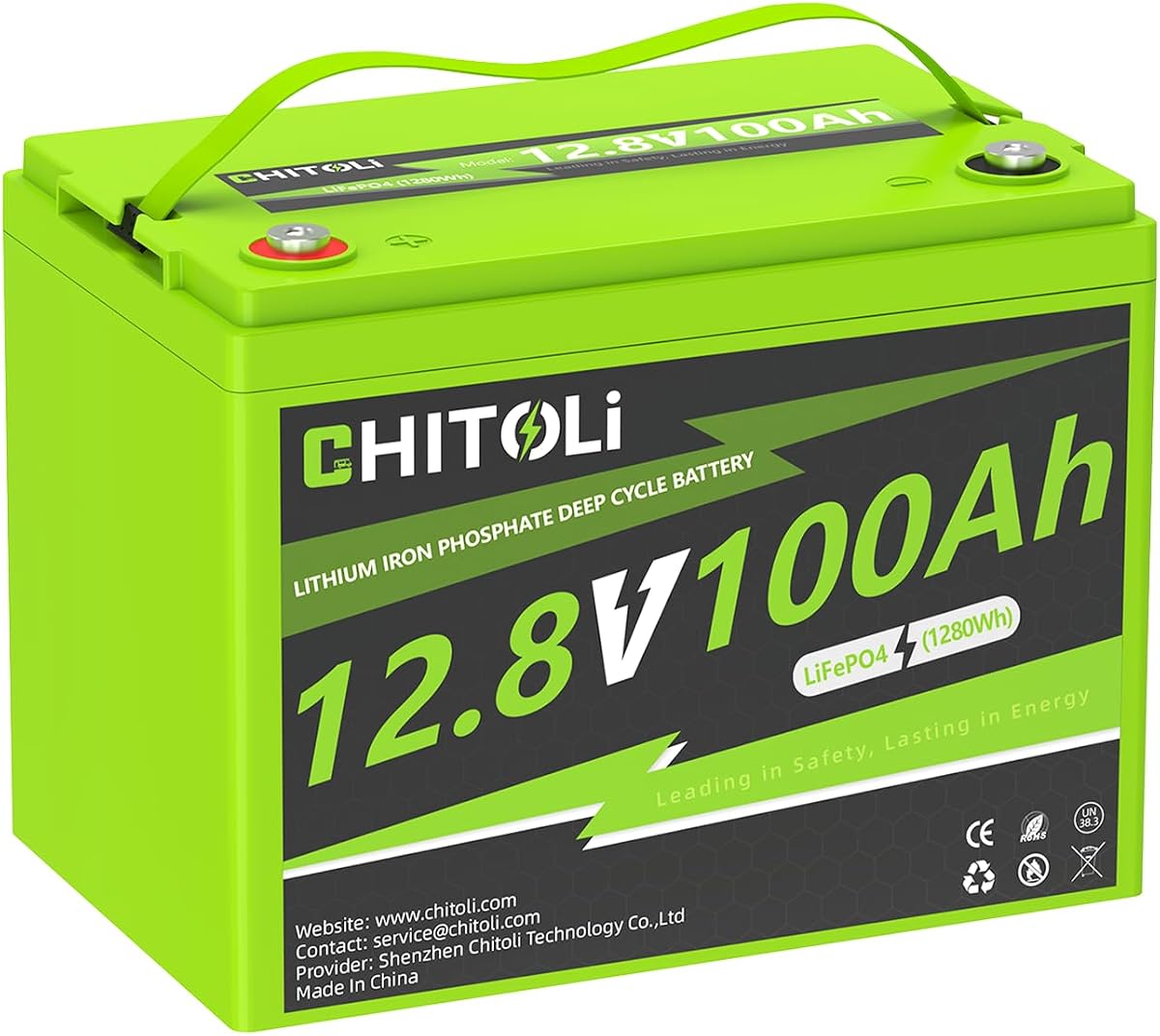




The CHITOLI 12V 100Ah LiFePO4 is a high-capacity deep-cycle battery with a 4.7 rating and an unusually broad claimed cycle range of 4,000 to 15,000 deep cycles. Its Group 24 format makes it the most conventionally recognizable option in the list for RVs, trolling motors, marine equipment, camping systems, solar storage, and other applications where a standardized battery-box footprint is valuable.
We may earn a commission when you buy through this link, at no additional cost to you.
The built-in 100A smart BMS protects against overcharging, over-discharging, overcurrent, and short circuits. Automotive-grade prismatic LiFePO4 cells form the core, while a 4S4P arrangement can be expanded to as many as 16 units in series or parallel. The listed 80% capacity retention after 2,000 cycles and self-discharge below 3% per month support the positioning as a long-duration storage battery.
The trade-off is that a battery with this much capacity is substantial to move, and the wide cycle claim depends on proper charging, operating conditions, and configuration. It is also an energy-storage product rather than a guaranteed engine-starting solution. Buyers should therefore check starting-current requirements, charger voltage, and the exact terminal arrangement before replacing an existing lead-acid or AGM battery.
This is the strongest all-around choice for readers who want a substantial, standardized battery with a high user rating, flexible expansion, and extensive protection features. It suits serious off-grid and recreation users who can accommodate the size and will use a LiFePO4-compatible charging system. For smaller projects, the 20Ah two-pack is more manageable; for high-current golf-cart use, the 36V CHINS options are purpose-built.
At 12V and 100Ah, this battery offers a large energy reserve while retaining the familiar Group 24 format. The stated 4S4P scalability gives installers a path to larger systems, although each parallel group must use electrically matched batteries.
The integrated 100A BMS handles common electrical faults without requiring a separate protection enclosure. Low self-discharge also makes the battery practical for seasonal equipment, provided the manufacturer or charger's storage guidance is followed.
We may earn a commission when you buy through this link, at no additional cost to you.
The ExpertPower 3.2V 304Ah is a single prismatic LiFePO4 cell rather than a ready-to-install battery, and the supplied listing does not provide a numeric customer rating. That distinction matters because the cell is positioned for experienced builders creating high-energy systems for electric vehicles, golf carts, cabins, solar setups, and other demanding applications.
We may earn a commission when you buy through this link, at no additional cost to you.
The cell is described as UL 2580 listed, tested through a 152-point inspection process, and equipped with a safety valve for over-temperature protection. Its rigid aluminum body, high energy density, high-current capability, and low self-discharge rate make it attractive for stationary storage and transportation projects. The company states that a battery management system must be used at all times.
The main complication is that one cell is not a functioning pack. A builder must select matched cells, design the busbars and enclosure, establish a suitable series and parallel arrangement, and implement a properly sized BMS. Mistakes in cell matching or protection can create imbalance and safety problems, so this product is not ideal for a first-time battery builder.
It is best suited to technically confident users who need a large, certified cell and value the flexibility of assembling a custom system. Buyers who want a finished battery, integrated BMS, charger, and clear installation should choose one of the complete 12V, 24V, or 36V packs instead. Within this DIY category, the ExpertPower cell offers strong credentials and substantial capacity.
The 304Ah rating and prismatic enclosure make this a building block rather than an ordinary AA-sized cell. Its value comes from the flexibility to create a custom voltage, capacity, and enclosure around a specific load.
UL 2580 listing and the built-in safety valve are meaningful protections, but the manufacturer explicitly requires a BMS. Buyers should treat the management system, wiring, enclosure, and charger as essential parts of the finished design rather than optional accessories.
We may earn a commission when you buy through this link, at no additional cost to you.
The Vatrer 12V 300Ah is built for large stationary and mobile energy-storage installations, carrying a 4.6 rating and a claimed life of more than 5,000 cycles. Its 200A BMS, high-temperature charging cutoff above 167°F, and low-temperature discharge protection make the battery particularly relevant to RVs, boats, campers, travel trailers, and off-grid solar systems.
We may earn a commission when you buy through this link, at no additional cost to you.
Automotive-grade LiFePO4 cells provide the stated foundation, and the battery supports expansion through up to four series and four parallel groups. The listing describes fast charging and discharging, charging efficiency up to 100%, and no memory effect. It is also described as roughly 30% lighter than a lead-acid battery of equal capacity, although absolute weight remains substantial because of the 300Ah rating.
This is not a compact battery, and its size may be the limiting factor in smaller boats, trailers, or equipment bays. High-temperature cutoff and low-temperature protection are valuable safeguards, but they can interrupt operation when conditions become unsuitable. The product also combines energy-storage and starting functions in the description, so buyers with demanding starter applications should verify actual cranking requirements rather than relying only on the combined-use claim.
The Vatrer model makes sense for buyers who need maximum capacity at 12V and can manage its weight, footprint, charging requirements, and ventilation. It is particularly attractive for full-time RV or marine use where ample stored energy matters more than portability. For lighter installations, the 12V 100Ah CHITOLI or 12V 20Ah SEFEPODER would be more manageable options.
The 300Ah capacity gives this battery a substantial reserve for appliances, lighting, pumps, and solar collection. That capacity makes it useful for installations that would otherwise need several smaller batteries and more complex interconnecting.
High-temperature charging cutoff and low-temperature protection can reduce damage caused by charging or discharging outside ideal conditions. These safeguards may require the user to allow the pack to reach a suitable temperature before the affected function resumes.
We may earn a commission when you buy through this link, at no additional cost to you.
The SEFEPODER 12V 20Ah two-pack is a compact option for small electronics, portable power, and modest off-grid loads, earning a 4.4 rating. Each battery includes a 40A BMS and is rated for 20A continuous discharge, with a stated 3C pulse capability. Two complete units provide more flexibility than a single small battery without approaching the size of high-capacity marine systems.
We may earn a commission when you buy through this link, at no additional cost to you.
The listing identifies a broad range of uses, including electric scooters, lighting, 12V routers, camping, power wheels, fish finders, amateur radio, kayaks, and solar or wind projects. The batteries can be connected in series or parallel, with up to four identical batteries supported in series. Their claimed 4,000-plus cycle life and lack of memory effect suit intermittent use, while the stated one-third weight of comparable lead-acid batteries helps with portability.
The lower 20Ah capacity limits sustained loads, and users should not confuse the advertised 40A BMS rating with a 40A continuous output rating. The supplied information also specifically instructs buyers to use a LiFePO4 charger, warning that an automatic SLA charger may not fully charge the batteries. A one-year warranty is included, which is shorter than the multi-year coverage described for several larger picks.
This two-pack is a good fit for portable camping gear, networking equipment, lighting, and other small systems that benefit from maintenance-free chemistry. It is also easier to install and move than a 100Ah or 300Ah deep-cycle battery. For a single critical device, buyers may prefer one battery; for a more robust installation, the pair can be configured to suit the required voltage or redundancy.
The relatively low capacity keeps each unit manageable for mobile use, while the integrated BMS provides protection against overcharge, over-discharge, overcurrent, and short circuits. That combination makes the batteries practical for portable projects where space and handling matter.
Two batteries can be operated independently, connected in parallel for additional current capacity, or arranged in series where the system voltage allows it. Buyers should use identical, closely matched batteries and observe the stated series limit.
We may earn a commission when you buy through this link, at no additional cost to you.
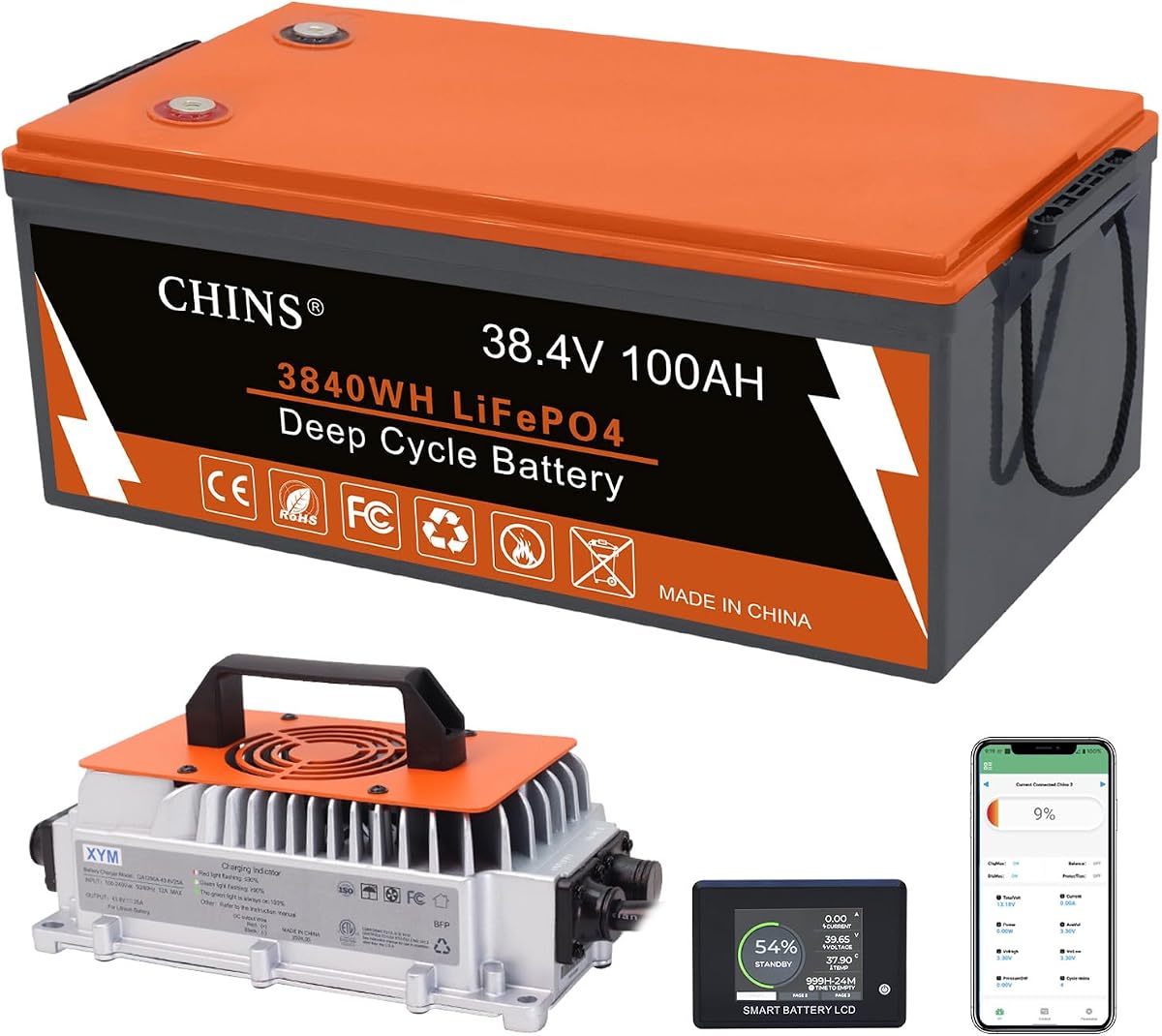
The CHINS 36V 100Ah golf cart battery is designed around a 36V mobility system and carries a 4.1 rating. Its 3.84kWh capacity, 200A continuous discharge, and 1000A short peak are aimed at golf carts and other high-current installations, while the included monitor and app provide battery information during driving and charging.
We may earn a commission when you buy through this link, at no additional cost to you.
The most distinctive feature is the included 43.8V 25A lithium charger, which the listing says can charge the battery from empty to full in approximately five hours. A 0V wake-up function is intended to recover batteries placed into low-voltage protection. The 200A BMS also supports stated peak levels of 300A for 57 seconds and 600A for 27 seconds, making the pack relevant to 8kW golf-cart motors and 70-pound trolling motors.
The range claim of roughly 30 miles with a 3kW motor is based on the manufacturer's testing and should not be treated as a guaranteed result. Actual range depends on terrain, speed, load, temperature, age, and motor efficiency. The product can also be used for solar systems, RVs, marine equipment, and off-grid storage, and parallel expansion is supported, but users must observe the battery's connection limits.
This is an attractive option for golf-cart owners who want fast charging, strong transient output, and integrated monitoring without buying a separate charger. The included accessories simplify ownership, but buyers should confirm the compartment dimensions, connector arrangement, and electrical requirements of their cart. Those who do not need rapid charging may prefer the 10A-charger version for a more gradual setup.
The 25A charger and onboard display provide a more integrated ownership experience than a bare battery. The app and wake-up function are convenient additions, although actual connectivity and charge times can depend on operating conditions and compatible settings.
A 200A continuous rating gives the battery more headroom for acceleration and motor startup than a typical storage pack. The stated short-duration peak levels are particularly relevant to golf carts equipped with more demanding motors or accessories.
We may earn a commission when you buy through this link, at no additional cost to you.
The 24V 100Ah LiFePO4 battery combines a 5.0 rating with a 2560Wh energy rating and a relatively compact 40.35-pound stated weight. It is positioned for RVs, marine equipment, solar storage, trolling motors, emergency backup, camping, monitoring systems, and other off-grid loads that benefit from operating above the usual 12V level.
We may earn a commission when you buy through this link, at no additional cost to you.
Grade A and Grade A+ cell claims support the stability and longevity positioning, while the built-in 100A BMS provides protection from overcharge, over-discharge, overcurrent, short circuits, and overheating. Automatic high- and low-temperature cutoff adds another layer of operating protection. The battery is rated for more than 4,000 cycles at 100% depth of discharge and supports expansion through a stated 2P2S arrangement.
A crucial limitation is explicit in the product information: this unit is for energy storage, not engines, golf carts, or other starting devices. That restriction prevents misuse in high-current starter applications. The battery also asks users to complete one charge-and-discharge cycle every six months when it will remain inactive, which makes storage planning relevant to occasional-use installations.
This is an excellent choice for mobile or stationary systems that need more voltage and capacity without moving to a 36V pack. Its stated 5.0 rating, compact weight, and clear energy-storage positioning make it particularly appealing for marine and travel applications. Buyers should pair it with a charger suitable for 24V LiFePO4 chemistry and confirm the connector, footprint, and load requirements before installation.
The 24V configuration reduces wiring complexity compared with a comparable multi-battery 12V system, while the 2560Wh rating provides a substantial reserve. The stated 40.35-pound weight also makes installation more manageable than many large lead-acid alternatives.
The manufacturer expressly prohibits using this battery as a starter battery. Its 100A continuous and protective management features are intended for sustained storage loads, not the repetitive surge current associated with engine cranking.
We may earn a commission when you buy through this link, at no additional cost to you.
The 18-piece Yinlong set consists of 2.3V 35Ah lithium-titanate, or LTO, cells rather than a complete battery. The supplied information does not include a numeric customer rating, but the 30,000-plus cycle and 30-year life claims distinguish this option from the conventional LiFePO4 packs elsewhere in the guide.
We may earn a commission when you buy through this link, at no additional cost to you.
Each cell is described as brand-new, Grade A, QR-code authenticated, and balanced with the rest of the set for matching voltage, internal resistance, and capacity. A multi-protection safety system and no-leakage construction are also listed. LTO chemistry is presented as providing more power than lead-acid at the same capacity, making the cells suitable for electric bicycles, motorcycles, scooters, RVs, solar and wind systems, UPS applications, golf trolleys, carts, and power tools.
This is a project kit, not a plug-and-play battery. It requires appropriate series and parallel design, a suitable battery management system, a compatible charger, insulated interconnects, a secure enclosure, and careful consideration of the unusually high current demands possible with LTO cells. The 30,000-cycle and 30-year statements are manufacturer claims and should be evaluated against actual charge depth, temperature, and operating discipline.
The set is best for technically experienced users seeking exceptional cycle longevity in solar, traction, or stationary applications. It offers the most ambitious longevity proposition in the roundup, but it also demands the most assembly effort. Buyers wanting a complete system should choose a finished battery with an integrated BMS and charger. For a long-term DIY project, however, matched LTO cells can provide a distinctive foundation.
The stated 30,000-plus cycle capability gives LTO cells a clear advantage for frequently cycled applications. If a project can maintain a suitable operating profile, that longevity can reduce battery replacement frequency over a long service life.
Factory balancing across internal resistance, voltage, and capacity is valuable when cells will operate together in a larger pack. It does not replace ongoing BMS monitoring, however, because cells can diverge as they age and experience different temperatures.
We may earn a commission when you buy through this link, at no additional cost to you.
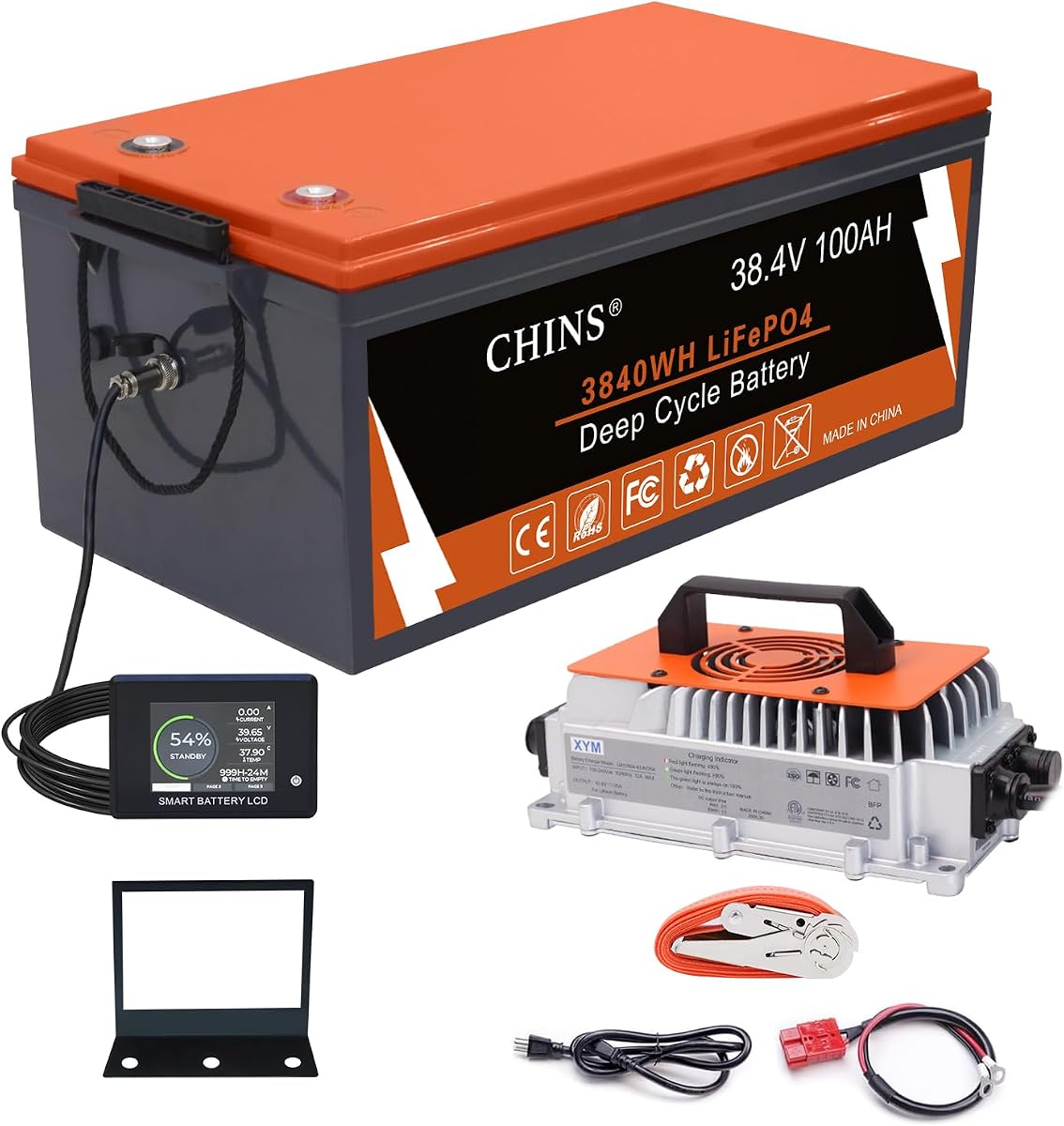
The CHINS 36V 100Ah battery combines a 4.5 rating with a complete package consisting of the battery, 25A charger, onboard monitor, and connectivity features. It is explicitly oriented toward golf carts while also supporting trolling motors, RVs, boats, solar systems, and off-grid installations, making it one of the most versatile mobility-focused products in the guide.
We may earn a commission when you buy through this link, at no additional cost to you.
The 200A continuous and 1000A peak output figures provide substantial power for acceleration and motor demands. The listing states that the battery powered a 3kW golf-cart motor for approximately 30 miles under testing and includes a 43.8V 25A charger said to complete a full charge in five hours. A recovery function is provided for batteries that have entered low-voltage protection, while the monitor and app show charge information.
This model supports parallel connection for greater capacity, but the product information explicitly states that series connection is not supported. That limitation makes it less flexible than systems designed around 48V nominal architecture. The range estimate is also a tested scenario rather than a universal promise, and heavy accessory use, steep terrain, speed, temperature, and battery age can all reduce actual distance.
It is the top recommendation for a reader who wants a ready-to-install 36V mobility battery with fast charging and monitoring included. The complete accessory set reduces the need to source a separate charger or display. Before buying, check the physical dimensions, electrical connectors, charger setup, and the requirements of the cart or trolling motor to ensure a clean installation.
Including the charger and monitor makes this battery more convenient than a bare pack for a straightforward installation. It also gives owners immediate visibility into state of charge and charging status, although app functions require a compatible phone and setup.
The stated 200A continuous and 1000A peak ratings make the pack suitable for high-current motors and accessories. Sustained loads should still remain within the battery and wiring limits, and proper fusing and connection are essential parts of a safe installation.
We may earn a commission when you buy through this link, at no additional cost to you.
The CHINS 36V Bluetooth battery has a 5.0 rating and a 100Ah LiFePO4 capacity rated at 3.84kWh. Its onboard monitor displays battery information while driving, while Bluetooth and the associated app allow charging status to be checked remotely. That makes it especially convenient for owners who want visibility without returning physically to the battery compartment.
We may earn a commission when you buy through this link, at no additional cost to you.
The integrated 200A BMS supports up to 200A continuous discharge and a stated 1,000A peak for three to five seconds. The listing also cites 300A and 600A intermediate discharge levels, along with suitability for a 70-pound trolling motor and an 8kW golf motor. Protection covers overcharge, over-discharge, overcurrent, short circuits, and charging above 122°F.
Unlike the 25A-charger CHINS model, this version includes a 43.8V 10A lithium charger and a stated ten-hour charge time from empty to full. That is slower but can be appropriate for setups where a lower charging current is preferred. The listing gives a 2,000-plus cycle claim, lower than the 5,000-plus figure on the other CHINS 36V models, which is worth noticing when comparing longevity claims.
This battery is a strong choice for monitored golf-cart, trolling-motor, marine, RV, solar, or off-grid projects that use a 36V architecture and support parallel expansion. Series connection is not supported, so it is not the right choice for a builder planning a 72V system. Verify physical clearance, connector compatibility, and charger conditions before installation.
Bluetooth status information can help owners identify charge level and charging progress without a wired display. The included charger's 0V wake-up function is also useful when a battery has entered protection after prolonged inactivity or deep discharge.
The included 10A charger offers a slower, potentially gentler charging setup than the 25A version. The claimed ten-hour recharge time makes it more suitable for owners who leave the battery overnight and value a complete matched package over rapid turnaround.
We may earn a commission when you buy through this link, at no additional cost to you.
The 3400mWh AA lithium four-pack is the most compact and approachable product in the guide, offering rechargeable 1.5V cells for cameras, game controllers, doorbells, flashlights, and other high-drain devices. It carries a 4.5 rating, and its claimed 1600-plus charge cycles and 3400mWh capacity distinguish it from ordinary disposable alkaline batteries.
We may earn a commission when you buy through this link, at no additional cost to you.
The cells maintain a constant 1.5V output until depletion and are stated to provide 3A of instant current, making them useful for equipment that needs short bursts of power. CPBI sealing technology is cited for higher energy density, while smart protection and explosion-resistant modules are included as additional safety measures. The batteries are also described as lightweight despite their stated capacity.
The most important restriction is charging: the instructions call for a compatible 1.5V lithium charger and explicitly warn against using a 1.2V NiMH charger. Devices that expect standard disposable AA voltage may work, but a charger designed for rechargeable NiMH cells is not automatically suitable. Users should also check whether their equipment permits rechargeable lithium cells and whether a low-voltage cutoff can create compatibility problems.
This four-pack is best for households or mobile users who want to reduce disposable battery waste in compatible electronics. It is also a sensible entry point to rechargeable lithium technology because the cells are standardized in size. It does not replace deep-cycle storage batteries, but it complements them by covering portable electronics and high-drain household devices.
Four cells allow multiple devices to be rotated or charged together. The constant voltage and stated 3A instant-current capability make the set more relevant to high-drain equipment than many general-purpose rechargeable AA cells.
A dedicated 1.5V lithium charger is required for safe and effective charging. Using the wrong chemistry charger can deliver an unsuitable voltage or charge profile, so the warning should be taken literally rather than treated as a minor note.
We may earn a commission when you buy through this link, at no additional cost to you.
The correct battery begins with the voltage and load of your equipment, followed by capacity, current handling, safety controls, charging method, and installation constraints. Comparing those requirements prevents a technically impressive battery from becoming an unsuitable purchase.
Match the battery to the device rather than choosing by capacity alone. Verify connectors, polarity, controller limits, and any manufacturer restrictions before installation.
Capacity determines how long a battery can support a load, while watt-hours provide a more useful comparison across different nominal voltages. A 12V 300Ah pack, a 24V 100Ah pack, and a 36V 100Ah pack may provide broadly comparable stored energy even though their amp-hour ratings look different. Consider the equipment's average draw, expected runtime, amount of solar or generator charging, and whether you want reserve capacity for unexpected loads.
A larger battery is not automatically better. Extra capacity can add weight, charging time, cost, and space requirements. Choose the smallest capacity that comfortably covers the intended load and operating conditions.
The BMS current rating indicates protection capability, but it is not always the same as the battery's permitted continuous output. For motors, compressors, and other high-start devices, distinguish sustained amperage from short-duration peak current. Wiring, contacts, fuses, controllers, and motors must also be rated for the load. Starting applications deserve particular caution because some energy-storage batteries are expressly prohibited from engine cranking.
For a storage-only load, prioritize usable capacity and sustained delivery. For mobility, compare both continuous and short-term peak figures with the motor's requirements.
A quality BMS protects against overcharge, over-discharge, overcurrent, short circuits, and potentially excessive temperature. Temperature cutoffs can prevent charging in hot or cold conditions, but they may also interrupt operation unexpectedly. Individual cells and custom LTO packs need an appropriately engineered external BMS, while complete batteries generally include one. UL listing can provide additional assurance, but it does not remove the need for correct installation, ventilation, and compatible charging.
Look for clearly stated protection functions rather than broad safety language. Confirm that the BMS is appropriate for the pack's chemistry, cell count, current, and intended load.
Cycle-life claims vary widely in the supplied listings, from 2,000-plus cycles for one CHINS 36V model to 30,000-plus for the LTO cell set. Treat these as comparative claims, not guaranteed service lives, because cycle count depends on depth of discharge, temperature, charge rate, cutoff settings, and battery age. A frequently cycled solar system may value LTO longevity, while a reserve battery used only during outages can operate for many years with far fewer cycles.
Choose a cycle rating that matches how often the battery will be worked. Also consider calendar aging, warranty length, and the stated retention of capacity over time.
LiFePO4 and LTO cells require charging equipment with the correct voltage and charge profile. Some complete packages include a matched charger, which simplifies installation, while individual cells and custom packs do not. The AA lithium four-pack specifically requires a 1.5V lithium charger and should not be placed on a NiMH charger. Review the listed charge times, recovery or wake-up functions, and whether the charger is appropriate for the expected daily use.
A supplied charger is convenient but not automatically the best choice for every installation. Verify its connector, ventilation needs, input power, and whether its output matches the battery system's voltage.
Lithium iron phosphate is often lighter than lead-acid, but high-capacity packs remain heavy. Compare both absolute weight and the space available in an RV bay, boat compartment, battery box, golf-cart floor, or cabinet. Terminal position, clearance, venting expectations, secure restraint, and orientation should be confirmed. The 12V 300Ah and 24V 100Ah options can require very different mounting arrangements even if they serve similar energy-storage needs.
Account for room to service the battery and route cables safely. Measure the compartment rather than relying on capacity alone, especially for Group 24 replacements and complete golf-cart packs.
Bluetooth apps, onboard displays, and real-time charge information can improve usability, particularly for golf carts, trolling motors, and systems stored where physical access is inconvenient. They do not replace a properly sized BMS or a good charger. Consider whether connectivity is useful to you, whether the listed mobile functions are available in your region, and whether the battery can still be checked safely if the app or connection fails.
Monitoring is most valuable when it supports preventive maintenance, such as noticing a prolonged low state of charge or unusual imbalance. It should supplement, not replace, sound electrical practices and manufacturer instructions.
Before installation, identify every battery's chemistry, nominal voltage, capacity, terminal arrangement, and required BMS or charger. Use cables, connectors, fuses, and a controller that are rated for both continuous and peak current. Confirm polarity carefully, secure the battery so it cannot shift, and follow the installation guidance for the particular device and battery category.
Charge with a compatible LiFePO4 or LTO charger, or the specified 1.5V lithium charger for AA cells. Do not substitute a charger merely because its connector fits. Keep the battery within its intended temperature range, avoid exposing it to water or physical damage, and do not ignore high-temperature cutoffs, low-voltage warnings, or unusual swelling, odor, leakage, or abnormal heat.
For stored batteries, follow the listed maintenance guidance, which can include periodic charging. The 24V 100Ah model specifically asks users to complete one charge-and-discharge cycle every six months to avoid damage from long-term inactivity. For custom cell packs, keep individual cell voltages matched, use a suitable BMS, and inspect interconnects and enclosure materials regularly.
Often, yes, but only when voltage, capacity, physical size, charging profile, and current requirements are compatible. LiFePO4 batteries have a different charge profile and may require a LiFePO4-compatible charger. Do not assume they are a direct replacement without checking the original equipment's requirements, especially for high-current starting applications.
The BMS rating generally describes the maximum current the protection circuit is designed to manage. It does not always equal the battery's safe continuous discharge rating, and short peak figures may have specific time limits. Compare both the battery and BMS specifications with the motor or load, wiring, fuses, and connectors being used.
No. The rules vary by product and chemistry. Some 12V packs support series and parallel arrangements within stated limits, the 36V CHINS models support parallel connection but not series connection, and the individual ExpertPower and LTO cells require a custom pack design with an appropriate BMS.
Yes, a charger with a compatible lithium iron phosphate charge profile is generally required for safe and complete charging. Some complete products include a suitable charger, while individual cells and custom packs require the buyer to source one. The 1.5V AA lithium batteries likewise require a dedicated lithium charger and must not be used with a 1.2V NiMH charger.
Amp-hours describe charge at a given voltage, while watt-hours better express usable stored energy across products with different voltages. Comparing watt-hours can reveal that a 12V 300Ah pack, a 24V 100Ah pack, and a 36V 100Ah pack are closer in energy than their amp-hour figures initially suggest. Actual usable energy also depends on discharge conditions and BMS cutoffs.
Several models are explicitly marketed for trolling motors, including the 12V 100Ah CHITOLI, 24V 100Ah battery, and multiple 36V CHINS packs. You must still match the battery voltage, continuous current, peak current, capacity, and connector arrangement to the motor. A trolling motor's startup surge can be substantial, so verify the complete electrical system rather than focusing on watt-hours alone.
Follow the manufacturer's storage instructions and use a compatible maintenance or smart charger when required. Avoid leaving a deeply discharged battery in a protected state, expose it to extreme temperatures, or store it where moisture and physical damage are possible. Some models, such as the 24V 100Ah option, specifically call for a charge-and-discharge cycle every six months during long inactivity.
No. Cycle claims are laboratory or manufacturer claims that depend on charge depth, temperature, current, cutoff behavior, and maintenance. They are useful for comparing products, but real service life also depends on calendar aging and proper charging. Owners should follow the manual, maintain suitable conditions, and avoid interpreting a maximum cycle figure as an unconditional guarantee.
The CHITOLI 12V 100Ah stands out as the most balanced general-purpose pick because it combines a high rating, a familiar Group 24 format, a 100A BMS, flexible expansion, and a broad deep-cycle claim. The CHINS 36V 100Ah package is the stronger dedicated mobility choice, while the Yinlong LTO cell set offers the most ambitious long-cycle project foundation.
Prioritize the requirements that cannot be changed later: nominal voltage, charging method, physical dimensions, continuous and peak current, and the need for a finished battery versus individual cells. Cycle life and capacity matter, but they are most useful after confirming that the battery safely fits the load and application. Smaller electronics projects may need only the AA lithium four-pack, while RVs, boats, and solar systems require careful attention to usable energy and charging time.
Finally, verify the current product page, included accessories, dimensions, ratings, warranty terms, and manufacturer instructions before ordering. Lithium battery specifications and configurations can change, and current pricing varies among sellers. Matching the battery to the actual equipment remains the most important step in choosing a suitable Chinese lithium battery.