
Celestron NexYZ 3-Axis Phone Adapter
4.2Editor score
Three-axis camera alignment
Fits 35–60mm eyepieces
Works with most smartphones
Metal-and-polymer construction
Smartphone astrophotography can range from attaching a familiar phone to an existing telescope to operating an all-in-one smart telescope that finds, tracks, and images targets automatically. A good system balances image quality, stability, portability, compatibility, and the amount of setup required to capture the night sky.
We compared smart telescopes, conventional telescopes with smartphone adapters, and electronic eyepieces using the information supplied for each product. The list covers fully automated deep-sky imaging, adaptable entry-level setups, and tools designed to turn a phone into a live viewing and recording screen under the stars.
Each pick reveals what it does best, where its limitations matter, and which type of observer it suits. Ratings and specifications reflect the available product information, while prices and availability can change, so compare the current listing details before making a purchase.
4.2Editor score

4.4Editor score

5.0Editor score
As an Amazon Associate we earn from qualifying purchases.
This comparison covers three distinct approaches: automated smart telescopes, phone adapters for conventional optics, and digital eyepieces that stream directly to mobile devices.



The ZWO Seestar S30 Pro is an all-in-one smart telescope that combines an optical system, imaging cameras, motorized tracking, and app-based control. It holds a 4.4 rating and stands out for offering a complete astrophotography workflow without requiring users to assemble a separate telescope, camera, mount, and tracking system.
We may earn a commission when you buy through this link, at no additional cost to you.
Automatic GOTO targeting and tracking allow the telescope to locate and follow celestial objects after the user selects a target in the app. Dual-camera imaging supports high-resolution 4K-quality results, while intelligent modes cover the Moon, Sun, Milky Way, star trails, nebulae, galaxies, and wide scenes. A built-in light-pollution filter and apochromatic optics are particularly relevant for observers working beneath brighter skies.
There are important limits to this convenience. The product is designed for deep-sky imaging rather than planetary observation, and the manufacturer advises keeping the device stationary during deep-sky sessions. Its 3.64-pound weight is manageable, but a stable tripod remains necessary for long exposures and consistent tracking, particularly in wind or on uneven ground.
This is the strongest recommendation for a beginner who wants dramatic results from a phone-centered workflow with minimal training. It also suits travelers and urban observers who value automated setup. Experienced astrophotographers may eventually want broader manual control, but the S30 Pro delivers a remarkably approachable package for first-time and intermediate users.
Automatic finding, tracking, stacking, mosaics, and AI processing reduce the number of manual decisions required at the eyepiece. The result is a short path from selecting an object to collecting a usable image, which is especially useful for observers new to astrophotography.
The built-in light-pollution filter and apochromatic optics directly address common urban imaging challenges. These features can improve contrast and color consistency, although actual results still depend on sky conditions, target visibility, and the duration of the imaging session.
We may earn a commission when you buy through this link, at no additional cost to you.
The tridaptor Universal Phone Scope is a phone-and-eyepiece adapter designed for people who already own a telescope, spotting scope, monocular, binocular, or microscope. It carries a 4.4 rating and focuses on the mechanical precision required to place a smartphone camera accurately over an optical eyepiece.
We may earn a commission when you buy through this link, at no additional cost to you.
Its three-axis system adjusts left, right, up, down, and forward or backward. The forward adjustment helps users reach the correct eye relief and reduce dark borders or vignetting. A rigid aluminum frame limits the flex and tilting associated with lightweight plastic adapters, while rubber pads help protect the phone and eyepiece from scratches.
The included Bluetooth remote is a valuable field accessory because it lets the user trigger capture without touching the phone or optical device. Compatibility is broad for most iPhone and Android models, including phones between 60 and 87.5 millimeters wide, and it supports eyepieces measuring 22 to 61 millimeters in outer diameter. Buyers should still measure their equipment because shorter eyepieces are not supported.
The tridaptor is best for budget-conscious observers who want to add phone photography to equipment they already own. It offers more control than a basic adapter and supports many popular optical brands. The tradeoff is that the user must already have suitable optics and still need a stable mount for sharp astronomical images.
Independent three-axis adjustment makes it easier to center the phone lens over the eyepiece and move the camera into the correct position. This is particularly important when a tilted camera or imperfect alignment would otherwise create dark corners and uneven framing.
Triggering the phone through the Bluetooth remote avoids direct contact with the optical device. That reduces the chance that a tap will shake the telescope, which is especially important during longer or more sensitive astronomical captures.
We may earn a commission when you buy through this link, at no additional cost to you.
The Celestron Basic Telescope Eyepiece Smartphone Adapter is a straightforward way to photograph through an eyepiece using a phone. It has a 4.0 rating and supports telescopes, spotting scopes, binoculars, monoculars, and microscopes, making it a general-purpose bridge between mobile cameras and optical equipment.
We may earn a commission when you buy through this link, at no additional cost to you.
Setup is straightforward: place the phone in the frame, center its camera over the eyepiece, and tighten the knobs. The adapter fits a wide range of iPhone, Samsung Galaxy, and Google Pixel models, often without removing the phone case. Its metal frame and polymer body are intended to withstand field use without requiring complicated adjustments.
The main limitation is its more basic alignment system. Unlike three-axis models, it offers fewer ways to compensate for eye relief, camera position, and framing, so dark edges may be more likely if alignment is imperfect. It also lacks the included Bluetooth remote found on more advanced Celestron adapters, making vibration control a concern during delicate captures.
This adapter is a sensible option for casual users, educators, birders, and astronomy beginners who want a simple, portable way to photograph an eyepiece. It is less attractive for serious astrophotographers who need repeatable positioning, remote shutter control, or a wider fit range for specialized eyepieces.
The center-and-tighten process is easy to learn, which makes this adapter approachable for first-time users. Its straightforward construction also means there are fewer adjustments to manage when switching between a phone and a different optical device.
Compatibility with multiple optical formats means the same accessory can support astronomy, wildlife, and close observation. The compact design is easy to place in a gear bag for travel, star parties, or birding events.
We may earn a commission when you buy through this link, at no additional cost to you.
This Seestar S30 Pro configuration combines the S30 Pro smart telescope with 128GB of internal storage. It uses the same app-directed, all-in-one approach as the standard model, allowing a connected phone or tablet to select objects, initiate imaging, and monitor progress without a separate camera or tracking mount.
We may earn a commission when you buy through this link, at no additional cost to you.
The built-in dual-camera system can capture high-resolution images of the Moon, galaxies, nebulae, and the Milky Way. Automated alignment, stacking, time-lapse, video, AI noise reduction, and mosaic modes reduce setup demands, while the light-pollution filter supports observing and imaging under imperfect skies.
Its travel bundle includes the telescope, tripod, carry case, solar filter, USB-C cable, quick guide, safety guidelines, and sticker pack. A battery life of up to six hours is listed, and the unit weighs approximately 3.6 pounds. As with the other S30 Pro configuration, it is not suitable for planetary viewing, and external eyepieces are not compatible.
This version is best for users who want to collect many images during remote outings without relying exclusively on phone storage. Raw files can be saved for later editing, while the 128GB capacity gives the system more room for extended sessions. Its main uncertainty is that no customer rating is available for this particular listing, so the broader S30 Pro platform should be evaluated on its documented features.
Built-in storage reduces the need to transfer every image immediately to a phone. That can be convenient for multi-night observing, roadside trips, and locations where network access or device storage is limited.
The included tripod and carry case create a more complete travel package than a telescope sold without support equipment. The stated battery life further supports extended sessions away from a convenient power source.
We may earn a commission when you buy through this link, at no additional cost to you.
The Celestron NexYZ DX is a three-axis smartphone adapter for telescopes and other optical devices. It has a 4.1 rating and differentiates itself from basic adapters with independent X-, Y-, and Z-axis positioning plus a Bluetooth shutter release for reducing vibration during image and video capture.
We may earn a commission when you buy through this link, at no additional cost to you.
Tension adjustments hold heavier phones securely, and the Z-axis control helps center the camera over the eyepiece quickly. The adapter supports phones from major manufacturers, including current iPhone, Samsung Galaxy, and Google Pixel models, generally with most cases in place. It fits eyepieces measuring 35 to 60 millimeters, including common 1.25-inch and 2-inch telescope formats.
As an adapter rather than a complete imaging system, it requires a telescope or other compatible optical device, along with a stable support. The included remote improves capture control, but the phone camera's native dynamic range, noise behavior, and ability to gather enough light still determine the final image quality. Two adapters for microscopes broaden its use beyond astronomy.
The NexYZ DX is a strong choice for observers who want repeatable alignment and remote triggering without moving to a much more complex digital imaging setup. It is particularly useful for star parties, birding, and anyone sharing an optical device between viewing and phone photography.
Independent controls make it easier to match the phone lens to the eyepiece's optical axis. Once the position is set, the spring-loaded design allows phones to be exchanged without rebuilding the entire alignment.
The Bluetooth remote lets the user trigger the camera without touching the telescope. This is a meaningful vibration-control feature for faint astronomical targets and precise views of distant subjects.
We may earn a commission when you buy through this link, at no additional cost to you.
The Celestron NexYZ 3-Axis Phone Adapter is built for users who want more precise phone alignment than a simple eyepiece clip can provide. It carries a 4.2 rating and uses three directional adjustment knobs to position a smartphone accurately over a telescope, spotting scope, binocular, monocular, or microscope.
We may earn a commission when you buy through this link, at no additional cost to you.
The adapter's metal frame and polymer body are designed for field stability, while tension adjustments secure the phone without requiring excessive pressure. Its spring-loaded slider also makes phone changes convenient. Compatibility extends to eyepieces from 35 to 60 millimeters in diameter, including those on telescopes with 1.25-inch and 2-inch barrels, and the package includes two microscope adapters.
Its primary weakness is that it does not include a remote shutter. Users who touch the phone to activate the camera can introduce vibration, so a separate remote or another low-vibration capture method may be needed for sensitive targets. It also cannot create an image without a compatible optical device and a stable mounting platform.
This NexYZ model is best for users who prioritize mechanical alignment, reliable phone retention, and broad optical compatibility. It is an especially logical choice for observers who already own a capable telescope and want to experiment with lunar or bright deep-sky phone images without purchasing a dedicated astronomical camera.
Three-axis control and tension adjustments work together to produce a stable connection. The holder keeps the phone in position while allowing the user to fine-tune the optical and physical alignment.
The included microscope adapters and support for several optical formats extend the product beyond astronomy. It is a practical travel accessory for anyone who alternates between telescope viewing, bird observation, and microscope work.
We may earn a commission when you buy through this link, at no additional cost to you.
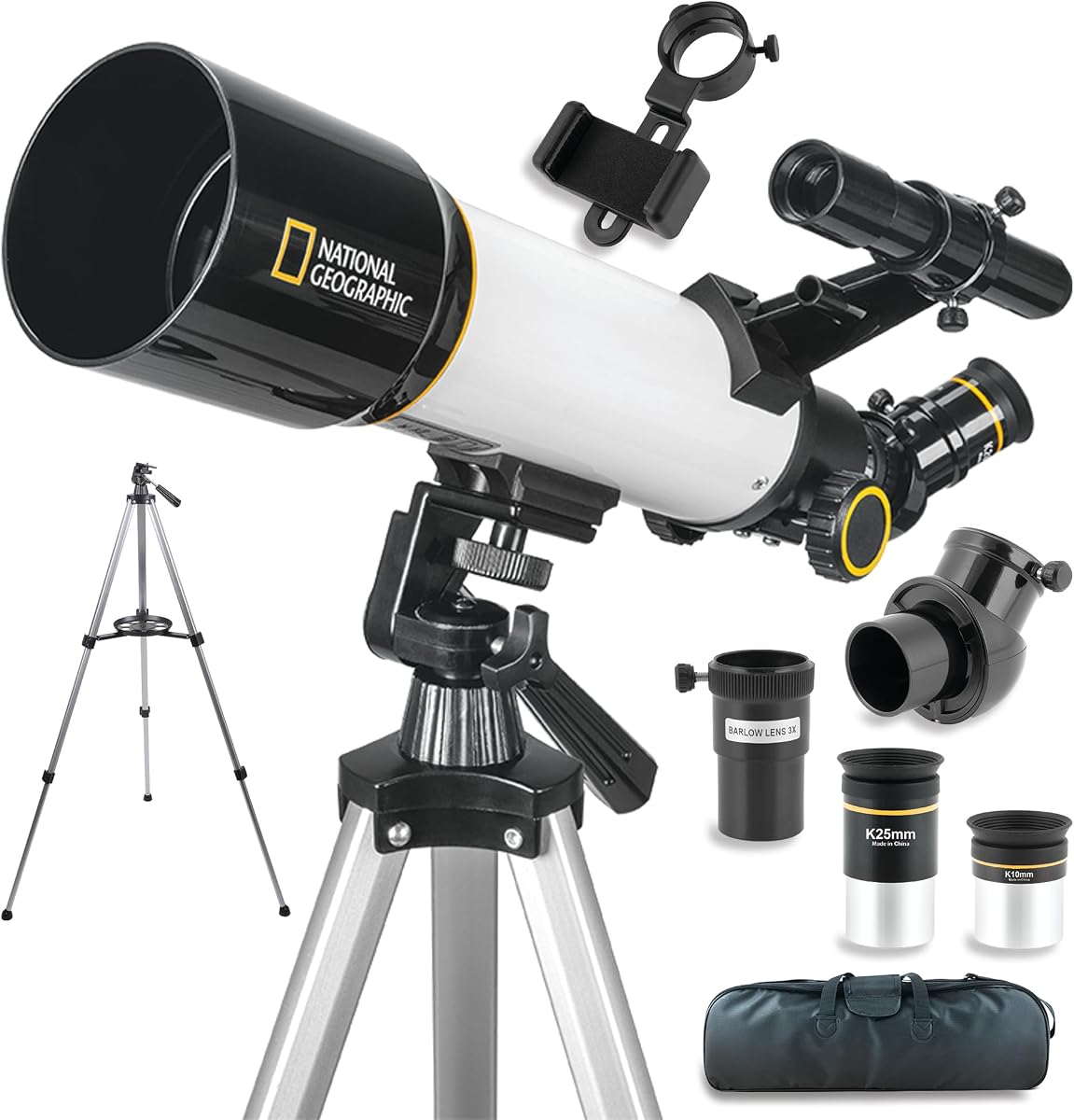
The National Geographic Sky View 70mm is a conventional refractor telescope designed for visual observing and introductory astrophotography. It has a 3.8 rating and includes a special smartphone adapter, making it more immediately useful for phone-based sky photography than a basic telescope that requires a separate accessory.
We may earn a commission when you buy through this link, at no additional cost to you.
Its 70mm aperture and 400mm focal length provide a foundation for viewing the Moon, planets, brighter nebulae, and star clusters. Two interchangeable eyepieces and a 3x Barlow lens offer 16x, 40x, 48x, and 120x magnification options. The included diagonal, straight-through viewfinder, panhandle mount, accessory tray, and adjustable tripod create a relatively complete setup.
The included adapter is likely the simplest route to photographing the Moon or other accessible targets, but the phone itself remains the imaging sensor. Compared with a dedicated smart telescope, this package offers less automation, no motorized tracking, and no advanced stacking or mosaic processing. Its 3.8 rating also suggests more mixed customer experiences than the better-rated alternatives.
This telescope is best for children, beginners, and casual observers who want one purchase to include viewing and basic smartphone photography. It is less suitable for advanced deep-sky imaging or anyone wanting unattended tracking, but it offers a simple introduction to aligning a phone with a telescope eyepiece.
The eyepieces, Barlow lens, diagonal, finder, mount, tripod, and smartphone adapter are included in one package. This reduces the number of separate purchases required before a beginner can observe and attempt a first phone-assisted image.
The straight-through viewfinder helps users locate celestial objects before looking through the main eyepiece. The panhandle mount then provides controlled movement for following the target and refining the camera alignment.
We may earn a commission when you buy through this link, at no additional cost to you.
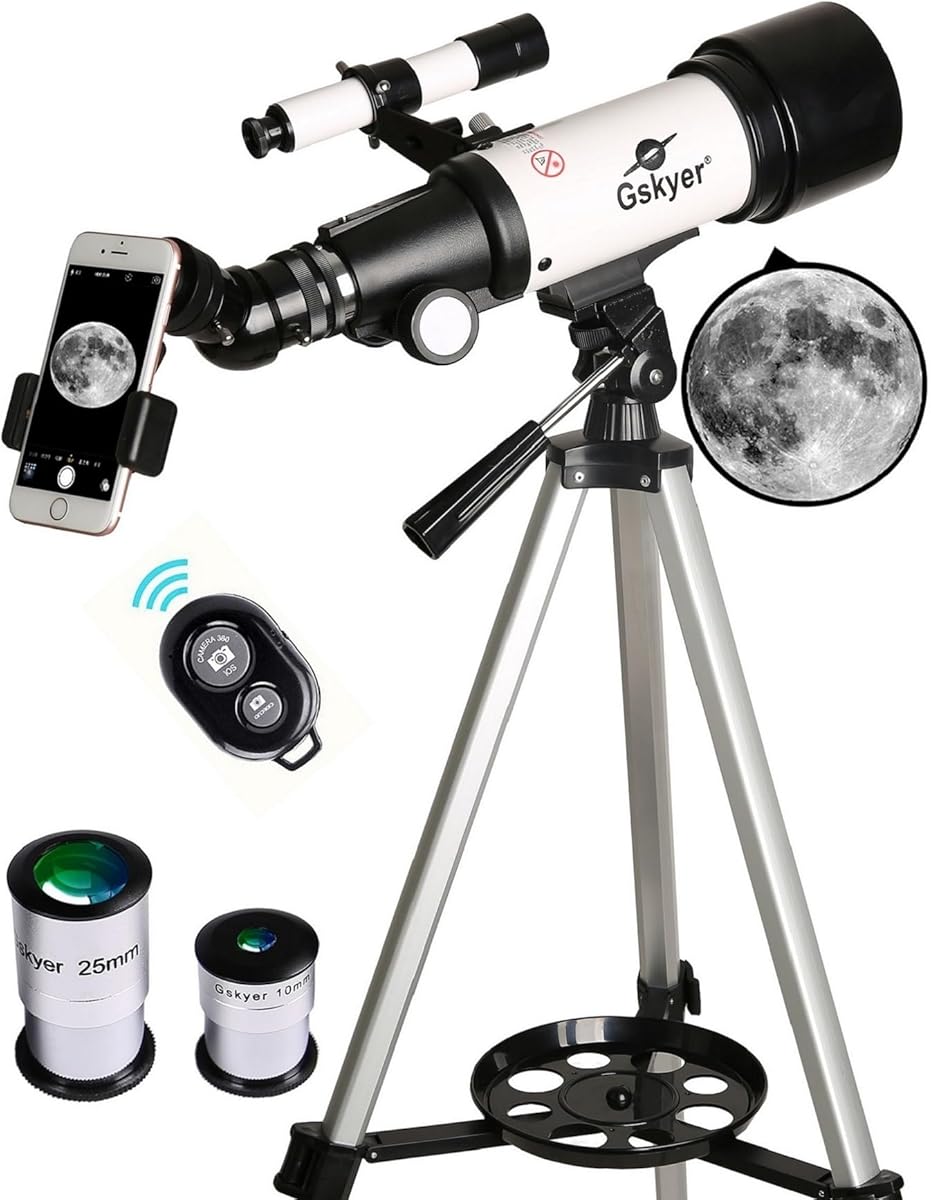
The Gskyer 70mm Refractor is a beginner-oriented telescope with a 4.3 rating, a phone adapter, and a wireless camera remote. Its 70mm aperture and 400mm focal length make it suitable for introductory views of stars and the Moon while also giving new users a path into phone-assisted astrophotography.
We may earn a commission when you buy through this link, at no additional cost to you.
Fully coated objective glass is intended to support light transmission, and the package includes two replaceable eyepieces, a 3x Barlow lens, and a 5×24 finder scope with crosshairs. The adjustable aluminum tripod allows different viewing positions, while the carry bag helps users transport and store the telescope and tripod together.
The wireless remote reduces the need to touch the phone when capturing an image, which can help limit vibration. Nevertheless, the manual alt-azimuth mount has no motorized tracking, and a phone camera remains less sensitive and more limited than a cooled dedicated camera. Those constraints make bright targets and short sessions more realistic than advanced faint deep-sky imaging.
This telescope is a good match for beginners, children, and travelers who want an inexpensive complete package with phone support. The included remote gives it a convenience advantage over many entry-level telescopes, although observers seeking automated tracking or advanced deep-sky results should choose a smart telescope instead.
The carry bag is designed to hold the telescope and tripod, making storage and transport simpler. This is useful for camping, observing trips, and moving between different dark-sky locations.
The included wireless camera remote allows users to trigger images without touching the phone. While it does not replace a stable tripod, it provides a more controlled start for lunar photos and snapshots through the eyepiece.
We may earn a commission when you buy through this link, at no additional cost to you.
The Andoer WiFi Electronic Eyepiece takes a different approach from phone adapters by becoming the camera itself. It has a 3.4 rating and fits a telescope with a 1.25-inch barrel, providing beginners with a straightforward way to observe, capture images, and record video through compatible optics.
We may earn a commission when you buy through this link, at no additional cost to you.
A WiFi connection allows the electronic eyepiece to communicate directly with a smartphone or tablet for real-time viewing and control. Because the sensor is aligned inside the barrel, the user does not need to position a phone camera above an eyepiece. Video recording is listed at 4K, offering a modern format for sharing astronomical or wildlife observations.
Its built-in 1600mAh lithium battery supports extended use and recharges through the included Type-C cable. The compact and lightweight body fits easily in a backpack. However, the 1.25-inch barrel requirement excludes many larger telescope eyepieces, and its 3.4 rating is the lowest among the products in this guide, which may warrant careful expectation-setting.
The Andoer is best for users who want electronic capture without adapting their phone physically to a telescope. It can serve astronomy and bird-watching needs, but owners should confirm their telescope's barrel size and compare software compatibility before buying. It is a convenient specialty tool rather than a complete telescope package.
Live wireless viewing gives users a larger display and makes sharing an observation with others more convenient. The digital sensor also removes the physical alignment and vignetting problems associated with many phone adapters.
The rechargeable internal battery and compact body support mobile observing and travel. The included Type-C cable simplifies recharging, while the lack of a separate phone camera keeps the imaging chain compact.
We may earn a commission when you buy through this link, at no additional cost to you.
The Vaonis Vespera Pro 2 is the most technically advanced smart telescope in this guide. It has a 5.0 rating, a 12.5-megapixel square IMX676 sensor, and a flat-field apochromatic quadruplet with stray-light baffles, all aimed at producing detailed, high-resolution deep-sky images.
We may earn a commission when you buy through this link, at no additional cost to you.
BalENS signal enhancement is designed to reveal faint targets and reduce sky gradients automatically, while master dark calibration is applied after an initial run. The system can create a 50-megapixel mosaic over a 4.18-by-4.18-degree field and automatically stack captures accumulated across multiple nights. Users can also take direct control with one- to 30-second exposures and gain settings from 0 to 30 decibels.
For advanced processing, FITS and TIFF files can be exported to PixInsight or Siril. The Singularity app supports both iOS and Android, offers automation and manual workflows, and can manage 30 simultaneous projects. A stated 11-hour battery, 225GB storage, aluminum tripod, hard case, and five-year warranty make it a complete mobile imaging package.
The Vespera Pro 2 is best for committed astrophotographers who want smart-telescope convenience without giving up control over capture data. It can automate difficult tasks while still allowing serious editing, which makes it more versatile than a simple phone adapter. The advanced tools may feel excessive to a complete beginner, but the 5.0 rating and feature set make it the premium choice here.
The combination of automatic tools and direct exposure, gain, and export controls serves both convenience-oriented and experienced users. A photographer can begin with automation and move toward a custom workflow as their skills and project demands grow.
Multi-night stacking, 50-megapixel mosaics, and a 225GB storage allowance support long imaging projects rather than isolated phone snapshots. The included tripod and hard case also help protect and deploy the telescope in the field.
We may earn a commission when you buy through this link, at no additional cost to you.
The right choice depends on whether you want a complete automated telescope, an adapter for equipment you already own, or a digital viewing and capture device. Compatibility, stability, sensor control, and target type should guide the decision.
Choose a smart telescope for the most integrated phone-centered experience. Choose an adapter if you already own capable optics and want to try phone photography without replacing them.
Always compare the listed dimensions with your own equipment. Compatibility problems are among the most avoidable causes of a disappointing purchase.
Prioritize repeatable alignment and remote triggering when image consistency matters more than convenience.
Beginners benefit from automation, while advanced users should look for raw control, long exposure options, and editable file formats.
Match the product to the target and expected level of detail rather than assuming every telescope can photograph every object well.
Choose a system you can comfortably transport and power through the sessions you realistically expect to make.
Treat the app as a core part of the camera, not an accessory, and verify its capabilities before buying.
Choose the balance between capability and complexity that fits your habits, not simply the model with the most features.
Begin away from the camera with a clear view of the intended target, then set up the telescope on stable ground. Balance the instrument, secure the tripod, and allow it to settle before making fine adjustments. For a smart telescope, connect the app, select the target, and begin with a short test image. For an adapter, center the eyepiece and use the alignment controls until the camera sees a bright, even field without excessive dark edges.
Use a remote shutter or another non-touch capture method whenever possible, and avoid touching the telescope or phone after framing is complete. Begin with shorter imaging sessions and simple targets, confirm that the sky background is as dark as practical, and review sharpness before extending the session. For stacking or multi-night projects, confirm that the device remains stationary and follow the manufacturer's guidance for tracking, mosaics, and file storage.
Protect the optics from moisture, dust, and fingerprints, and allow a recently moved telescope to settle before a precise capture. Store the telescope in its case or in a dry location, clean the objective or lens only according to the manufacturer's instructions, and avoid leaving a phone adapter under heavy mechanical stress. Recharge electronic eyepieces and smart telescopes before an outing, carry the appropriate cables, and inspect the mount, tripod, and storage capacity before leaving home.
It depends on the type of photograph you want. A wide night-sky phone photo can be taken without a telescope, but magnifying the sky and resolving the Moon, planets, nebulae, or galaxies requires optics. A conventional telescope with a phone adapter offers visual control, while a smart telescope integrates the optics, camera, tracking, and mobile workflow into one system.
A phone can capture bright targets such as the Moon, but planets are generally much more difficult because of their small apparent size and intense brightness. The Seestar S30 Pro is explicitly not designed for planetary observation. For planetary work, a suitable telescope, stable phone adapter, remote control, and a capable phone camera are more appropriate than expecting a general smart telescope to handle every target.
A phone adapter places your phone's own camera over a telescope eyepiece, so image quality depends on the phone's sensor and camera app. An electronic eyepiece contains its own camera and sensor, connects to a phone or tablet by WiFi, and sends a live view for display and capture. The electronic eyepiece avoids phone alignment but requires a compatible barrel and its own imaging software.
A remote shutter is quite useful because touching a phone to press the shutter can transmit vibration into the telescope. Even slight movement may soften fine detail or disturb alignment. Products such as the tridaptor, Celestron NexYZ DX, and Gskyer telescope package include remote control, while other adapters may be used with a separate compatible remote.
Many do, but fit depends on the adapter and the case. The Celestron adapters state compatibility with most cases, and the tridaptor lists phone widths rather than guaranteeing every case and camera arrangement. Measure the phone, check the width range, and consider removing a thick case if it prevents the camera from reaching the correct eye-relief position.
Usually, yes. Smart telescopes automate finding, tracking, stacking, and much of the image-processing workflow, so beginners can concentrate on selecting targets and planning sessions. A traditional refractor with a phone adapter teaches more of the mechanical process and may cost less, but it offers less automation and places more responsibility on the user for alignment and stability.
That depends on the product. The Seestar S30 Pro configuration with 128GB can save raw image files for custom editing, while the Vespera Pro 2 supports FITS and TIFF export for software such as PixInsight and Siril. Basic phone adapters usually capture through the phone's camera app and provide less control over the underlying imaging data.
Check target visibility, local weather and cloud cover, battery charge, storage, cables, adapter fit, and tripod stability. For a smart telescope, verify the app connection and update status, and for an adapter, measure the relevant eyepiece and confirm that the phone camera can be aligned. A short test image can identify alignment or setup problems before a longer session begins.
The ZWO Seestar S30 Pro is the most approachable all-in-one choice, combining automatic finding and tracking with dual-camera imaging, a light-pollution filter, and a broad selection of intelligent modes. The Celestron NexYZ 3-Axis offers the best budget route for users who already own a telescope, while the Vaonis Vespera Pro 2 leads the premium group with a 12.5-megapixel square sensor, advanced mosaics, multi-night stacking, and detailed manual control.
Your priorities should determine the winner. Choose a smart telescope for automation and portability, a three-axis adapter for flexible use with existing optics, or a traditional refractor package for hands-on learning. A premium smart telescope is most valuable when you want sophisticated workflows and editable data, while simpler adapters are best when your goal is to experiment with phone photography at low complexity.
Before purchasing, verify all current specifications, device compatibility, included accessories, and availability on the listing. Ratings, software features, and product bundles can change, and current prices fluctuate, so taking a fresh look at the seller's latest information will help ensure the chosen system still matches your telescope, phone, targets, and experience level.
