
2 Jar Solder Flux
4.6Editor score
Two 1.2-ounce jars
Semi-solid rosin consistency
Suitable for lead-free soldering
Discover the best solder flux paste options for electronics repair and PCB work, compared for dispensing control, residue, solder compatibility, desoldering
Solder flux paste helps heat move efficiently through a joint, removes oxidation, and encourages molten solder to spread across a clean connection. A useful formula should be easy to dispense, compatible with the solder and components in your project, and capable of leaving a reliable joint with minimal cleanup.
This guide compares ten flux products across practical considerations including rosin type, paste or liquid consistency, dispensing method, residue characteristics, temperature range, and included accessories. It covers general-purpose electronics work, detailed PCB repair, SMD and SMT soldering, wire connections, and desoldering setups.
The selections highlight which products offer the most convenient dispensing, strongest stated wetting performance, or most complete repair package. Product ratings reflect the supplied customer feedback, while technical claims come from the listed specifications. Availability, formulations, and market conditions can change, so verify the current listing before buying.
4.6Editor score

4.7Editor score

4.7Editor score
The table below compares all ten options by format, dispensing method, residue, compatibility, and repair accessories, making it easier to identify the right flux for general soldering, precision PCB work, or desoldering.



SRA Solder 135 is a 2-ounce jar of semi-solid rosin flux paste with a 4.7 customer rating. Its main advantage is the balance between strong electronics-focused fluxing and practical dispensing control. The paste is described as impurity free, acid free, and capable of supporting both lead and lead-free solder, making it a broad option for repair benches and hobby projects.
We may earn a commission when you buy through this link, at no additional cost to you.
Unlike ordinary paste-style hardware-store flux, the SRA formula has a solder-wax consistency that is intended to remain manageable during application. You can dip a copper wire directly into it or apply a small amount to a PCB pad. That flexibility is useful when switching between wire connections and board-level soldering without repeatedly switching between liquid and solid products.
The product is a Type RA, or rosin-activated, flux with a stated active temperature range of 93–315°C, equivalent to 200–600°F. It is also described as a no-clean formula with safe, clean residues. The trade-off is that a single 2-ounce jar may run out sooner than a multi-syringe set, and the package does not include a wick for removing excess solder.
This is a strong general recommendation for anyone who wants a dependable jar that can handle common electronic joints. It suits hobbyists working on circuit boards, copper wire, audio equipment, computers, RC vehicles, drones, model railroads, game consoles, and microcontroller projects. The balance of controlled application, alloy compatibility, and stated low-residue performance makes it the strongest all-around choice in this list.
The semi-solid consistency is the defining feature. It can be transferred with a soldering iron, brush, or fingertip without behaving like a fully liquid flux, helping limit spread around small pads. For anyone making repeated joints, that predictability can be more valuable than a very thin liquid that runs across the work area.
Compatibility with lead, lead-free, PCB, and copper-wire work makes this a practical bench staple. The stated Type RA classification also gives experienced users a useful indication of its activity level, while the no-clean positioning reduces the need for aggressive residue removal after routine soldering.
We may earn a commission when you buy through this link, at no additional cost to you.
This four-pack of 10cc no-clean flux syringes is built around controlled placement. It carries a 4.5 rating and is intended for PCB, SMD, SMT, component replacement, and everyday electronics repair. The supplied fine tips make it a compelling choice for users who regularly work around small pads, tight gaps, and densely populated boards.
We may earn a commission when you buy through this link, at no additional cost to you.
Its high-activity rosin formula is presented as removing oxidation and improving solder wetting. Because the material is a paste rather than a free-flowing liquid, it is designed to remain where it is placed instead of spreading across the board. That behavior can make it easier to add only the amount needed at a particular joint and can reduce cleanup around adjacent components.
The set is lead-free, halogen-free, and described as non-corrosive when used as directed. It leaves minimal residue, so additional cleaning is usually unnecessary. The main limitation is that the listing is specifically positioned around lead-free flux. The paste may also thicken in extremely cold conditions, although the manufacturer says normal flow performance applies at room temperature.
Choose this set if precision application and having several syringes on hand matter most. Four individually capped containers can be useful in separate work areas or reserved for different types of electronics work. It is especially attractive for phone, appliance, instrument, and circuit-board maintenance where a narrow application point can make the job less messy.
The push-style syringe and included fine tips provide a clear advantage on SMD pads and narrow lead spacing. Rather than brushing flux broadly over a work area, you can deposit a small quantity directly at the intended joint and bring the soldering iron to it.
Four 10cc syringes offer more flexibility than a single container. Users can keep one at a repair bench, reserve another for a portable toolkit, or rotate containers to reduce the chance of leaving paste open during an interruption.
We may earn a commission when you buy through this link, at no additional cost to you.
The Flux and Wick Kit combines 10cc of no-clean solder flux paste with a 10-foot, 0.1-inch-wide desoldering braid. Its 4.7 rating reflects a well-rounded option for anyone who both applies and removes solder. The combination is especially practical for correcting mistakes, replacing components, reworking mechanical keyboard switches, and freeing old wire from devices.
We may earn a commission when you buy through this link, at no additional cost to you.
The braid uses a woven copper design intended to improve capillary action and excess-solder absorption. Working together, the flux and wick cover two sides of common bench repair: preparing a joint so solder can be removed and using the braid to lift unwanted solder from a pad. The package is suitable for small PCBs, motherboard parts, relays, and other electrical components.
Its paste is described as halogen-free, non-corrosive, and fluid enough to assist solder removal without damaging components. The principal compromise is that a 10-foot braid at 0.1-inch width is less tailored to extremely small work than a narrow, purpose-specific wick. The listing also does not provide a detailed type or temperature classification for the paste.
This kit is a sensible pick for electronics repair, laboratory work, home projects, and industrial soldering tasks where removal is a recurring need. Rather than buying a separate flux and wick, the user receives both in one coordinated package. It is particularly useful for beginners assembling a first repair kit and for experienced users who want a ready-to-use rework combination.
The included wick turns the product from a simple consumable into a compact rework kit. After adding solder to a pad, the braid can be laid over the joint and heated with the iron to draw away excess material, making component replacement much more manageable.
At 0.1 inch wide, the braid is suited to many small-board and general electrical jobs. Its ten-foot length provides ample material for repeated sections, while the tight copper weave supports capillary action in the locations most likely to be worked on.
We may earn a commission when you buy through this link, at no additional cost to you.
The Two Jar Rosin Flux package includes two 1.2-ounce, or 35-gram, containers of semi-solid rosin flux paste. With a 4.6 rating, it stands out as a straightforward value option for general electronics soldering, repair, and rework, particularly for users who prefer an open jar over a syringe.
We may earn a commission when you buy through this link, at no additional cost to you.
Its semi-solid form is not easy to dump, which helps prevent accidental application of excessive material. Rosin is described as non-conductive when dry and non-corrosive to metal surfaces such as circuit boards. These characteristics make it a sensible general-purpose choice for instrument, electronic, and hobby soldering rather than a narrowly specialized formula.
The listing says the flux can be used with instruments, gold, copper, tin, and iron. It also states an anti-oxidation effect on a gold-copper alloy soldering iron head. One drawback is that it does not include a precision dispenser, so very small SMD work may require a separate tool for controlled placement.
This is a practical recommendation for a home bench, education setting, or general repair kit. Two jars help when a single open container is inconvenient, or when one is used frequently and the other is kept for a separate project. It may be especially attractive to users who need substantial paste volume without moving to a multi-component professional dispenser.
The paste is designed to stay in place rather than spread like liquid flux. Users can apply a small quantity with a tool or the soldering iron, which is convenient for through-hole joints, larger pads, wires, and general repair work.
Compatibility with gold, copper, tin, iron, and electronic soldering tasks makes the two jars versatile. The dry, non-conductive rosin residue is also useful for users who want a product that does not remain electrically conductive after the joint is complete.
We may earn a commission when you buy through this link, at no additional cost to you.
The Crivon Flux and Wick kit is a compact rework solution combining a no-clean rosin flux syringe with copper desoldering braid. Its 4.6 rating and broad repair focus make it a good fit for users who want both solder application and removal tools without assembling an entire bench around a single repair.
We may earn a commission when you buy through this link, at no additional cost to you.
The paste is described as improving solder flow and reducing cold joints, weak connections, and uneven bonding. Its controlled viscosity is intended to remain stable on PCB traces while dispensing cleanly, which helps prevent broad spreading. The accompanying wick absorbs excess solder and supports a repeatable apply, remove, and rework workflow.
The product is positioned for PCB repair, SMD soldering, microelectronics, component replacement, and general electrical maintenance. It is also said to improve heat transfer from the iron tip to solder wire and PCB pads. The compromise is limited technical detail: the listing does not state the syringe volume, active temperature range, or exact residue chemistry.
This kit is best for beginners building a repair kit and for professionals who want a ready-made flux-and-wick combination at the bench. Its balanced format is especially practical for rework, where creating a strong joint and removing unwanted solder are equally important parts of the process.
Paste that stays stable where deposited is valuable on exposed traces and small components. The stated controlled viscosity supports smoother solder flow and reduces the likelihood that flux will migrate across the board before the iron reaches the joint.
A dedicated wick makes the package useful beyond initial assembly. It can remove excess solder, reduce bridging, and help prepare a pad when replacing an SMD component, covering the removal tasks that a flux-only purchase would leave unresolved.
We may earn a commission when you buy through this link, at no additional cost to you.
The RMA Liquid Dropper is a 30ml, or 1-ounce, liquid flux that ranks highly for users who prefer a dropper to a jar or syringe. It has a 4.6 rating and is formulated for electronic soldering, with the listing identifying it as an RMA, or rosin mildly activated, flux.
We may earn a commission when you buy through this link, at no additional cost to you.
The dropper offers a familiar way to place small quantities directly on a pad, trace, or wire. The formula is described as effective against oxides on tin-lead, lead-free, gold, silver, and copper alloys. Its stated neutral pH, low volatility, and non-corrosive properties make it suitable for routine soldering, desoldering, rework, and reflow-related processes.
Unlike the paste selections, this product is explicitly liquid and is therefore different in handling. Liquid can spread more readily than paste, so careful drop placement matters. The glass dropper bottle should also be kept securely closed and handled carefully around the workbench, particularly when the bench contains small parts.
This is an excellent alternative for a technician or advanced hobbyist who values fine liquid placement over paste stability. It is also a useful flux category to keep alongside a paste because some users prefer liquid for joints and paste for broader pad coverage. The formula supports both lead-free and traditional solder systems, although the word paste in the broader shopping category does not describe this particular format.
The dropper can place a small quantity exactly where needed without loading a brush or syringe. This makes it convenient for recurring electronics repair, phone work, small instruments, and joints that require careful activation before heat is applied.
The stated ability to work with tin-lead, lead-free, gold, silver, and copper alloys is valuable for mixed repair environments. RMA classification also distinguishes it from more aggressive liquid fluxes, making it a sensible general-purpose electronics option.
We may earn a commission when you buy through this link, at no additional cost to you.
This three-piece kit pairs highly active rosin flux paste with two desoldering wick braids. It carries a 4.5 rating and is aimed at users who need a stronger cleaning action when removing oxide layers or correcting solder on BGA, SMT, appliance, instrument, and mobile-phone assemblies.
We may earn a commission when you buy through this link, at no additional cost to you.
Flux comes in a plunger-style package designed for smooth delivery and precise control, reducing material waste. The paste is described as no-clean, residue-free, low-smoke, and non-irritating to the odor. Its high activity is intended to improve wetting and remove oxide layers before the soldering iron is applied.
The copper wicks use high-purity, oxygen-free copper and are designed to absorb excess solder effectively. Two wick pieces provide more usable material than a single strip, although their exact width and length are not stated. The activity level may also be more than necessary for routine, uncomplicated joints, so users should consider whether their work truly requires a highly active formula.
The kit is a strong choice for repair technicians, electronics hobbyists, and anyone who already recognizes the benefits of active rosin flux. It supports both soldering and desoldering in a single package, which is especially helpful for component removal and correction work across multiple types of electronic equipment.
The highly active designation is the key distinction. It is intended for situations where oxidation must be cleared efficiently so solder will wet the work surface, making the formula more purposeful than a general low-activity no-clean paste.
Two wick pieces allow a damaged or solder-saturated strip to be replaced without ending the job. The copper braid supports solder removal during component replacement, helping clear excess material before the new part is installed.
We may earn a commission when you buy through this link, at no additional cost to you.
MG Chemicals 8341 is a 10ml no-clean flux paste supplied with a pneumatic dispenser, plunger, and dispensing tip. Its 4.7 rating and purpose-built delivery system make it the most specialized option in the list, particularly for technicians who want repeatable placement of small amounts.
We may earn a commission when you buy through this link, at no additional cost to you.
The product's standout feature is instant wetting. Flux is intended to prepare the surface rapidly so molten solder can spread evenly and form a more reliable connection. After soldering, the rosin residue is described as non-corrosive, non-conductive, and moisture resistant, addressing the concern that leftover flux might create electrical or long-term reliability problems.
It is compatible with both lead-free and leaded solder systems, which makes it adaptable to different workshop inventories. The pneumatic dispenser is the main trade-off: it offers precision, but may be excessive for a beginner making occasional through-hole connections. The 10ml capacity is also small compared with the jar and multi-syringe options.
This is the recommendation for professional repair, PCB assembly, and users who work with fine components often enough to value exact dispensing. The included hardware reduces the need to source a separate dispenser, while the compact package is easy to keep near a soldering station. For occasional general hobby work, one of the jars may be more economical and convenient.
The included dispenser is designed to meter small quantities of paste to a chosen location. This is useful in production-like work or repeated repair sessions where consistent placement reduces waste and helps protect nearby components from unwanted flux spread.
The listed non-corrosive, non-conductive, and moisture-resistant residue provides reassurance for sensitive boards. Compatibility with both leaded and lead-free systems also makes the paste convenient for mixed electronics without changing the basic workflow.
We may earn a commission when you buy through this link, at no additional cost to you.
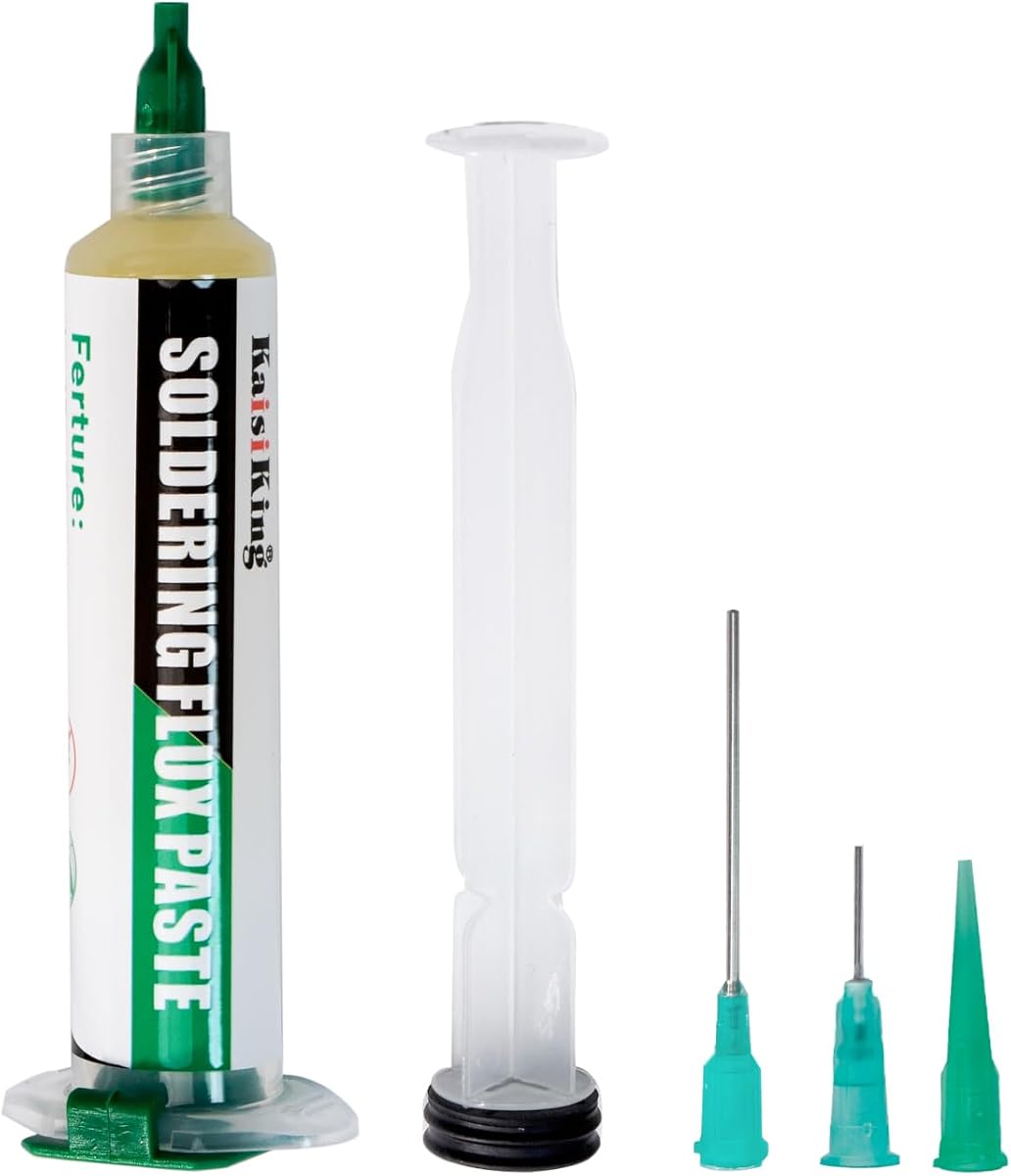
Kaisiking No Clean Paste is a push-type syringe of rosin flux paste with a 4.5 rating. It is designed for electronics soldering, repair, and rework, with a dispensing design that pushes the material out slowly enough to place it directly where needed.
We may earn a commission when you buy through this link, at no additional cost to you.
The formula is described as high purity, lead-free, halogen-free, non-corrosive, and low volatility. It is suitable for both lead-free and lead-based solder, which is useful for anyone who works on a mixture of modern and older equipment. Its good flow ability is intended to wet joints smoothly, while the rosin base helps remove stubborn oxide layers.
The cap can be replaced after use to keep the remaining paste protected, and the slow-flow design is intended to reduce waste. The main limitations are that the package contains one syringe and no desoldering wick, so it is a focused flux solution rather than a complete repair kit.
Choose Kaisiking for home electronics projects, general repair, and controlled work around small components. Its combination of a familiar syringe format, dual solder compatibility, and stated environmental properties makes it a versatile option for DIY users who want more control than an open jar provides.
Gently pushing the plunger allows the paste to overflow gradually, which helps prevent excess material from landing on adjacent traces. That controlled delivery is useful for users refining their technique on fine-pitch components or small circuit-board repairs.
Support for both lead-free and lead-based solder broadens the product's usefulness across mixed repair collections. The claimed low volatility and reduced smoke also make it more comfortable for prolonged bench sessions while still requiring normal ventilation.
We may earn a commission when you buy through this link, at no additional cost to you.
The SRA Solder 135 Two-Pack contains two 2-ounce jars of semi-solid rosin flux paste. With a 4.7 rating, it preserves the controlled application and broad solder compatibility associated with SRA 135 while providing enough material for a permanent bench, a second workspace, or projects that consume flux steadily.
We may earn a commission when you buy through this link, at no additional cost to you.
The paste is advertised as having a solder-wax consistency that resists goopiness and gives the user better control. It can be used to dip copper wire or apply flux directly to a PCB before introducing heat. The formula is intended for tin-lead and lead-free alloys, covering common hobby, repair, and electronics assembly work.
It is explicitly marketed as no-clean, meaning users generally do not need to remove the residue after soldering. The two-jar quantity is the clear advantage over a single-jar product, but there is no precision dispensing attachment or wick. Very fine SMD work may therefore need a more targeted applicator, and desoldering still requires a separate braid.
This is a good selection for serious hobbyists, educators, or repair technicians who expect frequent use. It can also suit household users with more than one electronics workspace. The familiar SRA 135 formulation, controlled paste texture, and ample supply make it a convenient way to equip more than one work area.
Two full-size jars reduce the interruption of running out during a demanding project. One can remain at a fixed soldering station while another travels with a toolkit or supports a separate hobby, especially for users who work on cars, computers, audio equipment, and controller projects.
The stated no-clean characteristic simplifies the finishing stage of a solder job. Users can focus on joint quality and component placement rather than routinely removing every trace of flux, provided their process and the components involved do not require a higher level of cleanliness.
We may earn a commission when you buy through this link, at no additional cost to you.
The right solder flux paste depends on the joint, board type, dispensing habits, and amount of rework involved. Consider format, activity, compatibility, residue, and accessories rather than choosing solely by container style.
Paste flux is thicker than liquid flux and can remain close to the point where it is deposited. That makes it attractive for small pads, SMD work, and users who want to limit spreading across a PCB. Semi-solid products such as SRA 135 are also described as easy to control and resistant to goopiness. By contrast, a dropper liquid may spread more readily and can be useful when a technician wants rapid coverage of a larger connection. The best choice is the consistency that matches the user's control needs and soldering technique.
A no-clean flux is formulated to leave residue that does not require routine removal under normal conditions, although some applications still demand additional cleaning. Look for claims such as non-corrosive, non-conductive, low-residue, or moisture resistant. These characteristics are particularly reassuring on sensitive PCB work and mixed-metal assemblies. Users should also consider whether the listed product is explicitly for lead-free work, because that can matter when planning a bench inventory or matching an established solder.
A syringe and fine tip offer controlled placement around small components, while a dropper supports measured drops and a jar is convenient for brush or iron-tip application. Pneumatic dispensing can improve repeatability for frequent professional work. The best method is the one that prevents excess flux while remaining comfortable in the user's hand. Multiple syringes may also be useful for keeping separate work areas supplied or for rotating containers.
Compatibility should cover the solder alloy, board materials, component finishes, and joining process being used. Many selections work with lead-free and leaded solder, while others are specifically positioned for lead-free electronics. The supplied specifications also mention copper, gold, tin, iron, and silver in different contexts. Users working on mixed equipment should favor a product explicitly described as suitable for both solder systems unless their process requires a different formulation.
Flux activity influences how aggressively it removes oxide and promotes wetting. Rosin, mildly activated, and activated classifications communicate different levels of chemical activity. General no-clean products are appropriate for many routine tasks, while highly active paste may be useful for stubborn oxidation or heavily used hardware. A stronger formula is not automatically better, because it can produce more residue or require more care on sensitive assemblies.
A flux paste is essential for wetting a joint, but removing existing solder requires a wick or another desoldering tool. Several products include copper braid so users can build an apply-and-remove workflow in one purchase. This is valuable for component replacement, correcting mistakes, and freeing old wire. Compare the wick length and width with the work: broad braids suit general board work, while very small assemblies may benefit more from a narrow strip.
Packaging affects both convenience and expected consumption. Open jars are easy to load onto a soldering iron but should be closed promptly between uses. Syringes limit drying and make localized delivery easier, while multi-packs provide several sealed units for a busy bench. Larger jars are useful for frequent through-hole work and wire tinning, whereas a small precision syringe is better suited to occasional fine repairs. The appropriate package depends on frequency, portability, and the number of people sharing the workspace.
Some listings provide an active temperature range, while others omit it. When a temperature range is available, compare it with the working temperature of the solder and the thermal demands of the board. Also note whether the product can thicken in cold conditions, whether a cap must be replaced promptly, and whether a liquid bottle needs careful storage. Good handling practices preserve the paste's intended flow and reduce contamination or drying at the opening.
Prepare the work area and the surfaces before applying flux. The component should be positioned and mechanically secured, the iron should be clean and at an appropriate temperature, and the solder type should match the project. A small amount of paste is usually enough. For a syringe, depress the plunger gently to place it at the pad; for a jar, use the iron tip or a suitable applicator to transfer a controlled amount.
Bring the soldering iron to the joint so the heat reaches the pad and component lead. Allow the solder to flow into the wetted area rather than pushing it directly into the joint. The supplied product descriptions emphasize improving heat transfer, removing oxides, and encouraging smooth flow. For rework involving excess solder, place a desoldering wick over the joint, heat the combination, and lift the braid when the unwanted solder is absorbed.
After soldering, inspect the joint for a smooth connection, bridges, cold spots, and misplaced solder. Reseal paste promptly, clean the syringe tip or dropper, and close the jar. Keep flux away from heat and direct sunlight, and store it in a clean area. Use ventilation during soldering, follow the product label, and apply any additional cleaning required by the specific electronics or assembly.
Solder flux paste prepares a joint for soldering by removing or disrupting oxide layers, improving heat transfer, and helping molten solder wet the surface. It is commonly used on PCBs, SMD and SMT components, copper wire, terminals, and electronic repair joints. The paste is usually applied before heating and can help produce smoother, more reliable connections.
No-clean flux is designed to leave a residue that does not normally require removal under ordinary use. Many of the listed products also describe their residue as non-corrosive, non-conductive, or low residue. Nevertheless, highly sensitive, high-voltage, or specification-controlled assemblies may require cleaning, so check the board manufacturer's guidance and the flux label before use.
Many of these products explicitly support lead-free soldering, and some also work with leaded or tin-lead alloys. Compatibility depends on the particular formulation, so check the listing rather than assuming every rosin flux is interchangeable. It is also wise to keep separate tools and containers for different alloy types if your workflow requires strict contamination control.
Paste flux is often easier to place precisely on small pads because it tends to stay where applied. Liquid flux can spread more readily and may be faster for covering a joint or working on a larger wire connection. The better choice depends on control requirements, joint size, personal technique, and whether you need a syringe, dropper, or open jar.
Flux paste helps solder wet and bond, but it does not remove unwanted solder by itself. A desoldering wick uses capillary action to pull excess solder from a pad during rework. If you replace components, correct bridging, or frequently remove old wire, including a wick will provide a more complete repair setup.
Use only enough to assist the solder at the connection. Paste dispensers and semi-solid formulas make a small quantity easier to control, while liquid flux can spread beyond the intended area. Excess flux does not necessarily improve a joint and may increase residue or cleanup work. The key is to cover the relevant surface without flooding nearby components.
Only when the manufacturer states compatibility with both systems. Several products in this guide explicitly support lead and lead-free alloys, while the four-pack syringe option is specifically listed as lead-free. Confirm the exact formulation and follow any separate solder-handling practices required for the alloy in use.
Keep the container tightly closed, clean, cool, and away from direct sunlight or heat. Syringes and droppers should be recapped after use, and open jars should be closed promptly to limit drying. The multi-syringe product states a shelf life of up to 12 months when kept away from heat and sunlight, and the paste may thicken in extremely cold conditions.
SRA Solder 135 is the strongest all-around option, combining a controlled semi-solid texture, broad lead and lead-free compatibility, and a 4.7 rating. The two-jar rosin flux stands out for budget-conscious general work, while MG Chemicals 8341 is the premium selection for users who value a purpose-built pneumatic dispenser and instant wetting.
Prioritize the format that matches the job. Choose a controlled syringe or fine tips for dense PCBs and fine components, a jar for general electronics and wire work, and a liquid dropper for fast, fluid application. If rework is part of your routine, select a kit that includes a properly sized desoldering wick so you can handle both application and removal.
Before purchasing, verify the current product description, solder compatibility, package contents, storage instructions, and any technical details that may have changed. Customer ratings can also evolve over time, so use the guide as a structured starting point and choose the flux that best matches your equipment, repair volume, and level of precision.