
Aurora AU110MB
4.6Editor score
110-sheet auto-feed capacity
30-minute nonstop runtime
P-4 micro-cut security
Four-gallon pullout basket
Our shredders for heavy items guide compares 10 high-capacity models for security, runtime, bin capacity, jam handling, and use in busy offices or homes.
Shredders for heavy items are built for demanding document destruction, combining higher sheet capacities, longer runtimes, larger waste bins, and reliable cross-cut or micro-cut mechanisms. A capable shredder can process routine paperwork, sensitive records, and thicker stacks without turning routine disposal into a frustrating or lengthy task.
We compared these 10 shredders using their stated sheet capacities, security levels, cutting dimensions, continuous runtimes, bin sizes, supported materials, safety features, and jam-management systems. The list includes manual-feed models for occasional heavy work and auto-feed machines designed for large batches in shared offices and high-volume home spaces.
Each review explains the shredder's most useful strengths, practical limitations, and ideal buyer so you can match machine size to your workload rather than judging only by capacity. Product availability and prices can change, so check the current listing and latest specifications before making your final purchase.
4.6Editor score

4.6Editor score

4.3Editor score
The table below compares all 10 shredders by their feeding method, paper capacity, security rating, and practical hardware. It highlights the tradeoffs between compact manual models, larger bin systems, and auto-feed machines designed for sustained document destruction.




The Amazon Basics 8-Sheet High Security is a compact manual shredder with a 4.3 rating and a stated ability to process up to eight sheets of 20-pound bond paper at once. Its most appealing feature is P-4 cross-cut security, producing approximate 0.2-by-0.7-inch pieces for destroying confidential paper, credit cards, staples, and small paper clips.
We may earn a commission when you buy through this link, at no additional cost to you.
This model is relatively compact at 12.76 by 7.28 by 14.09 inches, making it more appropriate to a home office than a busy shared workspace. A four-mode control switch provides automatic and manual operation along with forward and reverse functions, while LED indicators communicate power, overload, and overheat status. The 3.7-gallon bin simplifies removal of shredded material.
The main limitation is its three-minute maximum runtime, followed by a 30-minute cooldown. That pattern is sensible for intermittent use but not for destroying a large archive in one session. Its small bin also needs more frequent emptying than the larger models in this guide, so heavy-duty suitability depends on maintaining a steady shredding routine.
Choose this shredder when you need respectable P-4 protection in a modest space and your workload consists of recurring batches rather than continuous backlogs. It is a straightforward option for one user or a small home office, provided you respect the duty cycle and avoid metallic cards or aerosol products.
The P-4 cross-cut mechanism produces small, confetti-like fragments that are more difficult to reconstruct than strip-cut waste. It also accepts a single credit card, along with staples and small paper clips, making it suitable for routine personal and small-office disposal.
Automatic operation, manual control, forward movement, and reverse movement give users several ways to feed and clear paper. LED status indicators reduce guesswork when the machine is powered, overloaded, or too hot to continue.
We may earn a commission when you buy through this link, at no additional cost to you.
The Fellowes Powershred 99Ci combines a 4.6 rating with an 18-sheet manual capacity, making it one of the strongest all-around choices for heavy document destruction. It also has a 30-minute continuous runtime, so it can handle several substantial jobs without requiring the short duty cycles found on many compact shredders.
We may earn a commission when you buy through this link, at no additional cost to you.
Its 9-gallon pull-out bin is a major practical advantage for offices and home workspaces that produce steady volumes of paper waste. The LED bin-full indicator helps prevent overflow, while the machine's automatic jam-detection and quiet operation are especially useful in shared spaces. The bin-full indicator supports more organized disposal routines and reduces sudden interruptions.
The cross-cut mechanism produces 5/32-by-1.5-inch particles and meets a P-4 security grade. It handles paper, staples, credit cards, paper clips, CDs, DVDs, and junk mail, but it is a manual-feed model rather than an unattended auto-feed system. Its physical bulk and sizable waste bin are unavoidable tradeoffs for the capacity and runtime.
This is a strong recommendation for small businesses, departments, and serious home offices that shred regularly but do not need hands-free batch processing. The combination of P-4 protection, 18-sheet capability, a long runtime, and a large bin gives it more balance than compact alternatives.
Eighteen sheets per pass and a 30-minute runtime support consistent use beyond occasional home-office shredding. The machine is better suited to regular multi-document sessions than models limited to only a few minutes of continuous operation.
The nine-gallon pull-out bin accommodates substantially more waste than compact units. Its full indicator makes it easier to empty at an appropriate moment instead of discovering an overflowing basket at the end of a session.
We may earn a commission when you buy through this link, at no additional cost to you.
The Amazon Basics 8-Sheet Cross Cut in white offers a straightforward entry into P-4 document destruction. It carries a 4.3 rating, accepts up to eight sheets of 20-pound bond paper per pass, and cuts material into approximate 0.2-by-0.7-inch pieces.
We may earn a commission when you buy through this link, at no additional cost to you.
Its 3.7-gallon bin and compact 12.76-by-7.28-by-14.09-inch dimensions make it suitable for a small office or home workspace where desk or shelf space is limited. Automatic, off, reverse, and forward modes give users basic control, and LEDs show power, overheat, and overload status.
Like the other 8-sheet Amazon Basics model, its three-minute runtime and 30-minute cooldown prevent sustained heavy-duty use. It also lacks an auto-feed tray and a larger bin, so it is better for moderate recurring use than for clearing a serious backlog. Metallic cards and aerosol sprays should be kept away from the cutting mechanism.
Choose this model when your priority is affordable P-4 cross-cut security without the footprint or expense of a large office machine. It is most useful for a home office, occasional small-business disposal, or a second shredder in a room where space is at a premium.
The small external dimensions make this easier to position near a printer or in a home office than many high-capacity machines. It retains cross-cut protection for documents, cards, staples, and small paper clips.
Automatic shutoff helps protect the motor when the machine reaches its maximum run time. LED indications make it easier to identify overheating or overload conditions before attempting another batch.
We may earn a commission when you buy through this link, at no additional cost to you.
The Amazon Basics 24-Sheet Cross Cut is a high-value heavy-duty manual shredder with a 4.3 rating. It can process up to 24 sheets of 20-pound bond paper per pass, giving it the largest stated manual capacity among the products in this guide.
We may earn a commission when you buy through this link, at no additional cost to you.
Its 40-minute runtime and 50-minute cooldown cycle are particularly useful for long document-destruction sessions. A seven-gallon pull-out basket, an 8.7-inch paper-entry width, and included casters make the machine easier to manage in a home office or small business. Anti-jam auto reverse and indicators for bin full, overload, overheat, and open door add useful operational feedback.
The cross-cut output measures 5/32 by 1-1/2 inches and meets P-4 standards. It can also destroy CDs, DVDs, credit cards, staples, and small paper clips. However, it is a manual-feed design, so users must remain present and feed stacks themselves; the large bin and body also require more space than compact models.
This shredder is a compelling selection for buyers who want substantial capacity, security, and runtime without moving into an auto-feed platform. It is particularly well suited to home offices that periodically destroy large stacks but do not require unattended feeding.
A 40-minute continuous run allows a user to process multiple loads with less waiting than short-duty compact models. The 50-minute cooldown is predictable, so large jobs can be planned around the machine's thermal limits.
Automatic reverse helps clear minor paper jams and reduce the need to open the machine. The four-mode switch and detailed LED indicators let users diagnose common operating conditions more easily.
We may earn a commission when you buy through this link, at no additional cost to you.
The Amazon Basics 200-Sheet Auto Feed is designed for heavy batches, with a stated 200-sheet automatic capacity, a 10-sheet manual slot, and a 4.3 rating. It combines hands-free tray feeding with P-4 cross-cut output measuring 5/32 by 25/32 inches.
We may earn a commission when you buy through this link, at no additional cost to you.
Its auto-feed mode can run for 60 minutes before a 45-minute cooldown, the longest stated auto-feed runtime among the products here. The machine accepts stacks without requiring users to remove staples, and an 8.5-gallon pull-out bin limits emptying interruptions. LED indicators report feed errors, a full bin, an open door, overload, and overheating.
The principal compromise is size: dimensions of 18.35 by 14.02 by 22.83 inches require a dedicated place in a home office or workplace. The manual feed slot runs for only 10 minutes, and auto-feed operation still requires attention when feeding pages or clearing an alert. Its larger size also makes it less portable than compact units.
This is a strong option for administrators, operations managers, and home users who routinely destroy large document archives. Choose it when unattended tray processing and long continuous runs matter more than a small footprint.
The automatic tray can accommodate up to 200 sheets, allowing the machine to work through a substantial stack with less page-by-page handling. The system also works with ordinary staples rather than requiring them to be removed first.
An 8.5-gallon pull-out bin helps keep high-volume sessions moving. Detailed LED warnings for a full bin, open door, feed error, overload, and overheat support routine maintenance.
We may earn a commission when you buy through this link, at no additional cost to you.
The Amazon Basics 12-Sheet Cross Cut provides a useful middle ground between compact shredders and larger office models. With a 4.3 rating, it processes up to 12 sheets of 20-pound bond paper and meets P-3 cross-cut security standards.
We may earn a commission when you buy through this link, at no additional cost to you.
Its nine-minute runtime is longer than the three- to five-minute cycles of most small models in the list, while a five-gallon bin reduces emptying frequency. The 7.87-by-13.15-by-16.54-inch body is more substantial than an 8-sheet unit but remains manageable for a home office. Four operating modes and LEDs for power, overheat, and overload simplify basic use.
P-3 is the most important limitation. It offers cross-cut protection, but the approximate 0.2-by-1.2-inch pieces are larger than the P-4 fragments offered by many alternatives. The specification also lists forward and reverse modes, but not the explicit anti-jam auto-reverse found in larger models. Like several other entries, it should not be used on metallic credit cards.
This shredder is best for routine disposal of less sensitive records and mixed office clutter where long runtime and a reasonably sized bin are more important than the highest security classification. Users handling highly confidential material should favor a P-4 model.
A nine-minute runtime offers more room for multiple reams or document stacks than compact models with only a few minutes of continuous operation. Automatic shutoff protects the motor once that limit is reached.
The P-3 cross-cut mechanism is stronger than strip-cut disposal, making it useful for routine paperwork, cards, staples, and clips. It remains less granular than the micro-cut and P-4 cross-cut alternatives in this guide.
We may earn a commission when you buy through this link, at no additional cost to you.
The Locksworth 12-Sheet Cross Cut is a portable home-office shredder with a 4.3 rating and a stated 12-sheet capacity. Its P-4 mechanism creates approximately 5-by-20-millimeter cross-cut particles and also accepts credit cards, mail, staples, and paper clips.
We may earn a commission when you buy through this link, at no additional cost to you.
A portable handle makes the unit easier to move between a home office and workplace, while the 5.55-gallon bin includes a transparent window for checking the fill level. The lift-up top cover simplifies emptying. A lid-based safety feature stops the blades if the top is removed and prevents operation until it is properly replaced.
Heavy-duty performance is tempered by a five-minute runtime and a lengthy 60-minute cooldown. Reverse is available for clearing jams, but the product does not advertise an automatic anti-jam function. These limits make it more appropriate for regular batches than for a continuous records-destruction project.
Choose this model for users who want P-4 security, portability, and a clearly visible bin in a home or small-business environment. It is a sensible fit when documents must be destroyed in different locations but the total daily volume does not demand an auto-feed machine.
The handle and relatively compact design make the shredder easier to relocate than larger bin-and-caster systems. It retains P-4 cross-cut output for sensitive documents and common household office materials.
A transparent window shows when the bin needs attention, while the removable top cover helps empty it. Removing the lid stops the blades, reducing the risk of reaching into an active cutting mechanism.
We may earn a commission when you buy through this link, at no additional cost to you.
The Locksworth 8-Sheet Cross Cut is a compact shredder for confidential documents in home offices and small workspaces. It has a 4.3 rating, accepts up to eight sheets per pass, and creates approximately 5-by-18-millimeter P-4 cross-cut particles.
We may earn a commission when you buy through this link, at no additional cost to you.
The 4.23-gallon bin has a transparent viewing window, and a portable handle makes the unit easier to move. Its top cover lifts for waste removal, while the lid safety system stops the blades if the cover is removed. The shredder also handles credit cards, staples, and paper clips for routine document disposal.
Its four-minute runtime and 60-minute cooldown are the main constraints. Users clearing stacks will need to break the work into smaller sessions and wait between periods of continuous operation. Reverse helps resolve minor jams, but the machine has no advertised auto-feed system or larger-bin capacity.
This model is a good choice for a home user who values P-4 protection and portability over bulk processing. It is especially appropriate for records, mail, and client documents that require secure destruction but are handled in moderate quantities.
The cross-cut mechanism divides sensitive paperwork into small particles while keeping the machine reasonably compact. It can also process a single credit card along with staples and paper clips.
The integrated handle makes relocation between a home office and another workspace more convenient. The visual bin window provides a quick indication of when waste should be removed.
We may earn a commission when you buy through this link, at no additional cost to you.
The Quietlemon 200-Sheet Auto Feed stands out for its P-5 micro-cut security, touchscreen controls, and 200-sheet auto-feed capacity. Its 4.3 rating reflects a product positioned for users who need both high-volume processing and very small output particles.
We may earn a commission when you buy through this link, at no additional cost to you.
The machine can operate for up to 40 minutes on the auto-feed setting, while the manual slot handles up to seven sheets of 20-pound paper or six sheets of 24-pound paper. Its P-5 mechanism turns a letter-size page into more than 3,000 pieces measuring approximately 2 by 10 millimeters. Operation is listed below 60 decibels, and four swiveling wheels make the unit easier to reposition.
The manual-feed limitation and strict paper-thickness guidance are important. Exceeding the rated load can trigger a jam and automatic blade reversal, which the manufacturer describes as a protective response rather than a defect. At 16.73 by 14.25 by 24.88 inches and 28.66 pounds, the shredder is large, and its 5.8-gallon bin is modest for the claimed auto-feed volume.
Choose it when high security, quiet operation, and automatic feeding outweigh footprint and bin size. It is well suited to privacy-conscious home offices and offices handling sensitive records that justify a premium micro-cut system.
The P-5 micro-cut mechanism creates much smaller fragments than the cross-cut models in the guide. This makes the shredder particularly compelling for financial, medical, legal, or administrative records that demand stronger visual destruction.
The 200-sheet tray supports long unattended runs, and the stated noise level below 60 decibels is intended for offices and homes where conversation or remote calls occur nearby. A touchscreen gives users centralized control over the operating functions.
We may earn a commission when you buy through this link, at no additional cost to you.
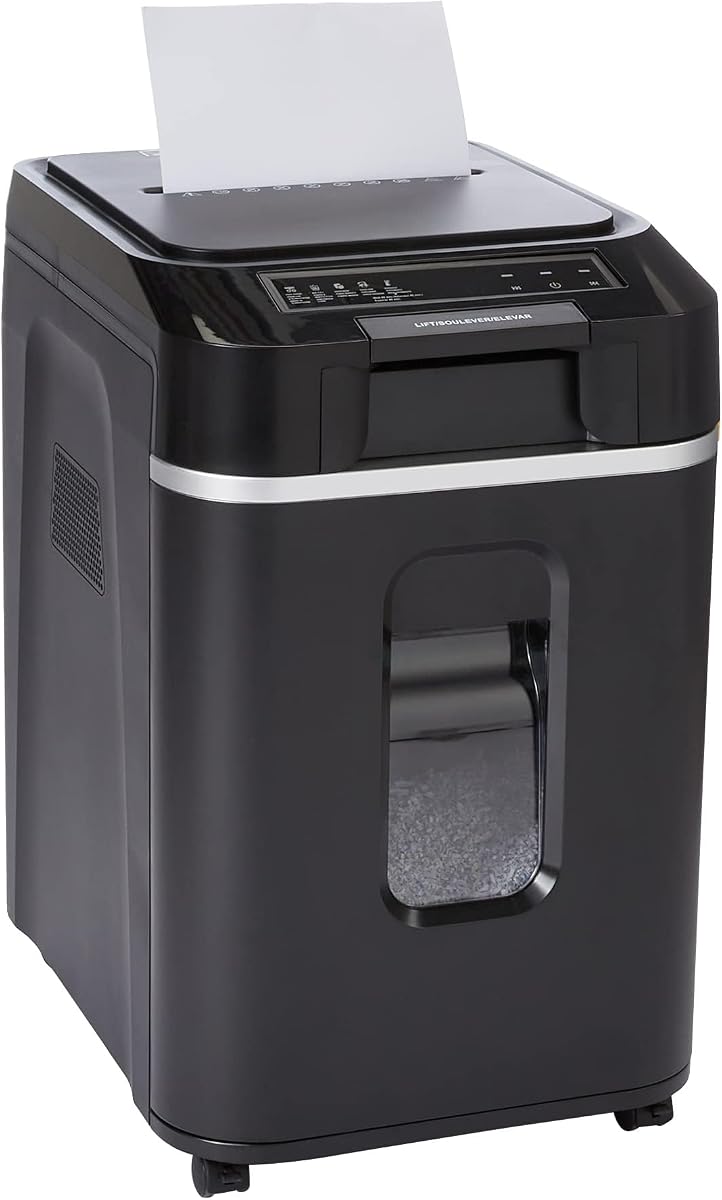
The Aurora AU110MB is a compact-looking auto-feed option with a 4.6 rating, one of the highest ratings among the listed products. It supports up to 110 sheets through its automatic tray and 10 sheets through the manual input, combining batch convenience with moderate flexibility.
We may earn a commission when you buy through this link, at no additional cost to you.
Its 30-minute nonstop runtime is well suited to sustained office destruction, while automatic start and stop, jam-prevention auto reverse, and overload protection help maintain operation. The P-4 micro-cut mechanism reduces paper and credit cards into pieces measuring 5/32 by 9/16 inches, offering finer destruction than standard cross-cut output.
The four-gallon pullout basket is the clearest drawback. A machine capable of processing 110-sheet batches may fill it sooner than users expect, making regular bin checks important. The specification does not state an estimated paper quantity for the basket, so actual emptying frequency will depend on paper type, compression, and how often the machine is used.
This shredder is best for offices that want auto-feed convenience, micro-cut security, and a long runtime in a moderate package. It is particularly attractive for users who value a 4.6-rated model and do not need the very highest security classification or the larger feeding capacity of premium heavy-duty systems.
The 110-sheet auto-feed tray removes much of the page-by-page effort associated with manual shredding. Automatic start and stop further streamline routine batch destruction.
P-4 micro-cut output produces small fragments for confidential paperwork and credit cards. Jam-prevention auto reverse, overload protection, and detailed LED indicators help users respond to operating conditions.
We may earn a commission when you buy through this link, at no additional cost to you.
The right shredder depends on the size and frequency of your workload, the sensitivity of the records, and the physical space available. Comparing capacity alone overlooks runtime, feeding method, bin volume, and the level of protection each model provides.
Sheet capacity is the maximum number of pages the manufacturer lists for a single feed, but real-world performance depends on page weight, condition, staples, and whether the machine is manual or automatic. Models rated for 8 to 12 sheets suit routine home-office disposal, while 18- and 24-sheet units better absorb thicker stacks. Auto-feed models can support 110 to 200 sheets but should still be operated within their stated limits.
A long continuous runtime is valuable when destroying records in batches. The options here range from three minutes on compact Amazon Basics models to 60 minutes on the Amazon Basics auto-feed machine. Longer runtimes reduce waiting, although each machine still needs a cooldown period. Consider the longest realistic session and whether you can plan around its thermal cycle.
Manual shredders offer control and usually require less space, but someone must feed each stack. Auto-feed systems accept larger batches and can reduce hands-on effort, making them useful for archives, shared offices, and bulk disposal. They are larger, require more bin capacity, and are best operated with the flap or tray correctly positioned.
P-4 is the most common security rating among the higher-end choices in this guide. Cross-cut shredders create small confetti-like pieces, while micro-cut systems produce much finer fragments. P-5 offers the highest listed protection but should be considered for particularly sensitive material. P-3 can suit routine disposal, although it produces larger pieces than P-4 systems.
The bin should match how often shredded material can be removed. Capacity ranges from 3.7 gallons on compact Amazon Basics units to nine gallons on the Fellowes Powershred 99Ci. A larger bin reduces interruptions but requires more floor space and can be heavier when full. Visual windows and full indicators help avoid overflow, particularly during long sessions.
Heavy-duty shredders should include clear recovery paths for paper jams. Forward and reverse controls are standard on many models, while anti-jam auto reverse is more convenient. Overload and overheat protection are also essential because they stop the motor before damage occurs. LEDs for jam, overload, door, bin, and thermal status make troubleshooting faster.
Quiet operation is valuable in home offices and shared workspaces. The Quietlemon model is specifically listed below 60 decibels, while the Fellowes is described as ultra-quiet. Safety systems can include automatic shutoff, touch-sensitive protection, or a lid interlock. Casters and handles improve mobility, but large auto-feed machines may still be difficult to reposition.
Paper is only part of the disposal task. Check whether the shredder accepts credit cards, staples, paper clips, mail, CDs, or DVDs, and whether a dedicated slot is required. Metal cards are explicitly excluded by several products, and aerosols should never be sprayed near a shredder. Using unsuitable material can damage cutters or create safety risks.
Before first use, place the shredder on a stable, dry surface with adequate clearance around the feed opening and bin. Read the user manual, confirm that the bin is seated correctly, and test the controls with a few sheets. Automatic-feed models should have their trays fully positioned, while manual models should be checked for a clear cutting path and properly aligned bin.
Feed paper within the stated sheet and weight limits. Avoid metal credit cards, and do not spray aerosol products around the machine. If a jam occurs, use the forward and reverse controls as directed and avoid forcing the mechanism. If a load repeatedly jams, reduce the stack size and confirm that staples, clips, and other objects fall within the permitted material list.
Empty the bin before it becomes full, especially during auto-feed sessions. Switch off and unplug the machine as directed before removing the basket or top cover, and clean the cutters only with a dry, approved method. Do not lubricate the machine unless the manufacturer specifically authorizes a lubricant and provides application instructions. Allow the required cooldown period before resuming heavy use.
An auto-feed shredder with a large sheet capacity, long runtime, and generous bin is usually the most convenient for heavy workloads. Manual models can still handle substantial stacks, but someone must remain present to feed them. The best choice also depends on available space, the sensitivity of the records, and how often the machine will be used.
P-4 is a strong choice for most confidential documents because it produces small cross-cut or micro-cut pieces. P-5 offers even finer micro-cut output and may be worthwhile for highly sensitive financial, medical, or legal records. P-3 is more appropriate for routine disposal where the risk and quantity of sensitive material are lower.
Some units accept staples, paper clips, and occasional mail, but cardboard, rigid folders, and thick bindings may exceed the rated sheet capacity. They can also cause jams or damage cutters. Check the manual for every permitted material, and remove or open thick bindings before feeding a document when the manufacturer recommends doing so.
Cross-cut shredders cut paper both vertically and horizontally into small rectangular pieces. Micro-cut shredders reduce those pieces further, producing a much finer and less readily reconstructed output. Micro-cut machines are useful for highly sensitive material, but they generally process fewer sheets at a time and may require more bin servicing.
The machine may have reached its continuous runtime limit, detected an overload, or triggered overheat protection. Let it cool for the stated period, empty the bin if it is full, and check for a jam. If the same load repeatedly causes problems, reduce the number or weight of sheets in each batch.
Empty the bin before it is completely full, particularly during extended or automatic shredding jobs. A visible window or bin-full indicator can help prevent overflow. The best interval depends on shredding volume and bin size, since a high-capacity auto-feed machine can fill a smaller basket much faster than a compact manual model.
Most of the listed shredders support plastic credit cards, usually one at a time and sometimes through a dedicated slot. Metal credit cards are explicitly excluded by multiple models and should not be inserted. The Quietlemon model lists plastic cards, pins, and staples as suitable, but it does not support CDs or metal cards.
No. Higher capacity can make a machine more efficient, but it may also increase its size, weight, bin requirements, and sensitivity to overloading. A compact 8- or 12-sheet model may be more practical for occasional home use. Auto-feed with a long runtime is generally more valuable when you routinely destroy large archives.
The Fellowes Powershred 99Ci is the most balanced overall option, combining an 18-sheet capacity, 30-minute runtime, P-4 security, and a nine-gallon bin. The Aurora AU110MB stands out for auto-feed convenience, while the Amazon Basics 24-Sheet Cross Cut offers a capable manual design with a large basket and long runtime at a budget-friendly tier.
Prioritize the feature that limits your workflow most: runtime for long sessions, auto-feed for large archives, bin size for infrequent emptying, or P-4 or P-5 security for sensitive information. Also account for floor space, noise, mobility, and the exact materials you need to destroy. The most technically impressive machine is not necessarily the most practical one for every room.
Before purchasing, verify the current listing, availability, dimensions, and included accessories. Specifications and prices can change over time, and current retailer information should be used to confirm that the model still fits your needs.