
1/2-inch NPT Hall Effect Flow Sensor
4.7Editor score
1–30 L/min rated range
Threaded 1/2-inch NPT connection
Sealed magnetic hall sensor
Works with common Arduino boards
An Arduino flow meter turns moving water into a stream of electrical pulses that a microcontroller can count, making it useful for irrigation controllers, leak monitors, beverage machines, water dispensers, and other DIY projects. The best model depends heavily on pipe size, expected flow, electrical requirements, and whether the sensor must handle a threaded plumbing connection.
The products in this guide were compared using their stated flow ranges, connection styles, operating voltages, pressure limits, output types, construction details, and suitability for common Arduino projects. The list covers 1/2-inch, 3/8-inch, 3/4-inch, and 1.5-inch options, with both compact hose-compatible sensors and plumbed-in threaded units.
Each review explains the sensor's strongest use case, practical advantages, and important trade-offs, while the comparison table makes the key specifications easier to scan. Product availability and current prices can change, so readers should verify the latest listing details, included accessories, and technical specifications before purchasing.
4.7Editor score

4.9Editor score

5.0Editor score
As an Amazon Associate we earn from qualifying purchases.
This side-by-side comparison covers every sensor in the guide, highlighting connection type, flow range, electrical characteristics, pressure rating, output method, and the project types each model is best suited to handle.


This compact hall effect flow sensor is a practical starting point for Arduino projects that need to measure water moving through a 1/2-inch line. It carries a 4.7 rating and combines a 1–30 L/min stated range with a threaded NPT connection. Its small body is particularly useful where the project cannot accommodate a large inline plumbing component.
We may earn a commission when you buy through this link, at no additional cost to you.
The rotating internal assembly produces magnetic transitions that the hall sensor converts into an electrical pulse with every revolution. Because the electronics are sealed away from the water pipe, the sensing side can remain dry while the flow path is installed. The 1/2-inch NPT fitting also makes it more convenient for permanent plumbing than a bare hose connection.
The most important installation consideration is flow direction. The product is designed to produce a signal only when installed in the indicated direction, so reversing it can leave the Arduino reading zero. Its compact dimensions and stated 1–30 L/min capacity also mean it is less appropriate for very low trickles or substantially higher flow than its specified range.
This is a strong choice for budget-conscious makers building an irrigation monitor, reverse-osmosis project, water-purifier display, or simple dispensing counter. Buyers should verify their pipe dimensions and the arrow marking before installation. When those requirements align, it offers a convenient threaded design, compact construction, and dependable pulse output without introducing a more complicated plumbing arrangement.
The rotating flow assembly produces one pulse per revolution, allowing an Arduino to calculate flow by counting incoming signals over a defined interval. This approach is well suited to displays, volume totals, alarms, and automatic shutoff controls.
The 1/2-inch NPT connection is valuable when a project will remain connected to a fixed water line. Correct threading, compatible fittings, and the marked flow direction are essential for a reliable installation.
We may earn a commission when you buy through this link, at no additional cost to you.
The DEVMO sensor stands out as the most balanced selection in this guide, combining a 4.9 rating with a stated 1–30 L/min operating range and a familiar 1/2-inch inline format. It is suited to Arduino projects that need a straightforward fluid-flow signal in a water-testing or water-cooling arrangement.
We may earn a commission when you buy through this link, at no additional cost to you.
The hall effect output provides a clean distinction between high and low signal amplitude: the stated high amplitude is at least 4.6 volts, while the low amplitude is no more than 0.5 volts. The stated electric strength is 1,250 volts per minute. Those output characteristics give a builder useful information when selecting input circuitry and interpreting pulse states.
The product description emphasizes water testing, water cooling systems, water heaters, credit-card machines, water vending machines, and dedicated flow measurement devices. Its listed details are less extensive than those of some competing models, so buyers should confirm the exact dimensions, thread type, pin arrangement, and operating voltage against the seller listing before finalizing a build.
For makers seeking a well-rated sensor without moving to a larger or more specialized flow range, this is an excellent all-around option. It is particularly appropriate for closed-loop monitoring, flow alarms, and runtime counters. The combination of strong customer feedback, a practical 1/2-inch size, and clearly specified signal levels makes it a particularly confident recommendation for an Arduino flow meter.
The stated 4.6-volt high level and 0.5-volt low level make the sensor easier to pair with digital input circuitry. Designers can also add signal conditioning if the Arduino board does not interpret the output cleanly.
Applications include water testing, cooling loops, heaters, vending equipment, and flow-measurement devices. The most important question is whether the actual line size and expected flow remain inside the sensor's stated limits.
We may earn a commission when you buy through this link, at no additional cost to you.
This DIGITEN model is the strongest choice for projects that move substantially more water than a typical countertop or irrigation line requires. Its 5.0 rating, 5–150 L/min range, and G1.5-inch BSPT connection distinguish it from the smaller sensors in the guide.
We may earn a commission when you buy through this link, at no additional cost to you.
The stated operating voltage is DC 5–18 volts, and the unit outputs a square-wave pulse for use with Arduino, Raspberry Pi, and reverse-osmosis systems. Water pressure below 1.75 MPa is permitted. Materials are stated to align with RoHS testing standards, and the product information says they can be used with potable water.
Its primary trade-off is specialization. The minimum rated flow of 5 L/min means it will not provide useful measurements for a slow drip, and the 1.5-inch fitting demands a corresponding plumbing size. The connection is BSPT rather than NPT, so an installer who needs NPT must use appropriate fittings and thread seal tape as directed by the listing.
This sensor is ideal for a high-capacity purifier, commercial-style dispenser, water heater, beverage machine, or circulation system. It may be unnecessary for a small plant-monitoring rig, but when a project genuinely operates in the upper end of the listed range, this model provides substantially more capacity than the other selections.
A maximum stated flow of 150 L/min makes this sensor useful for projects where the plumbing must carry a large volume quickly. Matching that capacity to the pipe and pump prevents the sensor from operating beyond its intended envelope.
The square-wave pulse output is compatible with common edge-counting methods. Proper voltage matching and signal conditioning remain important when wiring the sensor to a microcontroller board.
We may earn a commission when you buy through this link, at no additional cost to you.
This 1/2-inch hall effect flow sensor is aimed at makers building water heaters, coffee machines, purifiers, fountains, beverage machines, and similar equipment. Its 4.1 rating places it behind the more highly rated choices, but its food-grade plastic construction and stated flow accuracy formula remain useful for carefully designed projects.
We may earn a commission when you buy through this link, at no additional cost to you.
The listed output relationship is F=(7.5×Q)±2 percent, with Q expressed in liters per minute, while the usable flow range is 1–30 L/min. A DC 5–24 volt operating range is broad enough for many common Arduino power arrangements, and the allowable water pressure is no more than 1.75 MPa.
Its main technical caveat is the G1/2-inch BSPT connection. A builder expecting NPT may need adapters or compatible fittings, and proper sealing is important. The stated food-grade material should also be interpreted within the boundaries of the product description rather than as certification for every possible use.
This sensor is most attractive to a builder creating a compact food or beverage-water device where 1–30 L/min is appropriate. It is less compelling for someone seeking the strongest customer feedback or a model with extensive cable and connector information. Still, its construction and stated pulse relationship make it a credible choice for a controlled inline installation.
The food-grade plastic body and RoHS-aligned raw materials support applications involving drinking-water equipment. Builders should still validate cleanliness, temperature, and chemical compatibility for their particular fluid and installation.
The stated F=(7.5×Q)±2 percent relationship gives a starting point for converting pulse frequency into flow. Calibration against a known volume improves confidence in finished projects.
We may earn a commission when you buy through this link, at no additional cost to you.
This two-pack of YF-S201C transparent sensors offers a distinctive visual advantage: the clear body allows builders to observe water movement and rotor condition directly. It has a 3.7 rating and covers a stated 1–30 L/min range, making it the most noticeably transparent option in the guide.
We may earn a commission when you buy through this link, at no additional cost to you.
Internally, each sensor combines a plastic valve body, a water-flow rotor assembly, and a hall sensor. The rotor contains stainless-steel beads intended to improve wear resistance, while the separation of the electronic sensing components from the water helps preserve a dry electrical section.
The transparent version operates from DC 3.5–24 volts, whereas the product details specify DC 3.5–12 volts for the black version. Since the package title identifies the transparent model, DC 3.5–24 volts is the relevant figure. The stated load capacity is no more than 10 mA at DC 5 volts, and water pressure should remain below 1.75 MPa.
The pair is useful for a pump test, comparison of two lines, classroom demonstration, or a backup installation. However, the lower rating warrants more careful expectation setting, particularly regarding long-term consistency and completeness of documentation. It is most attractive to users who value visual confirmation and need two units rather than a single highly rated premium sensor.
The transparent valve body makes it easy to confirm that water is moving and that the rotor responds. This visual feedback can speed setup and help diagnose a blocked or incorrectly installed line.
A two-pack can support separate inlet and outlet measurements, a paired system, or one replacement. It is especially useful for builders comparing flow behavior before and after a filter or control valve.
We may earn a commission when you buy through this link, at no additional cost to you.
This compact sensor is designed for projects with relatively low water flow, such as a small dispenser, controlled drip line, or coffee-machine-style water path. It has a 4.2 rating and a title reference to 0.3–6 L/min, while the detailed bullet points give the usable range as 0.5–3 L/min.
We may earn a commission when you buy through this link, at no additional cost to you.
Its inlet accepts a hose with an internal diameter of approximately 5–7 millimeters, providing a straightforward connection method for flexible tubing. The published pulse relationship is F=(98×Q)±3 percent, where Q is measured in liters per minute. DC 5–24 volt operation covers many common supply choices.
The stated maximum water pressure is 0.8 MPa, lower than the 1.75 MPa allowance listed for several larger sensors. The hose must also match the specified internal diameter, and an imperfect seal can introduce leakage or air-related measurement errors. These details make the product less convenient for rigid, high-pressure plumbing.
This is a sensible pick when the project needs sensitivity at low flow and a hose connection is more practical than a threaded fitting. It is not the right choice for a main supply line or a system moving many liters per minute. Within its narrow operating envelope, it offers a simple way to add flow measurement to an Arduino-controlled device.
The 0.5–3 L/min usable range is useful where meaningful movement occurs at a relatively slow rate. It should not be selected for a trickle below the stated minimum or a high-volume line.
A 5–7 millimeter internal-diameter hose can connect without a rigid threaded assembly. Check the hose dimensions and secure the connection carefully to prevent leaks and unstable flow.
We may earn a commission when you buy through this link, at no additional cost to you.
The Taidacent YF-S201 is especially relevant to Arduino projects built around water heaters and dispensers. It carries a 5.0 rating and is identified in the product title as the black YF-S201 version with a four-point G1/2 interface, although the available bullet points do not fully define the four-point configuration.
We may earn a commission when you buy through this link, at no additional cost to you.
Its operating principle is easy to follow. Water passing through the rotor assembly changes the rotor's rotational speed, and the magnetic rotor creates corresponding changes that the hall sensor converts into a pulse signal. A controller can count those signals to determine the flow magnitude and regulate the equipment.
The stated installation location is the water-inlet end of a water heater, where measuring influent flow can support filling, dispensing, leak, or usage controls. Buyers should confirm the actual port dimensions, connector style, and electrical details in the current listing because the title's interface shorthand does not provide a full wiring diagram.
This sensor is a compelling choice for a dedicated heater or dispenser project because its intended application is explicit and its rating is excellent. It may also work in other compatible water circuits, provided the pipe and flow characteristics match. For a builder wanting a straightforward pulse sensor with a clear controller role, it is a strong choice.
Installing the sensor at the water-inlet end gives an Arduino controller a direct view of incoming flow. That makes it possible to monitor filling, estimate usage, and respond to abnormal conditions.
As flow changes, rotor speed changes with it. The hall sensor translates that motion into pulses, allowing a controller to estimate flow rate and total volume over time.
We may earn a commission when you buy through this link, at no additional cost to you.
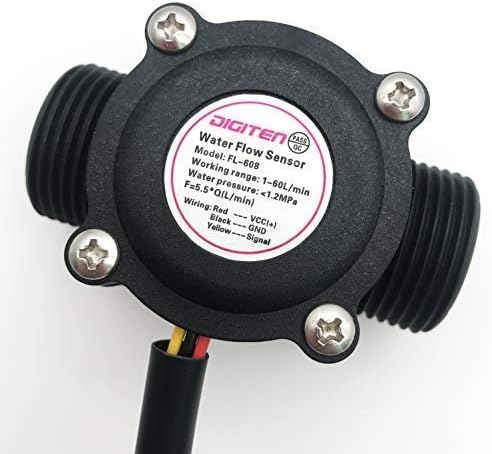
This DIGITEN sensor is especially convenient when the Arduino cannot be mounted directly beside the plumbing. Its 1.2-meter attached cable, stated SM2.54 three-pin connector, 4.8 rating, and 1–30 L/min range make it a polished choice for remote sensing installations.
We may earn a commission when you buy through this link, at no additional cost to you.
The sensor provides a square-wave pulse output and operates from DC 5–18 volts. Its materials are stated to comply with RoHS testing standards and can be used with potable water. The housing is also described as waterproof and resistant to heat, cold, and pressure, with water pressure below 1.75 MPa permitted.
The G1/2-inch connection uses BSPT male threads. If the available plumbing uses NPT, the product information specifically notes that thread seal tape is needed. The preattached cable also means builders should plan the controller position carefully, although it eliminates the need to terminate a short sensor lead at the plumbing point.
This model fits an Arduino display placed on a wall, a reverse-osmosis controller separated from its filter, or a dispenser with electronics mounted away from moisture. It is less suitable when the controller is more than the cable length away or when an unusual connector is inconvenient. Within those limits, it combines useful documentation with a practical layout.
The 1.2-meter cable allows the flow sensor to remain in the pipe while the Arduino electronics sit in a more accessible enclosure. This separation can simplify maintenance and improve physical layout.
The SM2.54 three-pin connector offers a defined way to connect the sensor to a controller board. A builder still needs to confirm pin functions and use appropriate voltage, ground, and signal connections.
We may earn a commission when you buy through this link, at no additional cost to you.
The DIGITEN G3/8-inch sensor fills a useful middle ground between the very small hose model and the 1/2-inch threaded sensors. It has a 4.5 rating and a stated 0.3–10 L/min range, making it appropriate for lines that need more capacity than a low-flow appliance connection but less than a major water line.
We may earn a commission when you buy through this link, at no additional cost to you.
Its operating voltage is DC 3.5–12 volts, and it outputs a square-wave pulse signal through a hall effect sensor. The housing is described as small, waterproof, and resistant to heat, pressure, and cold. Its raw materials are stated to comply with RoHS testing standards.
The G3/8-inch connection restricts the choice of plumbing adapters, and the listed voltage ceiling means a 12-volt supply should be used unless the current documentation provides otherwise. A low minimum rated flow is useful for moderate trickles, but extremely slow movement may still fall below the sensor's useful range.
Choose this model for an Arduino irrigation branch, compact purification assembly, or compact water appliance that needs broad flow coverage in a smaller body. Its lower operating voltage can simplify power arrangements. Compared with the 1/2-inch choices, it is the better fit when pipe dimensions—not simply the measurement range—are the deciding factor.
This range supports projects that may experience light flow while also needing room for moderate consumption. A practical design should remain near the sensor's calibrated operating conditions.
The DC 3.5–12 volt range is compatible with common microcontroller supply arrangements. A square-wave output makes pulse counting straightforward when the signal levels suit the selected input.
We may earn a commission when you buy through this link, at no additional cost to you.
This DIGITEN G3/4-inch model is intended for plumbing that carries more water than a standard 1/2-inch line while remaining below the capacity of the G1.5-inch option. It has a 3.2 rating, a stated 1–60 L/min range, and a 1.2-meter cable for more flexible placement.
We may earn a commission when you buy through this link, at no additional cost to you.
The sensor uses a hall effect element and produces a square-wave pulse signal. Its stated operating range is DC 5–18 volts, and the allowable water pressure is below 1.75 MPa. Materials are said to comply with RoHS standards, while the housing is described as small, waterproof, and resistant to heat, cold, and pressure.
The G3/4-inch BSPT male connection may need compatible adapters or thread seal tape for some installations. The low rating is the most important consideration, so buyers should review current customer feedback and confirm the complete technical details before committing. A sound Arduino project should be built around verified behavior rather than assuming every unit in a broad category performs identically.
This sensor makes sense for a 3/4-inch water heater inlet, purifier, fountain, or larger dispenser where the stated flow can reach 60 L/min. It is also convenient when the electronics need to remain away from the pipe. Those specific benefits justify consideration, but another model may be more reassuring for builders who place greater importance on customer feedback.
The 1–60 L/min range offers more headroom than the 1/2-inch alternatives. It is best suited to water heaters, dispensers, purifiers, and fountains that may move a moderate volume quickly.
The 1.2-meter cable keeps the sensor in the line while allowing the controller to sit elsewhere. Route the cable away from moving parts, heat, and moisture, and protect it from accidental damage.
We may earn a commission when you buy through this link, at no additional cost to you.
Choosing an Arduino flow meter starts with the physical system rather than the electronics. Pipe diameter, realistic flow, pressure, installation method, and sensor output determine which models can work reliably, after which calibration and electrical details shape the finished project.
In short, estimate normal and peak flow before choosing a model.
In short, measure the pipe first and confirm the exact thread standard.
In short, keep system pressure comfortably below the published maximum.
In short, match voltage and pin behavior before writing the counting code.
In short, expect to count pulses and calibrate the result.
In short, follow the flow arrow and support the plumbing without twisting the sensor.
In short, confirm that the stated materials suit the fluid and application.
In short, favor clear specifications, accessible wiring, and a body suited to the space.
Begin by identifying the sensor's power, ground, and signal wires, then confirm their voltage and pin functions before connecting it to the Arduino. If the sensor includes an SM2.54 connector, use the correct mating cable or header rather than forcing incompatible terminals. The microcontroller should share a suitable ground with the sensor, and the signal should be routed away from noisy pump wiring when possible.
Install the unit in the marked flow direction. Flush the pipe before attaching the sensor so loose particles cannot damage the rotor, then secure any adapters and apply the appropriate thread sealant for the stated fitting. After assembly, test with a small flow first and verify that the Arduino receives a stable pulse stream before increasing the water rate.
To obtain a useful measurement, count pulses over a fixed interval and convert the result using the sensor's published relationship or a calibration factor established with a known water volume. Check zero flow, several low-flow readings, and the project's expected operating rate. Clean or replace the sensor if readings become erratic, and protect the cable, connector, and electronics from moisture, impact, and excessive heat.
A 1/2-inch hall effect sensor is often the most convenient starting point because many household lines and project fittings use that size. Choose one whose stated flow range comfortably covers the expected rate and verify whether the connection is NPT or BSPT. The DEVMO and DIGITEN G1/2-inch models are strong general-purpose options, but their wiring details should always be confirmed before connection.
Yes. A hall effect flow sensor typically produces a pulse whenever its internal rotor completes a revolution, and pulse frequency rises as water speed increases. An Arduino can count those pulses over a fixed interval and convert the result into a flow rate. For dependable results, use interrupt-based counting, maintain consistent measurement windows, and calibrate against a known quantity of water.
No. NPT and BSPT use different thread forms, and a connection that appears similar may not seal properly when forced together. Some products mention that thread seal tape is required when adapting a BSPT sensor to NPT plumbing. Check the listing for the exact standard and use compatible fittings, seals, and installation methods.
Choose a sensor that includes both the controller's normal operating rate and any expected peak flow. A 0.3–10 or 1–30 L/min model covers many small irrigation branches, while larger dispensers or water heaters may need greater capacity. Flow below the sensor's stated minimum may not produce reliable readings, so measure the line rather than estimating from the pipe diameter alone.
It depends on the sensor and the project. Some low-voltage models can operate from a suitable regulated Arduino-related supply, while others have different voltage and current requirements. The flow sensor should never be powered from an Arduino pin unless the documentation explicitly allows it. Confirm the operating voltage, load requirements, and board-level power limitations before wiring.
First run water through the sensor for a known measured volume, such as a container with an accurately marked capacity. Record the number of pulses produced during that interval and use those values to calculate the conversion factor for your setup. Repeat the test at low, medium, and high flow, then average the results. Keep the hose, fittings, and sensor orientation consistent during calibration.
Common causes include reversed installation, insufficient flow, incorrect wiring, an unsuitable supply voltage, or a missing common ground. First confirm that the water direction matches the sensor arrow and that the rotor is visibly turning. Then verify the signal pin, ground connection, and voltage using the manufacturer's information before changing the counting code.
These models are primarily described for water-based applications, and many are marketed for water heaters, coffee machines, purifiers, fountains, and beverage equipment. The available information does not establish universal compatibility with oils, solvents, aggressive chemicals, or every food product. Fluid density, viscosity, material compatibility, temperature, and pressure must all be checked before using a sensor outside its intended water service.
The best overall pick is the DEVMO 1/2-inch hall effect sensor because it combines a high customer rating, a practical flow range, and clearly stated signal levels. The DIGITEN G1.5-inch model is the strongest high-capacity option, while the first 1/2-inch NPT sensor is a compelling value-oriented choice for permanent plumbing.
Prioritize physical fit and flow range before considering any other feature. Confirm the pipe size, thread standard, pressure, and expected water speed, then make sure the voltage and connector match the Arduino project. Lower-flow and specialty systems have different needs, so a smaller hose-compatible sensor may be more appropriate than a popular 1/2-inch unit.
Finally, check current prices, seller details, included connectors, and the latest technical listing before ordering. Product information and availability can change, and the connector or configuration shown in a review may not always match the version currently offered. Taking a few minutes to verify those details helps prevent an incompatible purchase.
