
KAIWEETS Digital Laser Tachometer
4.8Editor score
10–99,999 RPM range
±0.05% stated accuracy
Backlit digital display
Compare the best laser tachometer options for RPM measurement, featuring accuracy, ranges, displays, accessories, contact modes, and professional use cases.
A laser tachometer measures rotational speed without touching the machine, making it useful for checking motors, fans, engines, gears, belts, and other moving components. A good model combines a usable measurement range, clear readings, dependable accuracy, safe operation, and accessories that simplify setup in workshops, garages, laboratories, and industrial maintenance environments.
We compared all ten featured laser tachometers using their published specifications and listed features. The comparison covers RPM range, measurement distance, contact or non-contact capability, display functions, recorded data, power requirements, included accessories, and intended applications, giving both experienced technicians and first-time buyers a practical way to identify the right instrument.
Each pick highlights a different balance of features, from compact laser-only meters to combination tools and calibration-focused professional equipment. Ratings and specifications can change over time, and current availability or pricing may also vary, so confirm the latest listing details before making a purchase.
4.8Editor score

4.6Editor score

5.0Editor score
This side-by-side comparison shows the major measurement ranges, operating methods, display features, and practical advantages of all ten tachometers. It also highlights where included accessories, recording functions, or calibration documentation may influence your choice.




The Extech 461920 Mini Laser Photo Tachometer and Counter combines a broad measurement range with a genuinely compact housing. Its 4.6 rating reflects a well-balanced specification set for non-contact RPM work, including a 2–99,999 RPM range, ±0.05% stated accuracy, and 0.1 RPM resolution. The five-digit backlit display is particularly useful when working in dim garages or around machinery.
We may earn a commission when you buy through this link, at no additional cost to you.
Laser targeting allows the instrument to inspect rotating components without direct physical contact. Reflective tape is included to create a clear measurement target, while the display stores minimum, maximum, and last readings for convenient recall. A single included nine-volt battery powers the unit, and the complete kit also contains reflective tape and a manual. This combination makes the package straightforward to deploy for HVAC, automotive, or industrial checks.
The main limitation is that it focuses on laser photo measurement rather than adding a contact wheel. That keeps the body small and operation uncomplicated, but buyers who also need surface-speed or contact RPM measurements will need another tool or a separate contact-capable model. Although compact, the need for reflective tape means it is less convenient for surfaces that cannot be prepared with a target.
This is the strongest all-around choice for a buyer seeking a portable, accurate tachometer without a complicated feature set. It suits mechanics, HVAC technicians, maintenance personnel, and serious do-it-yourself users who want dependable RPM readings, recallable results, and a full accessory kit in a compact package.
Laser targeting makes it possible to measure a rotating part from a safer distance and without bringing a contact accessory near moving machinery. The included reflective tape improves the target for readings across a broad range of practical applications.
Storing minimum, maximum, and last values can reduce the need to record every reading by hand. This is especially helpful when comparing a machine's running speed before and after a repair or adjustment.
We may earn a commission when you buy through this link, at no additional cost to you.
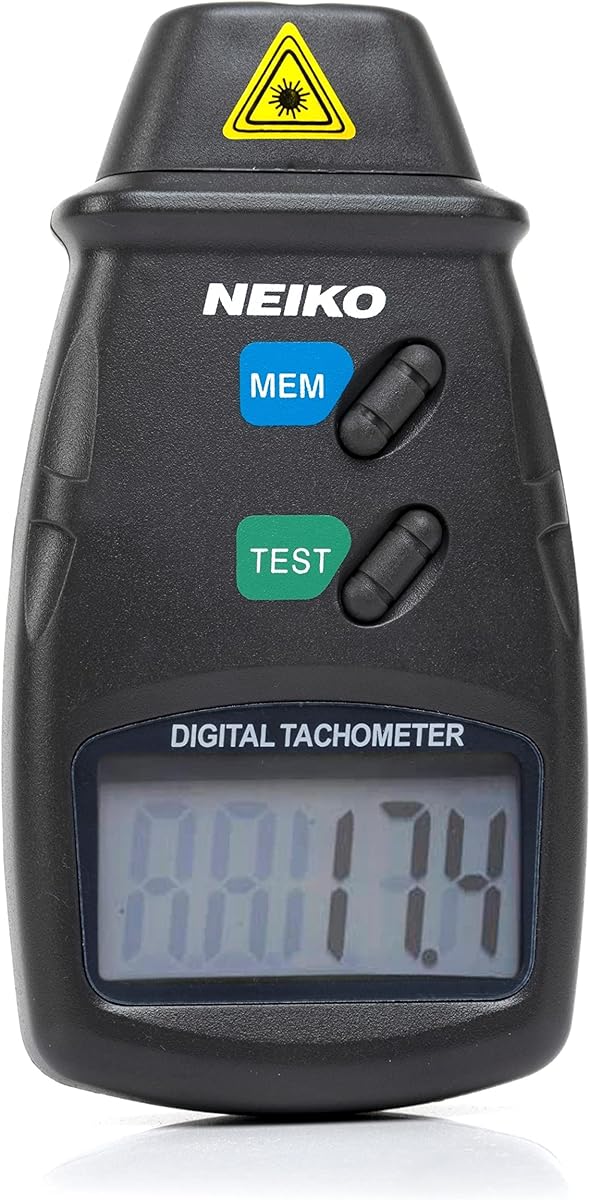
The NEIKO 20713A is an approachable digital tachometer for measuring the revolutions per minute of shafts, fans, engines, and other rotating parts. Its 4.2 rating reflects a straightforward laser photo instrument with a 2.5–99,999 RPM range and a stated accuracy of ±0.05%. The compact body makes it easy to carry into tight workspaces or move between several machines.
We may earn a commission when you buy through this link, at no additional cost to you.
The laser system provides instant readings from a distance of 2 to 20 inches, while a one-second sampling time provides a quick way to evaluate rotational speed. Readings appear on a large, easy-to-read LCD, and the unit retains the last, minimum, and maximum results. A nine-volt battery is included, so the meter can be put to work without purchasing a separate power supply.
Its most important trade-off is that the specification focuses on non-contact photo measurement. There is no described contact-wheel capability for belt speed or direct shaft testing, and reflective tape remains necessary for a reliable optical target. The compact construction also means users who need extensive data logging or multiple measurement modes should look to more specialized instruments.
The NEIKO is a practical choice for DIY users, automotive hobbyists, and technicians who need a straightforward laser tachometer at an accessible tier. It delivers the essential functions—wide range, strong stated accuracy, clear display, and reading recall—without adding a more complex physical design.
The 2-to-20-inch operating distance gives the user room to position the laser away from exposed moving components. This is useful for checking running equipment without placing a contact tool on the shaft.
Keeping the last, minimum, and maximum readings makes it easier to compare a live measurement with earlier observations. That convenience suits routine troubleshooting where rapid notes would otherwise be inconvenient.
We may earn a commission when you buy through this link, at no additional cost to you.
The Extech RPM33 is a combination contact and laser photo tachometer with a 2–99,999 RPM measurement range. Its 4.2 rating reflects a feature-rich instrument aimed at maintenance teams, automotive work, and industrial diagnostics. The ability to switch between non-contact laser measurement and mechanical contact testing gives it flexibility beyond a basic photo tachometer.
We may earn a commission when you buy through this link, at no additional cost to you.
The laser mode can capture readings from up to 1.6 feet away, allowing the operator to inspect motors, gears, and flywheels without approaching them closely. The contact configuration expands the tool's usefulness for belt and surface-speed checks. A backlit LCD supports readability, while the microprocessor-based design and quartz crystal oscillator support the listed 0.05% accuracy.
Data recording is one of its strongest professional features. The meter can store up to ten datasets containing current, maximum, minimum, and average values, which is more structured than a simple last-reading memory. A nine-volt battery, reflective tape, contact accessories, and a soft carrying case are included. Buyers must accept a larger, more versatile package than a pocket laser-only meter.
The RPM33 is ideal for maintenance professionals who want one instrument to cover several measurement styles. Choose it when surface speed, conventional contact RPM, non-contact RPM, and grouped data records all have practical value in your work; a simpler laser meter may be easier to carry for occasional checks.
The combination design is valuable when a job may involve both optical readings on exposed shafts and contact readings on accessible rotating parts. It can reduce the need to carry separate instruments for those tasks.
Each of the ten stored data sets can track current, maximum, minimum, and average readings. That makes the tool more useful for monitoring changes and comparing machine performance over a sequence of measurements.
We may earn a commission when you buy through this link, at no additional cost to you.
The Monarch PLT200 Pocket Laser Tachometer 200 stands apart through its calibration-focused positioning. It carries a 5.0 rating, the highest among the featured products, and ships with a new NIST-traceable calibration certificate containing data. The certificate is calibrated before shipment and is intended to provide assurance that the instrument meets its manufacturer's specifications.
We may earn a commission when you buy through this link, at no additional cost to you.
Its non-contact measurement system uses a Class 2 laser beam rated at less than 1 milliwatt and works at distances of up to 25 feet. That range is especially useful for inspecting large, elevated, or otherwise difficult-to-reach rotating equipment. The LCD presents test results and the unit of measurement, while on-target and low-battery indicators help clarify instrument status during a test.
The strongest feature is the traceability documentation rather than an extensive list of recording functions. The product also conforms to NIST standards for regulatory compliance, and its CE marking indicates compliance with applicable European Union directives. Buyers seeking multiple stored datasets or contact-wheel measurement may find other models more versatile, but those who prioritize documented calibration get a meaningful distinction here.
The PLT200 is best for quality-control environments, regulated maintenance programs, calibration labs, and professional users who need traceability for their measurement records. Its pocket format, long working distance, and calibration certificate make it a focused choice for applications where instrument documentation matters as much as the RPM display.
The included NIST-traceable calibration certificate with supporting data is the defining advantage. It supports users who must document instrument condition and show that measurements align with recognized quality-system expectations.
An operating distance of up to 25 feet lets an operator inspect larger equipment without approaching the moving assembly. The class of laser and displayed status indicators support a controlled, professional measurement routine.
We may earn a commission when you buy through this link, at no additional cost to you.
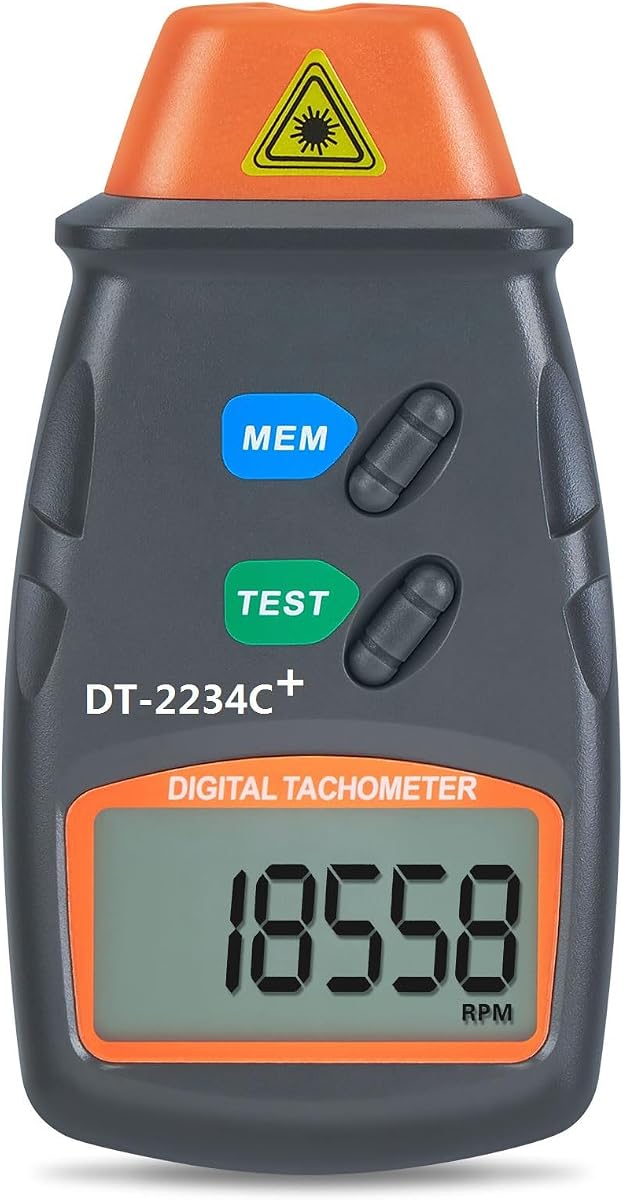
The KAIWEETS Digital Laser Tachometer delivers an unusually strong feature set for a budget-oriented instrument. Its 4.8 rating is the second-highest in this roundup, and the published specifications cover 10–99,999 RPM with ±0.05% precision. The handheld format, simple controls, and large backlit LCD make it approachable for mechanics, technicians, and do-it-yourself users.
We may earn a commission when you buy through this link, at no additional cost to you.
Photo laser technology handles non-contact measurement of motors, fans, pulleys, gears, wheels, blades, and other high-speed components. The display supports both RPM and count measurement, while auto shutoff and a low-battery indicator help simplify routine use. Its broad application coverage includes automotive maintenance, HVAC inspection, mechanical repair, and equipment diagnostics.
The primary trade-off is the lower bound of 10 RPM, which is less accommodating for very slow rotation than meters beginning at 2 or 2.5 RPM. The listed design is also laser-only, with no contact-wheel option. For work involving surface speed or direct mechanical contact, a combination tachometer would offer more flexibility.
This KAIWEETS model is an excellent choice for routine engine, motor, fan, and machinery checks when portability and ease of use matter most. Its strong rating, wide upper range, backlit display, and two measurement modes make it a particularly compelling budget pick for general users.
The combination of RPM and count modes supports different troubleshooting habits. Operators can check rotational speed or use the counting function when tracking accumulated revolutions is more useful than a live speed reading.
The large backlit LCD improves visibility in garages, workshops, and maintenance areas with uneven lighting. One-hand operation and uncomplicated buttons reduce the learning curve for occasional users.
We may earn a commission when you buy through this link, at no additional cost to you.
The KAIWEETS Non Contact RPM Tachometer is designed around clear readings and useful data functions. It has a 4.4 rating, a 40 mm five-digit LCD, and a stated photoelectric accuracy of ±(0.05%+1). The screen is backlit for dark workspaces, while data hold and maximum, minimum, and average functions make it easier to analyze a sequence of measurements.
We may earn a commission when you buy through this link, at no additional cost to you.
Automatic ranging removes the need to select measurement bands manually, simplifying operation in the field. The instrument measures from 10 to 99,999 RPM in photoelectric mode and handles one to 99,999 rotations in counting mode. An effective distance of up to 1000 mm provides more working flexibility than the shorter-distance meters in the roundup.
Portable construction is another strength. The unit weighs only 140 grams including batteries and uses three AAA batteries, with approximately 50 mA power consumption. The trade-off is that the lowest photoelectric speed is 10 RPM, and the accuracy expression includes an additional +1 term rather than presenting only a percentage. Users requiring measurements at exceptionally slow rotation rates should check compatibility before buying.
This model is well suited to automotive tuning, industrial machinery checks, and workshop diagnostics where average, minimum, and maximum values can help reveal operating variations. It is particularly attractive for users who want more analysis than a simple current-value display without moving to a larger professional data-recording instrument.
Data hold freezes the displayed value when needed, while maximum, minimum, and average readings summarize a test sequence. These functions can reveal speed variation that a single instantaneous reading might not communicate.
Auto-ranging reduces setup and makes the meter easier to use across different rotating components. Its low weight and three-AAA power source make it convenient to carry between a garage, workshop, and field service call.
We may earn a commission when you buy through this link, at no additional cost to you.
The AGPtek Professional Digital Laser Photo Tachometer is a compact non-contact meter with a 4.3 rating. It covers 2.5–99,999 RPM and offers resolution of 0.1 RPM or 1 RPM, giving it a useful low-speed starting point. The clear LCD and ergonomic, lightweight housing are designed for comfortable handling during repeated inspections.
We may earn a commission when you buy through this link, at no additional cost to you.
Its specified working distance is 50 to 500 millimeters, and reflective tape is required to produce a suitable optical target. The package includes a nine-volt battery, manual, three strips of high-adhesion reflective tape, and a blue storage bag. That accessory bundle makes it straightforward to organize and carry the meter in a toolbox.
The product description identifies electric motors, lathes, washing machines, paper-making equipment, and automotive parts as suitable applications, but specifically states that it is not supported for sawmills or lawn mowers. That limitation is important because surfaces or conditions associated with those uses may not present a reliable measurement target. Contact measurement is also not part of the listed feature set.
Choose the AGPtek when you need an inexpensive, portable laser tachometer for conventional motors and machinery with prepared reflective targets. It is less appropriate for specialized applications excluded by the manufacturer or for operators who require direct contact testing.
Three high-adhesion strips are included, allowing the user to prepare multiple rotating components. Keeping a spare target on hand also reduces the chance that a damaged or missing strip interrupts a measurement session.
The supplied storage bag protects the meter while organizing it with a battery, manual, and target strips. Its lightweight, one-hand design supports quick use in automotive, HVAC, and general workshop inspections.
We may earn a commission when you buy through this link, at no additional cost to you.
The KAIWEETS Laser Tachometer Digital RPM Meter focuses on high-speed monitoring, with a 10–99,999 RPM range and counting from one to 99,999 revolutions. Its 3.9 rating is the lowest in the group, but the published specifications remain useful for motors, tools, and rotating machinery. Photoelectric resolution is 0.1 RPM from 10 through 9,999.9 RPM and 1 RPM at 10,000 RPM and above.
We may earn a commission when you buy through this link, at no additional cost to you.
A large five-digit, 40 mm LCD presents current, maximum, and minimum readings. The microcontroller, photoelectric sensing, and anti-interference algorithms are intended to support consistent measurement in changing work environments. Reflective tape is included for preparing engine, motor, and fan targets, and the memory function allows the operator to review speed trends without writing every value down.
Power management is handled through a low-battery warning and automatic shutdown after approximately four minutes of inactivity. The supplied nine-volt 6F22 battery is included, and the complete weight is listed as 168 grams. The main trade-offs are the 10 RPM lower limit and the less favorable customer rating relative to the other models. Its laser-only design also excludes contact measurement.
This KAIWEETS model is best for monitoring medium-to-high-speed rotating equipment where resolution and maximum/minimum memory are the priorities. Buyers needing low-speed measurements, contact testing, or a particularly broad range of customer feedback should compare those requirements carefully before choosing it.
The stated 0.1 RPM resolution in the lower speed band supports finer monitoring of moderate rotational speeds. At 10,000 RPM and above, the resolution changes to 1 RPM, matching the scale of the measured value.
Automatic maximum and minimum storage helps reveal whether a motor or fan is fluctuating during a run. The display gives the operator immediate access to those remembered values after the measurement.
We may earn a commission when you buy through this link, at no additional cost to you.
The Digital 2-in-1 Tachometer combines contact and non-contact measurement in a handheld format. It has a 4.3 rating, a laser range of 3–99,999 RPM, and a contact range of 3–19,999 RPM. The listed ±0.05% accuracy and 50-to-500-millimeter laser range make it a flexible option for automotive work, industrial machinery, HVAC systems, and general engine diagnostics.
We may earn a commission when you buy through this link, at no additional cost to you.
The backlit screen supports visibility under varied lighting, while data hold and maximum/minimum functions allow a reading to be preserved or a measurement sequence to be summarized. For speeds above 60 RPM, the sampling time is listed at 0.8 seconds, providing relatively prompt updates during changing operating conditions.
The dual design broadens the tool's utility, but contact testing is limited to 19,999 RPM, so the laser mode covers substantially higher rotational speeds. The product is also listed generically rather than under a clearly differentiated manufacturer brand, which may make it less appealing to buyers who prioritize established naming or documented calibration. The supplied information does not mention a carrying case or advanced dataset storage.
This 2-in-1 tachometer is a good middle ground for users who need both laser and contact options without moving immediately to a more specialized professional model. It is particularly suitable for engine troubleshooting and machinery work where quick readings, held values, and maximum/minimum results are the main requirements.
Contact mode supports accessible shafts and other direct-contact measurements, while laser mode handles exposed rotating parts from a short distance. This flexibility makes the meter useful across a broader mix of workshop tasks.
A 0.8-second sampling period above 60 RPM supports quick observation as a machine starts, changes speed, or settles into operation. Data hold and maximum/minimum functions preserve useful points from that sequence.
We may earn a commission when you buy through this link, at no additional cost to you.
The Triplett TA200 is a contact and non-contact laser photo tachometer with a 3.9 rating. Its most clearly documented feature is the five-digit backlit LCD, which provides a sizable, illuminated display for workshop and maintenance environments. Supporting both contact and non-contact measurement gives it the fundamental versatility of a combination tachometer.
We may earn a commission when you buy through this link, at no additional cost to you.
The dual modes can accommodate different access conditions. Contact measurement is useful when a shaft or wheel can be reached safely, while laser photo measurement supports non-contact inspection of rotating components. This flexibility can reduce the need for separate tools when a technician routinely handles several types of equipment.
The available product information is limited compared with the other entries. It does not provide a specific RPM range, accuracy figure, measuring distance, memory functions, power requirements, or accessory list. Those omissions make it harder to compare the TA200 numerically with models such as the Extech RPM33 or Digital 2-in-1 Tachometer. Buyers should therefore review the current product page for complete operating specifications.
The TA200 is most appropriate for a technician who prioritizes a recognizable meter brand, dual-mode operation, and a readable backlit display. Confirm the detailed range, accessories, and application suitability before purchasing, especially if accuracy documentation or formal calibration traceability is essential.
Supporting two measurement methods makes the TA200 adaptable to both accessible and enclosed rotating parts. That combination is its main functional distinction within this roundup.
The five-digit backlit LCD presents the measurement prominently and improves visibility where ambient light is limited. The display format should appeal to users who regularly read RPM values in garages or industrial workspaces.
We may earn a commission when you buy through this link, at no additional cost to you.
Choosing a laser tachometer means balancing RPM range, accuracy, measurement method, operating distance, display features, and the type of equipment you routinely inspect. The most useful model is not necessarily the one with the longest specification list; it is the one that matches your actual diagnostic tasks.
Start by comparing the full operating range against the speeds your equipment can produce. A meter beginning at 2 or 2.5 RPM is better suited to slow rotating parts, while the 10 RPM starting point found on several KAIWEETS models is intended for faster rotation. At the upper end, several units reach 99,999 RPM, giving broad coverage for fans, motors, engines, and high-speed machinery. The range alone does not determine suitability, but it establishes whether the tool can capture the speed you need without leaving the operating band.
Accuracy describes how closely the instrument should track a known RPM value, while resolution indicates the size of the smallest displayed change. Several featured models state ±0.05% accuracy, and the Extech 461920 Mini offers 0.1 RPM resolution. The KAIWEETS Non Contact model uses an accuracy expression of ±(0.05%+1), so its specification includes an additional digit-based term. Compare like-for-like specifications and consider whether the application demands a percentage-only tolerance, a particular resolution, or documented calibration.
Laser photo tachometers measure without touching the component, which improves safety around exposed moving parts and reduces the need to stop equipment. Contact tachometers add a different value by measuring shaft rotation directly and supporting tasks such as belt-speed work. Combination instruments such as the Extech RPM33 and Triplett TA200 provide both approaches. Choose according to access, safety requirements, and the types of tests you perform rather than assuming one method is universally superior.
A useful working distance gives you room to position the instrument safely and frame a stable target. Published distances range from close-range operation on the NEIKO and AGPtek to up to 25 feet for the Monarch PLT200. Many laser photo meters require reflective tape on the rotating part, so consider whether you can prepare the surface without stopping the machine. The KAIWEETS models and several other products include target material, making setup more convenient from the outset.
A large, backlit LCD is valuable in garages, workshops, and industrial areas, and all or nearly all featured instruments emphasize readable digital output. Data functions add another layer of analysis. The NEIKO and Extech 461920 retain last, minimum, and maximum readings. The KAIWEETS Non Contact adds average and hold functions, while the Extech RPM33 stores up to ten datasets with current, maximum, minimum, and average values. More data can be helpful, but only if you have a practical reason to record and compare results.
Consider battery type, included power source, operating weight, and whether the meter needs to travel between jobs. Several products use one nine-volt battery, while the KAIWEETS Non Contact uses three AAA batteries and weighs 140 grams including them. The Monarch PLT200 also emphasizes pocket portability, while combination tools with contact accessories naturally occupy more space. A compact meter is convenient for occasional work, whereas a larger kit may be more appropriate for a technician who carries one complete instrument between multiple assignments.
Routine diagnostics and regulated quality systems may require different levels of evidence. The Monarch PLT200 includes a NIST-traceable calibration certificate with data and is calibrated before shipment. It also conforms to NIST standards for compliance and carries a CE mark for applicable European Union directives. Other tachometers may advertise strong accuracy specifications without providing the same documented traceability. If your results will be audited or used to validate equipment performance, a calibration certificate can be more important than extra display functions.
A complete kit can make a meter much easier to deploy. Reflective tape, batteries, manuals, storage cases, and contact adapters appear across the featured listings. The AGPtek includes three reflective strips and a storage bag, while the Extech RPM33 includes contact accessories and a soft case. Some products also list application restrictions. The AGPtek specifically states that it is not supported for sawmills or lawn mowers, so verify whether a particular machine or environment falls within the manufacturer's recommendations.
Before taking a measurement, read the manual, install the specified battery, and inspect the reflective target and meter for damage. Prepare a clearly visible strip on the rotating component unless your instrument uses a different targeting arrangement. Position the laser at a suitable distance, keep the beam away from eyes, and make sure the target is moving smoothly enough to produce a consistent signal.
Aim the meter at the prepared target and wait for a stable reading. For a single-value check, record the RPM shown on the display. If the model includes hold, minimum, maximum, average, or dataset memory, use those functions when they suit the test, but avoid assuming that a remembered value represents every instantaneous speed fluctuation. For contact measurements, attach the correct wheel or adapter and ensure the tool is seated securely before operating the equipment.
After use, switch off the meter, remove the battery if the manufacturer recommends long-term storage, and protect the instrument from moisture, excessive heat, impact, and dust. Clean the reflective tape and meter window with a soft, dry cloth, avoid abrasive cleaners, and keep accessories together in the supplied case or bag. Replace the battery when the low-battery indicator appears and arrange calibration or verification according to your organization's quality requirements.
A laser tachometer measures rotational speed in revolutions per minute without contacting the rotating component. It is commonly used on motors, fans, engines, gears, pulleys, shafts, and other moving equipment. Most models require reflective tape on the target so the photo sensor can detect rotation reliably. It is especially useful when direct contact would be inconvenient or potentially unsafe.
Several featured tachometers state an accuracy of ±0.05%, which is well suited to many diagnostic and adjustment tasks. Suitability still depends on correct target placement, stable readings, and the measurement needs of the vehicle or engine. For regulated quality control, look for documented calibration and traceability rather than relying only on a displayed specification.
Reflective tape is included with several models in this roundup, and others rely on it for a clear optical target. The tape provides a consistent surface for the photoelectric sensor to detect each revolution. Without a suitable target, readings may be inconsistent or unavailable. If you cannot apply tape safely to the component, check the manufacturer's instructions for an alternative target surface.
A non-contact tachometer uses a laser or photo sensor to detect rotation from a distance. A contact tachometer physically touches a shaft or uses a wheel to measure speed directly. Non-contact operation is convenient for exposed equipment and reduces proximity to moving parts, while contact measurement can be useful for accessible shafts, belts, and surface-speed work. Combination models provide both approaches.
That depends on the model's minimum RPM. The Extech 461920 begins at 2 RPM, the NEIKO and AGPtek at 2.5 RPM, and the Digital 2-in-1 at 3 RPM. Several KAIWEETS models begin at 10 RPM. If your shaft can rotate below the selected instrument's limit, choose a model with a lower minimum range to avoid inconsistent readings.
A backlit display, hold function, and maximum, minimum, or average readings make it easier to observe changes during a machine run. The Extech RPM33 goes further by storing up to ten datasets, each including current, maximum, minimum, and average values. Choose advanced recording features when you need to compare results over time rather than simply check a single operating speed.
Routine personal or general workshop checks may not require a formal calibration certificate. It becomes more relevant when measurements must satisfy a quality system, regulatory process, customer specification, or internal traceability standard. In that setting, the Monarch PLT200 stands out because it is supplied with a NIST-traceable calibration certificate containing data.
Attach a suitable reflective target to the rotating component, aim the sensor at that target, and hold the instrument within its specified measurement distance. Keep the target unobstructed and the meter stable until the display settles. Maintain safe separation from moving machinery and never direct the beam toward a person's eyes. Record only readings obtained with a consistent, reliable target and position.
The Extech 461920 Mini is the most balanced overall pick for its compact size, 2–99,999 RPM range, 0.1 RPM resolution, backlit five-digit display, and stored readings. The NEIKO 20713A and AGPtek Professional Digital provide accessible alternatives for non-contact work, while the KAIWEETS Digital Laser combines a high rating with a broad upper range and straightforward RPM and count modes.
Your priorities should determine the alternative. Choose the Monarch PLT200 when calibration traceability and a 25-foot working distance are critical. Select the Extech RPM33 or another combination model when both contact and non-contact measurements are routine needs. For structured troubleshooting, favor hold, average, or multi-dataset memory; for slow shafts, check the minimum RPM before ordering.
Finally, verify the current listing, accessories, power requirements, application limits, and availability before purchasing, because product details can change and prices fluctuate. A laser tachometer is most useful when its measurement range, operating method, documentation, and features align with the equipment you actually diagnose.
