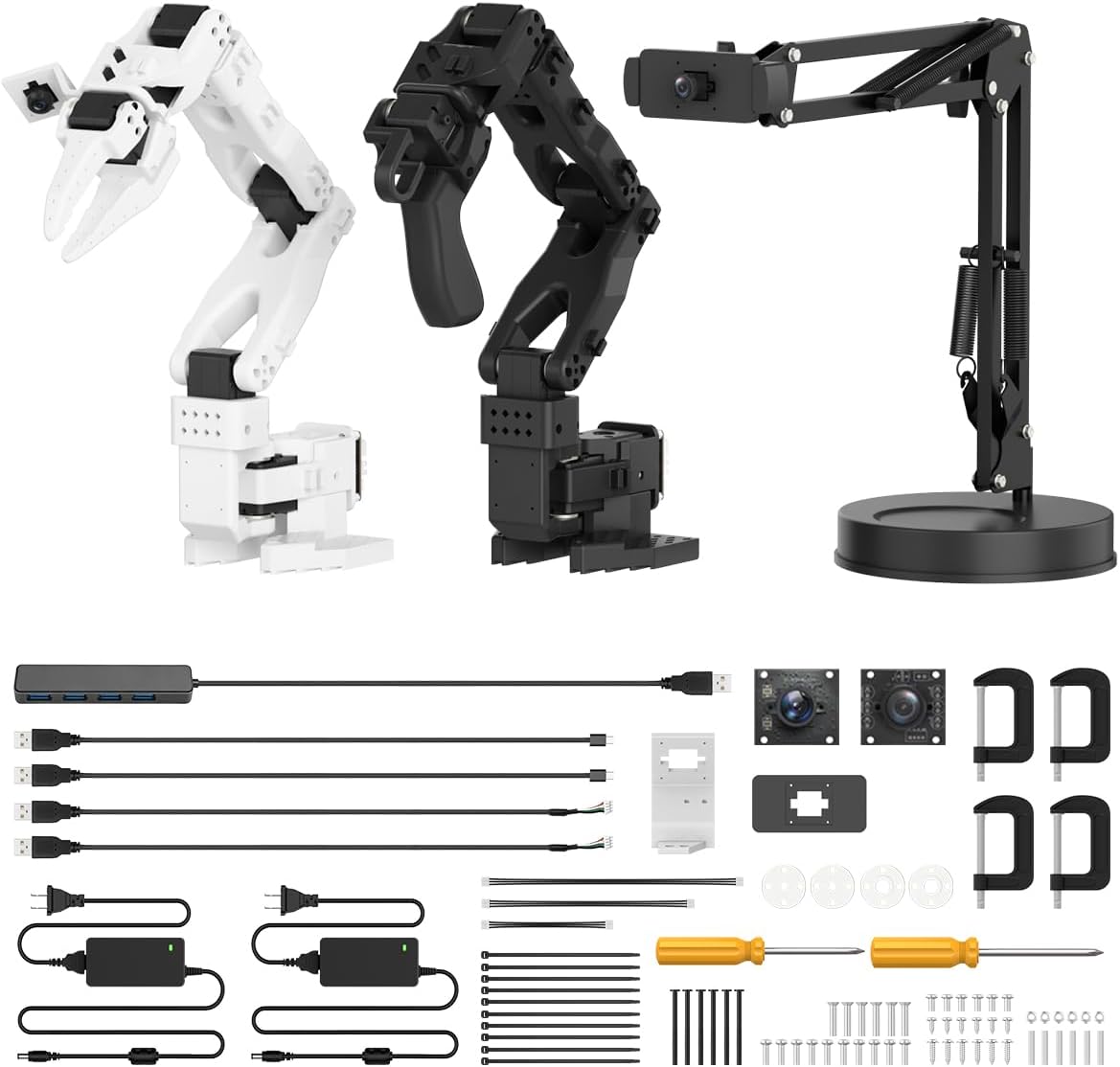
Hiwonder SO-ARM101 Robot Arm
4.3Editor score
Twelve magnetic-feedback servos
Dual-camera vision system
Open-source LeRobot compatibility
Discover the best Servo Motors for Robotics, comparing torque, speed, control electronics, durability, application fit, and value across ten leading options.
Servo motors for robotics range from lightweight micro servos for small mechanisms to high-torque digital units and complete robotic arm systems. A useful motor must match the joint’s load, required speed, control electronics, power supply, and mounting arrangement rather than simply offer the highest torque specification.
This guide compares ten options using their listed torque, speed, operating voltage, gear construction, feedback method, control interface, dimensions, rotation range, and intended applications. It covers individual servos, testing equipment, multipacks, and assembled arms so builders can compare both components and complete robotic platforms.
Each selection shows why a product suits particular projects, from compact Arduino mechanisms to rugged RC-inspired robot joints. Ratings reflect the supplied customer feedback, while technical claims are based on listed specifications. As with all electronics, availability, seller details, and prices can change, so confirm current information before purchasing.
4.3Editor score

4.8Editor score

4.2Editor score
The table below places individual micro servos, heavy-duty digital units, a robot arm platform, and a testing kit on a common set of practical dimensions. The goal is not to identify one universal motor, but to show which option aligns with each project’s torque demands, control system, scale, and available space.




The RDS3225 Dual Shaft 25KG Digital RC Servo earns the strongest overall position in this guide because it balances meaningful load capacity, rapid movement, durable construction, and installation flexibility. Its 4.8 customer rating is also the highest among the individual heavy-duty servos listed. The pack includes two motors, long and short U brackets, round metal disks, and screw sets.
We may earn a commission when you buy through this link, at no additional cost to you.
Its listed stall torque reaches 24 kg.cm at 5V and 28 kg.cm at 6.8V, while speed is stated at 0.19 seconds per 60 degrees at 5V and 0.17 seconds at 6.8V. Copper and aluminum gears, a high-precision potentiometer, a CNC aluminum center shell, waterproof seals, and heat-dissipation features suit articulated mechanisms that must remain stable under changing loads.
The dual-shaft arrangement is particularly useful when a joint needs stronger support than a standard single-shaft servo can provide. A 3-microsecond dead band and 500-to-2500-microsecond PWM control range support responsive positioning, although the exact behavior will depend on the controller, signal quality, power supply, and mechanical setup. This is not a lightweight motor for tiny pan-tilt mechanisms.
Choose this pair for robotic arms, crawler-scale platforms, buggies, or other joints that need more torque and structural support than an SG90 offers. It is a particularly sensible choice for builders who want rugged RC-style hardware in a reusable high-torque format. Users should still verify linkage loads, bearing alignment, and voltage limits before committing the servos to a load.
The 24-to-28 kg.cm torque range gives this servo substantially more headroom than compact plastic-geared units. That margin is useful when a robotic arm must hold position, react to gravity, or move a linkage without the motor appearing to stall.
Dual output shafts and multiple bracket formats make it easier to support a joint on both sides of a housing. The included disks, screws, and U-brackets also reduce the need to source a complete matching mounting set separately.
We may earn a commission when you buy through this link, at no additional cost to you.
This 25KG Robot Servo Motor is a strong option for high-load robotic arms and humanoid joints. It carries a 4.5 rating and is specified to reach a maximum torque of 34.5 kg.cm, with a listed speed of 0.17 seconds per 60 degrees at 6.8V. The package is positioned for robotic arms, industrial applications, bipedal robots, and other demanding mechanisms.
We may earn a commission when you buy through this link, at no additional cost to you.
Full metal gearing is the defining feature. The listed steel gears are intended to withstand higher loads than plastic pinions, while a high-resolution digital chip and high-precision potentiometer support stable, repeatable control. The CNC aluminum center shell and low-noise, fast heat-dissipation design are also relevant when the servo operates continuously near its performance envelope.
One unusual capability is the listed 270-degree control range. Servo travel can also rotate through 360 degrees while powered off, which can help with mechanical installation or manual positioning. That feature should not be confused with continuous free rotation under PWM control: the product is still a positioning servo rather than a continuous-rotation drive motor.
This servo is best for builders who need high output and broad positioning adjustment without moving to a complete robotic-arm platform. Its substantial size and power draw make it less appropriate for miniature robots. Confirm that the joint, brackets, controller, and power supply can handle the load before installation.
Steel gears help this unit address the tooth wear and deformation associated with sustained high-load service. They remain a sensible reason to choose a full-metal servo for robotic arms, but bearing alignment and cooling remain just as important as the gears themselves.
The 270-degree control range offers additional adjustment for linkages that cannot use a conventional 180-degree sweep. Check the controller’s pulse settings carefully and test the mechanism before attaching a load that could move beyond its intended travel.
We may earn a commission when you buy through this link, at no additional cost to you.
The four-pack of SG90 9G micro digital servos is an approachable starting point for Arduino, Raspberry Pi, RC car, boat, toy, and small robotic experiments. It has a 4.2 rating, the lowest among the three SG90 multipacks in this comparison, and its compact plastic construction keeps installation simple for learning projects.
We may earn a commission when you buy through this link, at no additional cost to you.
Each servo is listed at 1.6 kg.cm torque and a response speed of 0.3 seconds per 60 degrees. A 4.2-to-6V operating range gives builders flexibility with common hobby power sources. The four-unit quantity is useful for a pan-tilt platform, gripper, steering mechanism, or small multi-joint robot that requires a consistent set of matching motors.
The primary limitation is mechanical capacity. These servos are best suited to lightweight paddles, small steering horns, and modest linkages rather than large robot arms or joints holding significant weight. Their plastic gear construction also makes them less appropriate for continuous high-load work or applications exposed to substantial impact.
Choose this pack when you want four inexpensive general-purpose servos and can keep the load well below the motor’s limits. It is a sensible introductory choice for robotics students, prototype vehicles, and educational mechanisms. A separate tester can help verify direction and travel before the servos are installed in a larger assembly.
Four matching servos let a builder prototype several axes without mixing unknown motor characteristics. That consistency makes it easier to create symmetrical pan-tilt mechanisms, steering controls, and compact robotic arms where the mechanical loads remain modest.
The 1.6 kg.cm rating is adequate for light mechanisms but can be reached quickly by stiff linkages. Adding long arms, heavy end effectors, or unnecessary friction can cause stalling, so keep linkages balanced and use a more powerful servo when loads increase.
We may earn a commission when you buy through this link, at no additional cost to you.
Hosyond’s ten-pack provides enough compact SG90 servos for larger robot arms, multi-axle platforms, or a classroom supply. Its 4.5 rating is strong, and the listed no-load operating speeds of 0.12 seconds per 60 degrees at 4.8V and 0.1 seconds at 6V are quicker than the figures given for the four-pack SG90 selection.
We may earn a commission when you buy through this link, at no additional cost to you.
The motors operate from 4.8 to 6.0V, use analog control, and are compatible with JR and Futaba interfaces. Their stated stall torque is 1 kg.cm, while the listed dead zone is 7 microseconds. The physical package is designed for micro robots, small robot arms, helicopters, aircraft, boats, and Arduino projects where low weight matters.
Because this is an analog servo, it requires a continuous PWM signal to maintain its commanded position. The description also recommends a power source capable of supplying more than 1A of starting current. Applying several servos to a weak supply can produce resets, inconsistent movement, or failed starts even when each individual motor is within specification.
This multipack is a good match for builders assembling several small joints or keeping spares on hand. It may be less appropriate for a loaded robotic arm because its listed torque is modest compared with the metal-gear high-torque models. Use a proper controller, a regulated supply, and common-ground wiring for dependable results.
Ten matching units make it practical to build a six-axis arm, a pan-tilt-tilt assembly, or several independent robots. The extra units also make it easier to replace a failed servo without mixing performance characteristics across the project.
The stated starting-current requirement is more important than the 4.8V operating label. A supply that collapses when several motors move together can create false impressions of servo failure, so size the power source and distribution wiring for the full load.
We may earn a commission when you buy through this link, at no additional cost to you.
The Hiwonder SO-ARM101 is a premium robotic platform rather than a single replacement servo. It arrives as an assembled six-axis arm with twelve high-torque bus servos, including magnetic feedback for smooth, stable motion. Its 4.3 rating reflects a system designed for advanced experimentation, and the integrated architecture makes it more approachable than designing an equivalent arm from scratch.
We may earn a commission when you buy through this link, at no additional cost to you.
Vision is a central feature. A camera mounted on the gripper supports close manipulation, while an external camera adds environmental awareness. The arm is compatible with the LeRobot open-source framework, giving developers access to shared code, templates, and pre-trained models for imitation-learning research rather than limiting the platform to manual demonstrations.
The included Hiwonder BusLinker V3.0 board supports servo scanning, real-time status monitoring, and trajectory control. PC software assists with calibration and debugging, while magnetic feedback helps address the jitter and motion instability that can arise from insufficient power or imprecise position sensing. The package includes a 3D-printed component and the assembled arm.
Choose this system when you want to experiment with embodied AI, imitation learning, robotic manipulation, and vision-assisted control without fabricating the arm, designing a bus servo network, and assembling every bracket. It is less suitable for someone who only needs one small PWM servo. Software, wiring, calibration, and a suitable computer remain central to getting the full platform working.
Magnetic feedback gives the bus servos a direct position-sensing method that can improve stability and reduce visible jitter. This is especially valuable when a multi-axis arm must execute repeated trajectories while carrying a small payload.
LeRobot compatibility and access to shared code and models make the platform valuable for AI experimentation. A builder can concentrate on dataset collection, policy behavior, and manipulation tasks instead of spending the entire project on mechanical fabrication and low-level motor commissioning.
We may earn a commission when you buy through this link, at no additional cost to you.
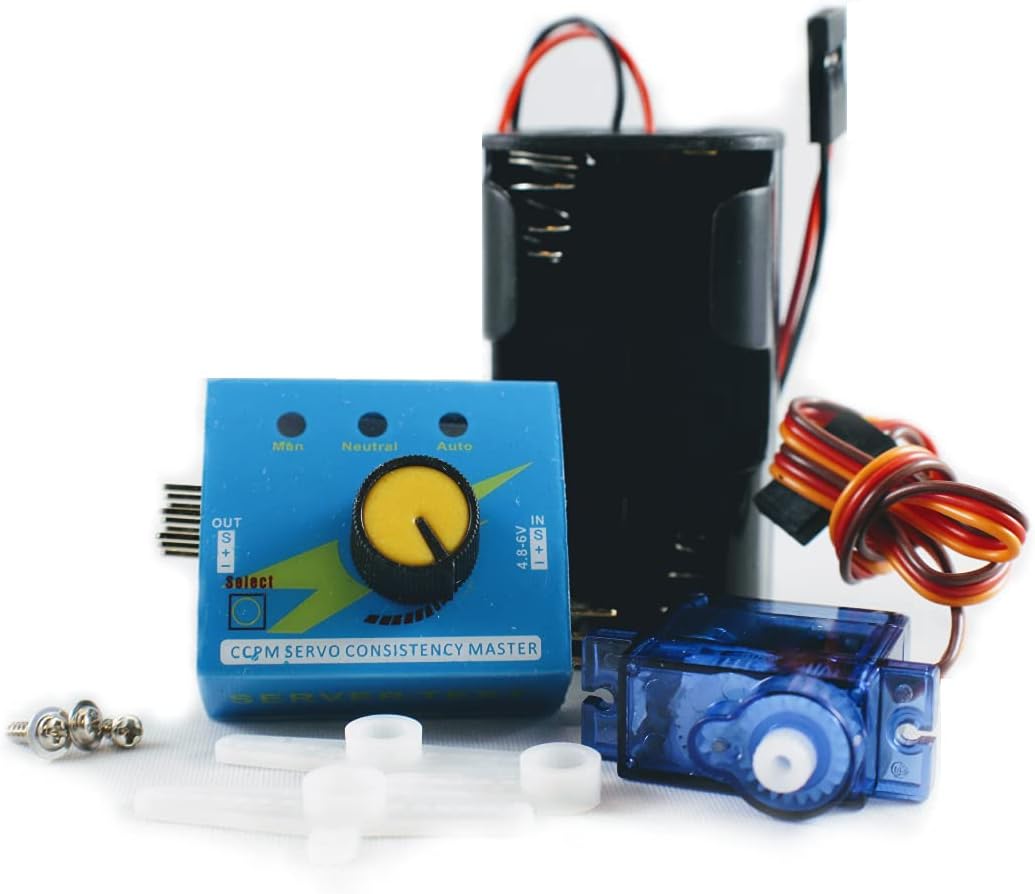
This Servo Motor Tester Kit is a practical companion for anyone building a robotics project from separate components. It combines a 180-degree 9G servo, an RC servo tester, a six-volt battery holder, and three servo horn styles. Its 4.4 rating reflects a straightforward setup package suited to hobby robotics and RC work.
We may earn a commission when you buy through this link, at no additional cost to you.
The tester offers manual/dial control, neutral positioning, and an automatic sweeping mode, with a stated range of approximately 45 to 135 degrees. That makes it useful for checking that a servo responds, finding its neutral point, and observing whether movement is smooth. The included 9G motor can also serve as a basic test subject for a new builder.
The tester is not a substitute for measuring stall torque, current draw, PWM accuracy, or signal integrity under load. Its range is also narrower than the full travel of many modern servos, and it cannot diagnose communication issues on a multi-servo bus. Even so, it catches many basic problems before they become embedded in a larger robot.
This kit is especially useful for first-time builders, students, and anyone working with servos from different suppliers. Test each motor before installation, center the horn where the mechanism needs it, and verify that the motion direction is correct. That short process can prevent a robot from driving a joint into a hard stop or reversing the intended movement.
A quick tester pass can reveal a dead motor, incorrect wiring, poor movement, or a horn that is unsuitable for the linkage. Detecting those issues before a servo is buried inside a chassis or arm is much simpler.
The neutral function helps establish a repeatable midpoint for a horn. Centering before fitting a linkage makes it easier to design symmetric travel and reduces unnecessary strain on the output spline.
We may earn a commission when you buy through this link, at no additional cost to you.
The Smraza SG90 9G ten-pack combines compact size with a faster listed speed and stronger torque than most of the other SG90 bundles. It has a 4.4 rating and is intended for micro robots, small arms, compact RC mechanisms, fixed-wing aircraft, gliders, and small boats.
We may earn a commission when you buy through this link, at no additional cost to you.
Each motor is listed at 1.9 kg.cm stall torque and 0.08 seconds per 60 degrees, with a five-microsecond dead band. The motor pinion and shaft are upgraded to metal, a design intended to resist the tooth breakage and heat deformation associated with plastic-gear micro servos. The stated operating range is 4.8 to 6.0V across a full 180 degrees.
The three-pin PWM connection is compatible with JR and Futaba receivers, while included servo arms and 24.5mm leads support tidy installation in compact projects. As with other analog SG90 servos, a continuous PWM signal is required, and the power supply must deliver more than 1A of starting current. Fast speed is useful, but it can also make a poorly balanced linkage move abruptly.
This ten-pack suits builders who need several small but responsive joints without moving into the size and cost of a high-torque digital servo. It is a good middle ground for compact robot arms and educational robots. Match the speed to the mechanism carefully, add suitable motion limits where possible, and avoid using it where a heavy load would exceed its mechanical rating.
The 0.08-second 60-degree figure gives this pack a responsiveness advantage over slower SG90 alternatives. That can be valuable in small mechanisms that need quick corrections without the inertia of a much larger servo.
Upgrading the small pinion addresses a common failure area in micro servos. It does not turn the SG90 into a heavy-duty motor, so the load should still remain well within the listed torque and thermal limits.
We may earn a commission when you buy through this link, at no additional cost to you.
The 45KG Waterproof Servo two-pack is the strongest option here for extreme torque and demanding environments. Its 4.9 rating is the highest among all ten products. The listed stall torque reaches 51 kg.cm at 8.4V, and the speed is 0.11 seconds per 60 degrees at the same voltage.
We may earn a commission when you buy through this link, at no additional cost to you.
The construction is designed for rugged use. High-precision stainless steel and aluminum gears have hard anodized finishes, while the IP67-rated enclosure and CNC aluminum center shell support operation in wet conditions and heat dissipation. A coreless motor, high-resolution digital chip, and high-precision potentiometer are specified for smoother, quieter, and more accurate positioning.
Its standard 40-by-20-by-38.5mm body is smaller than many high-torque RC servos, which can help where space is constrained. Nevertheless, the power requirements are substantial, and its 180-degree positioning range is ordinary compared with the 270-degree model elsewhere in this guide. The adjustable 25-tooth metal horn and mounting accessories are included.
Choose this pair for high-torque robotic arms, animatronics, Arduino projects, off-road RC platforms, boats, and large-scale aircraft where water resistance and load capacity matter. It is excessive for small pan-tilt mechanisms, and the 8.4V operating point requires a supply and control setup that can handle the load safely. Use a power system designed for multiple high-current servos.
The IP67 enclosure makes the servo a more credible choice for outdoor robots, marine projects, and environments where dust or moisture may reach the mechanism. Sealing helps preserve reliability, although cables and connectors still need appropriate protection.
The 51 kg.cm torque and 0.11-second speed create a compelling performance envelope, but rapid repeated movement can generate significant heat. Mechanical load reduction, airflow, and an adequate power supply help the servo operate within its design limits.
We may earn a commission when you buy through this link, at no additional cost to you.
Hanaive’s sixteen-pack is built for projects that need a large inventory of small servos, such as classroom robots, teaching exercises, or a multi-axis platform. It has a 4.5 rating and includes multi-arms and fixing screws with each motor, creating a convenient supply for repeated builds.
We may earn a commission when you buy through this link, at no additional cost to you.
The motors measure 3.2 by 3.09 by 1.24 centimeters, making them compact and lightweight. Listed stall torque is 1.6 kg.cm at 4.8V, the operating voltage is 4.8V, and the dead band is five microseconds. No-load speed is listed at 0.1 seconds per 60 degrees at 4.8V and 0.08 seconds at 6V, with a maximum running angle of 180 degrees.
The wiring follows a common three-wire arrangement: red for power, brown for ground, and yellow for signal. The listed JR and Futaba interface compatibility makes these convenient for common hobby receivers and microcontroller-driven mechanisms. The product is suitable for helicopters, micro robots, small arms, boats, and RC toys, though reduced pulling force limits its use in larger aircraft.
This pack is an excellent choice when quantity, compactness, and interchangeable parts matter more than heavy-load performance. It is less suitable for a full-size arm carrying a substantial end effector or for a powered model requiring strong steering torque. The stated operating voltage and 1.6 kg.cm output should guide the load, and a regulated supply must handle simultaneous starts.
Sixteen units make the pack practical for multiple teams or for building a robot with many repeated axes. Matching hardware also simplifies replacement and keeps response characteristics consistent across the fleet.
The listed dimensions and pulling force suit micro mechanisms rather than large steering systems. A long horn or heavy payload can quickly turn a responsive SG90 into a stalled or overheated servo, so keep lever arms short and payloads light.
We may earn a commission when you buy through this link, at no additional cost to you.
The 6DOF Robot Mechanical Arm Kit is a complete educational platform with six MG996 metal-gear servos, a claw, structural brackets, fasteners, bearing components, extension cords, and a flange rod. Its 2.8 rating is the lowest in the guide, so buyers should not treat the kit as a no-compromise industrial-grade arm despite the terminology used in its description.
We may earn a commission when you buy through this link, at no additional cost to you.
The six axes permit forward and backward, up and down, left and right, and gripping motions, making the platform useful for demonstrations, creator education, and introductory programming. Imported cup bearings are used at the steering joints to support smoother movement, and the brackets are made from 2mm aluminum plate for a more rigid structure than thin sheet-metal frames.
The included MG996 servos are analog and provide 180-degree movement. While their metal gearing is more durable than plastic micro servos, the system is still vulnerable to the common issues associated with hobby-scale PWM servos: limited feedback resolution, power-supply sensitivity, and reduced performance when several axes stall simultaneously. The mechanical design also places demands on balance and joint alignment.
Choose this kit for teaching, demonstrations, or a first assembled robot-arm project where six-axis capability matters more than advanced feedback. It can be a useful platform for experimenting with inverse kinematics, trajectory control, and gripper logic. Before heavy use, balance the arm, reinforce the power distribution, verify each axis independently, and avoid loads beyond what the MG996 servos and plastic components can sustain.
The assembled structure provides a functional foundation for studying coordinated movement. Instead of designing six joints, brackets, and a chassis from scratch, students can focus on control logic and kinematics.
The kit uses analog MG996 units, so positioning and repeatability are not equivalent to a premium bus-servo platform with magnetic feedback. Keeping the payload modest and the arm balanced is essential to prevent sustained stalls and excessive strain on the structure.
We may earn a commission when you buy through this link, at no additional cost to you.
The right robotic servo depends on more than torque. Match the motor’s size, gear material, feedback method, signal protocol, voltage, current draw, travel, and mounting options to the joint and the controller that will drive it.
For small paddles and light linkages, the SG90 products may be sufficient. High-torque digital servos suit articulated arms, crawler mechanisms, grippers, and powered steering. Shorten output arms, balance mechanisms, and reduce friction wherever possible because lower mechanical demand improves control and extends component life.
The listed products range from 0.08 seconds per 60 degrees to 0.3 seconds for compact SG90 models, while heavy-duty digital units sit around 0.11 to 0.19 seconds. Compare those figures under the same conditions and prioritize a response that the mechanical system and controller can manage smoothly.
Do not equate a metal gear label with unlimited strength. Shaft alignment, horn design, bearing support, shock loading, and cooling all affect service life. Use the product’s torque and environmental ratings as operating boundaries rather than targets.
Choose PWM when simplicity and broad platform compatibility matter. Choose a bus-servo ecosystem when you need higher update rates, direct feedback, coordinated motion, or access to calibration and trajectory tools. Verify signal voltage, pinout, protocol, and software support before buying a different motor type.
Current capacity deserves equal attention. Several servos starting or stalling at once can pull more current than a weak source can provide, causing resets and erratic behavior. Use a regulated supply with appropriate headroom, common grounding, and wiring rated for the aggregate load rather than powering every motor directly from a controller pin.
Measure the available cavity, shaft clearance, horn radius, and bracket width before ordering. Also account for cable bend radius and the space needed to remove or service the motor. The listed 40mm body of the 45KG model is especially useful to compare against larger traditional high-torque housings.
The listed 500-to-2500-microsecond range on the RDS3225 pair supports its stated maximum 180-degree travel. A tester can be useful for confirming initial behavior, although it should not be used to exceed the manufacturer’s control limits or to force a servo against a mechanical stop.
Beginners can use the tester kit to understand PWM movement before building. Classroom groups may benefit from multipacks, while researchers focused on embodied AI can evaluate the Hiwonder platform. Advanced builders often prefer individual motors because their arm geometry, payload, and control requirements are already defined.
Begin by identifying each motor’s rated voltage, signal interface, torque, and mounting pattern. Wire the signal lead to the appropriate controller output, connect the ground lead to the controller ground, and power the servo from a regulated supply within its voltage range. Do not attempt to power a high-current servo through a microcontroller pin. Check the wiring diagram for your exact model before energizing it.
Test the motor without a load using a compatible tester or a small controller program. Confirm that it moves in the expected direction, that it reaches the intended angle, and that it does not buzz continuously or stall. Fit the appropriate horn, use the tester’s neutral function where useful, and tighten brackets evenly so the output spline is not forced sideways.
Attach the mechanism gradually, watching for binding, excessive current, irregular noise, or a sudden loss of position. Keep linkages balanced and avoid exceeding the listed stall torque. During operation, provide ventilation, protect connectors from moisture, and disconnect the power before changing horns or linkages. If a servo becomes unusually hot, noisy, or unresponsive, remove the load and inspect the mechanism and power supply.
A robotic arm usually benefits from a digital servo with metal gears, a torque rating comfortably above the calculated joint load, and a mounting design that supports the output shaft. Compact SG90 models are suitable for lightweight teaching arms, while higher-capacity digital or bus servos are better for gravity-loaded joints. The correct choice also depends on the controller, supply, arm weight, and required repeatability.
Metal gears are generally more resistant to wear, impact, and heat deformation than plastic gears, making them useful in higher-load mechanisms. They do not eliminate the need for careful alignment or load management. A small metal-pinion SG90 may still be too weak for a large arm, while a well-designed high-torque servo can be unnecessary for a tiny mechanism.
Required torque depends on the payload, arm length, joint angle, acceleration, and mechanical losses. Gravity-loaded joints generally need more torque than balanced horizontal mechanisms, and reducing the arm length can lower demand substantially. Choose a servo with meaningful margin above the expected load rather than treating its stall rating as a safe continuous operating level.
Yes, SG90 servos commonly use a three-wire PWM signal that can be generated by an Arduino or Raspberry Pi through suitable libraries and GPIO arrangements. The signal wire goes to the PWM output, while the servo receives regulated power from a separate supply. The power source should meet the motor’s starting-current requirement, and the controller and servo grounds must be connected.
An analog hobby servo receives a PWM command and uses an internal control circuit to position its output. A digital servo uses a digital control chip, which can provide faster response, better holding behavior, and more consistent performance under changing loads. Bus servos add a communication protocol and may offer direct magnetic feedback, making them more suitable for coordinated multi-axis systems.
Buzzing can indicate that the servo is near its torque limit, the linkage is binding, or the signal is unstable. Resets often point to inadequate supply voltage, insufficient current capacity, poor wiring, or a common-ground problem. Check mechanical freedom first, then test the motor with a separate stable supply and verify the rated voltage, signal pinout, and controller configuration.
A tester is not mandatory, but it makes installation more reliable. It can confirm basic movement, identify a reversed direction, and help center the horn before a load is attached. A basic tester does not replace measurements of current, torque, signal accuracy, or bus communication, so advanced systems still need appropriate diagnostic tools and software.
Using matching servos can simplify programming, calibration, and replacement because the axes will have similar response characteristics. Different joints may still require different torque levels, especially in an arm where the base supports more weight than the wrist. A practical design can use a stronger servo at major joints and lighter models near the end effector.
The RDS3225 Dual Shaft Servo pair is the strongest all-around standalone selection for builders who need high torque, fast response, durable metal gears, and secure mounting. The Smraza ten-pack serves compact and responsive mechanisms well, while the Hiwonder SO-ARM101 stands apart as the premium option for AI, vision, and imitation-learning experiments.
Prioritize mechanical load before speed, then confirm that the signal system, power supply, voltage, mounting pattern, and feedback method fit the project. Small mechanisms benefit from compact SG90 servos, while high-load joints need higher-capacity digital units. Complete arm kits reduce assembly work but may use less sophisticated analog servos, so their limits should guide expectations.
Customer ratings and technical specifications offer a useful starting point, not a guarantee of performance in every build. Sellers, bundles, documentation, and prices can change over time, so verify the current listing and included components before ordering. A modest servo tester can also prevent installation errors and save time during early commissioning.