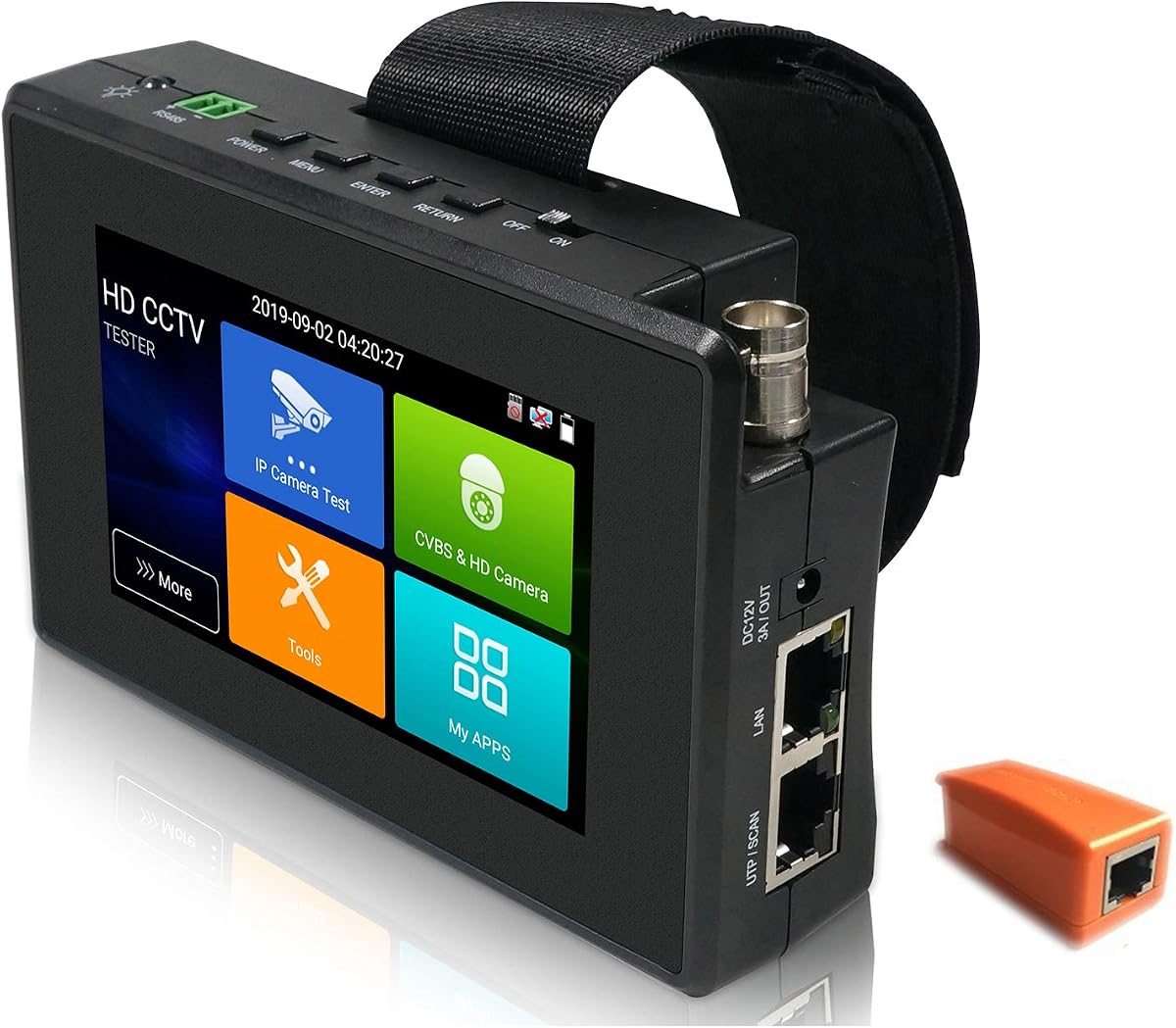
EVERSECU 5 in 1 CCTV Tester
4.4Editor score
Five camera format support
PoE and DC output
TDR and UTP testing
An IP and CCTV camera tester combines several jobs that normally require a laptop, separate power injector, cable diagnostic tool, and analog monitor. The best models make camera commissioning faster by providing video preview, PoE or DC power, IP discovery, PTZ control, network utilities, and cable measurements in one portable enclosure.
The ten products in this guide were compared using their supplied specifications, focusing on camera compatibility, display size, power output, Ethernet and Wi-Fi support, diagnostic tools, and practical field functions. The list covers compact 4-inch units, larger touchscreen models, optical-fiber interfaces, and a professional documentation-oriented system.
Each review identifies the strongest use for that tester, while the buying guide explains the trade-offs behind screen size, supported camera formats, PoE capability, SFP ports, and specialized optical tools. Product specifications and availability can change, so confirm the current listing details and accessory bundle before purchasing.
4.4Editor score

4.9Editor score

4.5Editor score
As an Amazon Associate we earn from qualifying purchases.
This side-by-side comparison highlights display size, camera-format support, network and cable diagnostics, and temporary power capabilities, helping technicians identify the tester that best matches their cameras and working environment.


The WANLUTECH E88 is a large-screen IP and CCTV camera tester centered on network-camera commissioning. It carries a 4.4 rating and combines an 8-inch touchscreen, 4K 12MP IP support, 90W PoE output, an SFP optical-fiber interface, Wi-Fi tools, and comprehensive cable diagnostics in one Android-based device.
We may earn a commission when you buy through this link, at no additional cost to you.
Its most useful trait is the unusual combination of 90W PoE and a Gigabit SFP port. That makes it relevant to technicians working with high-power PTZ cameras or installations that use fiber uplinks. IP discovery, quick ONVIF access, IPC testing, RTSP playback, automatic video viewing, and report generation cover the normal commissioning workflow, while tools for Hikvision and Dahua cameras add batch activation and address, password, and channel-name changes.
The network and cable functions are broader than those of simpler compact testers. Ping, IP scanning, DHCP server operation, PPPOE, trace route, port flashing, LLDP, and link monitoring are available alongside RJ45 TDR measurements for pair status, length, attenuation, reflectivity, impedance, and skew. Its cable-length function reaches 3,000 meters for listed cable types, and HDMI and VGA inputs broaden its role as a video monitor. The trade-off is that the listed analog support is narrower than that of the leading multi-format coax models.
This is a good choice for IP-first installers who want a large display, strong temporary power, and serious diagnostic depth without moving to the largest or most specialized model. It may be excessive for routine maintenance of standard-definition systems, but for modern network-camera work, the E88 offers an unusually balanced set of commissioning and troubleshooting tools.
The 90W output can temporarily power compatible high-power PTZ equipment under IEEE 802.3af, at, and bt protocols. This removes the need to search for a suitable outlet during a camera swap or alignment session.
The Gigabit SFP interface expands the tester beyond ordinary copper Ethernet. Combined with Wi-Fi analysis, PPPOE, link monitoring, and TDR cable measurements, it covers many stages of a network-camera installation.
We may earn a commission when you buy through this link, at no additional cost to you.
The RAINLEOTI 7-Inch IPC Tester is a 4.1-rated portable instrument designed primarily for IP cameras, with analog support limited to conventional CVBS. Its 1920×1200 IPS touchscreen, 6K 32MP capability, Gigabit Ethernet, built-in Wi-Fi, and 7.4V 7,000mAh battery make it practical for extended commissioning work.
We may earn a commission when you buy through this link, at no additional cost to you.
The core toolset covers IP detection, rapid recording, RTSP playback, IPC testing, automatic video viewing, and test-report creation. Its TDR function measures network-cable length, attenuation, quality, reflectivity, impedance, and skew over a listed range of 195 meters. Power options include POE at 48V, 24V and 12V outputs, 5V USB output, and 12V input, while RS485, audio input, HDMI output, and configuration utilities broaden the device beyond basic camera testing.
The important limitation concerns coaxial formats. Although the product is sometimes described generally as an IP and CCTV tester, the supplied instructions state that its analog section is for standard CVBS cameras and does not support AHD, TVI, or CVI. The user must use the included BNC arrangement and the power converter connected to the 12V output when testing conventional analog equipment. It also lacks an SFP interface and the optical measurement tools found in premium units.
Technicians who primarily maintain modern IP installations and occasionally need analog CVBS viewing will appreciate the large screen, broad power options, and solid report workflow. Those responsible for mixed HD-coax estates should choose a model with explicit AHD, TVI, and CVI support instead.
The 1920×1200 IPS panel provides more room for menus, video, and camera details than a typical 4-inch unit. It is particularly useful when navigating network settings or checking a larger image.
The tester combines PoE with multiple DC outputs and USB power. That flexibility lets technicians power or service cameras and peripherals without carrying several separate adapters.
We may earn a commission when you buy through this link, at no additional cost to you.
The Triplett 8150 CamView IP Pro 5 is a compact 1080p tester designed to bridge IP, analog, and HD-coax systems. Its 4.1 rating reflects a practical feature set: IP and analog camera support, TVI, CVI, and AHD compatibility, 4K H.264 and H.265 testing, and automatic recognition of HD coax camera type and resolution.
We may earn a commission when you buy through this link, at no additional cost to you.
Its ports support a flexible field workflow. HDMI, BNC, and RJ45 are included, alongside 24W PoE, 12V/3A DC output, and HDMI output. Wi-Fi connectivity and hotspot creation are useful for commissioning wireless cameras, and the Ookla speed test provides a quick indication of available network performance. RJ45 TDR and cable-quality tests can reveal opens, shorts, and miswires.
The main limitation is that this is a compact rather than expansive unit. It does not offer the SFP interface, optical power meter, visual fault locator, or very high PoE output found in specialized models. The supplied information also does not specify battery capacity or operating time, so buyers prioritizing all-day cordless use should verify those details directly with the seller.
Despite those limitations, the CamView IP Pro 5 is appealing for technicians who service mixed camera generations and value portability. It accepts more camera formats than the narrow CVBS-focused RAINLEOTI, while remaining simpler and lighter than the 7-inch and 8-inch Android models. It is a strong fit for routine installation, troubleshooting, and maintenance.
Automatic recognition of AHD, TVI, and CVI types reduces setup time when a technician does not know which coax standard a client camera uses. The added IP functions keep the same device useful for network cameras.
The lightweight enclosure and 1080p screen prioritize easy carrying over the expansive workspace of larger models. It is well suited to technicians who regularly move between sites.
We may earn a commission when you buy through this link, at no additional cost to you.
The Rsrteng IPC-9800ADHS Pro is a 4.5-rated, all-in-one tester for demanding service work. It supports IP cameras up to 8K 32MP, 4K 12MP, and 4K H.264/H.265 workflows while also handling up to 8MP TVI, AHD, CVI, and SDI coax cameras alongside conventional CVBS. Its 7-inch 1280×800 IPS touchscreen and Android 11 operating system give it the feel of a portable computing platform.
We may earn a commission when you buy through this link, at no additional cost to you.
The 90W PoE++ output is a major differentiator, allowing compatible high-power PTZ speed-dome cameras to be powered temporarily under IEEE 802.3af, at, and bt standards. A Gigabit SFP interface adds optical-network testing capability, while dual Gigabit Ethernet ports make it easier to compare links or keep a separate management connection active.
Its diagnostics are extensive: rapid video, automatic viewing, reports, IP discovery, IPC testing, RTSP playback, camera-specific tools for Hikvision and Dahua, power management, trace route, link monitor, DHCP server, port flashing, ping, UTP testing, and RJ45 TDR measurements. Coax work includes automatic HD detection, UTC PTZ control, OSD access, and color bars. The trade-off is complexity and size compared with a 4-inch general-purpose tester.
This model is most suitable for integrators supporting new and legacy camera formats, high-resolution IP systems, and professional installations that need configuration, documentation, and temporary power. It is a premium choice when one device must cover many roles, although technicians focused specifically on fiber power and visual fault finding should also examine the NOYAFA or Eversecu models with dedicated optical instruments.
The ability to test 8K IP alongside eight-megapixel HD coax and SDI systems makes this unusually versatile. Automatic HD detection helps standardize installation work across mixed camera estates.
The Android 11 platform provides a more extensible interface than a fixed-function monitor. It can benefit technicians who need specific camera utilities or other compatible applications.
We may earn a commission when you buy through this link, at no additional cost to you.
The NOYAFA NF-IPC728HSO stands out as a hybrid camera, network, copper-cable, and fiber-maintenance instrument. It has a 4.5 rating, an 8-inch Full-HD IPS touchscreen, and support for 8K 32MP IP viewing alongside TVI, CVI, AHD, SDI, and CVBS camera testing. That makes it one of the broadest choices in this roundup.
We may earn a commission when you buy through this link, at no additional cost to you.
Its defining advantage is the integrated seven-wavelength optical power meter and visual fault locator. The optical meter covers 850, 1300, 1310, 1490, 1550, 1625, and 1650 nanometer wavelengths over a stated detection range of -70 to +10 dBm, with FC, SC, and ST connector support. The VFL assists with finding fiber breaks, poor connections, and bending or cracking damage.
The rest of the feature set is similarly extensive. It includes 90W PoE++ under the listed IEEE standards, a Gigabit SFP interface, dual Gigabit Ethernet, HDMI input and output, audio input and output, RS485, Wi-Fi analysis, a cable tracer, TDR testing, and 1.2-kilometer cable-length and short-circuit testing for several cable types. Coax tools include automatic type recognition, PTZ control, OSD calls, and color bars.
The main compromise is that its specialized fiber functions demand care and understanding, and the supplied information provides only the battery capacity rather than a stated operating time. Technicians working across copper, coax, IP, and fiber installations will find this an unusually capable one-device solution. For a camera-only workflow, these advanced tools may add complexity without improving everyday results.
The visual fault locator helps identify breaks and poor connections, while the optical power meter checks signal strength across seven common wavelengths. Together they can narrow down a fiber problem without immediately reaching for separate instruments.
Camera formats, PoE, SFP, Wi-Fi, TDR, cable tracing, and optical measurement are combined in one enclosure. The breadth suits integrators who regularly cross disciplines rather than technicians focused on a single camera task.
We may earn a commission when you buy through this link, at no additional cost to you.
The WANLUTECH IPC-1800ADH Plus is a compact 4.4-rated tester that covers a useful mix of IP and coaxial camera formats. It supports IP discovery, quick ONVIF, IPC testing, RTSP playback, automatic video viewing, report generation, and conventional CVBS, while its Auto HD app recognizes AHD, CVI, TVI, and CVBS cameras up to the listed 8MP limit.
We may earn a commission when you buy through this link, at no additional cost to you.
It also provides batch activation of Hikvision and Dahua cameras, along with tools for changing IP addresses, passwords, and channel names. The 4-inch IPS touchscreen keeps the unit easy to carry, while UTC PTZ control, RS485 control, and support for more than 30 protocols broaden its usefulness with supported camera systems.
For on-site power, the tester offers up to 30W PoE output and 12V/3A DC output. Wi-Fi is built in, including hotspot creation, and the network utilities include ping, IP address scanning, port flashing, and a DHCP server. RJ45 TDR can check cable-pair status, length, attenuation, reflectivity, impedance, and skew, with a UTP mode for connection status.
Its limitations are the small display and lower temporary-power ceiling than high-end units. The 2,400mAh battery specification also suggests that buyers should plan charging around longer jobs. Even so, this tester offers one of the strongest balance of size and feature depth in the list, particularly for technicians who service both modern network cameras and HD coax systems.
A 4-inch screen is less comfortable for prolonged configuration, but it keeps the unit compact. The range of batch, PTZ, network, and cable functions prevents the small chassis from becoming a limited-purpose tool.
Batch activation and address, password, and channel-name management can reduce repetitive work when commissioning several compatible cameras. This is valuable in structured installations rather than one-off troubleshooting.
We may earn a commission when you buy through this link, at no additional cost to you.
The Eversecu 5 in 1 is a 4.4-rated budget-oriented choice for technicians who need broad camera compatibility without a premium instrument. It supports IP cameras, conventional analog cameras, TVI, CVI, and AHD, including mainstream 4K H.264 and 4K H.265 streams, all displayed on a 4-inch 800×480 IPS touchscreen.
We may earn a commission when you buy through this link, at no additional cost to you.
Its practical value comes from the combination of camera monitoring and field tools. IP scan, ping, Ethernet bandwidth testing, DHCP server, trace route, and automatic segment matching help identify network-camera addresses and connectivity problems. The RJ45 TDR function checks pair status, length, attenuation, reflectivity, impedance, and skew, while UTP testing displays cable connection status. An optional cable tracer can help locate cables in congested pathways.
Power output includes 25.5W PoE at 48V and 12V/3A DC, enabling temporary operation of compatible IP and conventional cameras. The interface can be customized, and the screen rotates 180 degrees so LAN cables can be connected at the bottom without awkwardly turning the device over. ONVIF PTZ and analog PTZ control are also supported.
The main compromises are the modest 800×480 screen and lack of SFP or dedicated optical measurement. It also does not match the camera-configuration depth of Android-based models. For installers who need a dependable mixed-format tester with PoE, DC power, network diagnostics, and cable testing, it remains an economical, focused solution.
Supporting IP, analog, TVI, CVI, and AHD in one unit covers common installation generations. Automatic IP discovery and segment adjustment simplify the initial connection to an unfamiliar camera network.
The 180-degree rotation is a small detail with practical value. It improves access to ports when the tester is positioned in a rack, cabinet, or on a ladder.
We may earn a commission when you buy through this link, at no additional cost to you.
The Eversecu 7-Inch CCTV Tester is a 4.4-rated diagnostic device aimed at technicians who need more than camera preview. Its 1280×800 IPS touchscreen can test up to 8K IP cameras, 8.0-megapixel HD coax cameras, and CVBS analog equipment, with H.264 and H.265 support and mainstream 4K display.
We may earn a commission when you buy through this link, at no additional cost to you.
Beyond camera testing, it includes TDR cable diagnostics, a digital multimeter, an optical power meter, and a visual fault locator. These additions make it suitable for diagnosing both installation and infrastructure problems. The tester also supports video recording and playback, screen snapshots with 4-times zoom, PTZ control, IP discovery, automatic login and viewing, and test-report creation.
Its network toolkit includes ping, IP scanning, port blinking, traffic display, and Ethernet testing. The stated hardware includes a 10/100M LAN port, built-in Wi-Fi, hotspot creation, audio input, and 24W PoE output alongside 12V/2A DC output. A 7.4V 5,400mAh battery is listed with a stated working time of up to 10 hours, while an LED lamp adds practical field utility.
The key limitation is that the physical LAN port is listed at 10/100M even though the supplied description also refers to 10/100/1000M Ethernet testing. Buyers needing a clearly specified Gigabit physical interface may prefer a model whose port specification is unambiguous. Within the Eversecu range, however, this larger unit is the more advanced diagnostic choice, especially when optical measurements are valuable.
Digital multimeter, optical power meter, visual fault locator, and TDR capabilities extend the device beyond camera configuration. It is better suited to technicians who diagnose the installation path as well as the endpoint.
The supplied information states a working time of up to 10 hours. Built-in Wi-Fi, hotspot creation, audio recording, and an LED lamp further reduce the need for separate field accessories.
We may earn a commission when you buy through this link, at no additional cost to you.
The Rsrteng E88 is the strongest all-around IP-focused choice in this guide, carrying the highest listed rating at 4.9. It combines an 8-inch 1920×1200 IPS touchscreen with 4K 12MP camera support, 90W PoE++ output, a Gigabit SFP interface, and two Gigabit Ethernet ports.
We may earn a commission when you buy through this link, at no additional cost to you.
Its camera workflow is thorough. Rapid Video, automatic viewing, IP discovery, report generation, and RTSP-style access cover standard commissioning. Dedicated Hikvision and Dahua tools support batch activation and changes to IP addresses, usernames, passwords, and channel names, making the tester especially useful when several cameras are being deployed together.
Power and connectivity are major strengths. The 90W output can power compatible high-power PTZ speed-dome cameras, and PSE voltage and protocol detection can help identify PoE switch or supply behavior. The network suite includes trace route, link monitoring, DHCP server, port flashing, ping, Wi-Fi analysis, channel occupancy, and signal strength. Cable tools include UTP testing, RJ45 TDR, cable length, PD power testing, and AC voltage detection.
The supplied data focuses on IP camera testing and does not clearly enumerate the supported legacy coax standards, so buyers with substantial AHD, TVI, or CVI estates should verify compatibility. Its Android 10 platform is also not the newest version offered in the list. Even with those caveats, the combination of screen quality, 90W power, SFP, batch configuration, and dual Gigabit networking makes this an excellent primary IP commissioning tester.
Batch activation and remote modification of addresses, credentials, and channel names streamline installation of compatible camera groups. The workflow is more useful than single-camera tools for structured deployments.
The 1920×1200 8-inch display offers a clear workspace for menus, diagnostics, and video. It is especially helpful when a technician must identify image or configuration issues without a separate monitor.
We may earn a commission when you buy through this link, at no additional cost to you.
The TREND Networks SecuriTEST IP is a professional installation and troubleshooting system for digital IP, HD coax, and analog CCTV estates. Its 3.9 rating is the lowest among the ten products, but the supplied information emphasizes a deliberate professional workflow centered on powering, configuring, documenting, and verifying camera systems.
We may earn a commission when you buy through this link, at no additional cost to you.
Its most distinctive feature is QuickIP, which is intended to help even less-experienced technicians configure IP cameras with a process closer to configuring analog cameras. A suite of network troubleshooting tools helps diagnose connectivity, while the internal Li-ion battery can supply PoE, PoE+, or standard 12V DC power to IP and analog cameras during installation.
Professional documentation is the defining advantage. Test reports can include camera and video screenshots, reducing manual spreadsheet work and helping document that each endpoint was tested correctly. Reports can also be transferred by email, which supports communication between installers, project managers, and clients.
The available product data provides less detail about the exact display, camera formats, cable diagnostics, and app compatibility than it does for the other models. Consequently, buyers should confirm the complete specification and accessory list before choosing this premium-oriented unit. For firms that value a standardized workflow and evidence-backed handover documentation, SecuriTEST IP is a compelling choice, while more general technicians may prefer the broader tool menus and higher-rated alternatives in this roundup.
QuickIP is designed to make IP camera setup accessible to a wider range of technicians. That can reduce training time and simplify the early stages of an installation.
Embedding camera and video screenshots in test reports provides evidence that endpoints were commissioned. Email transfer makes the documentation easier to deliver and retain.
We may earn a commission when you buy through this link, at no additional cost to you.
The right camera tester depends on the camera formats, power requirements, network infrastructure, and documentation demands of your work. The following factors help separate basic monitors from comprehensive field-service instruments.
Start with the highest resolution and codecs used in the systems you service. The testers in this guide range from 4K 12MP support to 8K 32MP capability, with common H.264 and H.265 decoding among the key requirements. A tester that can display a camera's native stream helps distinguish resolution, compression, and configuration problems from actual image faults. It also prevents a technician from interpreting a low-resolution preview as a defective camera when the limitation belongs to the tester.
Choose at least the maximum resolution and codec your installed equipment may use. For a mixed or future-facing toolkit, an 8K-capable model provides more headroom than a unit limited to 4K.
Coax support is not a single format. Conventional CVBS, AHD, TVI, CVI, and SDI can produce different signals, and some models support only one or two of them. The listed RAINLEOTI unit is explicitly limited to CVBS and excludes AHD, TVI, and CVI, while the Triplett, Rsrteng, NOYAFA, and other multi-format units cover broader combinations. Automatic HD recognition is especially useful when the camera standard is unknown.
Match the tester to your installed equipment rather than relying on a general 'CCTV tester' label. Confirm both the supported format and maximum resolution, and verify whether PTZ control uses UTC, RS485, or another method.
Temporary camera power is one of the most valuable tester features because it allows an installer to operate a camera without finding a nearby outlet or injector. Basic units may provide 24W to 30W PoE, while the WANLUTECH E88 and Rsrteng models support up to 90W under the listed IEEE protocols. Higher output is important for high-power PTZ speed-dome cameras, but it should not be assumed to power every device.
Check both voltage and maximum current or wattage, and distinguish PoE output from DC output. A tester with 12V, 24V, and USB outputs can cover more camera and peripheral configurations, while power-management screens help diagnose switch or PSE behavior.
Screen size affects how comfortably you can navigate menus, read network values, and inspect a live image. Four-inch IPS models are easy to carry and adequate for quick tests, while 7-inch and 8-inch screens provide a better workspace for dense configurations and video inspection. Resolution also matters: the Eversecu 5 in 1 uses 800×480, while several larger competitors provide 1280×800, 1920×1200, or Full-HD displays.
Balance workspace against portability. A large tester is easier for prolonged commissioning, but a compact device is more convenient in ladders, cabinets, and crowded racks. Consider the screen and the unit's port placement together.
A good tester should distinguish a camera problem from a network or cabling issue. IP discovery, ping, IP scanning, port flashing, trace route, link monitoring, DHCP server, PPPOE, and traffic display are common network tools. For copper, look for RJ45 TDR and UTP testing that report pair status, length, attenuation, reflectivity, impedance, and skew. Cable tracing and breakpoint-location functions can be valuable when the cable route is not obvious.
Prioritize the measurements you will actually use. A broad menu is useful, but accurate categories, understandable results, and repeatable reports matter more than a long list of labels.
SFP support and dedicated optical instruments serve different purposes. An SFP port lets a tester use a compatible optical module to test a fiber connection, while an optical power meter measures signal strength and a visual fault locator helps reveal breaks or poor bends. NOYAFA combines both dedicated optical tools with camera testing, and the Eversecu 7-Inch model also lists an optical power meter and VFL.
Fiber-capable technicians should verify wavelength coverage, measurement range, connector types, and required accessories before buying. For a copper-only workflow, paying for unused optical functions adds cost without improving daily results.
Fast commissioning depends on more than viewing video. Several models include Hikvision and Dahua utilities for batch activation, IP address and password changes, and custom channel names. Automatic login, quick ONVIF access, PTZ control, OSD access, and test-report generation can also reduce repetitive work. These features are particularly valuable for technicians commissioning multiple cameras per site.
Consider how proof of completion is handled. TREND SecuriTEST IP emphasizes professional reports containing camera and video screenshots, while Android-based testers can generate reports and update applications. Choose the workflow that matches your service process and documentation obligations.
Battery capacity affects whether a tester can complete a full workday without a charger. Listed capacities range from 2,400mAh in the compact WANLUTECH model to 7,000mAh in the RAINLEOTI unit, while the Eversecu 7-Inch model states a working time of up to 10 hours. Chargers, power adapters, test leads, and cables can materially affect usability, and the supplied product information does not describe every package equally.
Check whether the included power supply can charge the unit and whether the battery is removable or isolated by a shipping tab. Built-in Wi-Fi, hotspot creation, an LED lamp, audio input, HDMI, and SFP may be valuable, but they should complement the core camera and network functions you need.
Begin by fully charging the tester and removing any battery isolation tab described in the instructions. Inspect the case, test leads, connectors, and screen for damage, then install the required camera utilities before traveling to a site. Confirm the camera format, resolution, PoE requirements, and service access details so you can select the correct application and avoid unnecessary changes to a live system.
For an IP camera, connect the tester to the same network segment, use IP discovery to locate the camera, and verify the intended address. Run ping and link tests before assuming a camera is defective. Apply temporary PoE or DC power only when the voltage, connector, and power budget match the device. For coax testing, identify the supported standard, use the correct input and accessory arrangement, and avoid applying a 12V output to a camera that expects another supply.
After a successful test, save the report and capture any requested screenshots before changing credentials or network settings. Use a screen protector or protective case, coil cables without creating tight bends, and keep the tester away from excessive heat, moisture, and impact. Periodically open the unit only as permitted by the manual, clean the contacts gently, and verify battery health so unexpected shutdowns do not interrupt a service call.
It combines a portable monitor with network, power, and cable diagnostics for installing and troubleshooting security cameras. Depending on the model, it can provide PoE or DC power, discover IP addresses, preview video, control PTZ cameras, test coax formats, inspect cables, and generate reports. It replaces several separate tools that a technician would otherwise carry.
Many models do, but analog support varies significantly. CVBS is the traditional analog standard, while AHD, TVI, CVI, and SDI are HD-coax formats that require explicit support. The supplied RAINLEOTI product is limited to CVBS, whereas several Triplett, Rsrteng, NOYAFA, WANLUTECH, and Eversecu models cover broader combinations. Verify the exact formats and resolutions before purchasing.
No. A higher output is valuable when testing compatible high-power PTZ cameras, but it does not replace the right connectors, protocols, or diagnostic tools. A 24W unit may fully meet the needs of a standard camera installation, while a 90W unit is more appropriate for demanding devices. Match output voltage and capacity to the camera rather than relying on wattage alone.
An SFP port accepts a compatible optical transceiver, allowing the tester to communicate through a fiber link. An optical power meter measures optical signal strength, while a visual fault locator helps identify breaks or poor connections. These capabilities are related but not interchangeable, so technicians performing fiber troubleshooting should identify which functions they actually need.
Yes. TDR is the more detailed time-domain measurement, commonly used to evaluate cable length, pair status, attenuation, reflectivity, impedance, and skew. UTP testing generally checks whether connections and pairs are correct, locating opens, shorts, and miswires. Many of the listed testers provide both modes, giving a quick continuity check plus more detailed measurements.
A 4-inch model is easier to carry and often better for quick service calls, while a 7-inch or 8-inch screen is more comfortable for detailed menus, camera alignment, and extended diagnostics. Screen resolution also varies, so compare both physical size and panel quality. The best choice depends on whether portability or workspace is your priority.
Many can create test reports, and TREND SecuriTEST IP is particularly oriented toward professional documentation. Its reports can include camera and video screenshots and can be transferred by email. Other models also offer report generation, but the supplied data does not establish identical report formats or export methods, so confirm compatibility with your documentation process.
A dedicated tester can handle many routine tasks, including IP discovery, rapid video, camera-specific configuration, address changes, PTZ control, and report creation. Some devices run Android and allow application updates or installation, extending their flexibility. A laptop may still be useful for advanced camera administration, custom integrations, or vendor-specific software not represented in the supplied feature lists.
The Eversecu 5 in 1 is the best budget-oriented option for broad camera compatibility, 25.5W PoE, DC output, and practical cable diagnostics in a compact enclosure. The Rsrteng E88 is the editor's choice for IP-focused work because its 8-inch 1920×1200 screen, 90W PoE++, SFP interface, batch configuration, and dual Gigabit Ethernet form an exceptional commissioning package. The Rsrteng IPC-9800ADHS Pro takes the premium position for its 8K 32MP support, 90W output, Android 11 platform, and comprehensive mix of IP and coax formats.
Prioritize the formats and infrastructure you actually use. A standard IP maintenance kit may need little more than IP discovery, PoE, PTZ, and a good preview, while mixed-system technicians should verify AHD, TVI, CVI, SDI, and CVBS support. Fiber and high-power PTZ work justifies a larger investment, and professional documentation may make report generation one of the most important buying criteria.
Check the current listing, supported formats, included accessories, battery details, and warranty terms before ordering, since product configurations and availability can change. Comparing the current specifications against your cameras and typical jobs will lead to the most suitable IP and CCTV camera tester with fewer unnecessary compromises.