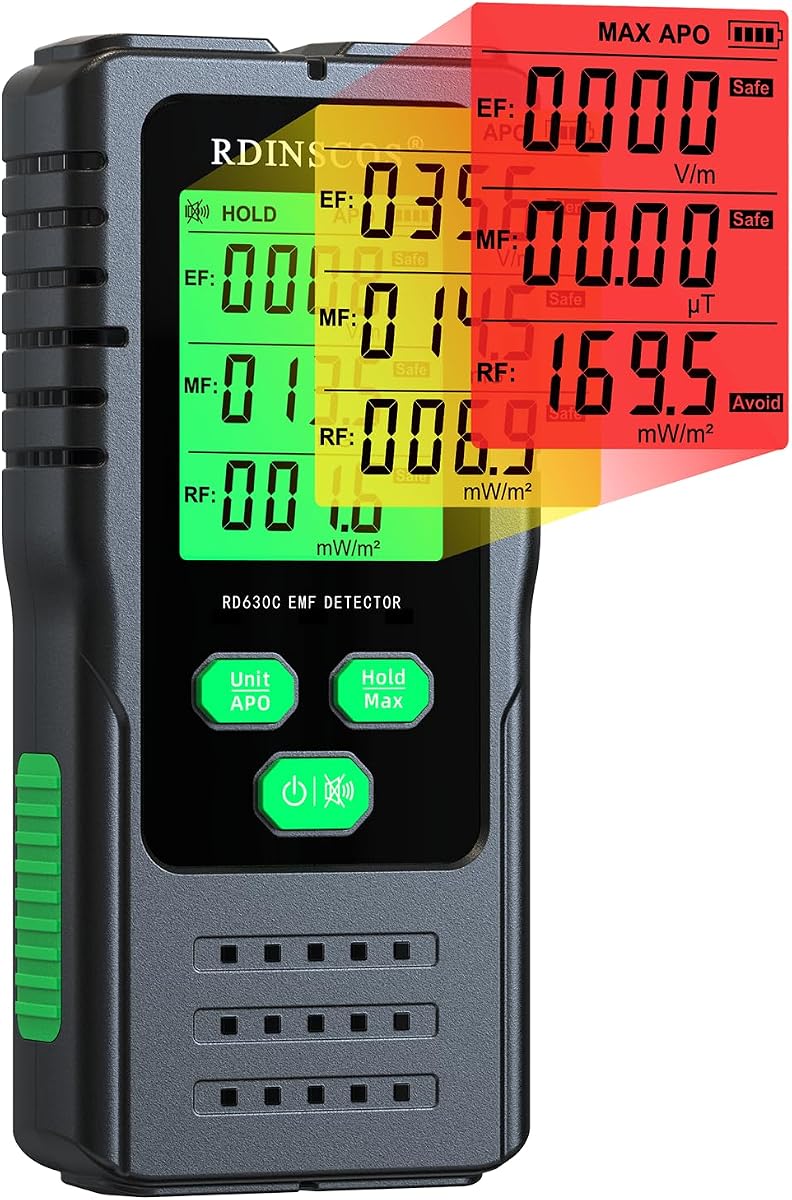
RDINSCOS RD630
4.4Editor score
Three common EMF field types
Tri-color backlit LCD
Audible level alert
Discover the best EMF meters detectors for home, office, and field use, with expert comparisons of detection ranges, alerts, displays, accuracy, and features.
EMF meters and detectors help users identify and compare electromagnetic fields from household appliances, wiring, wireless equipment, and other electronic sources. A useful model should cover the field types relevant to your environment, present readings clearly, and provide alerts that make hotspots easy to recognize during a room-by-room scan.
The products in this guide were compared by examining their supported field types, measurement ranges, detection limits, display functions, alert systems, included accessories, and practical features such as data hold, maximum readings, temperature monitoring, and rechargeable power. The list includes single-purpose magnetic field readers as well as multi-field instruments for electric, magnetic, and radio-frequency measurements.
Each review explains who can benefit most from a particular detector, where its strengths matter, and where its limits should be considered. Ratings and specifications reflect the supplied product information, while prices and availability can change at any time, so check the current listing before deciding which model fits your needs and budget.
4.4Editor score

4.6Editor score

4.1Editor score
The comparison below organizes all ten detectors by their supported field types, practical functions, and best use. It is designed to make it easier to distinguish a basic magnetic reader from a multi-field RF detector and identify the features that matter most for home checks, office surveys, or more advanced monitoring.


The ERICKHILL EMF Meter is a handheld detector designed to measure both electric and magnetic fields, earning a 4.4 rating. Its clear LCD, selectable units, rechargeable battery, and combination of sound and light alerts make it especially approachable for checking a bedroom, office, kitchen, or other area where low-frequency fields are the main concern.
We may earn a commission when you buy through this link, at no additional cost to you.
Its most useful strength is the specificity of the available measurements. The electric-field range extends from 1 to 1999V/m, while the magnetic-field range covers 0.01 to 99.99μT and can also be shown in mG. The screen turns red, the indicator flashes, and a buzzer sounds when the electric field exceeds 40V/m or the magnetic field surpasses 0.4μT, giving users both a numerical value and an immediate visual indication of a high reading.
The data hold function allows a reading to remain on screen while it is recorded or compared, and the automatic five-minute shutdown helps preserve battery life. It is worth understanding that magnetic readings can register zero when the appliance being checked is off or its field falls below the meter’s detection range. The top sensor should therefore be held close to a powered-on source, and changing distance or orientation can materially change the result.
This is a good fit for a homeowner who wants to compare locations and identify operating appliances as potential sources without learning RF terminology. It is less suitable for someone specifically researching Wi-Fi, cellular transmissions, or microwave radiation because the listed capabilities cover electric and magnetic fields rather than RF. For those priorities, a three-field instrument is the better fit, while for straightforward low-frequency checks the ERICKHILL offers a capable and approachable package.
The combined buzzer, flashing indicator, and red-screen warning make it easier to notice a meaningful rise while moving the sensor through a room. Mute mode is available when an audible alert would be inconvenient, allowing the other visual cues to carry the message.
The device is well suited to recording a baseline near electronics and checking a second location after a shielding product is introduced. A single comparison cannot prove that every source has been addressed, but it provides a repeatable way to observe changes in the same spot.
We may earn a commission when you buy through this link, at no additional cost to you.
The TF2 EMF Pollution Meter combines magnetic, electric, and RF field detection in one instrument and carries a 4.6 rating. It is the most versatile choice in this guide for users who want to examine both low-frequency sources and wireless transmissions without moving between separate devices.
We may earn a commission when you buy through this link, at no additional cost to you.
A defining feature is the display’s responsiveness. Bars update instantly for fast digital signals, while RF and numerical averages refresh four times per second. This behavior is especially relevant when comparing a Wi-Fi router, smartphone, Bluetooth device, or cell signal because the meter is designed to reveal fluctuations rather than conceal short peaks behind heavy averaging.
The instrument uses a three-axis magnetic sensor, a single-axis electric sensor with standard or weighted frequency responses, and a single-axis unweighted RF sensor. It can measure signals associated with 4G and 5G phones, cell towers, Wi-Fi routers, Bluetooth devices, AC power lines, and smart meters. Its stated RF coverage is 20MHz to 6GHz, which includes many common 5G signals but does not cover experimental millimeter-wave frequencies.
The TF2 is best suited to a technically engaged user who wants fast feedback and a single device for several source types. It includes a 9V battery, quick-start card, detailed manual, and soft-shell zip case, and AlphaLab includes a one-year manufacturer limited warranty and consulting support. Buyers should still note the single-axis electric and RF layouts and the stated exclusion of radioactivity when defining what the meter can measure.
The rapidly updating bars and averaging display are valuable near phones, routers, and connected equipment. They help a user see movement in the signal rather than relying only on a static value, which can make comparisons across a room more informative.
Combining three field categories reduces the need to buy separate detectors for power-line, appliance, and RF checks. The trade-off is that the meter remains more specialized than the simplest household indicator and may require a little more deliberate operation.
We may earn a commission when you buy through this link, at no additional cost to you.
The GQ EMF-390 is a multi-field electromagnetic radiation meter with a 4.6 rating. It detects electric, magnetic, and RF-related signals, reaches up to 10GHz in its RF detection capability, and adds tools not commonly found in simpler detectors: a data logger, an RF spectrum analyzer, and GQ RF Browser support.
We may earn a commission when you buy through this link, at no additional cost to you.
Its high-sensitivity sensors are designed to help recognize common sources such as power lines, smart meters, cell towers, mobile phones, and microwave equipment. The safety suggestion function is intended to give the user an immediate sense of the current condition, while the spectrum tools provide a more detailed view of RF activity in the environment.
The most important technical distinction is that the detector can detect RF signals up to 10GHz, whereas the built-in spectrum analyzer is specified through 2.5GHz. Users should therefore understand which operating mode they are using and not assume that every visualization includes the detector’s full stated RF bandwidth. It is a more advanced instrument for users who want to explore signal behavior rather than simply receive an on-screen warning.
This model is a strong choice for an RF-focused enthusiast, investigator, or technical user who wants logging and spectrum analysis in the same device. It is less attractive for someone who only needs a simple magnetic indicator or wants a compact general-purpose detector. Despite the broad feature set, the GQ EMF-390 earns a 4.6 rating, placing it among the strongest products in the comparison.
The built-in spectrum analyzer and RF Browser make this meter more useful when the goal is to inspect frequency behavior rather than merely identify a high overall reading. This added depth is particularly relevant around several competing wireless sources.
The data logger supports a more methodical approach than watching a display in real time alone. A recorded sequence can help a user compare a quiet baseline with periods of activity around particular devices or parts of a building.
We may earn a commission when you buy through this link, at no additional cost to you.
The RDINSCOS RD630 is a compact three-in-one detector that measures AC magnetic, AC electric, and microwave fields. Its 4.4 rating reflects a generally practical feature set, and the combination of a backlit tri-color LCD, audible alert, and straightforward handheld design makes it an appealing entry point for basic home and workplace scans.
We may earn a commission when you buy through this link, at no additional cost to you.
The screen provides an immediate visual hierarchy through green, yellow, and red areas, while the sound alert draws attention when a reading exceeds the specified level. This is particularly useful for users who are still learning how field strengths change around appliances, wiring, smart meters, and cell towers. One-handed operation further reduces the inconvenience of checking multiple points in a room.
Power management is handled through an automatic shutdown after 15 minutes. The automatic power-off function can be disabled by pressing and holding the APO button, which is useful during a longer inspection because it prevents the meter from turning off between readings. The illuminated screen remains readable in low-light conditions, and the overall layout is designed to work without professional training.
The RD630 makes sense for a first EMF detector, a renter conducting a quick room survey, or anyone who wants one compact instrument for three broad field categories. It does not add environmental readings, spectrum analysis, or RF frequency logging, so it is not the first choice for advanced signal research. For accessible multi-field checks, however, it balances capability, portability, and ease of use particularly well.
The tri-color display lets a user recognize a higher reading without memorizing a full technical scale. The backlight adds practical value during nighttime checks or inspections in dim rooms where a standard screen may be difficult to read.
Automatic power-off helps conserve the battery during intermittent use. Disabling it through the dedicated control makes the meter better suited to extended inspections where the user does not want an automatic timeout interrupting a sequence of readings.
We may earn a commission when you buy through this link, at no additional cost to you.
The POROMETISTO ET01Pro is a five-in-one detector that combines RF, electric-field, magnetic-field, temperature, and humidity measurements. Its 4.5 rating and broad low- and high-frequency coverage make it appealing for users who want to compare electromagnetic conditions with other environmental readings in the same space.
We may earn a commission when you buy through this link, at no additional cost to you.
The electric and magnetic modes cover 40Hz to 100kHz, while RF detection extends from 30MHz to 8GHz. This range includes common modern wireless signals such as Wi-Fi and 5G. A color-coded analog display presents green, yellow, and red warning areas, and the audio alarm can be muted for quiet operation or paranormal investigation.
Temperature and humidity monitoring give the device a distinct role in property inspections and environmental surveys. A user can track comfort conditions alongside field readings and watch for sudden changes in either category. The meter also includes maximum and minimum value displays, a data hold function, a low-battery warning, and an auto-shutdown that can be canceled for continuous measurement.
The package contains the meter, three AAA batteries, a screwdriver, a velvet bag, and a manual, and the stated package includes a one-year replacement service. This is a good all-around choice for home, office, property, or investigation use. It does not provide the detailed frequency visualization of the GQ EMF-390 or the calibration documentation of the LATNEX AF-5000, but it offers an unusually useful combination of features in a portable package.
Temperature and humidity readings help place field results in a broader environmental context. That makes the ET01Pro useful for checking whether a bedroom, rental, or workspace is comfortable while simultaneously identifying elevated electromagnetic activity.
The included batteries, storage bag, screwdriver, and manual give the user the basic accessories needed to begin. The one-year replacement service also adds reassurance for a portable electronic device intended to move between rooms and locations.
We may earn a commission when you buy through this link, at no additional cost to you.
The Handheld Color-LCD EMF Meter has a 4.7 rating, the highest among the ten products listed. It combines electric-field, magnetic-field, and temperature measurement with a rechargeable design, a bright color display, waveform viewing, and selectable sound or flash alerts in a compact body.
We may earn a commission when you buy through this link, at no additional cost to you.
Its stated frequency spectrum is 20 to 3500MHz, allowing it to detect RF signals from common electronics and low-frequency fields around household equipment. Numerical outputs make it possible to compare conditions, while waveforms provide a more visual representation of changing magnetic-field fluctuations. The alert controls let users select between audible and visual notification according to the setting.
The rechargeable battery and lightweight construction support movement around a home, office, or appliance area. The display is intended to remain easy to navigate without a complex setup, which is useful for occasional users as well as investigators. The product is also marketed for paranormal exploration because a changing display can make brief environmental shifts more visible.
This model is best for a user seeking portability, quick controls, and a high-rated rechargeable detector. Its 3500MHz upper limit is lower than the 6GHz to 10GHz reach of several competing products, so buyers focused on broader RF analysis should consider those alternatives. Within its stated range, however, it offers a compelling combination of readability, alerts, and compact measurements.
Waveform viewing adds context that a static number cannot provide. It can show that a reading is moving rather than assuming the displayed value is the only relevant information during an active scan.
The rechargeable format and lightweight housing make the meter convenient to carry between rooms. A user can keep it nearby for periodic checks without managing a replaceable battery during every short inspection.
We may earn a commission when you buy through this link, at no additional cost to you.
The TEMIRUP 5-in-1 is a rechargeable detector for electric fields, magnetic fields, RF, temperature, and humidity. Its 4.6 rating reflects a well-rounded feature set, and the large color LCD, three-color analog warnings, and broad RF coverage give it a good balance of visibility and capability for routine household or office inspections.
We may earn a commission when you buy through this link, at no additional cost to you.
Magnetic readings can use mG or μT, electric fields are shown in V/m, and RF is displayed in μW/cm². The RF mode covers 30MHz to 8GHz, allowing it to detect Wi-Fi, 5G, and microwave emissions from appliances. Electric and magnetic modes can be used around televisions, induction cookers, rice cookers, refrigerators, computers, and power lines.
The interface supports average and maximum-value readings, a hold function, Celsius and Fahrenheit switching, a low-battery indicator, and automatic shutdown after 15 minutes. An audible alert begins when the analog display reaches the yellow area, providing a quick indication that the reading has exceeded the meter’s stated reference range. The large screen and color bars are especially useful when the meter is carried from room to room.
The package includes the meter, charging cable, carry bag, and user manual, making it a self-contained choice. It is a good option for people who want electromagnetic scanning plus temperature and humidity monitoring without buying separate tools. Users who need a dedicated spectrum analyzer or formal calibration documentation should look to higher-tier instruments, but for broad field checks and ghost-hunting applications, the TEMIRUP is capable and approachable.
The large color LCD presents values alongside a three-color analog scale, reducing the need to interpret every change from numbers alone. This makes the meter practical for a user moving a probe slowly around furniture, appliances, and desks.
Maximum-value mode, averaging, and data hold support different ways of documenting a scan. A held reading is convenient for recording a location, while maximum mode can be more useful when briefly investigating a moving or intermittent source.
We may earn a commission when you buy through this link, at no additional cost to you.
The KAIWEETS EMF Detector is a rechargeable three-in-one meter for magnetic, electric, and RF fields, with a 4.5 rating. Its defining interface is a real-time trend graph, while the ability to show all three measurements together gives users a broad view of changing electromagnetic conditions.
We may earn a commission when you buy through this link, at no additional cost to you.
The three-axis magnetic sensor reduces the need to rotate the meter in search of a field direction. Stated ranges are 0.01 to 200μT or 0.1 to 2000mG for magnetic fields, 1 to 2000V/m for electric fields, and 0.001 to 200mW/m² for RF. These ranges cover common household and workplace sources, including power lines, appliances, and Wi-Fi routers.
Automatic backlighting and a beeping alarm provide immediate feedback, and the one-touch hold button freezes a reading for documentation or comparison. Maximum-value recording is another useful addition when a user is looking for spikes near a bed, desk, or children’s activity area. The product information describes the detector as a practical real-world tool rather than laboratory-grade instrumentation, which is an important distinction when interpreting results.
This detector suits users who value clear trends and simultaneous readings more than detailed frequency analysis. It is particularly effective for comparing the living area of a home or workstation and for investigators who want a visible response to changing conditions. The passive design means it does not transmit RF signals, and the manufacturer offers direct customer support for questions about operation.
A real-time graph can reveal a brief rise that a slower numeric display might make less obvious. This makes the meter useful for comparing a quiet baseline with activity around a router, appliance, or electrical installation.
The three-axis magnetic sensor is helpful in real rooms where furniture limits access and makes orientation awkward. Instead of carefully rotating the device to find a peak, the user can sweep the area more freely and observe the trend.
We may earn a commission when you buy through this link, at no additional cost to you.
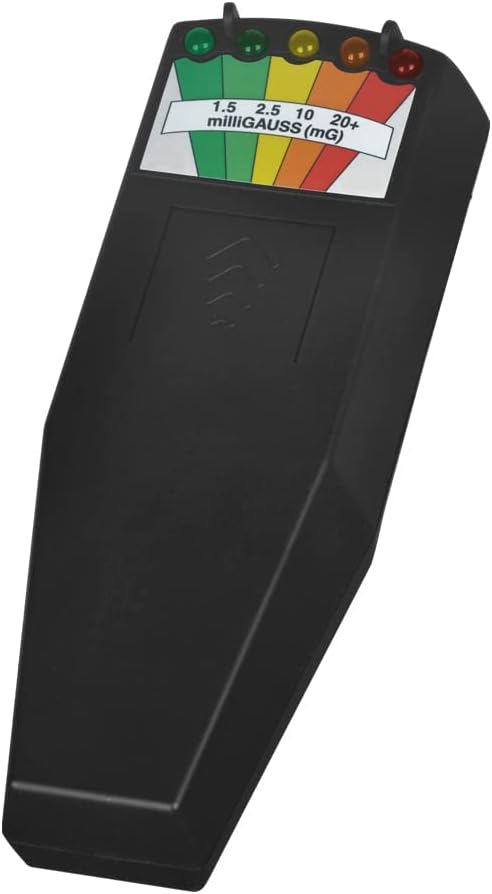
The AceFox EMF Meter is a compact, indicator-based detector designed for quick checks around TVs, computers, microwave ovens, refrigerators, printers, cell towers, and low-frequency household appliances. Its 4.5 rating and pocket-friendly form make it a straightforward choice for users who prioritize portability and immediate visual feedback.
We may earn a commission when you buy through this link, at no additional cost to you.
Five LED indicators make the reading visible in both daylight and darkness. Instead of displaying a precise number, the meter translates the field into a colored level, allowing a user to move quickly through a space without pausing to interpret a detailed readout. It can register cell phones within two feet and operates from a single battery.
The stated frequency range is 50Hz to 20,000Hz, covering low-frequency electromagnetic fields associated with many household devices and electrical wiring. That makes it useful for a basic exposure survey, though it is not a substitute for a meter that separately measures RF, electric fields, and magnetic fields across a wider spectrum.
The AceFox is best for casual users, investigators who want a pocket meter, and anyone who needs a quick answer about whether a nearby device produces a stronger indication. It is less useful for precise comparisons, documenting shielding effectiveness, or studying wireless broadcasts. Its simplicity is the central benefit, and it performs that role without requiring a larger display or rechargeable battery.
The small body can remain in a pocket or purse and be taken out for a fast check around an appliance. That convenience encourages repeated use instead of relying on a single reading taken at an uncertain distance.
The five LED indicators simplify the display for casual use and remain visible in dark rooms. The limitation is that users cannot inspect the exact value, so this model is better for relative comparisons than detailed measurement records.
We may earn a commission when you buy through this link, at no additional cost to you.
The LATNEX AF-5000 is a premium multi-field meter that measures RF, low-frequency magnetic fields, and electrical ELF fields. It carries a 4.1 rating and differentiates itself through individual testing, a dated calibration certificate, RF detection through 10GHz, three-axis magnetic sensing, and included technical support.
We may earn a commission when you buy through this link, at no additional cost to you.
Magnetic readings can be expressed in gauss or tesla, which is useful for users familiar with multiple unit systems. Electric-field measurements extend to 2000V/m at 50/60Hz, covering standard household AC frequencies, but the device is not designed for static or high-voltage industrial fields. RF measurements provide real-time strength readings for sources such as routers, cell towers, smart devices, and 5G networks.
Every unit is individually tested and certified by LATNEX before shipment under published specifications and ISO 9001:2015 standards. The supplied certificate is dated, providing a record that distinguishes this model from instruments that are only assembled and boxed. Readings can still vary with distance, angle, and interference from nearby electronics, so sound measurement technique remains essential.
This is the strongest choice for a professional, serious enthusiast, or buyer who values documented calibration and broader RF coverage. A two-year warranty and direct phone or email technical support add support for users who need help interpreting results. Its 4.1 rating is the lowest in this guide, so buyers should weigh the premium features against their specific requirements rather than treating it as an automatic choice for every task.
The individual certificate gives each owner a dated record of factory testing against published specifications. While readings remain sensitive to technique, this documentation can be valuable for users who need confidence in the instrument’s origin and performance.
Direct technical support can help a new user understand setup, positioning, and interpretation, while the two-year warranty provides coverage beyond the minimum support period. These services are particularly relevant to a higher-end instrument intended for repeated measurements.
We may earn a commission when you buy through this link, at no additional cost to you.
The right detector depends on the fields you need to examine, the locations you will scan, and the level of documentation you want from the results. Comparing field coverage, sensor design, alerts, and reading functions is more useful than focusing on a single headline specification.
A meter that measures magnetic fields alone is useful for locating strong low-frequency fields near wiring and operating appliances, but it cannot provide the broader picture suggested by the term EMF. Multi-field models measure electric fields, magnetic fields, and RF as separate modes, allowing a user to identify which category is changing at a particular location. The TF2, GQ EMF-390, RD630, ET01Pro, TEMIRUP, KAIWEETS, and AF-5000 cover multiple categories to varying degrees.
Low-frequency coverage matters around power lines, household wiring, and electrical appliances, while RF coverage is relevant to Wi-Fi routers, phones, Bluetooth equipment, cellular signals, and microwave sources. Compare the stated lower and upper limits, not merely whether a product says it detects RF. The TF2 covers 20MHz to 6GHz, the ET01Pro and TEMIRUP extend to 8GHz, and the GQ EMF-390 and LATNEX AF-5000 reach 10GHz for RF detection.
A three-axis sensor can detect magnetic fields without requiring repeated rotation to find the strongest direction. The TF2 and LATNEX AF-5000 use three-axis magnetic sensing, while the KAIWEETS also specifies a three-axis sensor. Meters with single-axis measurements can still be useful, but orientation may become more important when the goal is to find a peak near a cable, appliance, or narrow source.
A numerical display supports detailed comparisons, while color-coded bars and LEDs provide faster visual interpretation. The RD630 and ET01Pro use tri-color displays, the TEMIRUP uses a large color LCD with an analog risk scale, and the AceFox uses five LED indicators. Sound alerts are useful when the user is not staring directly at the screen, and mute functions help in quiet offices or investigations.
Data hold freezes a reading for note-taking, while maximum-value mode captures peaks during a sweep. A real-time trend graph, as offered by the KAIWEETS, can make short changes easier to recognize. The GQ EMF-390 adds data logging and spectrum analysis, which is valuable for a technical user who wants to examine a signal over time or within a frequency spectrum.
Rechargeable operation is convenient for repeated room scans because the meter can be carried without replacing a battery after every use. The ERICKHILL, color-LCD handheld model, TEMIRUP, and KAIWEETS are rechargeable. The AceFox is smaller and uses one battery, while the RD630 and ET01Pro use replaceable batteries and automatically power down after inactivity.
Temperature and humidity can provide useful context during a home, office, or rental-property survey. The ET01Pro and TEMIRUP combine those readings with electromagnetic detection, while the color-LCD handheld model includes temperature measurement. For more specialized work, the GQ EMF-390 provides spectrum analysis, and the LATNEX AF-5000 includes a dated calibration certificate and technical support.
A calibration certificate is relevant when measurement traceability and documented testing matter. The LATNEX AF-5000 is individually tested and certified before shipment, while the GQ EMF-390 offers the most advanced spectrum tools in this list. The TF2 includes a one-year manufacturer limited warranty and consulting support. Consumers should still treat all readings as dependent on distance, angle, nearby interference, and correct operation.
Begin by reading the meter’s manual and identifying the correct mode for the field or source you intend to test. Charge a rechargeable model fully or install fresh batteries, then confirm that the display, alerts, and sensor are operating normally. Establish a baseline in a location away from the suspected source before moving closer, since distance, angle, and nearby electronics can strongly influence a reading.
Move the sensor slowly and consistently through the area, holding it at a similar height and orientation for each location. Record the mode, unit, distance, and source operating state whenever a result matters. For powered appliances, turn the device on so it is actively producing a field; data hold, maximum-value mode, and trend graphs can make peaks and short-term fluctuations easier to document.
Compare measurements before and after changing a room layout, moving a device, or adding shielding. Store the unit in its pouch or case, keep the sensor face free of dust and moisture, replace batteries when the low-battery warning appears, and avoid leaving the meter in extreme heat or moisture. Do not use a consumer detector as a substitute for professionally performed safety assessment when the concern involves industrial equipment or a suspected electrical fault.
Electric-field meters measure voltage per meter, magnetic-field meters measure fields commonly shown in μT or mG, and RF meters measure radio-frequency radiation from wireless and microwave sources. A multi-field detector can switch among these categories, allowing a user to determine which part of the spectrum changes near a particular device. The figures should be compared only when the meter and mode are appropriate for that field type.
A basic meter can help narrow down the location of a source, especially when readings rise as the sensor approaches an operating appliance, cable, or wireless device. It may not identify the precise component on its own. Moving the sensor systematically, turning candidate devices off and on, and recording readings at consistent distances makes source isolation much more reliable.
No. These products measure selected electromagnetic fields and frequencies rather than every form of radiation. The TF2 explicitly does not detect radioactivity, and several models cover RF only to 8GHz or 10GHz rather than every possible frequency. Users with specialized requirements should confirm the instrument’s specified bands and sensor types before purchasing.
A high reading shows that the detector is registering a stronger field at that moment and location, but it does not by itself establish that a person will experience harm. Interpretation depends on the field type, frequency, duration, exposure pattern, and applicable standards. If there is concern about an unusual or persistent source, consult an appropriate qualified professional rather than relying only on a consumer meter.
Field strength commonly falls with distance and can vary with the orientation of the source and sensor. A three-axis magnetic sensor reduces orientation sensitivity, but consistent positioning is still important when comparing locations. Hold the meter at a similar height and angle, use the same mode and units, and document the distance from the suspected source.
A customer rating can reflect overall satisfaction, but it does not establish measurement accuracy by itself. Accuracy depends on the sensor, calibration, technique, operating mode, and environmental interference. Documented individual testing, a dated calibration certificate, a clear measurement range, and sound support are more concrete factors to evaluate when accuracy is a priority.
Yes, it can help compare readings taken in the same position before and after a shielding product is added. Keep the source, meter position, orientation, and operating state as consistent as possible, and record multiple observations rather than relying on one instant. The comparison will still reflect only the field and location tested, not every possible source in the room.
Choose a model with an explicit RF mode and suitable frequency coverage. The TF2 covers 20MHz to 6GHz, the ET01Pro and TEMIRUP reach 8GHz, and the GQ EMF-390 and LATNEX AF-5000 specify RF detection through 10GHz. The GQ model adds spectrum-analysis tools, while the others prioritize simpler field readings and environmental or trend functions.
The TF2 is the most balanced all-around choice because it detects magnetic, electric, and RF fields, responds quickly, and provides a clear bar display. The RD630 stands out as an accessible and economical three-type detector with an illuminated tri-color display, while the LATNEX AF-5000 is the premium option for buyers who value individual calibration, 10GHz RF coverage, and technical support.
Prioritize the field types and frequency range relevant to your actual sources, then choose a display style that suits your experience. Simple LED feedback works for quick household checks, numeric meters support recorded comparisons, and spectrum or calibration features make sense when accuracy and deeper investigation are central goals.
Before ordering, review the current listing for specifications, accessories, warranty details, and availability, and compare the latest prices with the other included options. Prices can change, but the right detector should meet your measurement needs before cost becomes the deciding factor.