
Servo Motor Sewing Machine AC110V 750W
4.2Editor score
Brushless 750W motor
Quiet energy-saving design
Includes installation hardware
Compare the best sewing machine servo motor options for power, speed, quiet operation, installation ease, compatibility, and durability in this practical
A sewing machine servo motor replaces a conventional clutch motor with controlled, efficient power that can improve stitching speed, reduce idle noise, and simplify operation. The right unit depends on machine compatibility, voltage, power, mounting configuration, speed range, and the types of fabric and sewing tasks you perform regularly.
This guide compares ten industrial brushless and carbon-brush servo motors based on their stated specifications, included components, installation features, speed controls, energy-saving claims, compatibility, and durability design. It covers models for home workshops, tailoring shops, garment businesses, and other settings where a belt-driven machine needs quiet, precise, and controllable operation.
Each review identifies the product's most useful features, practical trade-offs, and ideal buyer. Ratings reflect the supplied marketplace feedback rather than personal testing, while listed specifications come from product information. Availability and pricing can change, so readers should confirm current details and machine compatibility before purchasing.
4.2Editor score

4.7Editor score

4.6Editor score
The comparison below highlights motor type, rated power, speed capability, and major equipment considerations. Because compatibility depends on voltage, mounting, belt arrangement, and machine design, the table is a quick shortlist rather than a substitute for checking the machine manual and measuring the installation area.


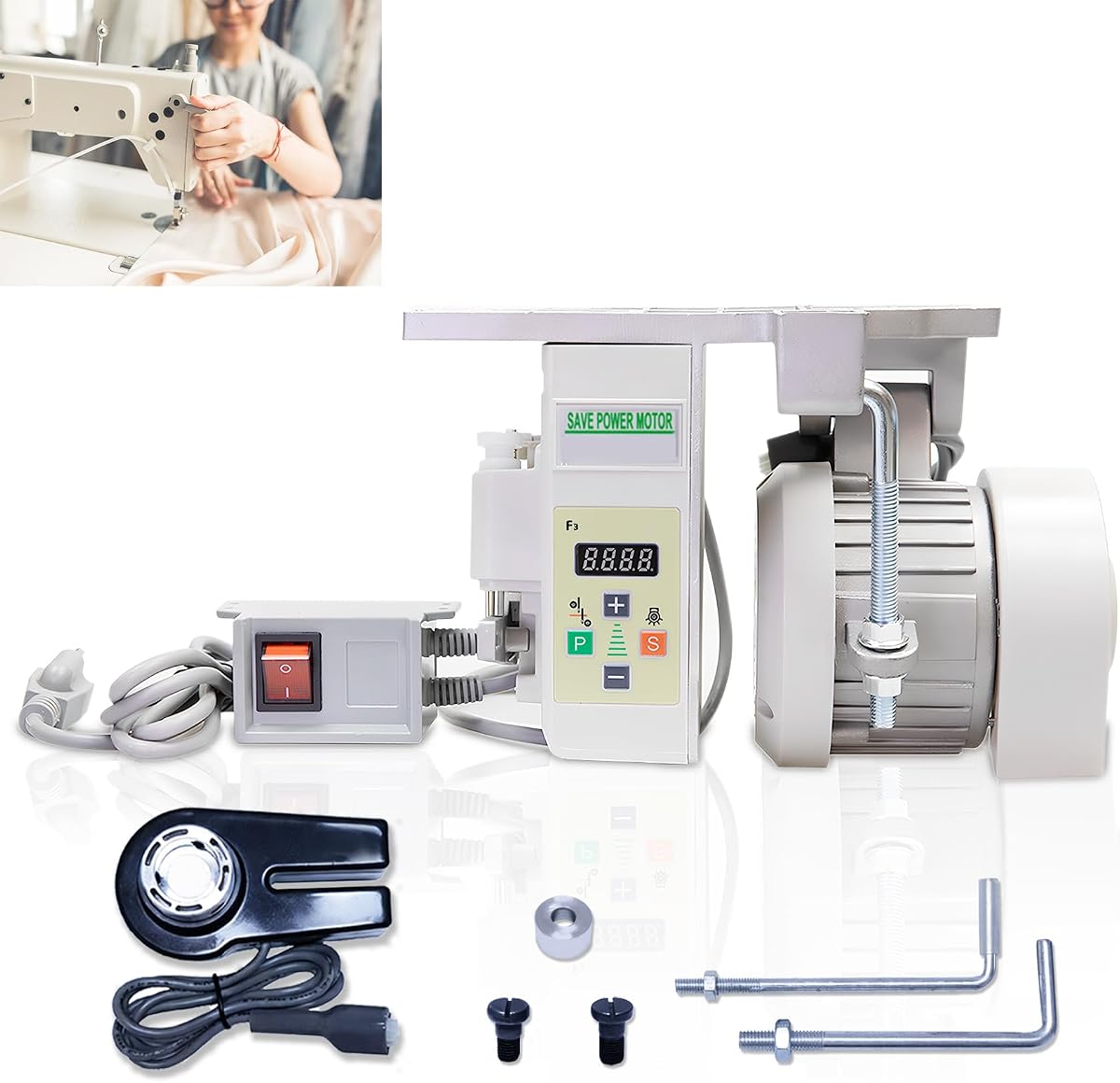


This 750W brushless industrial sewing machine servo motor carries a 4.2 rating and presents a straightforward combination of power, efficiency, and installation convenience. Its full-metal housing, pure copper coils, and stated compatibility with Juki, Brother, Singer, flatbed, twin-needle, and overlock or serger machines make it a broad candidate for common belt-driven equipment.
We may earn a commission when you buy through this link, at no additional cost to you.
The strongest part of the proposition is the balance between useful specifications and an accessible installation package. Product information says the motor includes bolts, a damper, and a belt cover, while an illustrated manual is intended to make assembly easier for beginners. That combination can reduce the need to source several separate pieces before beginning a conversion.
Energy-saving and mute operation are also important selling points. The listing claims 51% energy savings and operation quieter than normal conversation, though actual results will depend on the machine, belt, workroom, and task. Buyers should not treat those claims as guaranteed acoustic or electrical measurements for every installation.
This motor is a sensible pick for a home workshop, small tailoring operation, or established industrial machine that operates on AC110V and accepts standard clutch-motor mounting. Confirm voltage, mounting geometry, belt dimensions, and machine requirements before ordering, especially if the machine uses unusual electronics or controls.
The rated 750W and 1HP output places this unit in a practical class for many industrial sewing tasks. Its stated support for major machine brands and several common machine types makes it a sensible starting point when replacing a conventional clutch motor on a compatible belt-driven machine.
Bolts, a damper, a belt cover, and an illustrated manual are listed as included. Buyers should still inspect the machine's mounting pattern and verify that the supplied pulley and hardware are appropriate before dismantling the existing motor.
We may earn a commission when you buy through this link, at no additional cost to you.
This brushless servo motor earns a 4.4 rating and combines a 750W rating with a stated 200-6000 RPM operating range. It is designed for operators who want more granular speed control than a simple on/off motor provides, especially when moving between slow precision work and faster production sewing.
We may earn a commission when you buy through this link, at no additional cost to you.
The package includes the brushless motor, controller, foot pedal, English manual, and mounting components. Those components create a more complete control system than a basic replacement motor. The controller allows operating parameters to be adjusted, while the foot switch gives the operator direct control during sewing.
Construction details support the durability positioning: a metal frame, pure copper coil, and aluminum heat sink are specified. The product also claims smooth operation with low noise and vibration, which can be valuable in shared studios, residential workshops, and production rooms where conventional clutch motors are louder.
Choose this option for a compatible belt-driven flatbed, overlock, upholstery, twin-needle, or similar industrial machine. The reversible direction is useful for specialized setups, but direction, speed limits, and machine-specific behavior must be checked in the manual. It is a strong fit for users who value controller-based flexibility over a simpler switch arrangement.
A stated range of 200-6000 RPM supports both slow positioning and high-speed sewing. The actual usable range still depends on the machine, pulley ratio, needle material, fabric, and foot control, so operators should introduce new settings gradually.
The brushless design is positioned as a quieter alternative to traditional clutch motors. Lower mechanical noise can make focused work easier and reduce disturbance in a home studio or compact garment workshop.
We may earn a commission when you buy through this link, at no additional cost to you.
This 550W carbon-brush servo motor has a 4.6 rating and is built around straightforward speed adjustment. A switch on the side of the motor changes operating speed, providing a simpler control arrangement than a full digital controller while still allowing the operator to match speed to the task.
We may earn a commission when you buy through this link, at no additional cost to you.
The product is listed for flatbed, twin-needle, straight-stitch, overlock, serger, blindstitch, and other industrial machines, including Juki models. Its metal case and protective design are intended to withstand regular commercial use, while an energy-saving claim of roughly 50% compared with traditional clutch motors addresses operating efficiency.
The principal trade-off is the carbon-brush system. Brushes can wear and need replacement, although an extra set is included and the listing describes the motor as comparatively easy to maintain. Buyers who prefer brushless construction may accept that maintenance consideration in exchange for direct speed control.
This motor is well suited to owners who want simple controls, moderate power, and broad industrial-machine coverage. It is especially attractive if the operator does not need a very high maximum speed or bidirectional rotation. Verify the machine voltage, mounting holes, and belt arrangement before replacing the original motor.
The side-mounted switch makes speed selection approachable for new users. It is a useful alternative when the work requires frequent changes but not the advanced parameter settings found on a digital servo controller.
Carbon brushes are consumable components, but their replaceability can simplify repairs. The included spare set gives owners an initial replacement option when normal wear eventually affects performance.
We may earn a commission when you buy through this link, at no additional cost to you.
This 750W carbon-brush servo motor carries a 4.7 rating, the highest among the reviewed products. It combines more power than the 550W alternatives with the accessible side-switch control arrangement, making it a balanced option for operators who value straightforward adjustment and practical output.
We may earn a commission when you buy through this link, at no additional cost to you.
Its stated applications include flatbed, twin-needle, straight-stitch, overlock, serger, and blindstitch machines, with Juki machines specifically mentioned. The metal case and protective construction target daily industrial service. Mounting bolts, attachment hardware, a damper, belt cover, switch, spare carbon brushes, and an instruction manual are included.
The carbon-brush mechanism is the main compromise. It will eventually wear and may need replacement, but the included spare set and simple structure can make servicing easier than replacing an integrated brushless assembly. The listed maximum speed of 3450 RPM is sufficient for many conventional industrial applications but trails the 6000 RPM controllers.
This is our Editor's Choice for buyers seeking a middle ground between power, simplicity, and compatibility. It suits garment workshops and tailoring businesses that regularly use industrial machines and want straightforward speed changes without a more complex controller. Check electrical requirements and physical dimensions before installation.
The 750W rating provides additional capacity for demanding seam work compared with 550W choices. Actual performance still depends on pulley ratio, machine condition, needle setup, and the fabric being stitched.
The side switch is useful when operators want fast, uncomplicated changes. It avoids the need to navigate controller menus while retaining variable motor speed for different sewing tasks.
We may earn a commission when you buy through this link, at no additional cost to you.
This 550W industrial servo motor has a 4.9 rating and emphasizes high starting torque and dependable high-load operation. Its clutchless 110V configuration, 3/4HP output, and maximum speed of 3450 RPM make it a practical candidate for industrial sewing applications involving thick or high-density fabrics.
We may earn a commission when you buy through this link, at no additional cost to you.
Carbon-brush construction is central to the product's approach. The listing says the design provides strong torque at lower speeds, allows broad speed adjustment from slow precision stitching to faster straight-line sewing, and can handle higher current demands during extended high-load work.
Maintenance is another important strength. When the brushes wear, they can be replaced to restore operation rather than requiring the entire motor to be discarded. That simplicity may appeal to workshop owners who value straightforward serviceability over a fully sealed brushless system.
The motor is best for an industrial machine owner who prioritizes starting torque, high-load capacity, and simple repairs. Buyers should confirm whether the machine expects a standard clutch-motor mounting arrangement, what pulley is required, and how speed control is integrated with their particular sewing equipment.
High starting torque helps a machine begin moving without excessive hesitation when handling heavy material. This can be valuable for upholstery, canvas, leather-like products, and dense garment fabrics.
Replaceable carbon brushes can extend the useful life of the motor and simplify routine maintenance. Operators should still keep replacement brushes and the correct tooling on hand for planned servicing.
We may earn a commission when you buy through this link, at no additional cost to you.
This 750W brushless servo motor combines a controller and foot switch with a stated 200-6000 RPM range and CW/CCW rotation. Its 4.4 rating reflects a feature-rich option aimed at operators who want flexible speed control, direct pedal operation, and built-in electrical safeguards.
We may earn a commission when you buy through this link, at no additional cost to you.
Compatibility is stated for belt-driven flatbed, overlock, serger, twin-needle, decorative, and similar commercial machines. Juki DDL-8700 and DDL-8100 models are named, along with selected Brother, Singer, and comparable industrial models. Standard mounting holes are intended to simplify replacement.
The controller includes protections for overcurrent, voltage spikes, short circuits, and interference. The product information also provides an ER03 troubleshooting note: power should be turned off, the motor Hall wire plug checked, and the connection reseated before restarting or further investigating a damaged wire.
This is a well-rounded choice for home sewing rooms, tailoring shops, garment workshops, and small factories that value digital adjustment and low noise. Confirm machine compatibility, belt size, mounting geometry, controller placement, and electrical supply before purchase. The foot switch should also be positioned within comfortable reach.
Protection against overcurrent, short circuits, voltage spikes, and interference provides useful safeguards around the motor and controller. These features do not replace careful installation, correct wiring, or normal operator attention.
CW and CCW operation expands the motor's usefulness for compatible industrial setups. The broad speed range also supports gradual increases while operators become familiar with a newly installed system.
We may earn a commission when you buy through this link, at no additional cost to you.
The Consew CSM3000 is a 110V, 750W, 1HP brushless servo motor designed specifically for industrial sewing machines. Its 4.6 rating and clearly defined product identity make it the most model-specific option in the group, which can be a major advantage when it matches the intended equipment.
We may earn a commission when you buy through this link, at no additional cost to you.
A notable benefit is the elimination of the clutch and brake disk. The handwheel can be turned easily to position the needle, giving operators a convenient way to begin or end a seam. Electronic speed control covers 0-3600 RPM, allowing fine control from stationary positioning through active sewing.
Installation is streamlined through standard clutch-motor mounting holes. The stated package includes a belt guard, pulley, mounting hardware, power cord, and plug, reducing the need to assemble a separate accessory list. Energy use is stated to fall by up to 70%, with minimal draw and quiet behavior while idle.
This motor is best for owners of compatible Consew equipment or other industrial machines that accept the specified configuration. Buyers should confirm exact model compatibility rather than relying only on general dimensional similarity. Its focused design, needle-positioning convenience, and complete package justify selecting it as the premium option in this roundup.
Without a clutch or brake disk, the handwheel remains easy to turn. This makes manual needle positioning more convenient for precise setup, finishing a seam, and other positioning tasks.
The included belt guard, pulley, mounting hardware, power cord, and plug provide the main components needed for installation. The package remains most suitable when the machine's voltage, mounting pattern, and pulley arrangement match the unit.
We may earn a commission when you buy through this link, at no additional cost to you.
This 750W brushless servo motor stands apart through its included needle positioner and synchronizer. The 4.1 rating is the lowest among the ten options, but the specialized accessories may appeal to operators who want more convenient needle placement and integrated control functions.
We may earn a commission when you buy through this link, at no additional cost to you.
Its stated 200-6000 RPM range supports a wide variety of work, from fine stitching to demanding denim and industrial production. Compatibility is listed for Juki DDL-8700 and DDL-8100 models, Brother, Singer, walking-foot, overlock, upholstery, and other industrial machines.
Durability features include a full-metal body, pure copper windings, and an aluminum heat shield. The listing also mentions overcurrent, voltage-spike, short-circuit, and jamming protections. Installation hardware, belt cover, damper, and an illustrated manual are included, while standard clutch-motor holes are intended to ease replacement.
This option is worth considering for an industrial setup that specifically benefits from a needle positioner and synchronizer. The lower rating may reflect its relative appeal or available feedback rather than a complete absence of useful features. Confirm accessory requirements and electrical compatibility before buying.
The integrated needle positioner can make setup and seam-end handling more convenient. The synchronizer adds another control element intended to coordinate motor behavior, though actual operation depends on the connected machine.
The stated 200-6000 RPM span and CW/CCW capability provide flexible configuration for compatible systems. Operators should increase speed gradually and follow the included instructions for wiring and parameter setup.
We may earn a commission when you buy through this link, at no additional cost to you.
This industrial brushless servo motor offers a 750W rating, a stated 200-6000 RPM range, and CW/CCW rotation. Its 4.2 rating places it behind several alternatives, but it remains a capable choice for a compatible belt-driven machine that needs flexible speed and direction control.
We may earn a commission when you buy through this link, at no additional cost to you.
The motor is listed as compatible with Juki DDL-8700 and DDL-8100 models, Brother, Singer, walking-foot, overlock, upholstery, and other industrial machines. Standard clutch-motor mounting holes are intended to simplify replacement, while the kit includes bolts, a belt cover, and a damper.
Its full-metal body, pure copper windings, and aluminum heat shield support the stated durability positioning. Quiet operation and energy savings are central benefits, helping make the motor suitable for home studios and industrial environments where noise and unnecessary power consumption matter.
Compared with the more elaborate needle-positioner model, this unit may offer a simpler general-purpose package. It is best suited to a compatible industrial sewing machine and an operator who prioritizes speed range, direction capability, and straightforward installation over specialized positioning accessories.
The stated machine coverage includes several familiar industrial platforms and common configurations. Compatibility still depends on exact dimensions, voltage, belt position, and the electrical requirements of the connected machine.
The broad speed range lets operators select slower settings for delicate work and higher settings for efficient seam production. Brushless construction is intended to reduce mechanical noise throughout normal use.
We may earn a commission when you buy through this link, at no additional cost to you.
This brushless industrial sewing machine servo motor is titled as a 1000W AC110V model and carries a 4.6 rating. It offers the highest nominal power in the comparison, a 200-6000 RPM range, and both CW and CCW operation, making it a strong candidate for compatible high-output machines.
We may earn a commission when you buy through this link, at no additional cost to you.
The stated package includes a speed controller, foot switch, English manual, and installation hardware. The product information also describes a metal frame, pure copper windings, and an aluminum heat sink to support heat dissipation and stability during long sewing sessions. Multiple protections cover overcurrent, voltage spikes, short circuits, and interference.
The product page contains an inconsistency: the title identifies a 1000W motor, while one portion of the kit description refers to a 750W brushless motor. Buyers should confirm the actual motor label and package contents with the seller before ordering rather than assuming that every specification on the page is consistent.
Despite that ambiguity, the model is attractive for workshops seeking greater rated capacity than the 550W and 750W alternatives. Verify physical fit, pulley requirements, machine electronics, and the final electrical specification. It is best suited to operators who genuinely need the additional capacity and can verify the delivered configuration.
A stated 1000W output gives this model more nominal capacity than the other reviewed options. The practical benefit appears only when the connected machine, belt setup, and workload can use that capacity effectively.
The 1000W title and 750W kit reference create a material specification discrepancy. Confirming the motor label, controller compatibility, and physical package contents before a return window closes is especially important.
We may earn a commission when you buy through this link, at no additional cost to you.
A useful sewing machine servo motor must fit the machine electrically and physically while providing the control, torque, and speed required by the work. The following factors help narrow the field without overlooking installation details or long-term maintenance.
Most products in this guide are designed for AC110V or 110V industrial sewing machines, but voltage is only the first requirement. Check the machine's nameplate, existing motor configuration, control system, and installation instructions. A replacement may also need a specific pulley, belt, mounting pattern, plug, or electrical connection. Models listing Juki DDL-8700 and DDL-8100 compatibility are still not automatically suitable for every machine carrying similar names.
The reviewed range covers 550W, 750W, and a model titled as 1000W. More power can be useful for heavy fabric, long seams, and demanding production work, but it does not automatically make every installation better. The machine's internal mechanism, pulley ratio, needle, foot, and material all influence the result. A 550W motor with suitable torque may handle a normal workload more effectively than an oversized unit installed with incorrect components.
Speed options range from 0-3600 RPM in the Consew model to advertised ranges reaching 6000 RPM. A wider range can support everything from precise positioning to fast production stitching. Control style matters too: side switches offer direct simplicity, while digital controllers support more parameter adjustment and may include foot switches. Some models can run in both CW and CCW directions, which is useful only when the connected configuration requires it.
Brushless motors are promoted as quiet, smooth, and low in vibration, with no replaceable brush set to maintain. Carbon-brush designs can provide strong starting torque and straightforward servicing because worn brushes can be replaced. The 550W and 750W switch-controlled models include spare brushes, making this trade-off understandable. Choose brushless for low mechanical noise and simpler ongoing care, or consider carbon brush when high starting torque and serviceable components are priorities.
A complete kit may include bolts, mounting hardware, a damper, belt cover, pulley, power cord, foot switch, controller, or manual. Package contents vary across the list, so compare them rather than assuming every model is equally complete. Standard clutch-motor mounting holes are repeatedly cited, but buyers should measure the available space and inspect the existing pulley. An illustrated manual can be especially helpful for first-time conversions.
Several products claim energy savings of roughly 50%, 51%, or as much as 70% to 75% compared with conventional clutch motors. Such figures are useful for understanding the intended advantage but should not be treated as universal test results. Consumption varies with workload, machine efficiency, idle time, control behavior, and local conditions. A motor that consumes little power while the machine is not sewing can still provide meaningful savings in busy garment workshops.
Quiet operation matters most in residential rooms, shared studios, and workshops near conversations or customers. Brushless products repeatedly emphasize mute or low-noise performance, while carbon-brush models also describe reduced noise relative to older clutch motors. Actual sound depends on the entire system, including belts, pulleys, the sewing machine, and work surfaces. Installing the motor on a stable base and using correct belts can influence both noise and vibration.
Electronic protections for overcurrent, voltage spikes, short circuits, interference, and jamming add useful safeguards. They do not eliminate the need for correct wiring or routine inspection. Look for understandable troubleshooting guidance, replacement parts, and a clear warranty or support process. The products list response commitments ranging from within 24 hours to broader support availability, but buyers should save setup documentation and retain purchase records before installing a motor.
Begin by identifying the machine's voltage, mounting pattern, pulley type, and required controller or foot switch. Disconnect power before removing the existing motor and installing the replacement. Align the new unit with the standard mounting holes, connect the belt and electrical components exactly as described in the included manual, and check that the pulley turns freely without rubbing the belt guard or frame.
Power the controller and motor according to the instructions, then begin at a low speed. Confirm that the machine runs in the intended direction and that the needle stops or positions correctly. Gradually increase speed while watching for unusual vibration, belt slippage, overheating, loose connections, or inconsistent needle positioning. Stop the machine if the controller reports an error, and disconnect power before inspecting plugs or wiring.
For ongoing care, keep the motor and heat sink free of lint and thread, inspect belts and pulleys regularly, and tighten mounting hardware without over-tightening. Brushless motors require no brush replacement, while carbon-brush models should be checked as brushes wear and replaced with the correct compatible parts. Schedule servicing for unusual noise, vibration, heat, or speed changes, and consult the machine and motor manuals whenever compatibility or settings are uncertain.
Often, yes, when the sewing machine uses a compatible belt-driven motor arrangement and the electrical and mounting specifications match. Most of the reviewed products cite standard clutch-motor mounting holes, but the pulley, belt, voltage, control method, and machine electronics must also be checked. A machine manufacturer or qualified technician can confirm suitability when the listing is unclear.
Brushless motors are generally marketed as quieter because they do not contain the mechanical brush assembly found in carbon-brush motors. The complete system still produces sound from the sewing machine, belt, pulleys, and worktable. Installation quality, belt condition, machine balance, and the operating speed all influence the final noise level.
Those figures describe nominal electrical power rather than the amount of usable sewing performance. Actual output depends on the motor's construction, the machine, pulley ratio, speed, needle, fabric, and duty cycle. A higher number may provide additional capacity for demanding work, but compatibility and correct setup remain more important than wattage alone.
It depends on the model and control design. Several brushless options explicitly include a controller and foot switch, while the side-switch carbon-brush models use a simpler adjustment method. The 750W and 550W models generally do not include the foot switch. Check the package contents before assuming that every listed motor arrives with the same controls.
Only if the motor, controller, and sewing machine all use compatible AC110V power and the installation meets the machine's requirements. Some listings also mention 110V, while a portion of one product description refers to different component wording, so exact labels should be verified. Never connect a motor to an incompatible supply or bypass required safety components.
A clutch motor typically runs continuously and uses a mechanical clutch to engage the sewing machine. A servo motor controls power electronically and can reduce activity while the machine is idle, provide adjustable speed, and often run more quietly. The exact behavior and installation requirements depend on the model and controller.
For side-switch models, rotate the switch on the side of the motor as directed by the manual. Controller-based systems normally use their controller interface or foot switch, with speed adjusted gradually. Do not operate the machine at a speed unsupported by the needle, thread, fabric, pulley, or machine instructions.
Replacement depends on operating hours, workload, motor condition, and the quality of the brushes. Some of the reviewed carbon-brush products include an extra set, but owners should keep compatible replacements available. If vibration, noise, sparking, or unstable speed increases, stop using the motor and inspect it rather than continuing until it fails.
The Best Budget pick is the 750W brushless model for buyers seeking a broad compatibility statement, installation hardware, and an accessible package. The Editor's Choice is the 750W carbon-brush motor because its 4.7 rating combines useful power with uncomplicated side-switch control, while the Consew CSM3000 stands as the Best Premium option for buyers who can confirm model-specific compatibility and value its focused industrial design.
For everyone else, prioritize exact electrical and physical fit before comparing speed ranges or power. Side-switch models are compelling for straightforward operation, controller systems provide more control, and brushless designs reduce brush maintenance. Carbon-brush motors may suit owners who value replaceable parts and strong starting torque, provided routine servicing is acceptable.
Marketplace ratings, product details, availability, and pricing can change over time. Review the current listing and manufacturer instructions before purchase, confirm that all required components are included, and ask the seller to resolve any specification ambiguity. A careful compatibility check is the most important step in selecting the right sewing machine servo motor.