
Moukey Microphone Isolation Shield
4.4Editor score
Three-layer sound treatment
Compact three-panel folding design
Includes stand thread adapters
A microphone shield creates a more controlled recording environment by absorbing reflections and reducing unwanted sound arriving from the sides and rear. The best models combine dense acoustic foam, stable framing, useful mounting hardware, and a shape that suits your microphone, room, and recording style.
This guide compares ten microphone isolation shields and related recording bundles across noise control, panel construction, portability, microphone compatibility, included accessories, stand support, and ease of setup. It covers compact desktop designs, larger folding booths, enclosed foam shields, and complete podcasting kits for different budgets and spaces.
Each review explains the product's strongest benefits, practical limitations, and ideal recording environment. The top selections represent the strongest overall options, while the full list includes alternatives for travel, minimal desk space, complete microphone setups, and users who already own a stand. Product availability and pricing can change.
4.4Editor score
4.6Editor score

4.4Editor score
As an Amazon Associate we earn from qualifying purchases.
The comparison below highlights the construction, coverage, compatibility, and included equipment that distinguish each recording shield, from compact desktop models to complete microphone and stand bundles.



This enclosed foam microphone shield has a 4.5 rating and stands out for combining acoustic isolation with a front pop filter. Its five-sided construction surrounds the microphone rather than leaving it in an open reflective position, making it a practical choice for voice-over, podcasting, streaming, and close microphone work where room reflections and plosives are concerns.
We may earn a commission when you buy through this link, at no additional cost to you.
The interior uses sound-absorbing foam, while the front side incorporates double-layer screening. That combination targets two common recording problems at once: unwanted sound entering from several directions and harsh air bursts striking the microphone. The removable holder accommodates most XLR and USB condenser microphones with a removable-jacket diameter between 50 and 75 millimeters, offering more flexibility than a fixed one-size opening.
Its main trade-off is dimensional compatibility. A microphone that falls outside the stated range may not sit properly in the holder, and the enclosed design is most useful for speech-focused recording rather than broadly capturing an instrument. At only 120 grams, it also adds little bulk to a portable setup and can be fitted to desktop stands, tripods, cantilever arms, or floor stands.
This is a strong choice for creators who want a compact all-in-one microphone windshield without purchasing separate panels and a large folding booth. It is especially attractive for personal recording, radio work, outdoor performance, and professional studio use where controlling reflections around a vocal microphone matters. For users with a larger or unusually shaped microphone, checking the holder dimensions before buying is essential.
The double-layer front screen helps soften plosive consonants, while the five-sided foam body reduces interference and reflections reaching the microphone from multiple directions. This makes the shield useful when the recording space itself is not fully treated.
At 120 grams, the shield is easy to move between a desk, stand, or mobile location. Its included holder and broad stand compatibility also reduce the number of separate accessories required for a basic vocal recording setup.
We may earn a commission when you buy through this link, at no additional cost to you.
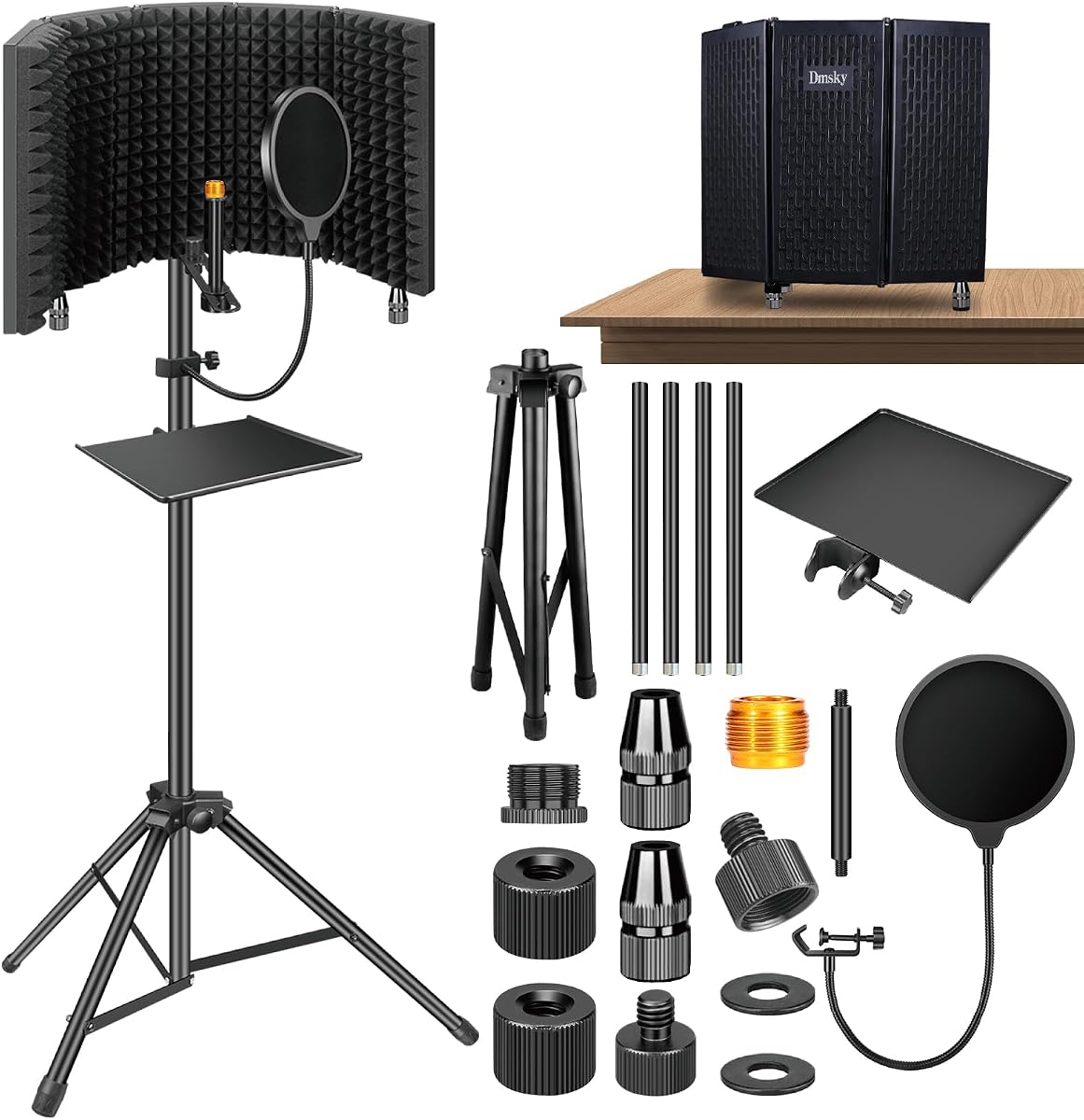
The Dmsky kit earns a 4.6 rating, the highest among the products in this guide, and offers the most complete general-purpose package. It combines a five-panel folding isolation shield, a full-height adjustable steel stand, a pop filter, mounting adapters, and a storage tray. That combination makes it a strong starting point for podcasters, streamers, singers, broadcasters, and home-studio creators who do not already own a substantial microphone setup.
We may earn a commission when you buy through this link, at no additional cost to you.
The shield uses a three-part acoustic approach described as reflective, filter, and absorbing layers. Its high-density foam is intended to reduce audio-wave bounceback and interference, while the reflective area helps redirect sound away from the open side of the booth. Five panels can be adjusted by 180 degrees, allowing the user to form a tighter or more open enclosure depending on the room, microphone, and desired amount of isolation.
The bundled stand is made from steel and adjusts to a maximum height of 78.7 inches. It can be used on a desk, mounted to a boom through an adjuster, or positioned for both seated and standing work. The product description includes a note that the received stand tube may differ from the image, although both versions are described as steel and the stand screws as removable. This is worth noting for buyers who place great importance on exact appearance.
The Dmsky kit is the most convenient all-in-one option here because it removes the need to separately assemble a shield, stand, pop filter, and adapters. The storage tray is also useful for an external sound card or mobile phone. Its main disadvantage is bulk, making it less convenient for frequent travel than a compact enclosure. Even so, the combination of flexible panels, sturdy support, and useful accessories makes it the strongest recommendation for a comprehensive first recording setup.
The included steel tripod, pop filter, adapters, and storage tray create a functional recording station rather than just a standalone acoustic panel. It is especially convenient for users setting up podcast, broadcast, or streaming equipment for the first time.
Each of the five panels adjusts through 180 degrees, so the shield can be configured more tightly for noisy spaces or opened slightly for monitoring and natural room response. This adaptability is valuable when moving between different recording environments.
We may earn a commission when you buy through this link, at no additional cost to you.
This three-panel Moukey shield carries a 4.4 rating and provides a focused, economical way to improve a home or project recording space. It uses reflective, filter, and absorbing layers, with high-density acoustic foam positioned to reduce reflections and interference around the microphone. The curved three-panel form is less enclosed than a five-panel booth but still gives a vocal performer a more controlled acoustic position.
We may earn a commission when you buy through this link, at no additional cost to you.
Its folding construction allows the panels to be repositioned, making it easier to tailor the angle to a microphone and recording space. The shield can sit on a desktop or tabletop for live broadcasting, or it can be mounted to a microphone stand for a more formal studio arrangement. Metal adapters convert 3/8-inch and 5/8-inch threads, allowing use with many popular stands and shock mounts.
One important limitation is that the package focuses on the shield itself. A microphone stand, microphone, and separate pop filter are not listed among the included components, so existing users may appreciate that, while beginners must account for additional accessories. Its three-panel layout also provides less rear and side coverage than the five-panel alternatives, which matters most in untreated or visibly noisy rooms.
For podcasters, singers, and voice-over artists who want a portable acoustic screen without buying a large complete kit, this model provides a balanced package. It is particularly suitable for users with limited desk space and existing microphone hardware. The combination of foldability, layered treatment, and included adapters makes it a convincing budget choice rather than a bare frame with decorative foam.
The folding panels create a partial acoustic enclosure that helps reduce nearby reflections without taking up the space required by a large booth. This makes the shield useful for apartments, offices, and temporary recording spaces.
The included 3/8-inch and 5/8-inch conversion nuts allow the shield to work with a broad range of microphone stands and shock mounts. Existing equipment owners can integrate it without purchasing a matching stand.
We may earn a commission when you buy through this link, at no additional cost to you.
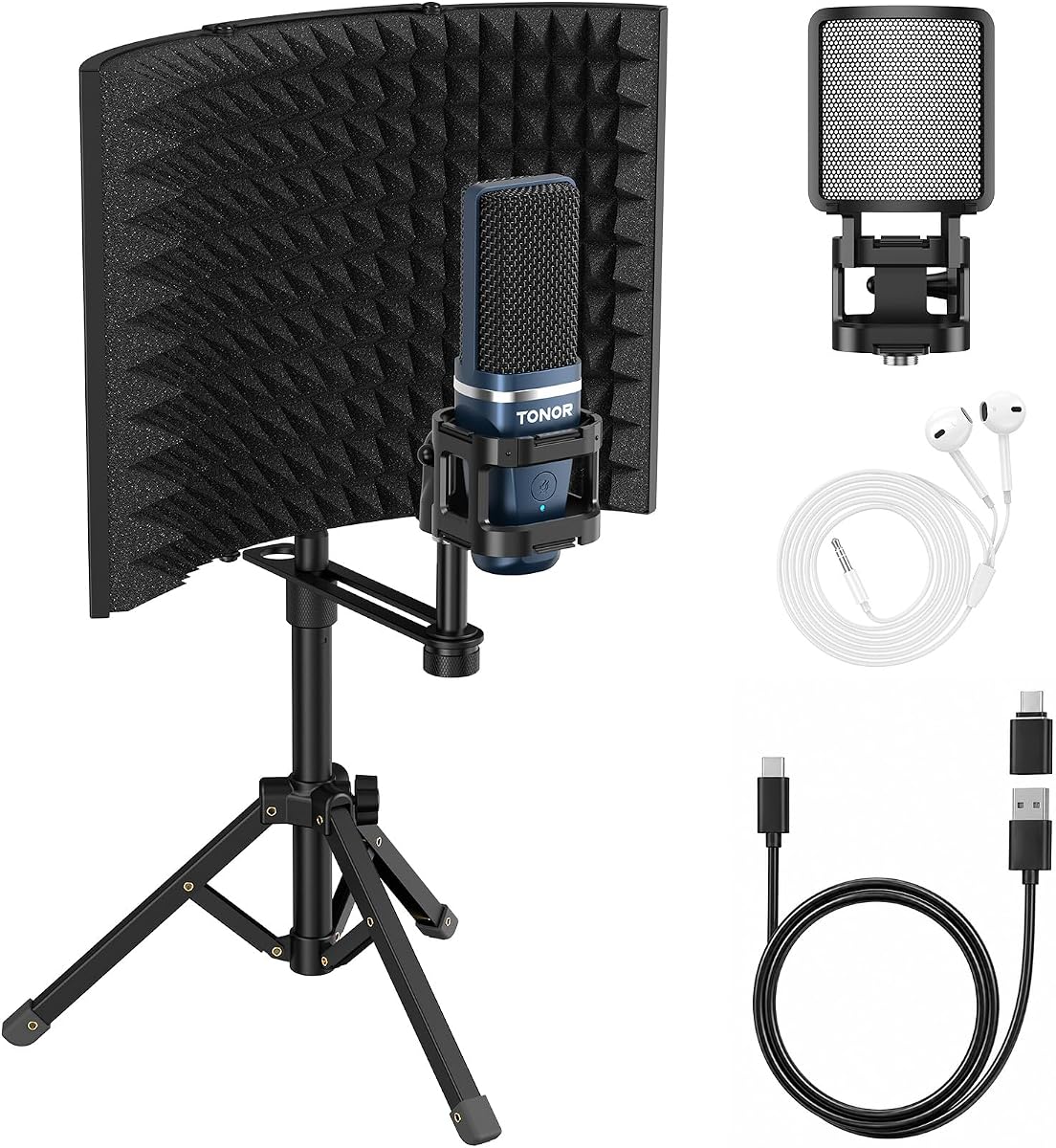
The TONOR TC777 Pro-IS bundle has a 4.3 rating and differs from the other products by including a complete USB recording microphone. Its three-panel isolation shield, dual-layer pop filter, shock mount, tripod, earphones, USB cable, and USB-C adapter provide most of the equipment required to begin recording or podcasting with one coordinated package.
We may earn a commission when you buy through this link, at no additional cost to you.
The shield uses reflective, filtration, and absorption layers, while the high-density foam is designed to reduce ambient noise and echo. It folds down and adjusts to fit more compact workspaces. On the microphone side, a one-touch mute control and LED indicator make status easy to check, and a lower gain dial allows sensitivity changes for streaming, voice-over, or meetings.
Platform compatibility is another key strength. The microphone is listed as working with Windows, macOS, iOS, Android, PS4, and PS5, and it is recognized by applications such as Zoom, Skype, and Discord. Xbox is explicitly excluded. The included metal tripod supports desk use, while a standard boom arm can be used separately. This makes the bundle particularly accessible to podcasters and remote workers who want one straightforward setup.
The main trade-off is that this is a fixed bundle rather than a choice between several microphone levels or connector styles. Someone who already owns a preferred microphone may see less value in the included unit. It also lacks the full-height stand and larger acoustic enclosure offered by the Dmsky kit. Even so, it is the clearest all-in-one option for a first podcasting setup and provides a more complete solution than a shield sold by itself.
The combination of microphone, pop filter, shock mount, headphones, cabling, adapter, shield, and tripod eliminates much of the initial shopping required for a functional recording station. It is a practical choice for users who prioritize a straightforward setup.
A one-touch mute button with a visible LED and a dedicated gain dial give the microphone convenient controls for streaming, calls, and voice-over sessions. These features are especially useful when the operator is not permanently seated at the desk.
We may earn a commission when you buy through this link, at no additional cost to you.
This microphone stand and isolation shield system has a 4.4 rating and is the most substantial stand-based option in the guide. It combines a large folding acoustic shield with a 72.8-inch steel stand, allowing creators to record while seated or standing. The package does not include a microphone, but it provides the acoustic environment and support structure needed for a complete vocal station.
We may earn a commission when you buy through this link, at no additional cost to you.
Its acoustic sandwich consists of a sound-reflective layer, a precision filter layer, and an absorption layer. The front panel is covered with studio-grade foam and backed by lightweight ABS plastic. The product description specifies 26 dB of noise reduction and also mentions dual noise-blocking zones that reduce ambient noise by 87 percent. These are manufacturer-stated figures, so actual performance will depend on the room, microphone, placement, and source of the unwanted sound.
The stand is designed for stability. A weighted triple-leg base is intended to limit tipping, while a screw-locking clamp and quick-release adapters make positioning easier. Height adjustment covers 42 to 71.5 inches, and the shield can be used on the desktop configuration or attached to a boom arm. The foldable shield measures 17.1 inches in diameter, giving the microphone substantial visual and acoustic separation from the operator.
This is the best choice for users who want a serious full-height recording station and already own a microphone. The premium construction and broad adjustment range make it useful for standing vocals, voice-over work, live streaming, and podcast sessions where a desktop shield sits too low. Its drawbacks are footprint and weight, both natural consequences of the full-size stand, and the need to source a microphone separately.
The weighted triple-leg base, industrial-strength clamp, and broad height range provide a stable platform for standing or seated work. This is important for performers who need precise microphone height and prefer not to balance equipment on a desk edge.
A 17.1-inch folding shield gives a condenser microphone greater separation from room reflections than a small desktop screen. Its layered construction is particularly relevant in rooms where the operator is close to the recording position.
We may earn a commission when you buy through this link, at no additional cost to you.
This five-sided Moukey isolation shield has a 4.4 rating and offers a middle ground between a small desktop screen and a large studio booth. Its five folding panels create a more encompassing acoustic environment than the three-panel version, while the open front keeps the microphone accessible and prevents the shield from feeling completely enclosed.
We may earn a commission when you buy through this link, at no additional cost to you.
Reflective, filtering, and absorbing layers work together in the product's acoustic design. High-density foam is used to reduce audio-wave bounceback and interference, which can improve vocal clarity in a room that has not received professional acoustic treatment. Each panel can be repositioned, allowing the user to narrow the sides for isolation or open them for a more natural sound and easier monitoring.
The rear structure is made from ABS, giving the panels a durable frame without requiring a full stand system. Anti-slip support points help prevent movement when the shield is placed on a desktop. For boom or microphone-stand use, the included metal adapters accommodate common 3/8-inch and 5/8-inch connections. A separate microphone stand and pop filter are not included in the described package.
This model suits podcasters, singers, voice-over artists, and broadcasters who want more side coverage than a basic three-panel shield but do not need a full microphone or tall stand. It folds for storage and can be deployed in home, office, or studio settings. The main compromise is its larger desktop footprint compared with the compact Moukey option, although the additional panels should provide better isolation in challenging rooms.
Five panels create a broader acoustic barrier while remaining suitable for desktop recording. This gives users more control over side reflections without requiring the footprint of a full microphone-stand system.
The adjustable arch and folding sections can be configured around different microphone positions. Creators can tighten the sides for a noisier room and leave more space open when natural acoustics or speaker monitoring are important.
We may earn a commission when you buy through this link, at no additional cost to you.
This portable three-panel sound shield has a 4.2 rating and prioritizes a small footprint and straightforward mounting. At approximately 7.48 inches tall and 10.8 inches wide, it is intended for condenser microphones placed on a desktop, tabletop, or compatible microphone arm. High-density absorbing foam lines the inner side to help reduce reflections and preserve the clarity of voices and instruments.
We may earn a commission when you buy through this link, at no additional cost to you.
Its folding panels can be angled to suit the microphone position, and the lightweight construction makes the shield easy to carry between home, office, and temporary recording locations. It can be fixed directly to a desktop setup or mounted to a microphone stand. The package includes several adapters in common 3/8-inch and 5/8-inch configurations, which is unusually generous for a compact accessory.
The clearest limitation is compatibility with the Blue Yeti microphone, which the product description explicitly says is not suitable. Users should also consider that the three small panels provide less acoustic separation than a five-panel or fully enclosed design. It is therefore more appropriate for a modestly reflective room or close vocal work than for a highly reverberant space where maximum isolation is required.
For creators who already own a microphone, stand, and pop filter, this model can provide a inexpensive improvement without taking over the desk. It is also a useful travel accessory for mobile recording. The combination of folding construction, dense foam, and multiple adapters makes it convenient, although buyers should verify the shape and dimensions of their microphone before ordering.
The compact dimensions make it practical for small desks and home offices where a full isolation booth would be intrusive. The folding panels can also be brought closer together when the shield is not in use.
A generous selection of thread adapters allows the shield to connect to multiple common microphone stands and arms. Its simple folding structure also allows the angle to be changed without complex tools.
We may earn a commission when you buy through this link, at no additional cost to you.
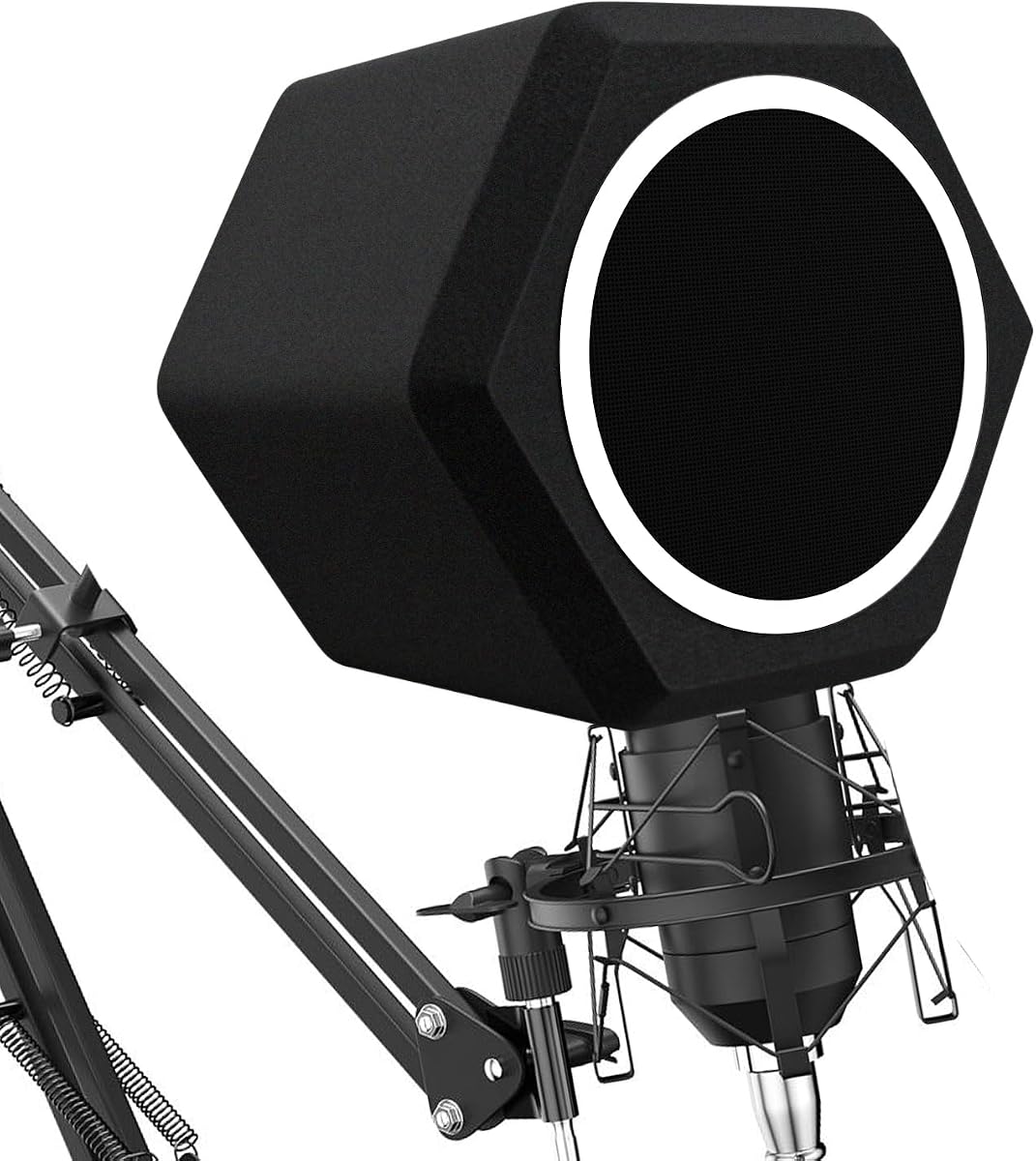
This black five-sided wind shield ball has a 4.4 rating and combines a compact acoustic enclosure with a dual-layer pop filter. Dense, durable foam is used to absorb unwanted noise and reflections, while the front screen addresses harsh sibilance and plosive consonants. It is designed for close vocal recording in home studios, offices, broadcast spaces, and professional facilities.
We may earn a commission when you buy through this link, at no additional cost to you.
The shield supports microphones between 50 and 68 millimeters in diameter, covering many compact condenser models. It weighs 200 grams, making it straightforward to carry and install on desktop stands, boom arms, floor stands, or shock mounts. The design is more enclosed than a folding panel, which can make it especially effective at keeping direct environmental reflections from reaching the sides and rear of the microphone.
The supplied information notes that neither the microphone nor holder is included. That means the enclosure will require a compatible support arrangement, and its fit should be checked against the microphone body and the way the user intends to mount it. The dual-layer pop filter is a welcome feature, but it serves a different purpose from general acoustic isolation and should not be viewed as a substitute for room treatment.
This product is best for mobile creators and podcasters who want more control than a flat pop filter but need a compact solution that can move between recording locations. Its enclosed shape can improve clarity when the microphone is close to reflective walls or a busy desktop. The main limitation is the specific 50–68 millimeter fit range, followed by the absence of an included holder and microphone.
The dual-layer front screen controls sharp plosives while the surrounding foam reduces reflections and interference. Combining both features simplifies the accessory list for close, speech-focused recording.
At 200 grams and without a bulky folding frame, the shield is convenient to move and install on different stands. It is a practical addition for creators who alternate between a home office and other recording locations.
We may earn a commission when you buy through this link, at no additional cost to you.
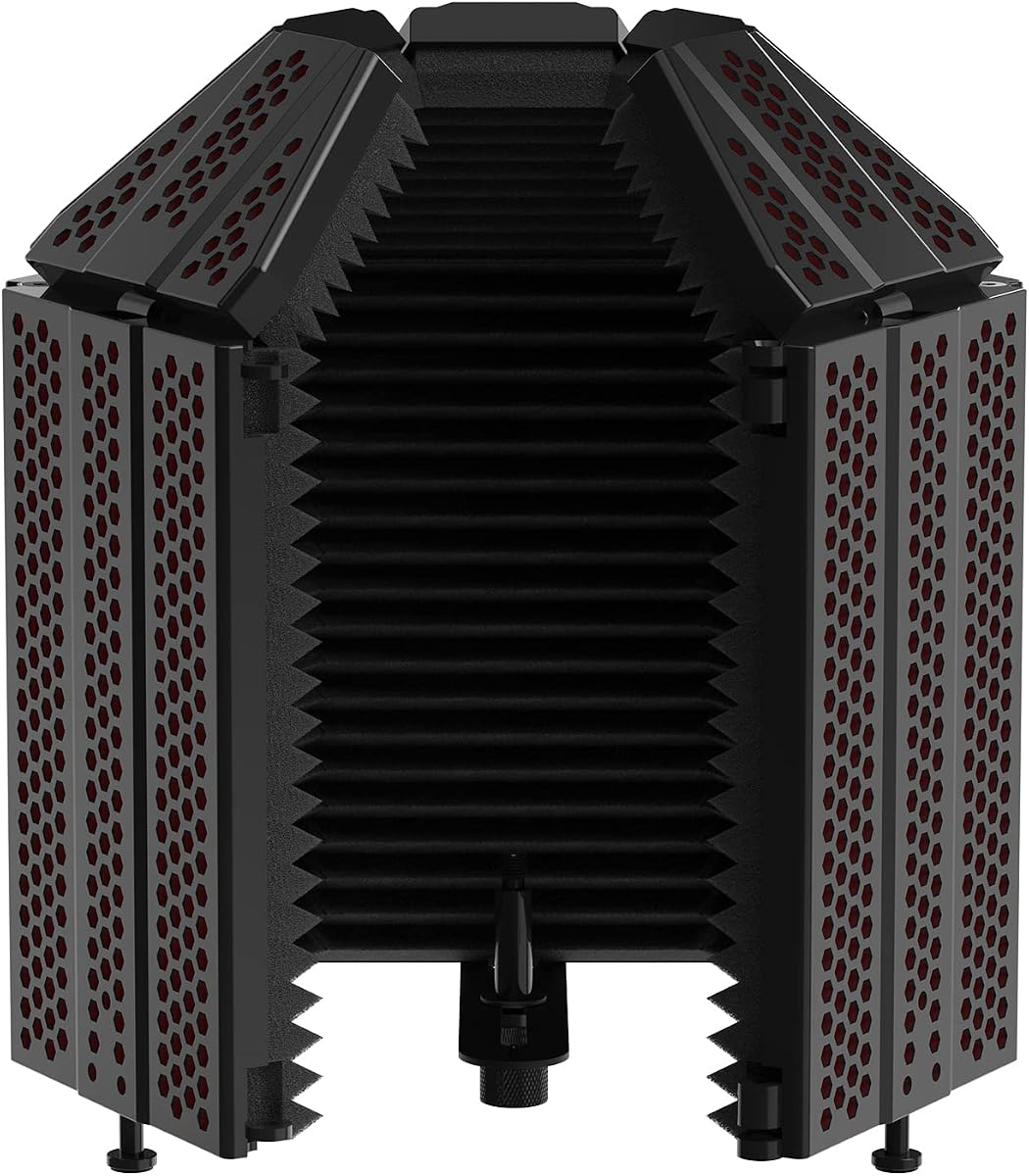
The XTUGA MIS02 has a 4.3 rating and stands out for allowing users to alternate between three-panel and five-panel configurations. It can function as a more open three-sided screen or open into a larger five-sided enclosure. This flexibility makes it useful for creators who want to balance isolation, ease of access, portability, and the acoustic character of a particular room.
We may earn a commission when you buy through this link, at no additional cost to you.
Its three-layer construction combines reflectors, filter material, and a thickened high-density foam insulator. The product description explains that these elements work together to impede interference waves and reduce the side and rear sound reaching the microphone. A foldable top provides another layer of structure, while the panels can be angled to create a more focused recording space.
The shield can be disassembled for separate installation and set directly on a desktop or fitted to a microphone stand. Because it works with multiple stand arrangements and the four end panels fold down, it can adapt to different heights and available space. It does not include a microphone or dedicated stand, making it primarily an addition for users who already have a compatible recording setup.
The XTUGA is best for vocalists, podcasters, and home-studio users who value configurability. A three-panel arrangement is convenient when the shield must be stored frequently, while the five-panel version offers more coverage in a challenging acoustic environment. The trade-off is that the product does more than a fixed three-panel shield and therefore may require more deliberate setup to achieve the balance of coverage and openness you want.
Using three panels creates a lighter, more open screen, while all five panels form a fuller enclosure. This lets one product serve both quick desktop recording and more focused isolation work.
Reflector, filter, and foam layers address reflections in different ways. The thickened insulating material is particularly useful when the microphone is positioned near walls, furniture, or untreated walls that return sound toward the capsule.
We may earn a commission when you buy through this link, at no additional cost to you.
The LZSIG XL isolation shield has a 4.3 rating and distinguishes itself with wide dimensions of 30 by 12.9 inches. Its five adjustable panels and 30-inch width create a broad acoustic barrier around the microphone, offering more surface area for absorbing reflections than smaller desktop shields. The enlarged format is aimed at podcasters, musicians, streamers, and voice-over artists who want a generous recording environment.
We may earn a commission when you buy through this link, at no additional cost to you.
Inside, a three-layer reflective, filter, and absorbing structure surrounds a high-density acoustic foam core. The stated foam density is 30 kilograms per cubic meter, or 66 pounds per 3.2 cubic feet. The intent is to reduce ambient noise, echo, and sound bounce, although the final result will depend on the room and the placement of the microphone relative to the shield.
Setup is designed to be simple and tool-free. The five panels fold, their angles can be adjusted, and the arched shape uses knob controls for positioning. A rugged ABS frame and anti-slip support points help the shield remain stable. For stand-based recording, the included adapters accommodate common 3/8-inch and 5/8-inch microphone stands, shock mounts, and dynamic or condenser microphones.
This is a strong option for users who want a wide shield without purchasing a full-height stand. It provides more coverage than a compact three-panel model, and the XL dimensions can be especially helpful for larger condenser microphones. The tradeoff is desk space: a 30-inch enclosure may crowd a small workstation, and neither a microphone nor a separate stand is included. Those constraints still leave it particularly appealing for dedicated recording corners and larger home studios.
The 30-inch width gives the microphone a broad acoustic surface to sit within. That larger area can be valuable for users working with a spacious condenser microphone in rooms with noticeable wall or furniture reflections.
Knob adjustments allow the user to alter the arch and panel angles without assembling a complex frame. The panels fold for transport or storage, making the wide design easier to manage between sessions.
We may earn a commission when you buy through this link, at no additional cost to you.
The most useful mic shield depends on your microphone, room, stand, and recording style. Compare panel coverage, acoustic layers, mounting options, included accessories, stability, and portability before choosing.
Choose a small three-panel model for limited desk space and a five-panel or enclosed design for stronger acoustic separation. Also consider the distance between the shield and the microphone so you can monitor the performer comfortably.
Prioritize dense foam and multiple working layers for untreated rooms. Treat manufacturer noise-reduction figures as directional specifications, not laboratory results for every environment.
Measure your microphone body and check its mounting pattern. For panel shields, verify that the supplied adapters match the stand or shock mount you already own.
Choose desktop support for a compact workstation and a full-height stand for standing sessions. Confirm whether the microphone, stand, pop filter, and adapters are included before calculating the remaining setup cost.
Choose an integrated filter for convenience or add a separate model for precise positioning. Keep the filter properly spaced from the microphone and avoid covering the capsule with fabric.
Prioritize lightweight materials and folding sections for frequent travel. For a permanent studio, weight and storage convenience matter less than coverage, stability, and precise positioning.
Check that the base is wide enough for the stand's center of gravity. Tighten all height and angle joints before recording and test stability with the actual microphone attached.
Choose a bundle for a fast start and a modular shield for an established studio. Confirm operating-system support, included adapters, and whether a separate boom arm must be purchased.
Begin by assembling the shield on a stable surface or compatible stand. If the panels are adjustable, set them before attaching the microphone, forming a close but breathable enclosure around the front and sides. Keep the front pop filter or screen clear of the capsule, and position the microphone at a comfortable speaking distance so the shielding does not force the performer to lean awkwardly.
For the best acoustic result, place the shield in the most reflective part of the room, ideally with its open side facing the performer. Leave enough space to monitor audio without putting a speaker directly behind the microphone. If using a full-height stand, tighten the clamp, height adjustment, and panel joints, then check that the weighted base cannot be reached or knocked by foot traffic.
Care for the shield by keeping the foam dry, removing dust with a soft brush or low-suction vacuum, and avoiding sprays or harsh cleaners on the acoustic surfaces. Wipe metal and ABS parts with a slightly damp cloth and dry them immediately. Collapse or unplug the unit before transporting it, inspect adapters for looseness, and replace damaged fasteners before the next session.
No. A mic shield mainly helps control reflections and sound arriving around the microphone, while room treatment addresses echoes and reverberation throughout the entire space. A shield can make a modest home studio more controlled, but it cannot fully correct a highly reverberant room. Professional acoustic panels, bass traps, and careful room placement remain valuable in dedicated studios.
A five-panel shield usually provides greater side and rear coverage, making it preferable in noisy or reflective rooms. A three-panel model is lighter, smaller, and often easier to monitor. The correct choice depends more on your available space and room conditions than on the number alone, since placement and microphone technique remain critical.
Enclosed shields have model-specific diameter limits. The penypeal-style shield supports removable-jacket XLR and USB condenser microphones between 50 and 75 millimeters, while the five-sided wind shield ball supports microphones between 50 and 68 millimeters. Measure the microphone body and check whether its shock mount or removable jacket affects the fit.
It depends on the product. Some kits include a separate pop filter, some enclosed shields include front screening, and others provide acoustic isolation without any pop-filter layer. Pop filtering addresses air pressure from plosives, so a separate filter can still be useful with a large-diaphragm condenser even when the shield includes a basic screen.
Many models can be attached to a microphone stand or boom arm using the included 3/8-inch and 5/8-inch adapters. Compatibility depends on the shield's mounting hardware and the boom's connection size. Check the package contents and thread dimensions before installation, and avoid forcing an adapter that does not fit correctly.
No. A shield can reduce reflections near the microphone and limit some incoming environmental sound, but it cannot eliminate every echo, keyboard noise, computer fan, or background conversation. Good microphone selection, gain control, room placement, and basic acoustic treatment still determine much of the final recording quality.
It depends on the product. Self-supporting desktop designs can often be placed directly on a table, while full-height and boom-arm configurations require a compatible stand. The Dmsky and TONOR bundles include tripods, but most standalone shields do not. Always check the listed package contents before assuming that a stand is included.
The filter should sit between the speaker and microphone without touching the capsule or its protective grille. Adjust the distance so plosive bursts are controlled without the filter obstructing the intended frequency response. A separate filter can usually be positioned and adjusted independently, which is helpful when testing different vocal techniques.
The Dmsky kit is the strongest all-around recommendation because it combines five adjustable panels with a steel tripod, pop filter, adapters, and storage tray. The Moukey three-panel model is an effective budget option for creators who already own a stand, while the full-height Microphone Stand With Isolation Shield is the premium choice for standing sessions and precise positioning.
Before purchasing, prioritize microphone fit, stand compatibility, available desk space, and the severity of reflections in your recording room. Compact enclosed shields are convenient for mobile voice work, wide folding panels provide more surface area, and complete bundles save time for beginners. Remember that a shield works best with careful placement, sensible gain settings, and reasonable expectations.
Finally, check the current listing details and product specifications before ordering, since microphone compatibility, included accessories, stand designs, and product availability can change. Reading current customer feedback alongside this comparison can also help confirm whether the shield suits the microphone and setup you already own.