
DR302 DIN Rail Modbus Gateway
4.5Editor score
DIN rail mounting
Modbus RTU to TCP
TCP and UDP modes
Compare 10 RS485 to Ethernet Converter options across Modbus support, serial ports, mounting, network modes, power, security, and configuration at a glance.
An RS485 to Ethernet Converter bridges industrial serial equipment with an IP-based network, making it easier to monitor and control devices such as PLCs, sensors, meters, and Modbus-compatible instruments. The right model should align with your serial interfaces, network architecture, operating environment, and maintenance requirements rather than simply offering the broadest feature list.
This guide compares ten converters based on the supplied specifications, including supported serial standards, Modbus conversion, TCP and UDP operating modes, Ethernet capabilities, power options, mounting methods, watchdog features, cloud support, and configuration access. It covers compact single-purpose modules, dual-port devices, wireless models, and gateways designed for multiple RS485 connections.
Each review highlights the features that distinguish one product from another and identifies the kinds of installations for which it appears most suitable. Ratings and product details can change over time, and pricing also fluctuates, so readers should verify current specifications, availability, and terms before making a final purchase.
4.5Editor score

5.0Editor score

4.3Editor score
The comparison below highlights the principal differences among the ten converters, including serial-port flexibility, Modbus functionality, network operation, physical installation, and remote-management features.




The DR302 DIN Rail Modbus Gateway combines a 4.5 rating with a focused set of features for connecting RS485 equipment to an Ethernet network. It is designed around Modbus RTU to Modbus TCP conversion and includes TCP server and client modes, UDP server and client modes, and virtual COM support. Its DIN rail format makes it a natural candidate for a compact control cabinet.
We may earn a commission when you buy through this link, at no additional cost to you.
The strongest feature is the combination of protocol conversion and installation practicality. The device offers a compact, lightweight enclosure intended for managed industrial spaces, while the RS485 connection provides the expected physical interface for serial equipment. Supporting both TCP and UDP gives installers more flexibility when connecting to software, control systems, or remote hosts.
The trade-off is that this is a single-purpose RS485 solution rather than a multi-interface serial server. It does not add RS232, RS422, Wi-Fi, cloud access, or a multiport design, so buyers who need to bridge several kinds of equipment may need a more elaborate gateway. Nevertheless, for a straightforward RS485-to-Modbus-TCP installation, those omissions are reasonable because the core functions are clearly identified.
Choose the DR302 when you want a compact DIN rail converter with direct Modbus RTU to TCP conversion and multiple network modes without adding unnecessary wireless or multiport features. It is especially relevant for cabinets containing one Modbus RTU network that must be made accessible over Ethernet. For that use case, it offers a strong balance of functionality, compactness, and ease of setup.
Direct Modbus RTU to Modbus TCP conversion makes this converter appropriate for control networks that need a standard Ethernet bridge. TCP server and client modes support different host relationships, while UDP modes provide alternatives for compatible environments.
DIN rail mounting and the compact, lightweight design reduce the space required beside other industrial equipment. This makes the module easier to organize than a loose desktop converter, particularly when cabling is already routed within a cabinet.
We may earn a commission when you buy through this link, at no additional cost to you.
The USR-TCP232-410s earns a 4.4 rating because it combines two serial interfaces, flexible power options, and multiple ways to configure and connect. Its RS232 and RS485 ports can operate simultaneously, which separates it from converters that require choosing only one serial standard at a time. It also supports Modbus RTU to Modbus TCP conversion and Modbus polling.
We may earn a commission when you buy through this link, at no additional cost to you.
This configuration flexibility makes the gateway useful when a site has older RS232 equipment alongside RS485 devices. TCP server and client modes, UDP server and client modes, and an HTTPD client mode cover several communication patterns. Administrators can use the webpage, AT commands, or setup software, reducing dependence on a single configuration method during commissioning or maintenance.
Redundant power support is another useful feature. The listed options are DC 5–36V or terminal power supply, giving installers more choice when integrating with available cabinet power. The omission of an explicitly stated DIN rail mounting method and cloud functionality may matter in advanced installations, but neither absence prevents it from serving as a capable local serial-to-Ethernet gateway.
The USR-TCP232-410s is best for users who need simultaneous RS232 and RS485 access, especially where commissioning teams may prefer web, command-line, or software configuration. It is also appropriate when Modbus polling and several transport modes matter more than wireless connectivity. For a dual-port, locally managed industrial gateway, this model offers an especially versatile feature set.
RS232 and RS485 can be used simultaneously, allowing separate equipment groups to share one Ethernet gateway. This can simplify installations that would otherwise require multiple serial-to-network devices.
Webpage access, AT commands, and setup software provide three ways to prepare the converter. Technicians can choose the method that best matches their tools, access level, and familiarity with the device.
We may earn a commission when you buy through this link, at no additional cost to you.
The TCP232-306 Multi-Interface Gateway has a 4.2 rating and supports RS232, RS485, and RS422, giving it broad serial-device compatibility. Its ARM Cortex-M0 platform uses an optimized TCP/IP stack with low latency and strong scalability. Modbus RTU to TCP conversion and multi-host polling add practical value for systems that need structured serial data bridged onto Ethernet.
We may earn a commission when you buy through this link, at no additional cost to you.
The standout feature is the combination of hardware and software watchdog protection. The gateway is designed to restart automatically if it goes down, helping restore communication without immediate physical intervention. That behavior is useful in unattended installations where temporary network or serial disruptions could otherwise leave equipment difficult to reach.
A 10/100Mbps Ethernet port with Auto MDI/MDIX simplifies physical connections by supporting straight-through and crossover arrangements. The tradeoff is that the supplied information does not explicitly describe simultaneous use of all three serial interfaces, so buyers should confirm the exact port behavior for their application. Like many focused industrial gateways, it also offers no listed Wi-Fi option.
Consider this gateway when equipment can use RS232, RS485, or RS422 and unattended reliability is important. It is a strong candidate for Modbus installations needing multi-host polling and automatic recovery. The combination of protocol conversion, broad serial support, and watchdog features makes it more specialized than a basic transparent serial server and more versatile than an RS485-only unit.
Hardware and software watchdog support lets the gateway restart after a failure. In a cabinet that is inconvenient or unsafe to access frequently, this recovery behavior can reduce the impact of a temporary device fault.
RS232, RS485, and RS422 support makes the converter useful for mixed industrial estates. It can bridge several generations of equipment without changing the serial protocol used by each device.
We may earn a commission when you buy through this link, at no additional cost to you.
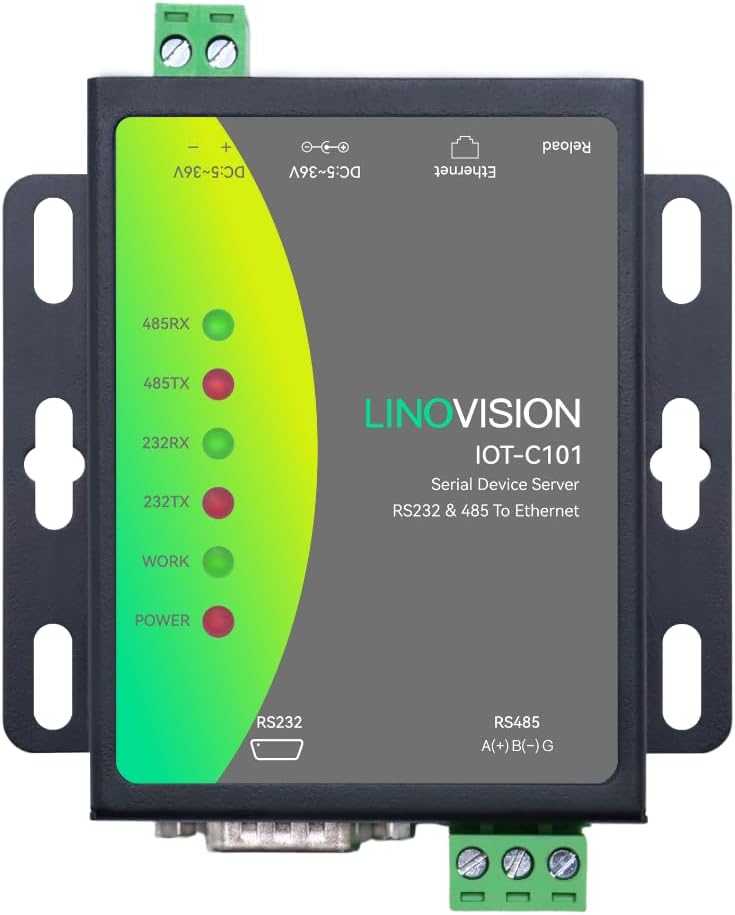
The LINOVISION Dual Port Gateway has a 4.1 rating and brings together RS232, RS485, Ethernet, Modbus conversion, and remote cloud monitoring. It is designed to integrate existing serial equipment with a network for remote monitoring and control. The gateway supports Modbus RTU/TCP conversion and multi-host polling for as many as 16 hosts.
We may earn a commission when you buy through this link, at no additional cost to you.
Its cloud service is one of the main distinctions from the more basic converters. The standard Linovision AIoT RemoteMonit service is free for up to 30 managed devices, while additional devices, storage, and customized functionality may require negotiation. This makes the product particularly interesting for small remote deployments that want centralized visibility without designing every monitoring component independently.
The industrial enclosure is IP30 rated and supports wall or rail mounting, with an operating temperature range from -40°F to 185°F. Those specifications suit many controlled indoor environments, but IP30 does not imply protection against harsh weather or substantial dust and water ingress. The number of cloud-managed devices is also a relevant planning constraint for larger estates.
Choose this gateway when remote monitoring and Modbus polling are central requirements and when a modest number of devices fit the standard cloud allowance. It is especially useful for applications involving PLCs, agricultural sensors, point-of-sale equipment, or medical devices that benefit from remote visibility. Local installers still get a versatile dual-serial gateway, while connected sites gain a path to centralized monitoring.
The RemoteMonit platform provides a cloud-oriented option for monitoring connected devices. The standard allowance covers up to 30 managed devices, making it useful for focused deployments that want centralized visibility without building a separate service.
RS232 and RS485 support, Modbus conversion, and 16-host polling suit sites with several serial devices. The broad application examples make the gateway relevant to automation, agriculture, commercial equipment, and monitored medical-device installations.
We may earn a commission when you buy through this link, at no additional cost to you.
The USR-W610 Wireless Serial Server has a 4.2 rating and stands apart by supporting bidirectional transparent transmission between RS232 or RS485 and WiFi or Ethernet. It supports 2.4GHz 802.11b/g/n wireless standards in addition to a wired network path, making it useful where running a network cable to serial equipment is inconvenient.
We may earn a commission when you buy through this link, at no additional cost to you.
The converter offers TCP server and client modes, UDP server and client modes, and an HTTP client mode. Its wireless arrangements include AP, STA, and AP+STA, allowing it to work as an access point, join an existing wireless network, or operate in a combined arrangement. RS232 and RS485 support broadens the equipment it can serve.
The principal limitation is that the stated wireless support is limited to 2.4GHz networks rather than newer WiFi bands. Buyers should also confirm their preferred physical installation method because DIN rail mounting is not specified. These constraints may matter in facilities standardized around newer wireless infrastructure or strict cabinet-mounting practices.
The USR-W610 is a strong choice for remote monitoring where WiFi is more practical than a cable run. It also works for installations that need both serial interfaces and want the option to move between wireless and Ethernet connectivity. For sites without modern WiFi requirements or needing a wired-only industrial converter, one of the more specialized gateways may be a better fit.
Bidirectional transparent data transfer over both WiFi and Ethernet lets the installer choose the path that fits the site. This flexibility is useful for temporary installations, equipment moves, or buildings where cabling is difficult.
AP, STA, and AP+STA modes cover several network relationships. A device can create a local wireless link, join infrastructure as a station, or use both arrangements according to the deployment's communication pattern.
We may earn a commission when you buy through this link, at no additional cost to you.
The USR-TCP232-306 Converter has a 4.2 rating and supports RS232, RS485, and RS422, offering a broad choice for connecting legacy serial equipment. It operates in TCP server, TCP client, UDP client, UDP server, and HTTPD client modes. The HTTPD client option is particularly notable because it can send serial data in HTTP format.
We may earn a commission when you buy through this link, at no additional cost to you.
Its wide 5–36V DC power supply is useful in industrial cabinets with varied available power. Because the converter supports multiple serial standards, it can serve projects with more than one type of equipment over its lifecycle, even though only one port is active at a time. That limitation may not matter when the network gateway is assigned to a single device or bus.
The significant compromise is the inability to use the serial ports simultaneously, as explicitly stated in the supplied information. A dual-port gateway is preferable when RS232 and RS485 equipment must remain online together through one network device. The module also does not list cloud services or an explicit watchdog, making it more of a locally managed network bridge.
Buyers looking for a straightforward, multi-standard serial server will find this converter practical. It is well suited to projects that require selectable RS232, RS485, or RS422 connectivity, a wide power range, and several TCP, UDP, or HTTP communication modes. For one serial connection at a time, it offers a capable and flexible foundation.
RS232, RS485, and RS422 compatibility gives installers flexibility in which equipment to connect. The selected interface serves one serial device or bus at a time, avoiding the need for separate converters when the project changes.
TCP and UDP modes cover common client-server and datagram arrangements, while HTTPD client mode supports serial data sent in HTTP format. This range supports both industrial software and network-oriented integrations.
We may earn a commission when you buy through this link, at no additional cost to you.
The LINOVISION 4 Port Modbus Gateway has a 4.3 rating and is the most feature-rich multi-port option in this list. Four RS485 ports allow several serial devices or buses to connect to one Ethernet gateway. Modbus RTU/TCP conversion and multi-host polling for up to 16 hosts make it especially relevant to installations that need centralized serial bridging.
We may earn a commission when you buy through this link, at no additional cost to you.
The gateway also performs local edge processing. Instead of requiring the central server to handle every raw serial data task, the device can integrate and process information from multiple serial devices locally and send it onward as custom JSON. A 400MHz Cortex-M7 processor provides the stated processing capability, while SSL/TLS encryption helps protect data in transit and reduce unauthorized-access risks.
Built-in web access allows configuration of TCP server, TCP client, UDP client, UDP server, and HTTPD client work modes. It also includes Modbus RTU to TCP conversion and Modbus polling. The advanced feature set is not automatically ideal for a simple point-to-point installation, and the IP30 enclosure means it should not be treated as a weatherproof unit.
This is the pick for multi-device sites that need more than a basic serial bridge. Choose it when consolidating four RS485 connections, reducing central server load, transmitting structured JSON, or adding encryption is important. It also suits users who can take advantage of cloud access through the standard RemoteMonit allowance. The additional capabilities justify a premium approach for larger or more demanding installations.
Four RS485 ports reduce the need for separate network converters when several devices must be connected. This is especially useful in cabinets where device density and cabling organization are already concerns.
The gateway can process data from multiple serial devices locally and send it to servers as custom JSON. This distributed approach can reduce central processing demand and improve the reliability of data transfer paths.
SSL/TLS encryption helps prevent data leakage and unauthorized access during transmission. It is a meaningful feature for industrial networks that carry operational data across organizational or external boundaries.
We may earn a commission when you buy through this link, at no additional cost to you.
The USR-TCP232-304 Ethernet Server carries a 5.0 rating and provides a focused RS485-to-TCP/IP bridge with transparent data transfer. It supports DHCP, allowing the device to obtain an IP address automatically, and the address can also be queried through the serial setting protocol. A built-in webpage provides a direct path to configuration.
We may earn a commission when you buy through this link, at no additional cost to you.
Its serial settings are versatile. The baud rate ranges from 600bps to 230.4Kbps, and parity options include None, Odd, Even, Mark, and Space. The Ethernet side uses an RJ45 10/100Mbps connection with Auto MDI/MDIX, simplifying cabling. TCP server, TCP client, UDP client, UDP server, and HTTPD client modes cover several common network roles.
For installations that need a PC or SCADA system to behave as though it is directly connected to the RS485 port, virtual serial port support is particularly useful. The supplied USR-VCOM software is listed for this purpose. The trade-off is that the module focuses on RS485 and offers no RS232, RS422, multiport, or cloud functions.
The USR-TCP232-304 is a compelling choice for a single RS485 device or bus that needs transparent Ethernet access. It is well suited to industrial networks where automatic addressing, selectable serial parameters, and flexible transport modes are important. Users seeking multiple serial ports should look to the dual- or four-port gateways, but for a focused bridge this model is remarkably capable.
The gateway carries data transparently between TCP/IP and RS485. With virtual serial port support and the listed USR-VCOM software, compatible applications can communicate through a familiar serial-port interface.
DHCP support allows the converter to obtain an IP address automatically, while serial setting protocol access offers another method for identifying it. This reduces some of the initial network configuration burden.
A broad baud-rate range and five parity choices allow the converter to match many legacy devices. This flexibility is particularly useful when integrating older RS485 equipment whose communication settings cannot be changed easily.
We may earn a commission when you buy through this link, at no additional cost to you.
The USR-DR302 DIN-Rail Converter has a 4.1 rating and is built for straightforward bidirectional transparent transmission between an RS485 port and Ethernet. Its DIN rail mounting and small size are well suited to control cabinets where tidy installation and straightforward maintenance are priorities. Configuration is available through a webpage or software.
We may earn a commission when you buy through this link, at no additional cost to you.
A useful network-management feature is the identity heartbeat packet. When the converter operates as a TCP client, it can send an identification packet to a TCP server. The packet may use an IMEI code, ICCID code, or a user-edited identity string, helping a receiving system identify the source of the connection.
The converter also lists level 4 anti-static protection, level 3 electrical pulse protection, and level 2 surge protection. These safeguards are relevant in industrial environments where cabling and connected equipment may be exposed to electrical transients. As with any protection rating, correct grounding, wiring, and installation remain important.
Buyers who want a compact RS485-to-RJ45 module for a cabinet will appreciate the DIN rail format and transparent transfer. It is less suitable when multiple serial devices, wireless access, or cloud management are required. Within its focused role, it combines practical monitoring features with physical protection suited to industrial cabling.
The TCP client can send a heartbeat or identity packet to the remote server. Using a standard IMEI, ICCID, or editable identifier can help administrators distinguish the converter and monitor its connection behavior.
Anti-static, electrical pulse, and surge protection provide several layers of resilience for connected serial equipment. These features are particularly helpful where long cable runs or electrically active industrial devices are involved.
We may earn a commission when you buy through this link, at no additional cost to you.
The Dual Port Industrial Converter has a 3.1 rating and offers a straightforward combination of RS232, RS485, and Ethernet connectivity. Its 32-bit ARM processor is listed as operating at up to 120MHz, while the Ethernet interface provides 10/100M Auto-MDI/MDIX support for convenient cabling. Bi-directional transparent data transmission is the core function.
We may earn a commission when you buy through this link, at no additional cost to you.
Both RS232 and RS485 interfaces can work independently at the same time without interfering with one another. That makes the converter more useful than a single-serial model when two separate device groups need network access. Configuration is available through a webpage, and the listing references example code for host-computer sockets and several development environments.
The main concern is the lower listed rating, which may indicate more mixed customer experiences than the higher-ranked products. The supplied specifications also provide fewer details about advanced functions such as watchdog recovery, security, cloud access, or specific operating modes. Buyers should therefore examine current documentation closely before selecting it for a critical industrial deployment.
This converter is most appropriate for cost-conscious users who specifically need two independent serial interfaces and transparent data transfer through one Ethernet connection. It may work well for straightforward integrations and prototype development. For installations requiring extensive diagnostics, documented recovery behavior, or sophisticated remote management, one of the more fully specified gateways may offer greater reassurance.
RS232 and RS485 can operate simultaneously without interfering with each other. This allows the converter to bridge two distinct serial devices or device groups while presenting one Ethernet network connection.
The listed example-code resources cover host-computer socket use and several programming environments. Those references may help software teams validate communication behavior during early development or integration work.
We may earn a commission when you buy through this link, at no additional cost to you.
Selecting an RS485 to Ethernet Converter requires matching serial requirements, network behavior, environmental needs, and management expectations. The most important starting point is the equipment already connected to the RS485 bus, followed by the way host software expects to communicate with it.
Begin by identifying every serial standard that must remain connected. Some gateways provide RS485 alone, while others include RS232, RS422, or both RS232 and RS485. A dual-port model may consolidate separate equipment, but it is important to verify whether the interfaces operate simultaneously or whether only one can be active at a time. For an existing RS485 installation, a single-interface converter is often the simplest match.
Match the converter to the required serial protocol, not just the connector type.
A transparent serial bridge carries data between serial and network clients, whereas a Modbus gateway specifically converts between Modbus RTU and Modbus TCP. That distinction affects how host software addresses the serial device and whether the converter performs request-response mapping. Multi-host polling is another useful feature when one gateway must coordinate several Modbus masters or connected devices.
Choose native Modbus conversion for Modbus-focused networks, or transparent mode for broader protocol matching.
Network behavior is determined by the relationship between the converter and the software or server that connects to it. TCP server mode waits for incoming clients, while TCP client mode establishes an outbound connection. UDP server and client modes support datagram arrangements, and HTTPD client mode is relevant where serial data must be transmitted in HTTP format. Virtual COM support may also help PC-based applications work with a network converter.
Verify that the listed operating modes match the systems that will connect to the device.
A converter with a built-in webpage, AT commands, setup software, or multiple configuration methods can simplify commissioning and maintenance. Hardware and software watchdogs add recovery behavior when a device stops responding, which is particularly useful in inaccessible installations. Cloud services and edge processing are worth considering for remote sites, multi-device estates, or applications that need centralized status information and local data preparation.
Prioritize management features that match the site's monitoring requirements and technical expertise.
Power requirements determine whether the converter can use available cabinet infrastructure. Some modules accept a broad DC range, while others offer terminal power options as well. Physical mounting also matters: DIN rail formats simplify cabinet organization, whereas wall mounting may suit distributed equipment locations. Enclosure protection and operating temperature are important when equipment is near heat, cold, dust, or moisture. A stated IP30 enclosure should not be treated as weatherproof.
Confirm voltage, mounting, enclosure, and temperature before ordering equipment.
DHCP support can simplify initial addressing, while DNS-related capability and serial setting protocol access make a converter easier to identify on a larger network. For networks carrying sensitive or operational data, consider whether the gateway supports encryption. The LINOVISION 4 Port model lists SSL/TLS encryption, while the other products place more emphasis on local or cloud-oriented monitoring. The appropriate level of security depends on network boundaries and organizational requirements.
Choose addressing methods and security features that match the network's exposure and administration.
A single-port converter is economical and straightforward when one RS485 bus needs network access. Multiple ports reduce the number of separate gateways when several devices must be bridged, but they also introduce questions about host polling, port independence, and centralized processing. Four-port gateways with local JSON processing may suit larger installations, whereas dual-port models offer a middle ground. Consider not only today's device count but also likely expansion.
Select port density based on present connections, polling complexity, and anticipated growth.
Transparent mode works best when the host software understands how to exchange data with a remote serial server. Modbus gateways suit software that expects Modbus TCP on Ethernet and Modbus RTU on the serial side. Virtual COM software can bridge some conventional PC applications, but operating systems, driver support, and application behavior must be checked. Listings that provide setup utilities or example code can make implementation easier.
Confirm host software behavior and available utilities before finalizing a converter.
Before installation, document the serial device's baud rate, data bits, parity, stop bits, Modbus unit identifier if applicable, and RS485 wiring arrangement. Connect the converter using the correct serial standard, terminate the bus properly where required, and follow the manufacturer's grounding and voltage guidance. Applying power only after checking pin assignments helps prevent avoidable communication faults.
Configure the Ethernet address, working mode, and serial parameters through the available webpage, setup software, AT commands, or other documented interface. Test the connection on a local network before exposing the converter to external traffic. For Modbus gateways, verify request and response behavior with the target master and confirm that polling operates as intended across every host and port.
For ongoing care, keep vents and terminal areas free of dust, inspect cables for damage, and periodically review status information and connection logs. Firmware, setup utilities, and documentation should be updated only through the manufacturer's trusted channels. Before adding devices or changing modes, record the current configuration so the installation can be restored if a network change causes communication problems.
An RS485-to-Ethernet converter commonly provides transparent transmission between the two interfaces. A Modbus gateway specifically converts Modbus RTU traffic on the serial side into Modbus TCP traffic on the Ethernet side. The correct choice depends on whether the host software expects a direct serial connection or communicates through Modbus TCP.
Not necessarily. A single-port model is sufficient when one RS485 bus needs Ethernet connectivity. A dual-port or four-port gateway makes more sense when separate serial devices or buses must remain connected simultaneously. Confirm whether each product allows its serial interfaces to operate at the same time.
In TCP server mode, the converter listens for incoming network connections. In TCP client mode, it initiates an outbound connection to a configured server. Server mode works well for locally initiated sessions, while client mode suits systems that expect devices to report or maintain connections to a central host.
Yes, most of these devices are designed for local Ethernet networks and do not require internet connectivity for basic serial bridging. Internet access may be relevant when using cloud monitoring, remote access, or external network routing. The USR-TCP232-304 also lists support for use in an external network, subject to appropriate network configuration.
They can bridge an RS485-equipped PLC or other controller to Ethernet when the serial settings and protocol match. Modbus RTU controllers are especially common with gateways offering Modbus RTU to TCP conversion. The host software must be configured to communicate through the gateway rather than directly with the original serial port.
Virtual COM support allows PC software to use a serial-port interface even though the physical device is connected through Ethernet. This can simplify integration with applications that expect a conventional COM port. Compatibility depends on the host operating system, installed software, and the converter's virtual COM implementation.
A DIN rail converter is usually easier to organize in a control cabinet than a loose module or a wall-mounted unit. It keeps the device aligned with other rail-mounted equipment and simplifies cable management. Verify the enclosure's environmental rating and operating temperature because DIN mounting alone does not provide weather or dust protection.
That depends on the port count, serial architecture, and polling method. Some devices connect one RS485 bus, while others provide two or four RS485 ports. Multi-host polling support can coordinate multiple Modbus hosts, but the converter still shares its processing and network capacity among connected equipment.
The DR302 DIN Rail Gateway is the strongest all-around choice for a compact, focused RS485 installation, while the USR-TCP232-304 stands out for transparent bridging, DHCP support, broad serial settings, and virtual COM functionality. For more advanced requirements, the LINOVISION 4 Port Modbus Gateway offers the most comprehensive multi-device, edge-processing, and encryption-oriented feature set.
Prioritize the requirements that cannot be changed easily: serial interface count, simultaneous port use, Modbus behavior, electrical compatibility, mounting method, and the relationship between TCP clients and servers. Management features such as cloud access, watchdogs, local processing, and encryption matter most after the basic communication architecture has been confirmed.
Finally, check current specifications, documentation, ratings, and availability before purchasing. Product configurations can be revised, and prices change over time, so the product listing should be treated as the final source for current features. A careful checklist will lead to a converter that fits both the immediate equipment and the longer-term network architecture.