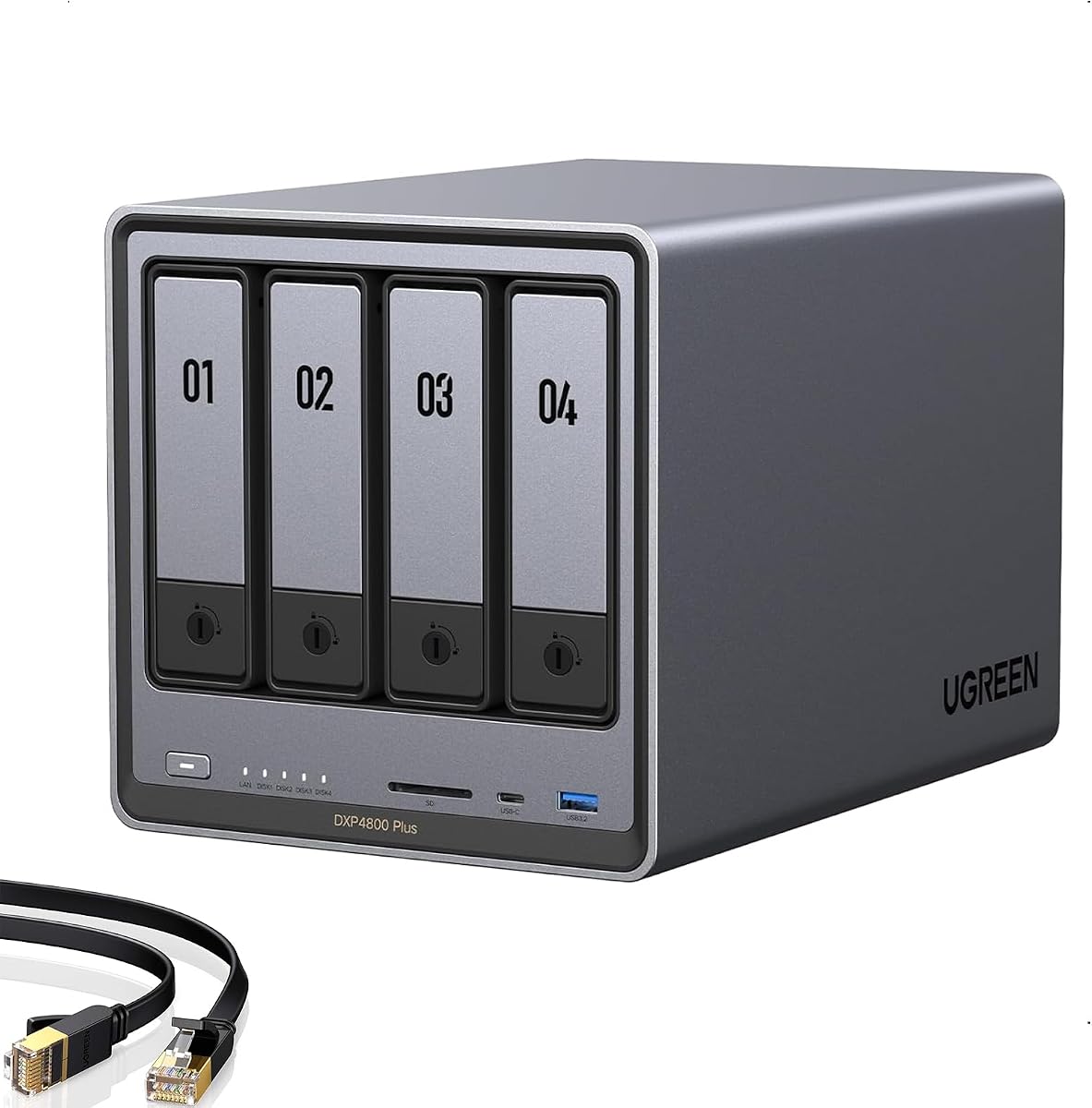
UGREEN NAS DXP4800 Plus
4.6Editor score
Four-bay storage design
10GbE network connectivity
10Gbps USB ports
Docker and virtual machines
A NAS with SSD cache combines high-capacity hard drives with the responsiveness of solid-state storage, helping reduce the delay users often encounter when accessing small files, opening recent projects, running applications, or managing active photo libraries. The right setup depends on cache type, bay compatibility, network speed, endurance, and workload.
This guide compares NAS enclosures and dedicated caching drives selected for the keyword, examining processor capability, available storage interfaces, supported drive arrangements, cache-related features, and continuous-operation credentials. It also explains when a standalone SSD offers a more direct upgrade path for an existing NAS.
Each pick reveals a different route to faster storage: a compact two-bay system, capable four-bay models, a high-end creator platform, dedicated SATA and NVMe cache drives, and capacity-focused NAS hard drives. Product availability and pricing can change, so confirm current specifications and NAS compatibility before purchasing.
4.6Editor score

4.6Editor score
4.0Editor score
As an Amazon Associate we earn from qualifying purchases.
This side-by-side comparison includes complete NAS platforms, NAS-specific hard drives, and standalone SSDs that can serve as cache or storage-tier upgrades, with the best choice depending on whether you need a new enclosure or a targeted performance upgrade.





The Western Digital 4TB WD Red Plus WD40EFZZ is a capacity-focused 3.5-inch NAS hard drive rather than a dedicated SSD cache. It carries a 4.2 rating, and its most relevant strengths are its 4TB capacity, 5400 RPM operating speed, SATA 6Gb/s interface, 128MB onboard cache, and CMR recording format. That makes it a dependable foundation for a NAS that keeps large media libraries, backups, and family archives.
We may earn a commission when you buy through this link, at no additional cost to you.
Its 128MB cache improves the handling of frequently accessed data, but it should not be confused with a user-configured SSD cache. The drive's own cache sits closer to the disk and serves the hard drive, whereas an SSD cache can maintain frequently used files in a much faster tier. For bulk storage where capacity and steady operation matter more than minimum response time, this distinction is reasonable.
The main limitation is that the 5400 RPM mechanism cannot approach the random-response performance of even a SATA SSD, much less an NVMe drive. It also cannot provide cache benefits without a compatible NAS enclosure and software configuration. Buyers who need faster application data should pair it with a supported SSD rather than expecting the internal cache to transform the entire system.
This drive is best for photographers, archivists, and families that need a roomy, continuous-operation volume inside a NAS supporting up to eight bays. It makes more sense as the storage layer in a cache-enabled NAS than as a standalone answer to the keyword. Add a compatible SSD in a supported cache slot and configure the caching feature according to the NAS software instructions.
This drive provides the large-capacity layer that SSD caching is designed to accelerate. Once popular files are moved into a supported SSD tier, the NAS can retain the HDD's generous capacity while improving access to frequently used data.
Its continuous-operation design and NAS-focused firmware make it suitable for systems that remain reachable throughout the day. It is a better fit for shared archives and media libraries than for short-lived scratch storage.
We may earn a commission when you buy through this link, at no additional cost to you.
The UGREEN NAS DXP2800 is the strongest balanced choice in this guide, earning a 4.6 rating for its combination of dedicated M.2 expansion, capable hardware, and a manageable two-bay form. Its Intel N100 quad-core processor, 8GB DDR5 memory, 2.5GbE networking, and two M.2 NVMe slots give it enough flexibility for a personal NAS with meaningful application and caching potential.
We may earn a commission when you buy through this link, at no additional cost to you.
The dual M.2 slots are the most important detail for anyone searching for SSD cache performance. They allow compatible NVMe storage to be installed for cache, hot-data, or application use, depending on the operating system and configuration. A two-bay enclosure also keeps the physical footprint modest while leaving room for substantial HDD storage once matching drives are added.
There are important limits. Hard drives and SSDs are not included, so the full cost and complexity depend on the chosen media. The maximum 80TB figure assumes two suitable hard drives and NVMe capacity, while real usable capacity depends on the selected RAID or storage configuration. A two-bay layout also offers less expansion flexibility than a four-bay model.
This NAS is ideal for advanced home users, remote workers, and creators who want fast access to frequently used projects, centralized media, and a private file hub without deploying a large enterprise enclosure. It is the top overall pick because the M.2 support is explicit, the hardware is well matched to contemporary workloads, and the overall design balances capability with a compact footprint.
The two M.2 NVMe slots provide a direct path to a high-speed storage tier. They are especially valuable when hot files should remain available without repeatedly seeking on rotating media.
The Intel N100 and 8GB of DDR5 memory support Docker, compatible media-server applications, virtual-machine workloads, and centralized backups. This makes the enclosure more than a simple file repository.
We may earn a commission when you buy through this link, at no additional cost to you.
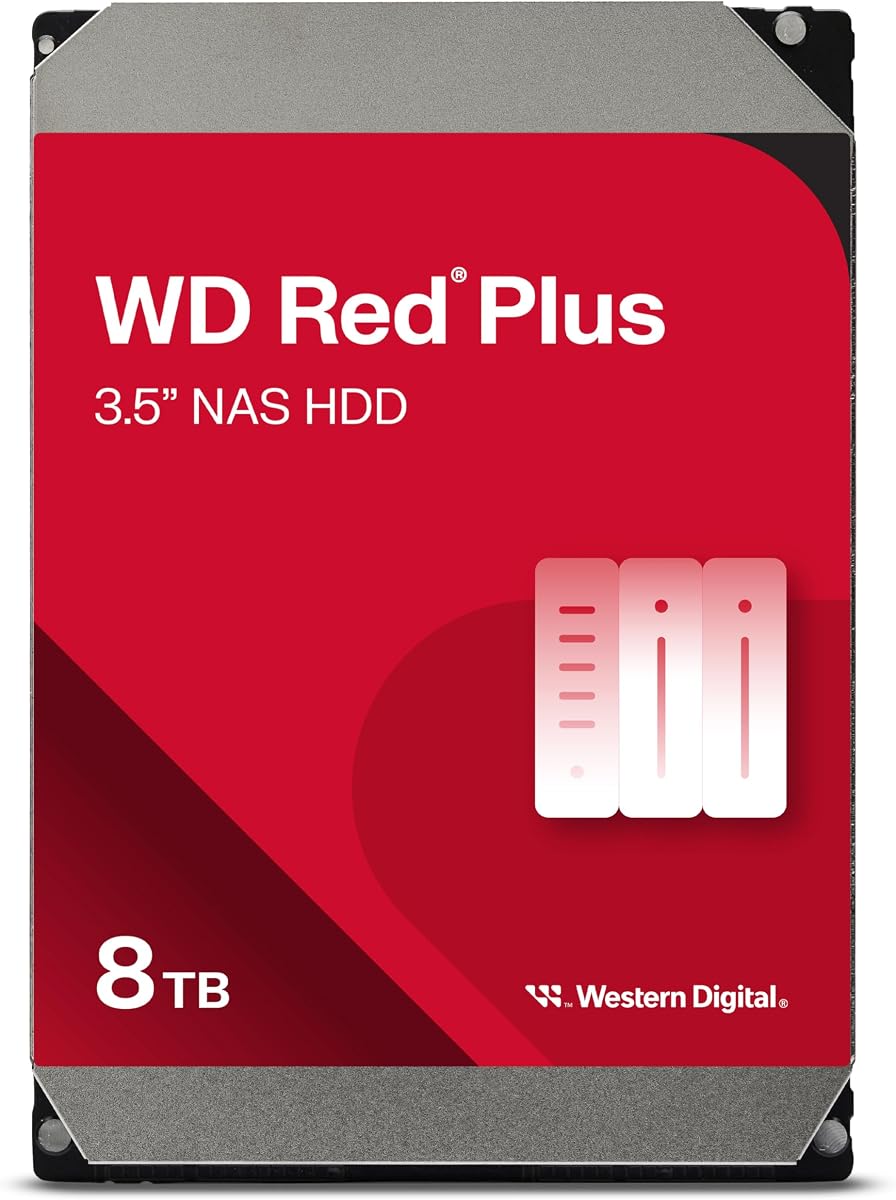
The Western Digital 8TB WD Red Plus WD80EFPX provides 8TB of CMR storage with a 5640 RPM spindle speed and a 256MB onboard cache. Its 4.2 rating reflects its role as a purpose-built storage component for small or medium business NAS systems rather than as a direct SSD caching upgrade.
We may earn a commission when you buy through this link, at no additional cost to you.
The larger capacity and somewhat faster rotation than lower-capacity Red Plus models can improve sequential transfer and reduce the amount of data that must wait behind a mechanical seek. A supported SSD cache remains valuable because repeated access to small, frequently used files remains an area where rotational storage can lag behind solid-state performance.
The 180TB-per-year workload rating describes sustained use in compatible systems, not SSD-level responsiveness. Buyers should not interpret the 256MB internal cache as equivalent to a dedicated SSD cache, because the memory does not create a persistent, user-managed high-speed storage tier. The drive also needs a suitable three-and-a-half-inch NAS bay and mounting arrangement.
Choose this model when capacity is the dominant requirement and the goal is to build a large storage foundation that can be paired with a dedicated SSD. It is especially appropriate for small-business archives, shared project files, and 24/7 repositories where expanding later would be inconvenient. For a complete new system, pair it with a NAS offering supported SSD cache slots.
Eight terabytes allows large media collections, project archives, and backup sets to remain online. That makes the drive useful for users who would rather retain data than repeatedly move it to offline storage.
The stated workload rate and continuous-operation focus suit a NAS that is accessed throughout the day. An SSD cache handles the latency-sensitive portion while the hard drive supplies capacity.
We may earn a commission when you buy through this link, at no additional cost to you.
The UGREEN DXP4800 Plus is the premium general-purpose pick in this roundup, with a 4.6 rating and a feature set designed for families, creators, and small teams. Its four-bay chassis, 10GbE connection, and 10Gbps USB ports create a strong foundation for high-speed backups, large shared libraries, and applications that benefit from quick access.
We may earn a commission when you buy through this link, at no additional cost to you.
A four-bay platform makes it easier to combine RAID with dedicated cache or SSD-tier media than a two-bay design. The enclosure supports Docker and virtual machines and can work across Windows, macOS, Linux, iOS, Android, web browsers, and compatible smart TVs. Its 10GbE port is particularly relevant when a NAS cache is only part of the bottleneck.
The 144TB maximum is based on a specific arrangement of compatible drives and should not be read as the capacity available in every configuration. Storage hard drives are not included, and real transfer speed depends on the network, CPU, selected drive, file size, and configuration. High-speed networking also requires compatible switches, adapters, and client hardware.
This model suits a household or small team that wants room to grow, frequent large-file transfers, and room for application data. It is a particularly logical choice for creators who edit high-resolution assets and value quick transfers more than the smallest possible enclosure. For a premium NAS with SSD cache, it balances expandability, networking, and application support better than a basic disk-only design.
A 10GbE connection prevents the network from becoming the immediate ceiling during many large transfers. That makes SSD caching more noticeable in collaborative environments and high-resolution workflows.
Four bays allow administrators to balance redundancy, capacity, and a faster SSD tier. Docker and virtual-machine support also provides room for services that would be difficult to host on a simple external drive.
We may earn a commission when you buy through this link, at no additional cost to you.
The UGREEN NAS DH4300 Plus is aimed at beginners, home users, and remote workers who want a private file hub without entering the most demanding NAS class. It holds a 4.2 rating and combines four drive bays with a 2.5GbE network port, 8GB LPDDR4X memory, Docker support, and 4K HDMI output.
We may earn a commission when you buy through this link, at no additional cost to you.
Its app-driven setup, automatic phone photo and video backup, AI-assisted albums, duplicate detection, and cross-platform access make it approachable for a family moving away from cloud storage. Four bays also offer more configuration freedom than a typical two-bay starter enclosure, giving users room to add an SSD for a faster tier if the NAS operating system supports that arrangement.
The crucial caveat is that the supplied specifications do not explicitly identify a dedicated SSD cache slot. Compatibility and supported cache functions should therefore be verified in the NAS software and UGREEN compatibility documentation before buying drives for that purpose. The system does not support virtual machines, although Docker applications are available, and it connects by wired Ethernet rather than Wi-Fi.
This model is most suitable for households that value automatic phone backups, shared media, easy remote access, and a manageable learning curve. It is less compelling for developers needing virtual machines or administrators seeking a high-end creator platform. It can still form part of a performant SSD-assisted storage system, but the cache and storage roles should be confirmed before installation.
Guided setup, NFC-assisted connection, and a beginner-friendly interface reduce the difficulty of building a household storage hub. The result is approachable for users migrating from consumer cloud accounts.
Real-time photo and video backup helps prevent valuable mobile memories from remaining trapped on a single device. AI album organization and semantic search make the growing archive easier to navigate.
We may earn a commission when you buy through this link, at no additional cost to you.
The UGREEN DXP4800 GT is the most technically advanced NAS in the guide, earning a 4.6 rating through its AMD Ryzen Embedded R2514 processor, dual 10GbE networking, and unusually flexible SSD support. It is designed for creators, technical users, and small office teams that expect to run storage, applications, media processing, and surveillance workloads together.
We may earn a commission when you buy through this link, at no additional cost to you.
The enclosure can combine four SATA drive bays with as many as two compatible U.2 NVMe SSDs and two M.2 SSDs. That broadens the ways an administrator can build a cache or tiered-storage system. Its four-core, eight-thread processor, expandable memory, and up-to-64GB memory option provide more headroom for Docker applications, virtual machines, and multi-user access than entry-level models.
Link Aggregation can combine the dual 10GbE ports for greater aggregate throughput on compatible network equipment, while a USB-C 10Gbps port offers another high-speed route for importing media. The built-in SD card slot, surveillance capabilities, and 4K/8K editing support are useful for production workflows. However, the system is more complex than a basic home NAS and its maximum capacities depend on exact drive arrangements.
Choose the DXP4800 GT when sustained throughput, application flexibility, and storage-tier options justify a professional platform. It is particularly compelling for teams that already have compatible infrastructure and plan to use NVMe rather than merely add a modest SATA cache. Buyers should also note that the preinstalled memory is non-ECC, while error-correction memory requires a compatible ECC upgrade.
M.2 and U.2 support makes it possible to choose different SSD formats as storage needs evolve. This flexibility is valuable for teams that want more cache capacity or a dedicated application tier.
Dual 10GbE interfaces support fast transfers and link aggregation on compatible equipment. The result is a platform capable of serving demanding clients without forcing all access through a single one-gigabit connection.
We may earn a commission when you buy through this link, at no additional cost to you.
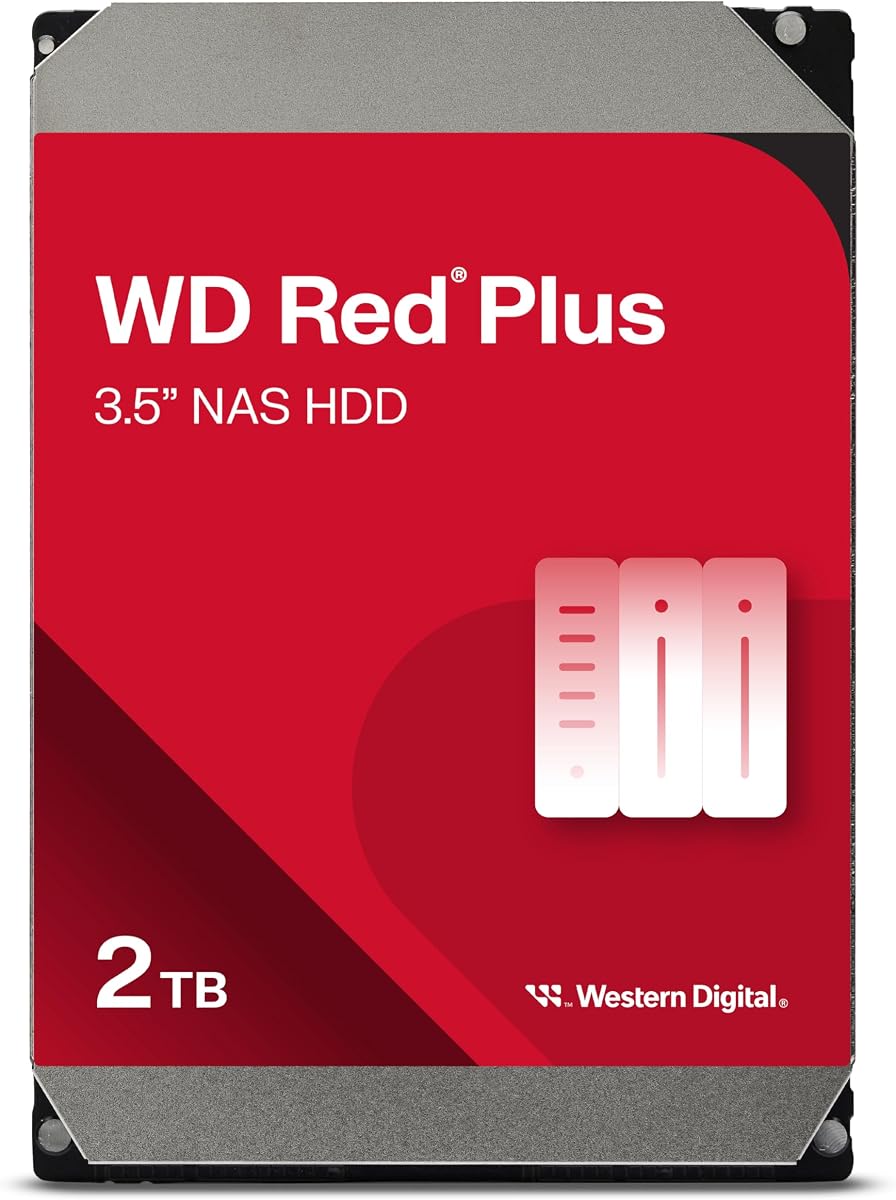
The Western Digital 2TB WD Red Plus WD20EFPX is a compact 3.5-inch hard drive for small or medium business NAS systems. It has a 4.2 rating, 2TB CMR capacity, 5400 RPM spindle speed, SATA 6Gb/s interface, and 64MB onboard cache. Its primary value is as an affordable-capacity storage layer inside a compatible NAS.
We may earn a commission when you buy through this link, at no additional cost to you.
The 64MB cache is modest, and it functions as part of the hard drive's own operation rather than as a separate application cache. A two-bay NAS can use this drive for primary storage, backups, or a RAID arrangement, while a separate SSD handles active files. That division keeps frequently used data fast while retaining the larger, slower drive for less frequently accessed material.
Its main limitation is that the relatively small 2TB capacity can be consumed quickly by modern photo, video, and backup collections. Mechanical latency also remains, so it should not be selected when direct SSD performance is the primary requirement. A separate enclosure and compatible mounting hardware are required, and the drive's three-year warranty includes regional terms.
Buy this model for a small NAS that needs a straightforward CMR storage member, particularly in a two-bay home or business system. It works well when the goal is a mixed-speed configuration rather than maximum density. Pairing it with a compatible SSD cache is a sensible way to improve responsiveness without replacing the entire enclosure.
Two terabytes remains useful for smaller document archives, modest media collections, and targeted backup sets. It fits particularly well when one bay is reserved for a faster SSD tier.
The 5400 RPM design emphasizes steady, relatively quiet operation. It is appropriate for offices and living spaces where a high-performance desktop replacement would be excessive.
We may earn a commission when you buy through this link, at no additional cost to you.
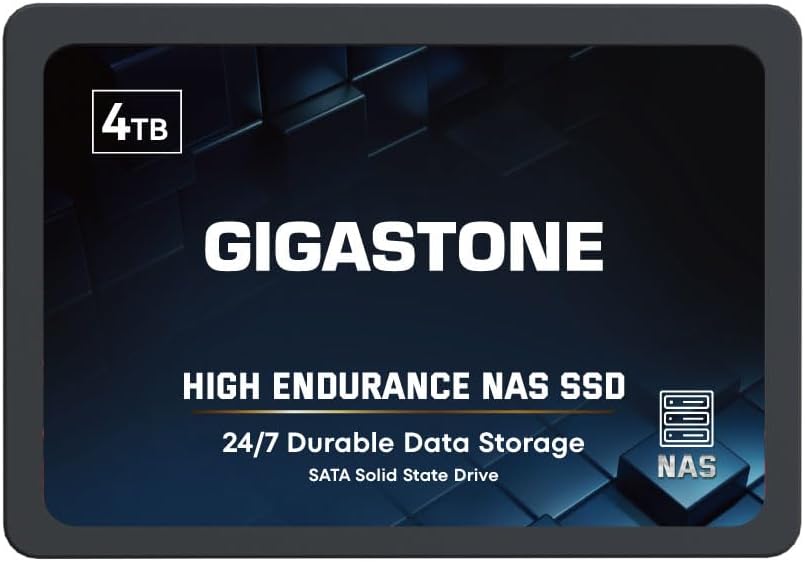
The Gigastone 4TB High Endurance SSD is the most direct cache option among the standalone drives, receiving a 4.0 rating for its continuous-operation design and stated sequential speed of up to 530MB/s. Its 2.5-inch SATA III format, 3D NAND, SLC cache support, ECC, and power-loss protection make it a credible addition to a compatible NAS.
We may earn a commission when you buy through this link, at no additional cost to you.
A drive of this type can improve the responsiveness of an existing NAS if the enclosure accepts SATA SSDs and its operating system supports the desired cache or SSD-tier function. The manufacturer states verification with Synology, QNAP, Asustor, and other models, but consumers should still check the exact NAS model and firmware before installation. The drive is not suggested for server models or SAN environments.
Its limitations are important. SATA has substantially lower ceiling potential than NVMe, especially for parallel random operations, and a cache cannot make the entire NAS as fast as a native flash storage tier. The included SLC cache is a feature of the SSD itself and should not be confused with NAS-managed read or write caching. Compatibility and intended drive role must be confirmed in the NAS interface.
This is a strong choice for a household or small office that already owns a compatible four-bay NAS and wants a dedicated, quiet, high-endurance 2.5-inch SSD without replacing the enclosure. It is particularly relevant to creative workloads involving virtualization, collaborative editing, photo rendering, and intensive database access, provided the NAS supports that drive in the desired role.
The 2.5-inch SATA interface is broadly accessible and often simpler to integrate than U.2 or PCIe adapter arrangements. It offers a practical performance increase for compatible NAS models without changing the entire storage architecture.
The high-endurance rating and power-loss protection are relevant to systems that run around the clock. Those qualities matter more for a cache than consumer response-time claims alone because sustained workloads repeatedly rewrite data.
We may earn a commission when you buy through this link, at no additional cost to you.
The Western Digital 500GB WD Red SN700 WDS500G1R0C is a fast NVMe option for NAS devices that expose a compatible M.2 2280 slot. It has a 4.5 rating, supports up to 3,430MB/s according to its specifications, and uses the PCIe Gen3 interface. It is among the most responsive standalone products here for compatible systems.
We may earn a commission when you buy through this link, at no additional cost to you.
As a cache or hot-storage tier, an NVMe drive can deliver much lower latency than SATA and mechanical storage. That advantage is particularly useful for small files, application databases, virtual machines, photo catalogs, and projects that users repeatedly open. The Red SN700 line is positioned for NAS workloads, including virtualization, collaborative editing, and multi-user multitasking.
Compatibility remains the central question. A NAS must provide a suitable M.2 slot, accept the physical format, support the intended cache or storage function, and provide the required cooling or adapter arrangement. A 500GB capacity may also be modest for a heavily populated cache, and a full cache can be less useful if working data exceeds its capacity.
This is the right choice for users who already own or are choosing a modern NAS with explicit NVMe support. It is a compelling cache component for creators and multi-user households seeking sharp responsiveness. By contrast, buyers with only a 2.5-inch SATA bay or an older enclosure should select a SATA-compatible cache drive instead.
NVMe performance is especially valuable for small, frequently accessed files that are penalized heavily by mechanical seek latency. Keeping those files in flash can make the storage platform feel substantially more immediate.
The stated use cases include virtualization, collaborative editing, and concurrent multi-user activity. Those are demanding patterns for a cache because they combine random reads, writes, and application metadata.
We may earn a commission when you buy through this link, at no additional cost to you.
The SanDisk 1TB NAS 600 is a 2.5-inch SATA SSD designed for NAS caching, storage tiers, and continuous operation. No numerical customer rating was supplied for this product, so the assessment relies on its documented specifications: 1TB capacity, 3D NAND, endurance up to 2,500 TBW for 4TB models, 2.25 million hours MTTF, and a five-year limited warranty.
We may earn a commission when you buy through this link, at no additional cost to you.
The drive is explicitly intended to energize I/O performance in demanding multi-user environments. Its 2.5-inch, seven-millimeter design can fit standard 3.5-inch NAS bays when the enclosure supports it, making the upgrade path familiar. It can also serve as a dedicated storage tier for large media assets and application datasets rather than functioning only as a transient cache.
The endurance figures are model-dependent, so buyers should read the exact capacity and product documentation rather than applying every rating to every version. SATA also has a lower theoretical ceiling than NVMe, and the NAS must recognize the SSD for the intended caching or tiering task. The listed 2,500 TBW endurance applies to 4TB models, while the compared product is the 1TB version.
This SSD makes the most sense for owners of a compatible NAS that supports 2.5-inch SATA SSDs and want a quiet, endurance-oriented upgrade for active files. It is a solid choice for homes and small offices that value steady operation and simple integration more than the highest possible throughput. Confirm model-specific endurance and cache support before installation.
The drive can support either approach depending on NAS software. A cache prioritizes speed for frequently used information, while a tier places selected data on fast storage for more persistent placement.
Continuous 24/7 operation is central to the design. Endurance and mean-time-to-failure specifications help buyers evaluate suitability for demanding NAS roles rather than treating it like a temporary boot drive.
We may earn a commission when you buy through this link, at no additional cost to you.
Choosing a NAS with SSD cache starts with identifying the storage role you need, then matching it to the enclosure's physical interfaces, software support, network path, and endurance requirements. The most important principle is that a fast cache cannot compensate for an incompatible slot, an undersized network, or an unsupported configuration.
In short, verify the cache function before choosing the SSD. Do not assume every supported drive can be used for every accelerated role.
In short, choose the interface that the NAS explicitly supports for storage. Form factor compatibility alone does not guarantee cache functionality.
In short, match computing power to the workload. A cache is useful, but it cannot make an underpowered CPU handle every application at once.
In short, improve the weakest link. An SSD cache cannot overcome a one-gigabit network, unsuitable switch, or slow client device.
In short, size the cache for active data and size the RAID array for retention. Keep a separate backup strategy for files that cannot be recreated.
In short, favor a drive with workload-oriented endurance. A high-endurance cache is more valuable than a short marketing claim about sequential speed alone.
In short, treat software support as part of the hardware specification. Verify exact model, firmware, drive role, and recovery behavior before purchase.
In short, plan for heat, sound, and maintenance. A quiet, well-ventilated setup is easier to run continuously and protects both performance and component longevity.
Begin by confirming the NAS model, its supported drive roles, the drive interface, and the current compatibility documentation. Install the SSD in the approved bay or slot, secure any adapter or mounting hardware, and back up important data before changing an existing storage configuration. The operating system should normally be used to create, format, and assign the cache or tier so that it can manage metadata and rebuild behavior correctly.
After adding the drive, use a manageable test dataset to verify read and write performance, monitor temperatures, and confirm that the cache is being used as intended. Avoid assuming that a single benchmark reflects real-world gains: small-file responsiveness, application databases, media seeking, and large sequential transfers can produce different results. Schedule backups independently of the cache and RAID array, and document the roles assigned to every drive.
Ongoing care includes keeping the NAS firmware and management software updated, checking the health status of both SSDs and hard drives, maintaining airflow, and ensuring that the system receives reliable power. Monitor cache capacity so frequently used data does not exceed the fast tier unnecessarily. If an SSD fails, follow the manufacturer's rebuild or recovery procedure and do not erase the underlying data until its status and recovery path are fully understood.
No. An SSD cache usually stores a portion of frequently accessed data temporarily or semi-persistently, while hard drives remain the primary capacity layer. A NAS built entirely from SSDs can offer consistent low latency but usually offers less capacity for the same storage budget. The better approach depends on whether the priority is active-data responsiveness, total capacity, redundancy, or a balance of all three.
No. The NAS must have a compatible physical slot, accept the SSD's interface and dimensions, and support the desired cache function in its firmware. Some systems support SATA SSDs only for storage, while others provide M.2 slots reserved for NVMe cache or high-speed tiers. Always verify the exact model and current software documentation before buying an SSD.
NVMe generally offers lower latency and greater parallel performance, making it preferable for databases, virtual machines, active editing, and demanding multi-user access. SATA SSDs are easier to find in compatible bays and are often sufficient for read-heavy acceleration in a home NAS. The best choice is the fastest supported interface that fits the enclosure, its cooling design, and the user's budget.
The useful capacity depends on the working set: the data accessed most often. A smaller cache can be effective when a limited collection of applications or documents dominates access, while larger caches suit media libraries and many simultaneous users. Because a cache does not normally replace primary storage, a larger hard-drive array may still be required for retention and backups.
It can, particularly when files are repeatedly read and the cache uses read-ahead or stores hot data. Sustained transfers of files larger than the cache may see less benefit because the data must be read from the hard drive and written into the fast tier. The network connection, drive type, file size, protocol, and workload all influence the result.
A desktop SSD may work, but it is not automatically the best choice. NAS-oriented drives are generally qualified for continuous operation, sustained write endurance, vibration tolerance, and the applicable interface. A consumer SSD can still be appropriate for light workloads, but administrators should confirm firmware compatibility, thermal behavior, and the manufacturer's support for its intended role.
Yes. RAID helps maintain availability when drives fail, while a cache accelerates access; neither replaces a backup. Accidental deletion, ransomware, account compromise, filesystem errors, and loss of the entire NAS can affect every drive. Maintain at least one separate copy of irreplaceable files and test that the recovery process works.
Compare familiar tasks before and after adding the SSD, using files and applications that represent your normal workload. Track small-file opens, database queries, thumbnail generation, media seeking, and backup completion rather than relying on one large-file test. NAS management screens may also show cache hits, utilization, and drive activity, which help confirm that the configured tier is being used.
The UGREEN DXP2800 is the strongest all-around choice because its two M.2 NVMe slots, Intel N100 processor, 8GB DDR5 memory, and 2.5GbE networking create a capable yet compact cache-enabled platform. The DXP4800 Plus is the premium pick for users who want four bays, 10GbE networking, and room for more demanding applications, while the Gigastone 4TB SSD is the direct upgrade for owners of a compatible SATA NAS.
Prioritize compatibility before speed. Confirm the NAS's physical interface, supported cache role, storage layout, and network path, then size the SSD for the working set you expect. For new systems, processors such as the DXP4800 GT's AMD R2514 and flexible M.2 and U.2 support suit ambitious creators and small teams, while the DH4300 Plus offers a simpler four-bay starting point for households.
Finally, review current product specifications, NAS support information, and pricing before ordering, since configurations and market conditions can change. A cache is most valuable when it complements a reliable storage design, redundant backups, adequate cooling, and a network that can carry the speed the SSD delivers. The right combination delivers faster access without sacrificing the capacity and resilience that make a NAS useful in the first place.