
ECO-WORTHY UL1741 5000W
4.1Editor score
UL1741 listed design
100A MPPT controller
10000W peak output
Six-unit parallel support
Compare 10 models of 5000 Watt Solar Inverter by power, charging, battery support, output, safety, and suitability for home backup, RV, and off-grid systems.
A 5000 watt solar inverter can form the heart of a capable home backup, cabin, RV, or commercial power system, but the strongest unit is not automatically the right one for every installation. Battery voltage, charging architecture, output phase, surge handling, and installation requirements can matter as much as headline power.
We compared the listed inverters using their published specifications, including continuous and peak output, MPPT capabilities, supported battery chemistries, charging modes, protection features, and phase options. The guide covers both integrated 48-volt solar inverter chargers and lower-voltage power inverters intended for vehicles, RVs, and portable off-grid use.
Each pick highlights the configuration that makes that model distinctive, while the comparisons also identify important limitations such as single-unit-only operation, restricted PV voltage windows, or the need for a larger battery bank. Product availability, configurations, and prices can change, so confirm current specifications before purchasing.
4.1Editor score

5.0Editor score

5.0Editor score
The table below compares the ten models by system voltage, inverter type, charging capability, output configuration, and key scalability, making their different installation roles easier to distinguish.


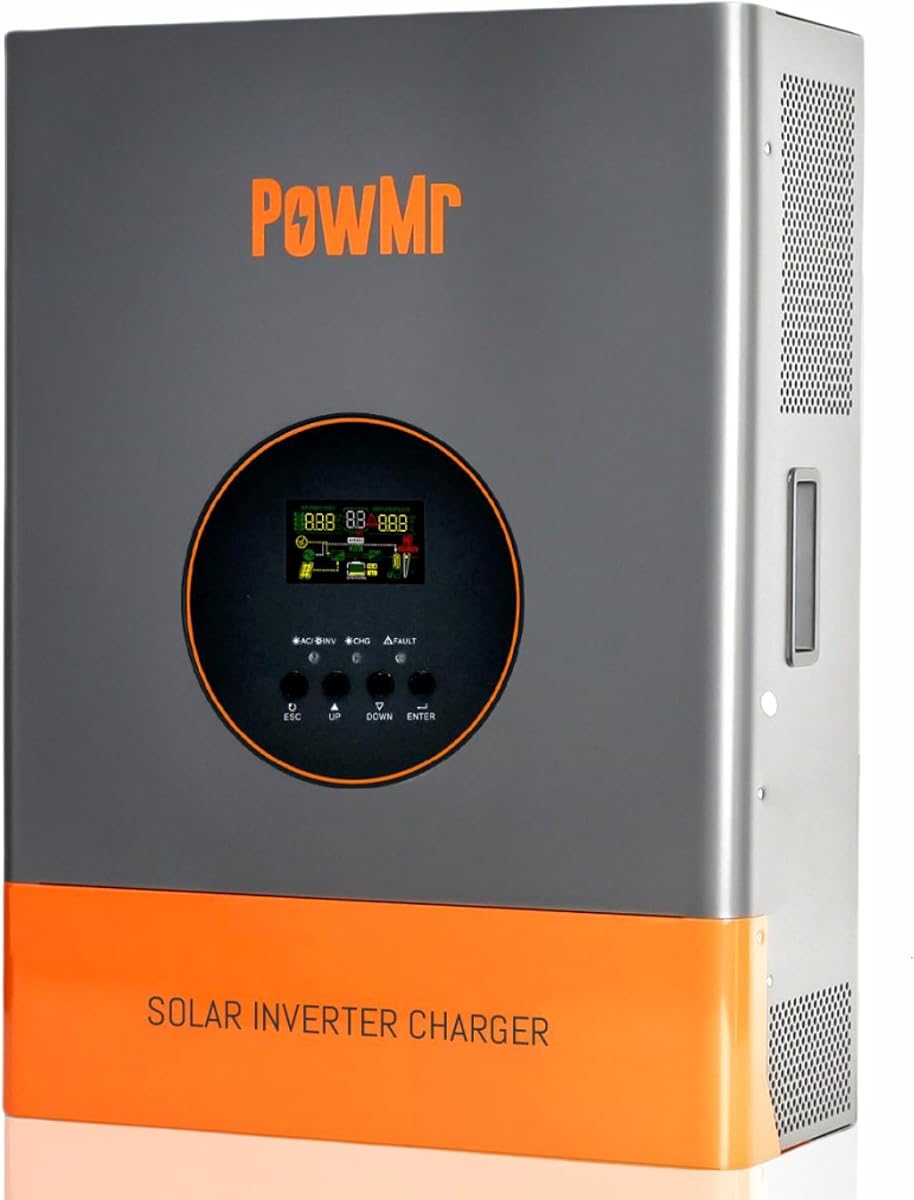

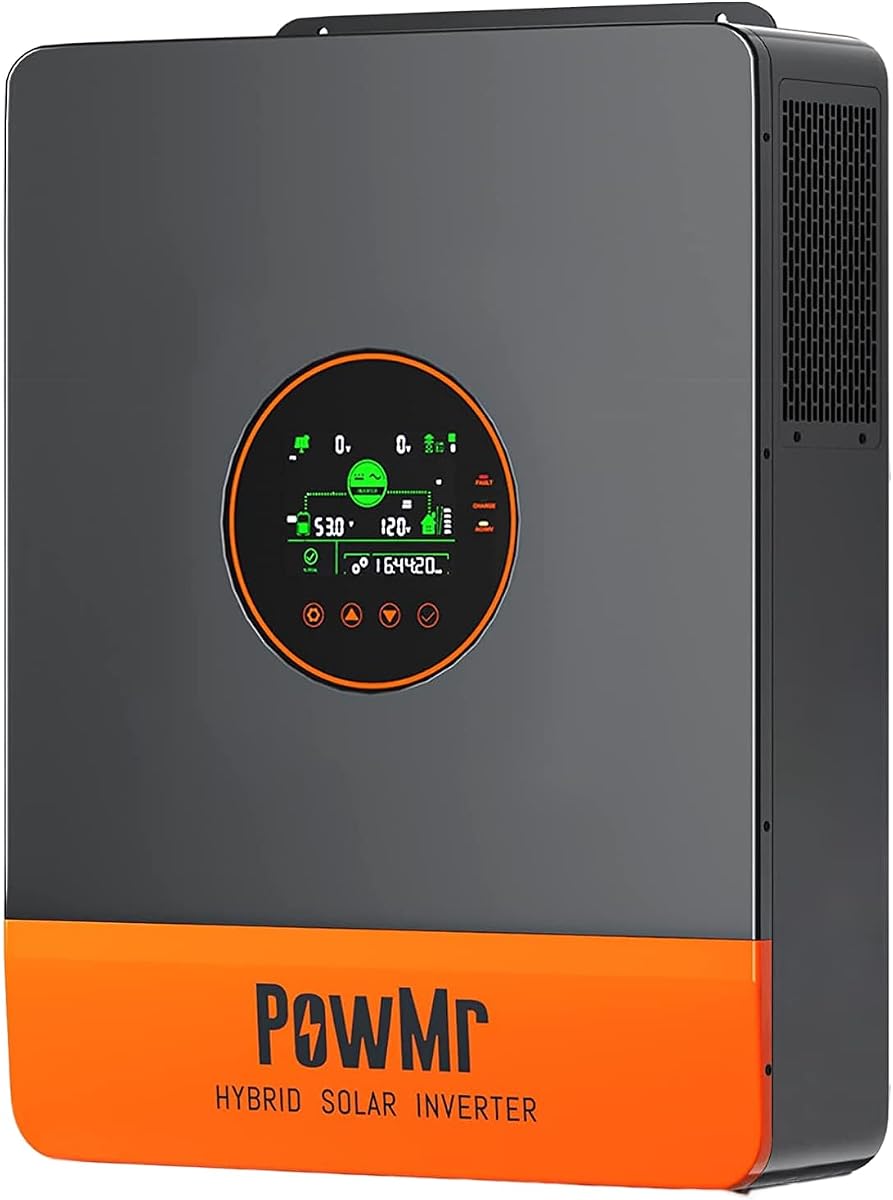


This PowMr combines a 5000W pure sine wave hybrid inverter, a 120A MPPT charge controller, and flexible charging controls in one 48-volt package. Its 5.0 rating reflects a particularly versatile specification sheet, with native 110V and 220V outputs, 50Hz and 60Hz frequency options, and a rated output of 5000W.
We may earn a commission when you buy through this link, at no additional cost to you.
The standout feature is its combination of high continuous output and a claimed 15000W peak capacity. A larger toroidal transformer is credited with improving load handling, which makes the unit more relevant to refrigerators, fans, air conditioners, and other loads that create startup surges. The built-in MPPT also reduces the need for a separate solar charge controller, simplifying the architecture of a compact off-grid system.
Three charging modes—Solar-Only, Utility Priority, and Solar Priority—give the installer meaningful control over how solar and utility power reach the batteries. The corresponding discharge modes support Utility Priority, Solar Priority, and Inverter Priority behavior. Compatibility is broad, including flooded, LiCoMnNiO2, LiFePO4, AGM, gel, and user-defined 48V batteries.
There are important constraints. The 60–105VDC MPPT range is narrower than that of many high-voltage PV designs, and the inverter accepts no more than 6400W of maximum PV input. Its stated 29A maximum AC input also means a properly selected transfer or charging arrangement matters. Buyers needing 120V/240V split phase should not assume that two output sockets create full split-phase capability.
This is our leading recommendation for a buyer who wants one integrated unit to manage batteries, solar charging, utility charging, and AC output. It is particularly compelling for a dedicated 48V system serving mixed household loads. Prospective owners should confirm the PV voltage window, battery charging profile, output configuration, and electrical code requirements before installation.
Combining the inverter, MPPT controller, and charging logic in one enclosure can reduce component count and simplify wiring. The LCD, LED indicators, cooling fan, and protection suite further improve visibility into operating status and system health.
Native 110V and 220V options make this model more adaptable than a fixed-voltage unit, while multiple solar and discharge priorities let users tailor behavior to available energy, required runtime, and backup expectations.
We may earn a commission when you buy through this link, at no additional cost to you.
The ECO-WORTHY is a 5000W, 48-volt hybrid inverter charger with a 100A MPPT controller, a 40A AC charger, and a 120V rated output. Its UL1741 designation and 4.1 rating make it a credible premium option for buyers who value listed equipment, installation flexibility, and the ability to expand a system later.
We may earn a commission when you buy through this link, at no additional cost to you.
One of its strongest advantages is scalability. Up to six units can be paralleled, allowing installers to build larger single-phase or separate-phase systems. The listed configuration states that multiple inverters can provide 120V, 208V, or 240V parallel output, making the unit relevant to residential, commercial, and small industrial projects where one enclosure would not be sufficient.
Solar collection is designed around a 120–500VDC PV input window, substantially higher than systems that require a low-voltage MPPT arrangement. Rated maximum solar charging is 100A, while maximum AC charging is listed at 40A. Four charging choices cover solar-only, utility priority, solar priority, and combined solar and utility charging, with timed grid charging and discharging for users following time-of-use schedules.
The product is not perfect for every buyer. Its 4.1 rating trails several competitors, and the parallel instructions are more involved than those of a stand-alone inverter. Phase selection also requires at least two units in the appropriate configurations. A 120V output limits direct compatibility with 240V-only appliances unless suitable step-up or step-down equipment is included.
Overall, this inverter is a strong match for a professionally planned system expected to grow. It is particularly useful where a broad PV voltage range, listed design, and parallel capacity outweigh the need for native dual 110V/220V output in a single chassis. Confirm current certification details and phase requirements with the manufacturer and installer before ordering.
Six-unit parallel support gives this model an advantage when household demand eventually exceeds one 5000W enclosure. A carefully balanced installation can increase capacity and create additional phase configurations, subject to the documented wiring requirements.
The 120–500VDC PV range offers considerable design flexibility for conventional high-voltage solar arrays. It is especially attractive where the battery bank is already organized around a 48V architecture and the goal is integrated solar charging.
We may earn a commission when you buy through this link, at no additional cost to you.
SUNGOLDPOWER packages a 5000W pure sine wave inverter, an 80A MPPT solar charger, and a 40A AC charger into a single 48V unit. The 5.0 rating reflects a well-rounded feature set, while its integration makes it an approachable option for a stand-alone backup or off-grid installation that does not need future parallel expansion.
We may earn a commission when you buy through this link, at no additional cost to you.
The inverter produces 120V AC and is advertised as capable of supporting a 4HP motor load with overload protection. That specification is useful for interpreting realistic surge demands, but motor starting current, cable sizing, and battery capability still require careful attention. The unit supports AC Priority, Solar Priority, Only Solar, and combined solar-and-grid charging, as well as PV Priority, Utility Priority, Inverter Priority, and Hybrid output behavior.
Battery compatibility is another strength. The listed charging voltage range is 40–60V, and the inverter works with AGM, sealed, gel, flooded, and lithium batteries, along with a user mode for custom settings. An RS485 port provides a route for BMS communication, which is particularly relevant when using lithium storage with a compatible battery management system.
Its clearest limitation is explicitly stated: it does not support parallel operation. That makes it less suitable for buyers who may later need a larger system or more output configurations. The 120V AC input and output also mean it should not be treated as a native 240V split-phase inverter. Maximum PV array support is listed at 5500W, which comfortably supports a meaningful solar contribution while still requiring correct string voltage and current.
This is our budget-oriented recommendation for a single 5000W installation that combines solar charging, utility charging, and reliable AC output. It is well suited to a cabin, small home, office, or backup panel where simplicity matters more than expansion. Buyers should confirm battery settings, RS485 compatibility, and required wiring before installation.
The integrated inverter, MPPT, and AC charger reduce the number of major devices needed for a new system. That simplification is valuable for installers and owners who want one coordinated control unit instead of separately configured power blocks.
Support for lead-acid, AGM, gel, lithium, and custom profiles gives users room to select a battery bank that matches their budget and capacity needs. Proper charging parameters remain essential because battery chemistry and environmental conditions affect safe operation.
We may earn a commission when you buy through this link, at no additional cost to you.
The TOPBULL is a 12V-to-120V power inverter aimed at vehicles, RVs, mobile offices, camping, and portable off-grid use. Its 4.6 rating reflects a generous feature set: 5000W continuous output, 10000W peak capability, four 20A AC receptacles, two 3.4A USB charging ports, a 30W Type-C port, and three AC terminal blocks.
We may earn a commission when you buy through this link, at no additional cost to you.
Unlike the integrated 48V hybrid models in this guide, TOPBULL does not include a built-in MPPT solar controller. It converts power from a connected 12V or 12.8V battery, making it versatile for systems built around separate solar controllers. The color display reports voltage, power, and operating status, while the included remote can operate the unit from up to 200 feet away.
Protection is unusually comprehensive for a portable inverter. The listed features include low- and high-voltage protection, overload and short-circuit protection, thermal protection, reverse-polarity protection, grounding protection, overcurrent and leakage protection, and battery protection. A temperature-controlled dual-fan system is designed to manage heat while reducing unnecessary noise.
The central caveat is electrical demand. Delivering 5000W from a 12V battery can require several hundred amps, depending on efficiency and load. A typical vehicle starter battery may not sustain the stated output for long, and cable length or thickness can create meaningful voltage loss. This unit is better suited to a deep-cycle battery bank, especially for mobile use.
TOPBULL is a good choice for portable and vehicle-based users who value outlets, monitoring, and remote operation more than integrated solar charging. It can also serve as the inverter stage in a larger solar system when paired with a separate MPPT controller. Verify available battery capacity, cable specifications, and appliance startup demands before installation.
Four high-current AC receptacles, USB ports, a Type-C port, and hardwired terminals cover a wide range of travel and workshop equipment. This variety reduces the need for multiple adapters when powering computers, tools, or household appliances.
The metal enclosure, temperature-controlled fans, and extensive protection suite are designed for mobile and variable operating environments. A rugged housing alone does not make the unit weatherproof, so it should still be protected from moisture and direct exposure.
We may earn a commission when you buy through this link, at no additional cost to you.
LVYUAN offers a straightforward 12V power inverter for vehicles, RVs, trucks, solar systems, and off-grid cabins. It converts 12V DC into 110V/120V AC, provides 5000W continuous output with a 10000W peak rating, and carries a 4.5 customer rating.
We may earn a commission when you buy through this link, at no additional cost to you.
Four AC outlets and a hardwire terminal give users flexibility for both temporary appliances and a more permanent installation. The LCD reports voltage, battery level, load information, and alerts, while the included wireless remote makes the inverter easier to control when mounted inside a cabinet or away from the working area.
Its smart cooling system activates when the internal temperature rises above 104°F or load exceeds 45%. This approach can keep the inverter quiet during light use while providing additional airflow when it is working harder. Protection includes overvoltage, undervoltage, overload, short-circuit, reverse-polarity, and overheating safeguards.
This is not a solar inverter charger in the integrated sense. It has no listed built-in MPPT controller, so a standalone solar charge controller may be needed to regulate battery charging from a photovoltaic array. Its 12V architecture also means substantial current must flow through the battery cables. Effective copper conductors, secure terminations, and appropriately fusing are essential.
LVYUAN is a well-rounded option for RV builders and mobile installers who need straightforward AC conversion, multiple receptacles, and remote access. It can also be incorporated into a larger off-grid system after adding a suitable charge controller. Choose it when the 12V system is already established and MPPT integration is not required.
The mix of four AC outlets and a hardwire terminal supports both quick appliance hookups and fixed RV or cabin wiring. That flexibility makes the inverter easier to adapt as mobile power needs change.
The LCD provides useful operating information, and the wireless remote reduces the need to reach a concealed inverter. Together, they improve visibility in installations where the unit is mounted inside a cabinet or service compartment.
We may earn a commission when you buy through this link, at no additional cost to you.
This second PowMr offering is a 48V hybrid inverter charger rated for 5000W continuous output and 15000W peak output. Its 4.8 rating and combination of pure sine wave AC, 110V/220V output, and a built-in 120A MPPT controller make it one of the strongest general-purpose options in the guide.
We may earn a commission when you buy through this link, at no additional cost to you.
The larger toroidal transformer and optimized load handling are the main selling points. The published specifications position the inverter for demanding equipment such as refrigerators and industrial machinery, although actual performance depends on surge duration, battery state of charge, and load quality. The output frequency can be configured to 50Hz or 60Hz, adding flexibility for different equipment.
Charging priorities are clearly organized into three modes: Solar-Only, Utility Priority, and Solar Priority. Discharge behavior can similarly emphasize PV priority, utility priority, or inverter priority. Supported 48V battery types include flooded, LiCoMnNiO2, LiFePO4, AGM, gel, and user-defined settings, giving owners room to work with different storage chemistries.
Its MPPT operating range is 60–105VDC, and maximum PV input is limited to 6400W with a 120A maximum current. That restricts array architecture compared with high-voltage MPPT inverters. Unlike several competitors, the supplied information does not advertise parallel support, so buyers seeking a scalable system should not assume that multiple units can be combined.
This model makes sense for a medium-sized off-grid building, small commercial site, or backup system where both 110V and 220V loads may be needed. It is also a practical option for buyers who prefer a single enclosure over separate inverter and controller components. Installation should follow the manual's current, voltage, and power limits exactly.
Separate charging and discharge priorities make it possible to favor solar production, preserve stored energy, or keep essential loads supplied during outages. These controls are especially useful in systems where grid availability varies through the day.
A corrosion- and dust-resistant finish, dual cooling fans, an LCD, and three LED indicators support dependable operation and straightforward status checks. The protection suite covers short circuit, voltage, overload, and reverse conditions.
We may earn a commission when you buy through this link, at no additional cost to you.
This general-purpose 12V inverter delivers a listed 5000W continuous output, 10000W surge capability, and conversion efficiency above 90%. Its 4.4 rating reflects a capable and accessible option for vehicles, RVs, marine settings, campers, and emergency use, as well as off-grid solar systems that use a separate charge controller.
We may earn a commission when you buy through this link, at no additional cost to you.
Connectivity is practical: four AC sockets, one USB port, a hardwire port, and pure copper cables are included. The LCD displays input voltage, output voltage, battery level, and load status. A 16.5-foot wired remote allows shutdown or adjustment when the inverter is installed out of immediate reach.
Safety coverage includes undervoltage, overvoltage, overload, overheating, short-circuit, reverse-polarity, leakage, and overcurrent protection. The temperature-controlled fan activates above 104°F or when the load exceeds 40%, while the housing's heat-dissipation design helps maintain stable operating temperatures.
As with other 12V models, power availability is constrained by battery-bank design. Producing 5000W at 12V involves very high current, so long cable runs and undersized conductors can cause voltage drop and heat. The listed compatibility with vehicle, RV, and deep-cycle batteries is useful, but battery capacity and cold-weather performance vary substantially by model.
This inverter is a good fit for portable and mid-size off-grid projects that value efficiency, a hardwired option, and straightforward monitoring. It is less convenient for a new homeowner wanting a single integrated solar system because PV charging requires another controller. A professional review of cable length, fusing, and load startup is advisable.
The stated efficiency above 90% reduces conversion losses, which is valuable when battery capacity is limited. Actual system efficiency also depends on wiring quality, inverter load level, temperature, and battery condition.
Four AC outlets, USB, a hardwire port, battery cables, remote, and manual provide a well-rounded package. The hardwire option is especially useful for permanent installations where a plug-in receptacle is not sufficient.
We may earn a commission when you buy through this link, at no additional cost to you.
This PowMr model targets larger and more technically involved systems. It combines a 5000VA pure sine wave inverter with a 100A MPPT controller, supports 120V single phase, 120V/240V split phase, and 208V two- or three-phase arrangements, and can be paralleled with up to six units. Its 3.9 rating places it behind the category leaders.
We may earn a commission when you buy through this link, at no additional cost to you.
The 120–500VDC PV operating range and 120–450VDC MPPT window offer flexibility with common high-voltage arrays. Maximum PV input is listed at 5500W, and the MPPT tracking efficiency is stated as high as 99.9%. Communication options include CAN, USB, and RS485, which are useful for monitoring and BMS integration.
Output flexibility is the defining feature. A single unit handles 120V loads, while two or more can be configured for split phase or other phase arrangements. The supplied data explicitly notes that two or more inverters are required for split phase and that a single unit is not supported for that function. Parallel expansion can therefore address larger residential, office, commercial, or industrial needs.
The complexity is substantial. Load balancing, phase configuration, battery communication, and AC interconnection all need careful planning. The product also supports a batteryless mode in which loads can be supplied from PV or the grid, but this should not be confused with a complete substitute for carefully sizing stored energy.
Buyers should choose this model when they value phase control, high-voltage PV input, and parallel scalability more than a simple installation. It suits a professional installer or advanced off-grid builder comfortable configuring multi-inverter systems. A lower rating and extensive setup requirements make it less compelling for a straightforward single-inverter backup.
Support for single-, split-, and three-phase arrangements allows the same platform to serve projects with different power-distribution requirements. Achieving the higher-phase configurations requires additional units and exact adherence to the configuration guide.
CAN, USB, and RS485 interfaces provide useful paths for system communication and battery management integration. These connections can improve visibility, but their practical value depends on compatibility with the rest of the selected equipment.
We may earn a commission when you buy through this link, at no additional cost to you.
LiTime combines a 5000W inverter, 100A MPPT controller, and 40A battery charger in one 48V hybrid unit. Its 4.2 rating reflects a capable design aimed at home backup and expandable off-grid systems, with a peak surge listed at 10000W and an LCD for monitoring operating data.
We may earn a commission when you buy through this link, at no additional cost to you.
The energy-management controls are especially useful. Two charging modes cover PV-Only and Hybrid operation, while four output modes include Inverter Priority, PV Priority, Utility Priority, and Mix Load. After grid power fails, the battery or PV system can continue supplying the load, providing the inverter's stated UPS-like function. Timed charging and discharging can align battery use with local peak and off-peak tariff periods.
Expansion is another core benefit. Up to six units can operate in parallel, with single-phase and split-phase arrangements supported. The listed configuration states that one inverter produces 120V and more than two units can provide 120V/240V parallel output. This makes the platform more adaptable than the fixed 120V stand-alone designs in the guide.
The inverter works with 48V lithium and lead-acid batteries and includes a user mode for custom settings. Its protection features include overload, overheat, short-circuit, low-voltage, overvoltage, and overcurrent protection. The enclosure is also listed as covered by AIG Product Liability Insurance, with the supplied information giving an effective date of May 22, 2026.
LiTime is a good fit for buyers who want a compact integrated unit and may later add parallel capacity. It is less suited to someone needing 240V output immediately from a single inverter. Parallel and phase configurations should be planned with the manufacturer's current instructions, especially where split-phase output is required.
Integrating the inverter, MPPT controller, and battery charger saves installation space and can simplify system design. The display also provides a convenient central point for monitoring operating information.
Timed mains charging and discharging allow stored energy to be used according to a preferred schedule. This is useful for owners following time-based utility rates, provided battery capacity and available solar production are properly sized.
We may earn a commission when you buy through this link, at no additional cost to you.
This 5000W split-phase hybrid inverter combines 48V battery conversion with a built-in 120A MPPT controller. It offers 110V/240V AC output, a rated 5000W, and a listed 15000W peak capacity. Its 5.0 rating makes it one of the most highly rated products in the comparison.
We may earn a commission when you buy through this link, at no additional cost to you.
The 60–150VDC MPPT range and 6400W maximum PV input create a useful middle ground between low-voltage and very high-voltage solar designs. Charging efficiency is listed as up to 99%, and the 120A controller can manage substantial solar input into a 48V battery bank. Maximum AC input current is listed at 50A.
Control flexibility includes three charging modes—Solar-Only, Utility Priority, and Solar Priority—and three output modes covering PV Priority, Utility Priority, and Inverter Priority. Flooded, AGM, gel, LiFePO4, and user-defined batteries are supported. Communication options include BMS/RS485, RS232, and dry contact, giving installers several ways to integrate monitoring or control signals.
The claimed ability to run refrigerators, industrial machinery, air conditioners, fans, and lighting is useful, but motor loads and compressor startup surges should be tested against the complete system. The 15000W peak figure is not the same as a 15000W continuous rating. A properly sized battery bank, inverter cables, breaker, and overcurrent protection are all necessary.
This inverter is a strong option for a 48V system that needs flexible 110V/240V output, substantial solar charging, and modern communication choices. It is especially relevant to homes, offices, and mobile systems where appliances span different voltage requirements. Confirm the exact split-phase behavior, PV string requirements, and battery communication protocol with the manual.
The 60–150VDC MPPT range supports more conventional string arrangements than low-voltage MPPT designs. It gives installers useful latitude while still requiring attention to maximum open-circuit voltage, temperature effects, and array current.
The LCD, LED indicators, dual cooling fans, and multiple communication interfaces support monitoring and thermal management. Protection for short circuit, voltage, overload, and reverse polarity adds another layer of operational safeguards.
We may earn a commission when you buy through this link, at no additional cost to you.
The most useful inverter is the one that matches your battery architecture, load profile, solar array, and expansion plans. Evaluate power and electrical compatibility before considering convenience features or remote controls.
Begin with the battery system, because it determines the inverter family and cable requirements. The hybrid models in this guide generally operate from a 48V battery bank, while the portable TOPBULL, LVYUAN, and general 12V units draw from 12V or 12.8V sources. A 48V system is usually more efficient for a fixed home installation and can carry substantial loads with lower battery current. A 12V system is more convenient for vehicles and compact mobile setups, but it demands much greater current for the same wattage.
Choose a battery bank with enough usable capacity for expected load duration, temperature, battery age, and desired reserve. Do not treat the inverter's wattage as a battery-capacity recommendation. The inverter determines how much power can be delivered at once, while the battery bank determines how long that power can be sustained and how well surge loads are supported.
Check continuous output separately from peak or surge power. A 5000W continuous rating is the more meaningful figure for running ordinary household and office loads, while peak ratings help explain the ability to start motors, compressors, pumps, and other inductive equipment. The listed peak values range from 10000W to 15000W, but they should not be treated as sustained capacity.
List the appliances you intend to run, identify their running watts and startup demands, and leave sensible headroom. A refrigerator compressor or air conditioner may create a short surge that exceeds the running load. Very large motors, welders, and heating equipment can consume the inverter's entire continuous allowance with little room for anything else, especially when several loads operate together.
The MPPT controller's operating voltage must match the PV array's string configuration. The PowMr models with 120A controllers use a 60–105VDC or 60–150VDC MPPT range, whereas the ECO-WORTHY and multi-phase PowMr accept high-voltage arrays. The SUNGOLDPOWER operates across a 120–500VDC PV input range and supports a maximum listed 5500W array. Incorrect voltage can cause charging failure or damage.
Maximum PV input power, maximum input current, and maximum open-circuit voltage all matter. Temperature affects panel voltage, so the coldest expected conditions should be considered when designing a string. If there is no integrated MPPT controller, as with the 12V power inverters, use a separate controller matched to the battery chemistry and array design.
A unit that supplies 120V cannot directly run a 240V-only appliance, and an inverter labeled 120V/240V may still require additional units for true split-phase operation. The SUNGOLDPOWER is specifically listed as 120V input and output and does not support parallel operation. The LiTime and ECO-WORTHY can create higher-output configurations when multiple units are properly combined. Multi-phase PowMr systems have more demanding configuration requirements.
Survey the connected loads before selecting an output format. Homes with central air, electric water heating, ranges, or well pumps may need 240V service. Smaller electronics and many tools use 120V, and some systems benefit from both. The manufacturer's phase guide should determine exactly which outlets, breakers, and subpanels can be supported.
Compatibility with a battery chemistry is more than a checklist item. Flooded, AGM, gel, lithium, and user-defined profiles use different charging voltages, current limits, and equalization procedures. A lithium bank may also need BMS communication over RS485 or another supported connection, and incorrect settings can create safety or battery-life problems.
Review the inverter's stated battery charging voltage range and confirm the battery manufacturer's recommended settings. Do not assume that a generic user mode is a substitute for proper commissioning. Matching the profile, cable size, ventilation requirements, and temperature compensation is especially important for a permanently installed home or commercial system.
Solar-only, utility-priority, solar-priority, and hybrid charging modes determine when and where battery energy comes from. Discharge priorities establish whether the inverter favors PV, stored energy, or utility power. These controls are valuable in areas with unreliable grid service, frequent outages, or time-based utility rates, where preserving battery capacity may be important.
Look for uninterrupted power supply behavior if transfer time and outage handling are central to your application. Also consider how the inverter behaves during overloads, low battery conditions, and prolonged grid outages. A sophisticated display is helpful, but the underlying operating priorities matter more than the number of interface options.
Parallel support can increase system capacity, create split-phase output, or provide redundancy when units are installed according to the manufacturer's instructions. The ECO-WORTHY, multi-phase PowMr, and LiTime list support for as many as six units. The SUNGOLDPOWER explicitly does not support parallel operation, and no parallel capability is documented for the 12V portable models or the other PowMr units reviewed here.
If expansion is likely, plan communication cables, phase configuration, battery interconnection, AC protection, and load balancing from the beginning. More inverters do not automatically create more usable power unless the battery bank, solar array, wiring, and load schedule can support them. Expansion also needs a design that remains safe and maintainable rather than simply adding parallel hardware.
Look for short-circuit, overload, over- and undervoltage, overcurrent, reverse-polarity, thermal, and ground-fault protections as applicable. Cooling fans, LCD displays, LED indicators, and remote controls improve visibility and convenience, but they cannot replace proper fuses, breakers, grounding, torque, ventilation, and code-compliant wiring.
Permanent 48V installations should be designed by someone with relevant electrical and solar experience. The ECO-WORTHY listing specifically recommends professional installation for 48V off-grid systems. Even for simpler mobile units, consult the manual, use appropriately rated cables, and install overcurrent protection close to the battery. Confirm the final design against local electrical and fire codes.
Before connection, identify every load, calculate its running and startup requirements, and confirm that the inverter, battery bank, charge controller, cables, breakers, and grounding are appropriate. Read the manual for the unit's exact terminal layout, battery profile, PV voltage limits, output configuration, and commissioning sequence. Do not connect a PV array until its open-circuit voltage and current have been checked against the published limits.
Power the inverter in a controlled sequence according to its manual. For a hybrid system, this commonly involves setting the battery type and charging parameters, checking battery polarity, connecting communications equipment, and verifying grid and load settings before enabling AC output. For a 12V power inverter, use the shortest practical battery cables, appropriate fusing, and well-ventilated placement. Avoid connecting a large surge load until normal operation has been confirmed.
Use the display and remote to monitor input voltage, output voltage, battery level, load status, charging state, and fault messages. Keep the enclosure away from moisture, direct sun, combustible material, and dust accumulation. Let the cooling system remain unobstructed, and address unusual noise, heat, odor, or repeated fault codes promptly. Periodic inspections should include terminals, cable insulation, battery condition, fan operation, and current settings.
A 5000W inverter can power many household essentials, but it cannot necessarily run an entire home at the same time. Start with a load list, separate continuous consumption from startup surges, and prioritize circuits such as refrigeration, lighting, communications, and essential appliances. A larger battery bank extends runtime but does not increase the inverter's instantaneous output, and a professionally designed system may need multiple inverters and suitable electrical distribution.
For a permanently installed off-grid system, 48V is generally more efficient because it moves half the current required by an equivalent 12V system. Lower current allows smaller cables and reduces resistive losses. A 12V system may be more convenient for an RV or vehicle, but it requires a very capable battery bank and short, heavy cable runs to sustain a 5000W load.
It depends on the inverter. The listed 48V hybrid models include MPPT solar charge controllers, while the TOPBULL, LVYUAN, and general 12V power inverters do not list an integrated controller. Those portable units need a separate solar controller if they are intended to charge batteries from panels. The controller must match the battery chemistry, PV voltage range, array current, and allowable charging current.
Peak power is the short-duration surge capability available to start or briefly support demanding loads. It is not the same as continuous output, and actual performance depends on battery state of charge, battery power capability, wiring, and load duration. Compare both figures: use continuous output for normal load planning and peak output to assess startup requirements for motors and compressors.
It depends on the model. The SUNGOLDPOWER is listed for 120V input and output and does not support parallel operation. The LiTime and ECO-WORTHY require multiple units for their listed higher-voltage parallel configurations, while the multi-phase PowMr also requires suitable additional units for split phase. Verify the current manual because output behavior can differ between single-unit and multi-unit configurations.
Many models list LiFePO4, lithium-ion, or related 48V battery compatibility, but support varies by product. Confirm the exact chemistry, nominal battery voltage, maximum charging voltage, charge current, temperature limits, and BMS communication method. Incorrect charging settings can damage a battery, so use the manufacturer or battery supplier's recommended profile and commissioning procedure.
Professional installation is strongly recommended for permanent 48V hybrid, split-phase, or grid-interactive equipment because of the high battery current, PV voltage, AC interconnection, and code requirements. Even 12V mobile units benefit from correct cable sizing, fusing, polarity checks, and ventilation. The ECO-WORTHY manufacturer specifically advises professional installation for 48V off-grid systems.
There is no single correct capacity because runtime and load determine the answer. A modest battery bank may be sufficient for essential loads and short outages, while extended operation requires substantially more storage. Divide required watt-hours by the battery bank's usable voltage and account for inverter losses, battery depth of discharge, temperature, aging, and the power needed to support surge loads.
The PowMr B0HC9XRHXK leads the guide because it combines 5000W continuous output, native 110V/220V selection, a 120A MPPT controller, extensive battery compatibility, and flexible operating priorities. The ECO-WORTHY stands out for its UL1741 listing, broad PV range, and six-unit scalability, while the SUNGOLDPOWER offers a focused, all-in-one 120V solution with a strong customer rating.
Prioritize the fundamentals before focusing on headline wattage. Match the inverter to your 48V or 12V battery architecture, confirm the PV voltage window, ensure continuous output covers normal loads, and verify that surge capacity is adequate. If future expansion or split-phase output is important, choose a model with documented parallel support; otherwise, a simpler single-unit installation may be more reliable.
Before ordering, review the current manual, product listing, certification details, and compatibility list. Confirm the exact output, battery, charger, communication, and parallel options, and compare the complete system requirements rather than the inverter alone. Prices and configurations can change, so check current listings and the latest manufacturer information before making a final purchase.