
12V 600Ah Two-Pack LiFePO4 Battery
5.0Editor score
Two matched 300Ah batteries
Grade A+ lithium cells
Built-in 200A protection
Our 600Ah LiFePO4 Battery guide compares 10 models for capacity, BMS protection, cycle life, monitoring, expansion, and RV, solar, or outdoor usability.
A 600Ah LiFePO4 battery offers a substantial reserve for home backup, solar storage, RVs, and other demanding off-grid applications. The important distinctions extend beyond nominal capacity: battery management systems, cycle ratings, temperature controls, physical design, monitoring features, and expansion options can make a major difference.
We compared all ten options by examining usable energy, protected continuous and peak output, stated cycle life, low-temperature behavior, installation requirements, connectivity, and supported series or parallel arrangements. The list includes individual 12V batteries, matched two-pack systems, a larger-capacity 640Ah option, and a rack-ready 48V system.
Each review identifies the configuration that makes the product most useful and also highlights limitations to consider before purchase. Product configurations and availability can change, and current prices fluctuate, so readers should confirm the latest listing details and system requirements before ordering.
5.0Editor score

5.0Editor score

4.4Editor score
The comparison below shows the key configurations, protection ratings, monitoring options, and expansion capabilities of all ten batteries so shoppers can identify the model that fits their power system.


This 12V 600Ah lithium battery earns the strongest overall position because it combines a substantial 7.68kWh nominal capacity with a 300A BMS and unusually useful monitoring. Its 5.0 rating reflects a favorable buyer response, although ratings alone do not establish performance in every installation.
We may earn a commission when you buy through this link, at no additional cost to you.
The built-in battery management system protects against overcharging, over-discharging, overcurrent, short circuits, and extreme temperatures. A protection plate disconnects the unit when discharge current exceeds 500A for 640 milliseconds. The app can report voltage, current, power, state of charge, and cycle count, giving owners better visibility than a basic LED indicator.
Expansion is a major strength. Up to 16 identical batteries can form a 4P4S arrangement, expanding the system from 7.68kWh to as much as 122.88kWh and supporting outputs listed from 3.84kW to 61.44kW. Charging is compatible with solar, a generator, and a specified 14.6V 70A LiFePO4 charger, although exact charge times depend on the solar installation and operating conditions.
This is a strong choice for owners who want remote visibility, high-current capability, and room to grow. It is not appropriate as a starter battery or as a direct replacement for a golf-cart battery, and buyers should plan ventilation, secure mounting, and temperature-appropriate charging before installation.
The companion app turns the battery into a more manageable system component. Live state-of-charge, voltage, current, power, and cycle information can help users identify abnormal consumption and make charging decisions without repeatedly checking the battery physically.
The 4P4S capability makes this battery suitable for installations that may begin with one unit and later need more reserve. Expansion should use identical batteries and follow the manufacturer's wiring, balancing, and charger requirements.
We may earn a commission when you buy through this link, at no additional cost to you.
This NebuQuic option is a two-pack of 12V 300Ah batteries, creating a 600Ah total when connected in series as a nominal 24V system. It carries a 5.0 rating and stands out for matched EV Grade A+ cells, a 200A BMS, and a physical design that is smaller than comparable lead-acid banks.
We may earn a commission when you buy through this link, at no additional cost to you.
Each battery provides 3840Wh of nominal energy. The two units can be used in parallel for additional capacity at 12V or in series for a higher-voltage bank, while the stated internal 4P4S configuration supports stable output in larger systems. Protection covers overcharge, overdischarge, overload, voltage issues, overcurrent, overheating, and short circuits.
The stated cycle figures are 4000-plus cycles at 100% depth of discharge, 6000 cycles at 80%, and 15000 cycles at 60%. The low-temperature protection activates below -20°C or -4°F. These figures describe the manufacturer's stated performance under specified conditions, so actual results will vary with temperature, charge discipline, load, and depth of discharge.
This is the most budget-oriented way to obtain a 600Ah-class LiFePO4 configuration. It is especially relevant for RV, camper, solar, and marine projects where two smaller batteries are easier to handle than one large enclosure. Buyers should use matched wiring and equipment designed for the resulting series voltage.
Using two 300Ah units can simplify handling and offer more placement options than a single very large battery. Once connected in series, the resulting bank has a 24V nominal voltage and 600Ah capacity, while parallel operation retains 12V and doubles available amp-hour capacity.
The high stated cycle count makes the pair appealing for regular charging applications rather than only emergency reserve. Keeping routine operating depth within the manufacturer's recommendations remains important for achieving the best long-term results.
We may earn a commission when you buy through this link, at no additional cost to you.
The HumsiENK two-pack is the most capacity-focused option in the guide. Each battery is rated at 640Ah and 8192Wh, producing a combined nominal energy figure of 16.38kWh. Its 4.4 rating remains favorable, and the configuration is intended for larger RV, cabin, marine, solar, and off-grid systems.
We may earn a commission when you buy through this link, at no additional cost to you.
Bluetooth connectivity provides state-of-charge, voltage, and temperature information, while the 250A BMS supplies six layers of protection covering overcharge, overdischarge, overload, short circuit, and high or low temperature. The listing also states a 600A peak discharge capability, which is useful for loads with brief startup surges.
Expansion is unusually broad. The product can be configured up to 51.2V and 2560Ah, corresponding to a stated maximum system energy of 131kWh. Charging can use a compatible charger, solar panels, or a generator, with a claimed five-hour full recharge under the specified 0.2C method. Actual charging speed depends on equipment, temperature, and the charge protocol being used.
This premium configuration is most appropriate for buyers who genuinely need substantial storage rather than simply a 12V battery with a 600Ah label. The trade-off is weight: each battery is listed at 111.88 pounds, and the pair requires careful handling, secure mounting, and adequate transport capacity.
The 8192Wh energy figure per battery creates useful headroom for RV air-conditioning, marine equipment, household backup, and sustained off-grid consumption. The high peak output adds flexibility when starting compatible loads that briefly demand more current than their steady operating draw.
The battery can discharge in temperatures down to -4°F or -20°C, but automatic charging cutoff below 32°F or 0°C helps protect the cells. Users operating in cold climates should plan charging around that limitation or use a charging system that safely manages the cutoff.
We may earn a commission when you buy through this link, at no additional cost to you.
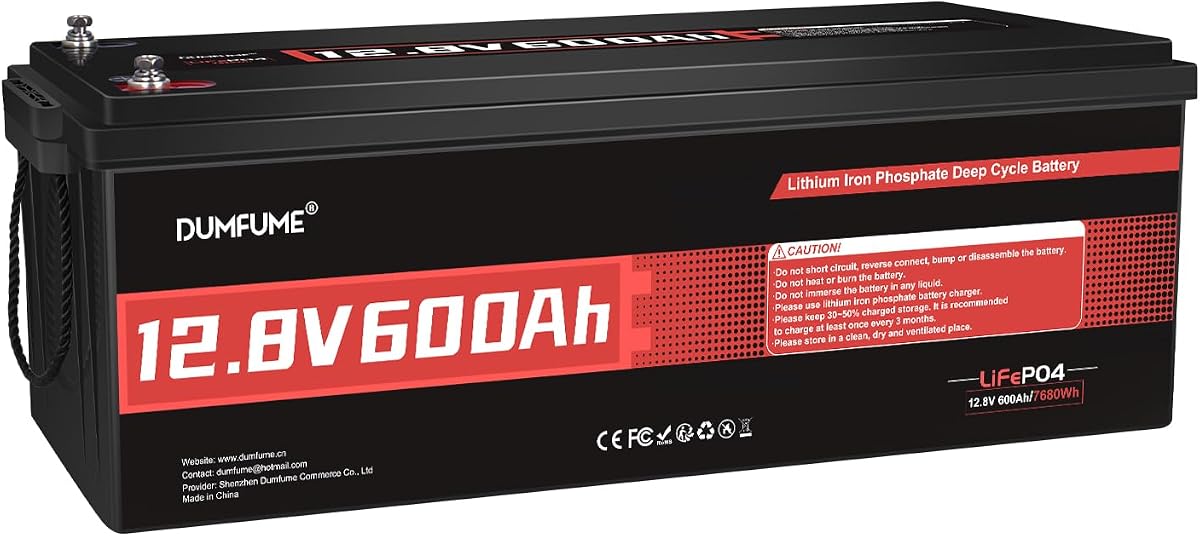
This DUMFUME battery offers a conventional 12V 600Ah configuration with 7.2kWh of nominal energy and a built-in 200A BMS. Its 4.4 rating indicates generally positive buyer sentiment, and the listed use cases include household backup, refrigerators, lighting, small appliances, RVs, campers, and solar storage.
We may earn a commission when you buy through this link, at no additional cost to you.
The BMS protects against overcharge, overdischarge, overcurrent, overheating, and short circuits. Temperature controls stop charging below 0°C and discharging below -20°C. Multiple batteries may be connected in series for 24V or 48V systems or in parallel for more capacity, although the manufacturer advises against mixing different brands.
Stated cycle performance includes more than 4000 cycles at 100% depth of discharge, 6000 cycles at 80%, and 15000 cycles at 60%. The battery weighs 107.81 pounds. Those cycle figures are particularly attractive for frequently cycled solar applications, though real outcomes depend on whether charging and operating temperatures remain within the stated requirements.
This is a sensible choice for a large stationary or mobile deep-cycle installation where users value capacity, familiar 12V sizing, and multi-battery expansion more than app-based telemetry. It requires sufficient floor or cargo support, a temperature-aware charger, and periodic maintenance charge when stored unused.
A 7.2kWh nominal battery gives an installer more room than ordinary lead-acid alternatives when powering refrigeration, lighting, electronics, and selected small appliances. Inverters and their continuous ratings should still be matched carefully to the battery and wiring.
Series and parallel support lets a system scale as demand changes. Using identical batteries with compatible cables and a properly sized charger reduces imbalance risk and follows the manufacturer's stated safety guidance.
We may earn a commission when you buy through this link, at no additional cost to you.
This 12V 600Ah LiFePO4 battery combines a 7.2kWh capacity with a 200A smart BMS and a 4.4 rating. It is positioned for deep-cycle use in solar systems, RVs, campers, home backup, and off-grid installations rather than engine starting, lifting jacks, or golf carts.
We may earn a commission when you buy through this link, at no additional cost to you.
The BMS includes overcharge, overdischarge, short-circuit, overheating, and low-temperature safeguards. Charging is disabled below 0°C, while discharge protection engages below -20°F. Its internal balancing function supports coordinated charging and discharging when identical batteries are connected in series or parallel.
The manufacturer states more than 4000 cycles at 100% depth of discharge and more than 6000 cycles at 80%. At 107.81 pounds, the battery is presented as substantially lighter than comparable lead-acid alternatives. That portability benefit still requires planning because it is too heavy for casual one-person handling in every installation.
Buyers should choose this model for a straightforward deep-cycle system that needs a large 12V reserve and standard expansion. It does not offer the same app visibility as the leading pick, but it provides the core capacity and protection many solar and backup installations need.
A 200A BMS provides a useful balance between current capability and system complexity. Automatic balancing helps keep identical units working together, while the broad series and parallel support allows the installation to grow toward 24V or 48V as energy requirements increase.
This battery is better suited to repeated storage and discharge than starting applications. Its depth-of-discharge cycle figures make it relevant to solar users who regularly harvest stored energy rather than relying on it only for infrequent emergencies.
We may earn a commission when you buy through this link, at no additional cost to you.
This DUMFUME model emphasizes a defined compact enclosure while retaining a 7.2kWh capacity and 200A BMS. It has a 4.4 rating and measures 24.09 by 9.64 by 8.86 inches, increasing to 25.19 inches with the handle, while weighing 107.81 pounds.
We may earn a commission when you buy through this link, at no additional cost to you.
Its BMS guards against overcharge, overdischarge, overcurrent, short circuit, and overheating. Low-temperature lockout prevents charging below 0°C and discharging below -20°C. The listed low self-discharge behavior supports stable storage, though the manufacturer still recommends recharging an unused battery every six months.
Multiple identical units can be arranged in configurations up to 4S4P, producing a 48V system with expanded capacity. Automatic voltage and current balancing is designed to improve stability when units operate together. Mixing battery models or manufacturers is discouraged because inconsistent cells can create imbalance and safety concerns.
This option is well matched to RV upgrades, custom solar arrays, and home backup systems where users want a defined footprint and robust expansion. Compared with a 660Ah alternative, it provides slightly less nominal energy, but its 4S4P support and compact case make it a flexible addition to a planned storage bank.
Published dimensions help buyers determine whether the battery will fit a battery compartment, equipment cabinet, or storage platform before ordering. The handle improves handling, but the listed weight means installers should still use appropriate lifting and mounting practices.
Automatic balancing helps keep identical batteries operating consistently in a larger bank. This feature becomes increasingly important as installations add parallel capacity or series voltage and need stable output across the group.
We may earn a commission when you buy through this link, at no additional cost to you.
The ECIENWELL listing includes two 12V 300Ah batteries, giving buyers a modular alternative for 600Ah-class energy needs. Each battery provides 3840Wh and weighs 54.45 pounds, making the individual units easier to manage than many 600Ah enclosures. The product has a 5.0 rating.
We may earn a commission when you buy through this link, at no additional cost to you.
The battery uses an EV A+ grade cell and a 200A BMS with protection against overcharge, overdischarge, overload, overvoltage, overcurrent, overheating, and short circuit. UL and CE certification, UN 38.3 testing, and MSDS testing are listed, while an IP65 rating supports use in damp or dusty environments.
Stated cycle life is more than 4000 cycles at 100% depth of discharge, 6000 at 80%, and 15000 at 60%. Identical batteries support 4P4S expansion to a stated maximum 51.2V and 61.44kWh. The product data also states that 70% of battery materials are recycled and that no lead or chromium heavy metals are used.
Its broad application list includes trolling motors, RVs, boats, camping equipment, solar panels, off-grid living, UPS systems, fish finders, emergency lighting, and other deep-cycle duties. Buyers should confirm wiring and equipment voltage because two 300Ah batteries connected in series produce 24V rather than a single 12V output.
The listed UL, CE, UN 38.3, and MSDS credentials provide useful documentation points for buyers evaluating safety and transport compliance. The absence of lead and chromium heavy metals also differentiates the chemistry from conventional lead-acid batteries.
Two separate 300Ah units can be placed where a single 600Ah case may be difficult to support. That modularity can simplify replacement planning, transport, and series or parallel expansion, provided all cables and connected devices are rated appropriately.
We may earn a commission when you buy through this link, at no additional cost to you.
The Paoweric battery is nominally marketed as 600Ah but is actually rated at 660Ah and 7680Wh, providing a modest capacity advantage over conventional 600Ah models. Its 4.6 rating is the highest among the individual large-format batteries in the guide, making it a strong option when both capacity and buyer feedback matter.
We may earn a commission when you buy through this link, at no additional cost to you.
A built-in 250A BMS provides overcharge, overdischarge, and overcurrent protection. The stated charging range is 0°C to 45°C, while discharge operation is listed from -20°C to 60°C. The load power rating is 3200W, giving installers a useful figure when matching the battery to inverter and household loads.
The battery measures 25.25 by 9.75 by 8.77 inches and weighs approximately 144 pounds. That weight is the clearest drawback, particularly for RV upgrades where every pound matters. Its IP65 shell is described as waterproof and wear-resistant, making it suitable for mobile and exposed installations when properly secured.
The listing recommends no more than six batteries in series or parallel and warns against mixing brands. Its stated cycle life of more than 10,000 cycles is attractive, but buyers should interpret cycle claims alongside the stated depth-of-discharge conditions and their own charging practices.
The 660Ah rating produces 7680Wh of nominal energy. That extra margin can be valuable when the inverter, charger, and wiring are designed for slightly more capacity than a standard 600Ah battery bank.
The manufacturer states that its service team can analyze customer issues within 24 hours and help users improve battery operation. Buyers should still review warranty terms, setup documentation, and local support availability before making a final decision.
We may earn a commission when you buy through this link, at no additional cost to you.
This single HumsiENK battery provides 640Ah and 8192Wh of energy, placing it slightly above the standard 600Ah capacity target. It carries a 5.0 rating and offers Bluetooth monitoring alongside a 250A BMS, making it a convenient option for owners who want more capacity without assembling a two-battery system.
We may earn a commission when you buy through this link, at no additional cost to you.
The app provides state-of-charge, voltage, and temperature information. Its six-layer protection covers overcharging, overdischarging, overload, short circuits, and extreme temperatures. A 600A peak discharge rating gives compatible loads some flexibility for brief surges, while the 250A continuous protection class gives installers a clear system parameter.
The battery supports charger, solar, and generator charging, with a stated five-hour recharge using the specified 0.2C method. It can discharge down to -4°F or -20°C, but charging stops below 32°F or 0°C. Its standard M8 terminals are designed to support direct integration with suitable existing systems.
This is a strong selection for RV, marine, solar, and home backup users who want a single high-capacity unit with remote status information. The primary compromise is weight, and buyers must also verify that the existing charger, inverter, wiring, and connection sequence are compatible with a 12V 640Ah lithium battery.
Bluetooth monitoring reduces the need for physical checks during routine operation. Seeing state of charge, voltage, and temperature can help owners recognize an unbalanced bank or a charging problem before it becomes more difficult to diagnose.
Keeping the installation to one 640Ah battery may simplify some layouts compared with a two-pack. At the same time, it concentrates a large amount of energy in one enclosure, making secure mounting, cable sizing, and ventilation particularly important.
We may earn a commission when you buy through this link, at no additional cost to you.
The AOUSK offering is structurally different from the 12V batteries in this guide. It consists of six 48V 100Ah rack-style batteries configured for a 51.2V nominal system with 10.24kWh of total energy. Its 5.0 rating reflects strong buyer interest in a turnkey high-voltage option.
We may earn a commission when you buy through this link, at no additional cost to you.
Each battery uses 16 automotive Grade A prismatic cells and includes a 100A BMS. CAN and RS485 communication allows compatible all-in-one solar inverters to exchange operating information, while Bluetooth and a mobile app provide status visibility. The system also includes a 125A air switch and a dedicated battery power switch.
The enclosures fit standard 3U cabinets and support vertical installation. Each 48V 100Ah unit weighs 94.8 pounds, and up to 15 batteries may be connected in parallel for larger installations. Unlike most entries in the guide, this battery operates at 48V nominal rather than 12V, so it requires compatible power electronics.
The package includes parallel wiring, communication cables, grounding wires, terminal covers, screws, a manual, and installation videos. It is best suited to users designing a higher-voltage solar or backup system around rack-mounted equipment. It would not be a direct substitute for a 12V battery in an RV or marine installation.
A 48V battery bank can reduce current relative to an equivalent 12V system with the same power, which may allow smaller conductors in properly engineered installations. That advantage only applies when the inverter, charger, controller, and other components are designed for 48V nominal operation.
CAN and RS485 support gives compatible inverters a way to communicate with the battery and configure cycle capacity. The Bluetooth app and included safety switches add further control, making this one of the more integrated choices for professionally planned solar installations.
We may earn a commission when you buy through this link, at no additional cost to you.
Selecting a large LiFePO4 battery requires matching electrical performance to the intended load, charger, inverter, installation space, and climate. The most important distinctions include actual energy configuration, current protection, temperature limits, expansion method, and monitoring capabilities.
Choose the voltage required by your existing equipment, then match the remaining capacity to your load.
Match both continuous inverter output and peak demand to the battery and wiring.
Treat the BMS rating as a protection limit, not an invitation to run maximum current continuously.
Check charging and discharging cutoffs separately before using the battery in cold climates.
Compare cycle life at the same discharge depth and follow the recommended charge routine.
Expand with identical batteries and verify charger, inverter, and communication compatibility first.
Choose monitoring that matches the inverter and gives the operating data you will actually use.
Check dimensions, weight, mounting strength, and weather exposure before finalizing a purchase.
Before energizing the system, read the battery manual, verify terminal polarity, confirm that the inverter and charger support the battery's nominal voltage, and inspect all connections. Use cables, fuses, busbars, and switches rated for the intended current. A battery should be securely mounted in a stable, ventilated location where it will not be exposed to excessive heat, moisture, or impact. Do not reuse the battery as a vehicle starter or connect it to incompatible equipment without confirming the manufacturer's requirements.
Charge with a LiFePO4-compatible charger using the specified voltage, current, and temperature limits. Allow the pack to warm naturally before charging if it has been exposed to freezing conditions. Equalization is not generally needed for LiFePO4 chemistry, and users should follow the manufacturer rather than applying lead-acid charging routines. During routine use, monitor state of charge and current, avoid prolonged deep discharge, and make sure the inverter's low-battery cutoff is set to a level that protects the battery while still supporting essential loads.
For storage, place the battery in a cool, dry, stable location and follow the specified state-of-charge recommendation. Several products in this guide advise recharging an unused battery every six months. Periodically inspect terminals, cable insulation, mounting hardware, corrosion, and the physical enclosure, and check monitoring data for signs of imbalance or abnormal temperature. If a battery is damaged, swells, becomes unusually hot, or develops a fault indication, stop using it, isolate it according to the manual, and seek qualified assistance.
A 600Ah battery at 12.8V has a nominal energy capacity of about 7.68kWh. A 12V 660Ah model provides about 7680Wh, while the two-pack configurations can provide substantially more when paired. Actual usable energy from an inverter will be lower because of conversion losses, wiring, temperature, and BMS operating limits.
Yes, if the batteries are identical, the inverter and charger support the resulting voltage, and the wiring follows the manufacturer's instructions. Two nominal 12V batteries in series produce about 24V, while four can produce about 48V. Mixing brands, models, ages, or capacities can create imbalance and should be avoided.
Most of the products in this guide are designed for deep-cycle storage rather than engine starting, and some explicitly state that they are unsuitable as starter batteries. Starting a vehicle or equipment engine creates a very high surge current with a different use pattern. Check the product manual before considering such an application.
Most included batteries automatically stop charging below 0°C or 32°F to protect their cells. Some can still discharge at much colder temperatures, but discharge and charging limits are not the same. In cold conditions, let the battery warm naturally or use a charging arrangement designed to manage the low-temperature cutoff.
It is optional rather than essential for basic operation, but monitoring can make a large off-grid system easier to manage. Bluetooth provides convenient battery status information, while CAN or RS485 can support deeper communication with compatible inverters. The value depends on whether the installed equipment supports the required protocol and app.
The stated figures differ by product and depth of discharge. Several list more than 4000 cycles at 100% depth of discharge, while one advertises more than 10,000 cycles. Cycle life also depends on temperature, charging habits, current, battery age, and how often the battery is deeply discharged, so the headline figure should not be treated as a guaranteed lifetime.
They can provide similar total amp-hour capacity when configured correctly, but they are not identical in every respect. Two 300Ah batteries in series produce about 24V and 600Ah, while parallel operation produces about 12V and 1200Ah. Individual size, cable routing, fault isolation, and compatibility with the rest of the system may differ from a single 600Ah battery.
Use a charger explicitly compatible with LiFePO4 chemistry and the battery's nominal voltage, current rating, and BMS requirements. Solar charge controllers and generators can be used with suitable equipment, but their charge profiles must match the manufacturer's recommendations. Confirm cold-temperature cutoff behavior and make sure the charger does not exceed the specified charge current.
The leading choice for most well-equipped installations is the app-enabled 12V 600Ah model with a 300A BMS because it combines high capacity, detailed monitoring, flexible expansion, and multiple charging options. The NebuQuic two-pack represents the budget-oriented route to 600Ah-class storage, while the HumsiENK 640Ah two-pack stands out for buyers who require the greatest combined reserve.
Prioritize voltage compatibility, BMS limits, temperature behavior, physical support, and the inverter's realistic load requirements before considering cycle claims or convenience features. A slightly lower-rated model with the correct protection and dimensions may be a better system fit than a higher-capacity battery that cannot be installed safely. Expansion plans should use identical batteries and compatible charging equipment.
Current prices and product configurations can change, so confirm the latest listing information, warranty terms, included accessories, and technical specifications before buying. Also review the seller's operating instructions and ensure that your planned environment and electrical equipment meet the battery's requirements.