
Fosi Audio TB10D
4.5Editor score
300 watts per channel
RCA and speaker outputs
Adjustable bass and treble
Compatible with 2-8 ohm speakers
Compact Class D design
Discover 10 amp for component speakers options and compare their power, connectivity, channel flexibility, protection, controls, and ideal home or car audio
An amplifier for component speakers supplies the power that dedicated drivers, tweeters, mid-bass units, and crossover networks need to produce balanced sound. A good match should provide clean output, compatible speaker loading, suitable input connections, and enough channel flexibility for the intended room or vehicle.
The products in this guide span compact home-audio units, Bluetooth-capable mini amplifiers, streaming amplifiers, and purpose-built car-audio models. We compared their stated power configurations, connectivity, controls, speaker compatibility, crossover features, protection, dimensions, and practical use cases without claiming hands-on testing.
Each pick reveals what a particular amplifier is best suited to accomplish, from powering passive bookshelf speakers to driving separate component channels in a car. Product listings and availability can change over time, so readers should verify current specifications, compatibility, and current prices before purchasing.
4.5Editor score

4.6Editor score

4.5Editor score
This side-by-side comparison highlights the major differences in power, channel count, signal handling, control features, and intended applications, helping you match an amplifier to passive home speakers or a component car-audio system.




The Taramps TS400X4 is a four-channel, full-range Class D car amplifier with a stated 400 watts RMS output and a 4.3 rating. Its most useful feature for component-speaker projects is channel flexibility: it can operate as a conventional four-channel amplifier or be configured as two bridged channels. That makes it relevant to installers who want to power multiple speaker sections without adding several separate monoblock units.
We may earn a commission when you buy through this link, at no additional cost to you.
The four-channel layout is particularly appropriate for a car with separate front and rear speaker groups. It also gives an installer more options than a conventional two-channel model when designing a component system around door speakers, rear speakers, or a mixture of full-range and bridged outputs. RCA inputs provide the familiar connection point for a head unit or processor, while the compact Class D format can make routing and mounting more practical in a crowded vehicle.
There is an important distinction between channel count and guaranteed performance. The product title identifies the unit as a 400-watt RMS four-channel amplifier, but buyers should review the detailed manual, speaker impedance requirements, and wiring recommendations before drawing conclusions about output into every possible load. The supplied information also strongly recommends professional installation to ensure safe setup, optimal performance, and protection against installation mistakes. That recommendation is sensible because a car amplifier depends on a secure chassis ground, correctly sized power wiring, and properly terminated speaker cables.
The TS400X4 is a compelling option for a builder seeking a multi-channel car amplifier in a relatively small enclosure. It is less suitable for a basic indoor bookshelf setup because it is designed around automotive power and installation requirements. For a serious vehicle component-speaker system, however, the four outputs and two-channel bridging capability make it more versatile than a typical single-purpose amplifier.
Choose the TS400X4 if your plan involves multiple separately wired speaker groups, a head-unit signal, and a vehicle electrical system that can safely support the amplifier. Have the installation checked against the manufacturer’s instructions, especially when bridging channels or operating near the unit’s minimum load. For shoppers who need a straightforward home amplifier with wireless music, one of the Fosi Audio models will be a simpler fit.
The combination of four channels and two bridged modes gives installers room to design around separate speaker groups. It is especially useful when a conventional two-channel amplifier would leave too much of the system unaddressed.
A dependable chassis ground, protected power connection, correctly sized wiring, and stable speaker termination are essential. The seller’s strong recommendation for qualified installation reflects the consequences of doing these steps incorrectly.
We may earn a commission when you buy through this link, at no additional cost to you.
The Fosi Audio BT20A Pro is a compact two-channel Class D home-audio amplifier with Bluetooth 5.0, a stated 300 watts x2 output, and a 4.4 rating. It is designed for passive speakers, giving listeners a simple way to combine traditional wired audio sources with direct wireless playback from a phone or computer. The combination of streaming convenience, a small enclosure, and user-adjustable tone controls makes it especially approachable.
We may earn a commission when you buy through this link, at no additional cost to you.
Its TPA3255 amplification chipset and replaceable plug-in NE5532 op-amps are notable for a mini amplifier. The stated signal-to-noise ratio is at least 108 dB, while total harmonic distortion is listed at no more than 0.005%. Users can also substitute compatible LME49720HA, MUSES02, OPA2604AP, OPA2134PA, LM4562, or NJM4556AD op-amps. That replaceability adds a level of enthusiast customization normally associated with larger component amplifiers.
The Pro version also includes bass and treble controls, allowing the sound to be adjusted without immediately reaching for an external processor. The stated idle loss of less than 2.5 watts is useful in a secondary listening area, patio, office, or home office where the amplifier may remain connected for extended periods. Bluetooth pairing can be removed by holding the volume control for five seconds, while memory and an alert tone simplify reconnection. The included power adapter, antenna, AC cord, and manual cover the core setup needs.
Its limitations are predictable for a unit at this scale. It has no HDMI ARC connection, room correction, or built-in streaming-service interface, so it does not replace a network amplifier for a television-centric system. It also uses an AC supply and speaker-level outputs, making it a home-audio device rather than a car amplifier. The advertised 300-watt x2 figure is also a headline output specification, so buyers should understand the test conditions and compare continuous output at their speakers’ impedance before concluding that every pair is equivalent in real-world headroom.
The BT20A Pro is a strong choice for someone who wants a small, flexible amplifier for passive bookshelf, desktop, patio, or outdoor speakers and values both Bluetooth and the ability to customize the internal op-amps. It is a better fit for music listening than a home-theater amplifier, and a better fit for casual, compact systems than one of the full-size car models in this guide.
Bluetooth 5.0 makes casual listening straightforward, while the amplifier’s broader home-audio role remains useful when you want to switch back to a wired source. The pairing-removal function and memory function add practical control for everyday use.
Replaceable NE5532 op-amps let technically inclined users experiment with alternative signal stages. This is a meaningful distinction for listeners who enjoy optimizing a system rather than treating the amplifier as an untouched appliance.
We may earn a commission when you buy through this link, at no additional cost to you.
The Fosi Audio TB10D is a two-channel Class D integrated amplifier with a 4.5 rating and a stated 300 watts per channel. It uses the TPA3255 chipset and is positioned for passive speakers ranging from compact desktop models to bookshelf speakers. That makes it one of the more direct answers to the core question of how to power passive component speakers without occupying much shelf space.
We may earn a commission when you buy through this link, at no additional cost to you.
The 2-8 ohm compatibility range gives the TB10D more flexibility than a unit designed only for a narrow impedance. A turntable with a built-in phono preamp, a computer, television, DVD player, CD player, game system, or another line-level source can feed its RCA input. The speaker outputs are passive, meaning the speakers receive the amplifier’s power directly. A bass shaker can also be integrated into a compatible setup, which broadens its usefulness for gaming and home theater experiments.
Bass and treble knobs provide basic room and speaker matching without a complicated menu, and a physical power switch adds convenience. Built-in protection circuits are listed as safeguarding stable operation and prolonging equipment life. The compact enclosure is useful for a desk, sideboard, media console, or small studio, while the stated power provides an encouraging amount of headroom for room-filling bookshelf speakers. As with other Class D mini amplifiers, buyers should examine the product’s detailed output conditions to understand power at different impedances.
The main omission is integrated wireless streaming. The TB10D does not provide the Bluetooth found in the BT20A or the app-driven services and HDMI ARC of the WiiM Amp. A separate streamer, Bluetooth receiver, or television connection may be needed. Nevertheless, that limitation also keeps the signal path and operating concept focused, and it can be an advantage for a permanently wired system.
The TB10D earns the Best Budget badge because it combines a high stated output figure, broad passive-speaker compatibility, familiar RCA connections, and straightforward tone controls in a compact package. It is an excellent starting point for a two-channel home system, particularly when the source is already line level. Buyers who require wireless music should add a streamer or consider the BT20A Pro instead.
Support for 2-8 ohm passive speakers makes the TB10D useful across a broad range of bookshelf and desktop models. Always confirm that the planned speaker combination falls within the manufacturer’s detailed requirements.
RCA input, passive speaker terminals, a power switch, and direct tone controls remove much of the complexity associated with larger integrated amplifiers. It can serve as the central power stage for a modest stereo system.
We may earn a commission when you buy through this link, at no additional cost to you.
The AIYIMA A07 Premium is a compact stereo Class D amplifier built around the Texas Instruments TPA3255 and NE5532 dual op-amp, with a 4.4 rating. Its listed maximum output is 300 watts x2, and it is designed to work with passive bookshelf speakers from 2 to 8 ohms. The product combines the convenience of an integrated mini amplifier with several features aimed at listeners who want to modify or expand their system.
We may earn a commission when you buy through this link, at no additional cost to you.
A particularly useful feature is the 3.5 mm AUX pre-out. It provides a full-range, volume-controlled signal that can feed active speakers, another power amplifier, or a powered subwoofer amplifier. That makes it possible to build a 2.1-channel system with the A07 handling passive speakers while a separate powered subwoofer handles bass. The amplifier also has RCA input and passive speaker output connections for more conventional stereo setups.
The internal design reflects an enthusiast approach. The NE5532 dual op-amps can be replaced with compatible OPA, LM, and MUSES series chips, and the listing highlights Japanese ELNA capacitors, 63-volt filter capacitors, and WIMA capacitors. The enclosure is a full-metal housing with upgraded internal cooling and higher-quality knobs. These details may appeal to someone who wants a compact audio component that can evolve instead of being restricted to a fixed factory configuration.
There are important practical caveats. The product does not support Wi-Fi, and the included 32-volt, 5-amp adapter may not deliver the amplifier’s maximum output in every situation. The listing notes that a 48-volt, 10-amp supply can be used for maximum 300-watt x2 output, while warning against industrial power supplies. Users should follow the supplied guidance carefully. The pre-out is also not the same thing as a dedicated subwoofer output, so a crossover may be needed for a properly filtered bass channel.
The A07 Premium is a strong candidate for a small high-fidelity stereo system where the listener values component quality, replaceable op-amps, and future expansion. It is less convenient for casual Bluetooth listening or television control, but for a wired two-channel setup or a carefully constructed 2.1 arrangement, it offers a more granular approach than many basic mini amplifiers.
The volume-controlled full-range pre-out lets the A07 serve as the central component in a larger setup. It can feed another power amplifier or a powered subwoofer when a suitably filtered bass channel is required.
Replaceable op-amps and upgraded internal capacitors give technically interested buyers a way to refine the signal stage. The cooling and metal housing also distinguish this model from basic plastic-cased mini amplifiers.
We may earn a commission when you buy through this link, at no additional cost to you.
The Rockford Fosgate Punch P300X2 is a full-chassis, two-channel amplifier with a 4.5 rating and a stated 300 watts RMS output. Unlike many compact amplifiers whose headline figure can obscure channel-by-channel performance, this model lists clear configurations: 100 watts x2 at 4 ohms, 150 watts x2 at 2 ohms, and 300 watts x1 in bridged mode at 4 ohms. That transparency makes it easier to compare it with a driver’s power requirements.
We may earn a commission when you buy through this link, at no additional cost to you.
Its versatility extends to several signal and system arrangements. RCA inputs accept both high-level and low-level audio, reducing the need for a signal converter in many installations. The amplifier can support a full-range or component system, and its bridge mode can drive smaller subwoofers. On-board Punch EQ offers up to an 18 dB boost at 45 Hz, while variable 12 dB-per-octave Butterworth crossovers help shape the frequency range assigned to different speakers.
The Class-A/B topology and full-size enclosure distinguish it from mini Class D home units. At 2.38 by 7.76 by 9.86 inches, the P300X2 will require more space than a desktop amplifier, but that size supports a more substantial automotive installation and a clean, serviceable layout. The C.L.E.A.N. setup system provides a structured way to configure gain and related settings, reducing the risk of clipping and unwanted noise.
Its trade-offs are mainly about specialization. It is a car amplifier with no HDMI, Bluetooth, room correction, or network streaming, so it is not a natural fit for a passive home-stereo system. It also has only two primary channels. While those channels can be bridged for a subwoofer, buyers seeking several independent front, rear, and tweeter channels would need a different unit.
The P300X2 earns the Best Premium badge for car-audio buyers who want detailed output ratings, flexible filtering, multiple input levels, and a full-size amplifier with a one-year warranty. It is particularly well suited to a component system that can make productive use of the Punch EQ and crossover controls. For a home listening setup, a WiiM Amp or Fosi Audio mini amplifier offers more convenient source integration.
Listing output at multiple impedances and in bridged mode gives installers a more useful foundation than a single maximum-wattage claim. Match those figures to speaker sensitivity, enclosure design, and system goals before selecting wiring or crossover points.
High- and low-level RCA inputs, variable Butterworth crossovers, and the Punch EQ make the amplifier adaptable to both conventional head units and more specialized component-system layouts.
We may earn a commission when you buy through this link, at no additional cost to you.
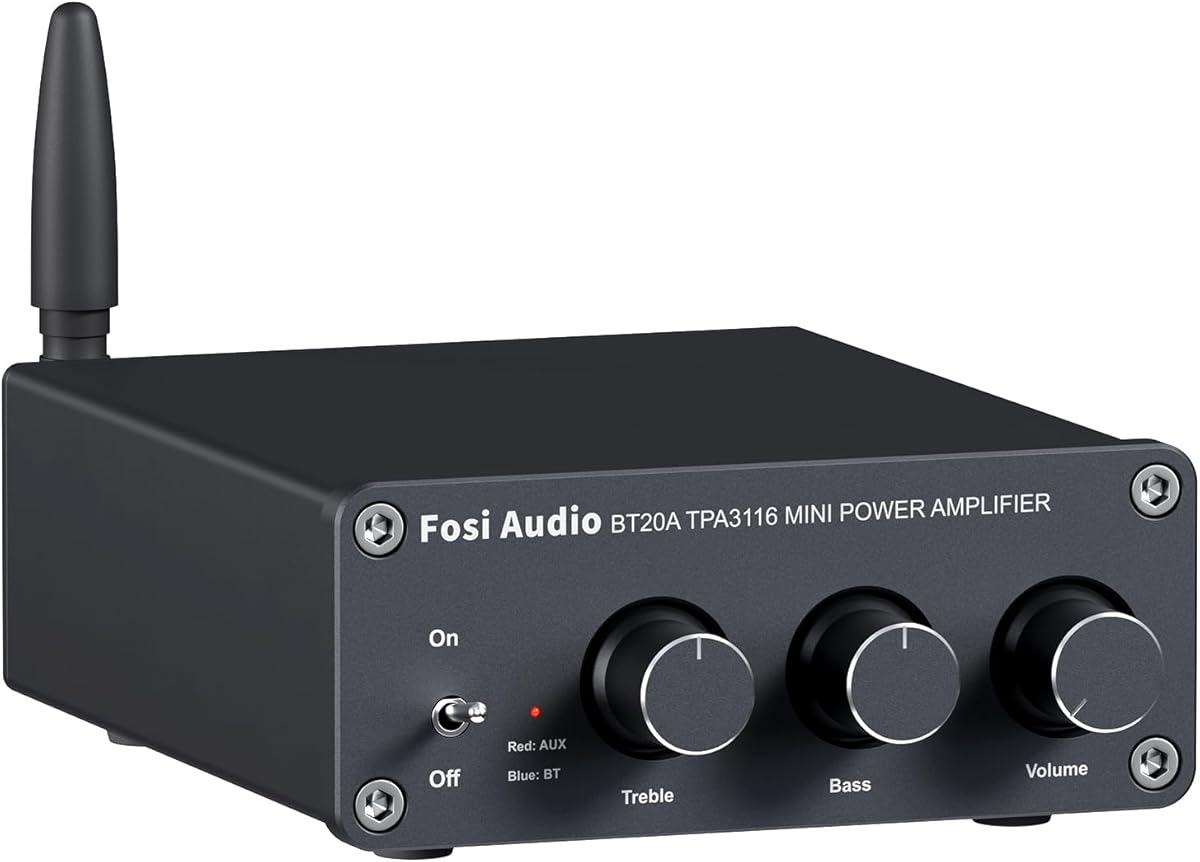
The Fosi Audio BT20A is a simple two-channel Class D amplifier with Bluetooth, a 4.5 rating, and a stated maximum output of 100 watts x2. It is designed for passive speakers in homes, offices, bedrooms, garages, patios, and other small spaces. The all-in-one approach makes it appealing to anyone who wants to give a pair of traditional wired speakers modern wireless playback without assembling a complicated network system.
We may earn a commission when you buy through this link, at no additional cost to you.
Bluetooth connectivity allows a phone to stream music directly, while RCA inputs support conventional line-level sources. The smooth bass and treble controls allow basic tuning for different rooms and speaker types, and the one-touch power switch removes unnecessary setup steps. Its integrated one-piece enclosure is also more durable than a collection of separate components, while the understated black finish can sit discreetly on a shelf.
The main strength is its low-friction operating model. There is no need to configure an account, install a control application, or learn a complex menu before enjoying a connected speaker system. That makes it particularly useful for secondary-room listening, an office, or a garage setup where convenience matters more than extensive room correction or audiophile-level component swapping.
Its limitations are equally clear. The 100-watt x2 maximum figure is lower than several other models in the guide, making it more appropriate for efficient bookshelf, desktop, ceiling, or outdoor speakers than for demanding low-impedance systems. It has no HDMI ARC, no high-resolution network streaming, and no room-correction features. It also cannot create the kind of deep customization path offered by the BT20A Pro.
The BT20A is a sensible choice for a first passive-speaker system or a simple Bluetooth upgrade. It offers the essential ingredients without unnecessary complexity. Buyers seeking higher output, replaceable op-amps, or greater source flexibility should step up to the BT20A Pro, while those who want app control and television integration should consider the WiiM Amp.
Direct Bluetooth streaming makes the BT20A especially convenient for casual listening from a phone. RCA inputs remain available for users who already own a preferred wired source.
The compact enclosure and stated 100-watt x2 output target indoor offices, bedrooms, patios, garages, and other areas where efficient passive speakers are likely. Matching the amplifier to appropriately sensitive speakers is the key to a satisfying result.
We may earn a commission when you buy through this link, at no additional cost to you.
The WiiM Amp is a connected amplifier for passive speakers with a 4.6 rating, a 4.7-inch touchscreen, and a stated 60 watts per channel at 8 ohms and 120 watts per channel at 4 ohms. It stands apart from the conventional mini amplifiers in this guide by combining speaker power with network streaming, app control, HDMI ARC, voice-command support, and multiroom functions in a compact enclosure.
We may earn a commission when you buy through this link, at no additional cost to you.
Its most valuable feature for component-speaker owners is the combination of a usable Class D power stage and a broad range of source options. Passive floor-standing, architectural, outdoor, and bookshelf speakers are all supported use cases. A turntable can be connected for analog listening, while HDMI ARC provides a direct path for television sound. Music services and local libraries can be streamed with stated support for high-resolution playback up to 24-bit/192 kHz.
The WiiM Home App gives control over volume, room settings, favorites, alarms, speaker synchronization, and individual equalization. It also supports voice commands through Alexa, Google Assistant, or Siri and can work with AirPlay 2 speakers, Amazon Echo, Google Home, and other WiiM-branded devices. Advanced room correction helps account for the listening space, a significant advantage over simple bass and treble knobs when the amplifier is being used in a real room rather than a controlled studio.
There are limitations. The stated output is lower than the headline power figures of several Class D mini amplifiers, although 60 watts per channel at 8 ohms can be ample for many efficient bookshelf and architectural speakers. It is intended for home use and lacks automotive wiring and protections. It can receive AirPlay streams but cannot transmit AirPlay to other AirPlay-enabled speakers, which means it can join a multiroom setup without serving as the source for every other speaker.
The WiiM Amp earns the Editor’s Choice badge because it solves more of the everyday problem of operating a modern passive-speaker system. It combines robust amplifier functions, flexible sources, room-aware tuning, and multiroom support without requiring separate network boxes. It is the leading choice here for a living-room system, television audio upgrade, or whole-home project, provided the planned speakers are compatible with its power and impedance requirements.
HDMI ARC, analog turntable input, network services, local libraries, and wireless protocols make the WiiM Amp more versatile than a basic line-level amplifier. It can serve as the central control point for both music and television audio.
The amplifier’s room correction and independent EQ settings can help optimize output for the actual placement of speakers and furniture. This is more useful for a living room than a flat tone control alone.
The amplifier can participate in a broader wireless ecosystem, but it is an AirPlay receiver rather than an AirPlay transmitter. Buyers who need it to send audio to separate AirPlay endpoints should account for that restriction.
We may earn a commission when you buy through this link, at no additional cost to you.
The Sundown Audio SFB-500.4D is a four-channel Class D car amplifier with a 4.0 rating and substantial stated output potential. It can deliver 500 watts x4 at 1 ohm under 14.4 volts, 450 watts x4 at 1 ohm under 12 volts, 320 watts x4 at 2 ohms under 14.4 volts, and 200 watts x4 at 4 ohms under 14.4 volts. In bridge mode, it is rated to produce 1,000 watts x2 at 2 ohms under the stated test conditions.
We may earn a commission when you buy through this link, at no additional cost to you.
For a car component-speaker project, the four-channel configuration is the defining attraction. A sophisticated installation can use separate channels for different speaker groups, and the broad impedance range offers more options than a conventional four-channel unit. Bridged operation also makes the amplifier relevant to a subwoofer stage when a system needs additional low-frequency power.
The detailed power matrix is useful because automotive amplifier output depends heavily on supply voltage. Comparing 12-volt and 14.4-volt figures gives a more realistic picture of what the amplifier can do under different electrical conditions. A larger, upgraded electrical system may support the higher output listed at 14.4 volts, while a standard system may produce figures closer to the 12-volt rating.
The trade-offs are substantial. It requires correct power-supply wiring, a secure ground, appropriate speaker cables, and careful attention to impedance to operate safely. It is physically and operationally designed for a serious vehicle installation rather than an indoor stereo. Its 4.0 rating is also the lowest among the ten products here, so prospective buyers should pay particular attention to recent customer feedback and warranty terms.
The SFB-500.4D is aimed at experienced installers who want high channel power and flexible low-impedance operation for a high-output car system. It can be an excellent platform when the vehicle is designed around a complete component audio architecture. For a smaller project, a more conventional four-channel amplifier may offer a simpler installation and greater room for error.
The published output matrix covers 1-, 2-, and 4-ohm loads, giving installers a clear basis for speaker pairing. It also makes the effect of the vehicle’s electrical voltage easier to understand.
High-output, low-impedance operation depends on correct wiring and a robust electrical system. This is not a casual drop-in amplifier for an improvised installation.
We may earn a commission when you buy through this link, at no additional cost to you.
The Skar Audio RP-75.4AB is a four-channel, full-range Class A/B car amplifier with a 4.6 rating. Its stated output is 125 watts x4 at 2 ohms and 75 watts x4 at 4 ohms, providing clear figures for matching a component system. Its four channels are useful when front and rear speaker groups each require independent amplification and control.
We may earn a commission when you buy through this link, at no additional cost to you.
The amplifier includes gain, variable low-pass and high-pass filters, and a three-position bass EQ offering 0, +6, or +12 dB. These controls are valuable in a vehicle because cabin acoustics can produce uneven bass response, and because separate speaker groups may need different frequency limits. Full-range capability also means the unit can serve a complete multi-channel system rather than being restricted to subwoofer duty.
Protection is another strength. The listed four-way protection circuitry is intended to guard the amplifier, and the stated frequency response extends from 20 Hz to 20 kHz. A signal-to-noise ratio of 105 dB supports a clean listening environment, while MOSFET output devices provide the basis for the amplifier’s Class A/B operation.
The main compromise is its narrow use case. Like the other dedicated car amplifiers in the guide, it is not intended to power indoor passive speakers or provide television audio. It also lacks the sophisticated signal routing and network features found in a modern connected amplifier. Buyers should focus on correct speaker impedance, adequate electrical supply, and professional installation practices.
The RP-75.4AB is a strong all-around choice for a car component system that needs four independently controlled channels rather than extreme monoblock power. Its 4.6 rating, useful filters, and straightforward output ratings make it easier to evaluate. It is particularly appealing to installers who value conventional Class A/B topology and direct tactile controls.
Four independently controlled channels provide a practical foundation for front and rear component systems. The amplifier can also support different filter settings for separate speaker groups.
Four-way protection circuitry, a stated 20 Hz–20 kHz frequency response, and a 105 dB signal-to-noise ratio provide useful technical context when evaluating system headroom and cleanliness.
We may earn a commission when you buy through this link, at no additional cost to you.
The Daakro AK45 is a compact stereo amplifier with Bluetooth 5.1, a 4.1 rating, and a stated 300-watt designation. It targets listeners who want to connect traditional passive speakers to a simple wireless source without committing to a more complex network amplifier. The physical volume, treble, and bass controls provide direct access to basic system adjustments.
We may earn a commission when you buy through this link, at no additional cost to you.
An included remote control allows volume and other adjustments from across a room, which is particularly useful in a bedroom, office, garage, or secondary listening space where reaching the amplifier would be inconvenient. The product’s Bluetooth support offers the quickest route to music playback from a compatible phone, while the multi-channel designation in the product name suggests a more expansive home-entertainment use case than a simple one-room stereo.
The AK45 is visually and operationally designed for accessibility. Its controls do not depend on an app, and the compact format should be easier to place than a full-size car amplifier. That makes it appealing for a straightforward project involving existing wired speakers that lack their own amplification.
The supplied information offers fewer technical details than many competing products. It does not provide a full channel-by-channel RMS power table, speaker impedance range, detailed input configuration, protection scheme, or dimensions. As a result, it requires more careful verification before purchase, especially for high-impedance requirements or a large listening space. The included remote also has an isolation plastic sheet that must be removed before use.
The AK45 is best viewed as an accessible, uncomplicated way to add Bluetooth to passive speakers. It may serve well in a modest room, but listeners seeking high-resolution network audio, television integration, room correction, or clearly documented power performance should choose a model with a more complete specification set. Its appeal lies in simplicity rather than advanced audiophile features.
Bluetooth 5.1 gives existing passive speakers a convenient way to receive music from a phone. The included remote reduces the need to walk over to the amplifier for everyday volume changes.
Because the available product information provides limited detail on impedance, continuous power, and protection, buyers should check the manual and manufacturer documentation. Speaker compatibility is especially important for an untested or newly assembled system.
We may earn a commission when you buy through this link, at no additional cost to you.
The right amplifier depends on speaker impedance, power requirements, source connections, channel layout, and installation environment. Use these factors to narrow the field before comparing cosmetic features or headline wattage.
Speaker impedance is the first constraint to confirm. An amplifier must remain within the minimum and maximum load supported by the manufacturer when one or more speakers are connected. The Fosi Audio TB10D and AIYIMA A07 Premium are described as compatible with 2-8 ohm passive speakers, while the Sundown Audio SFB-500.4D supports very low one-ohm loads in its stated automotive configurations. The Rockford Fosgate Punch P300X2 gives separate figures for 2-ohm and 4-ohm operation, which makes pairing more transparent. Never infer suitability from the number of speaker outputs alone. Series and parallel wiring changes the effective load presented to an amplifier, and combining several low-impedance drivers can create a load that an amplifier was never designed to handle.
Check the speaker manufacturer’s recommended minimum impedance and the amplifier’s instructions before connecting anything. If specifications are unclear, choose a product with documented load limits and seek installation assistance rather than experimenting.
Headline wattage is not the same as consistent power at every impedance. The Rockford Fosgate P300X2 lists 100 watts x2 at 4 ohms, 150 watts x2 at 2 ohms, and 300 watts x1 in bridged operation. The Sundown Audio SFB-500.4D similarly separates output by impedance and by 12-volt or 14.4-volt supply conditions. Those details are more useful than a single maximum number because they reveal how output changes with the actual load. The Fosi Audio models describe 300 watts x2 or 600-watt total figures, but buyers should check the detailed test conditions and expectations before assuming either figure represents continuous output into every speaker pair.
Power needs also depend on speaker sensitivity, enclosure size, listening distance, and preferred volume. More efficient bookshelf speakers may sound excellent with a smaller amplifier, while demanding floor-standing models benefit from greater headroom. Match the amplifier to the system instead of choosing power in isolation.
Component systems often require more than one stereo pair. A four-channel amplifier can support front and rear groups or other separately filtered sections, while a two-channel model is generally sufficient for one pair of passive speakers. Bridging can turn two channels into one higher-power mono output, but it may disable certain controls or prevent independent operation. The Taramps TS400X4 and Skar Audio RP-75.4AB are four-channel car options, while the Punch P300X2 uses two channels and can bridge them for a subwoofer. For home audio, the TB10D, BT20A, BT20A Pro, and A07 are conventional two-channel choices.
Map every driver group before choosing the channel count. If tweeters and mid-bass units use passive crossovers, one stereo pair of amplifier channels may be all that is required. If the system has active crossovers, additional channels, or separate subwoofers, the count can rise quickly.
The amplifier must accept the signal available from the rest of the system. RCA inputs are standard for line-level home and car sources, and the BT20A, BT20A Pro, TB10D, and A07 support them. The A07 also includes a 3.5 mm AUX pre-out for feeding another amplifier, active speakers, or a powered subwoofer. The Rockford Fosgate P300X2 accepts both high- and low-level signals, which can simplify certain vehicle installations. A turntable may need a phono preamp unless the amplifier includes one, and a television may need HDMI ARC or an optical, digital, or analog connection.
Think about direction as well as format. A pre-out sends a signal onward, while a line input receives one. Confusing the two can lead to a system that appears correctly wired but produces no sound. Check every connector and the manual before installation.
A component system may need different frequency ranges sent to different drivers. The Rockford Fosgate P300X2 includes variable 12 dB-per-octave Butterworth crossovers, and the Skar Audio RP-75.4AB provides variable low-pass and high-pass filters plus three bass EQ positions. These are particularly useful in cars, where cabin placement strongly affects bass response. For a smaller home system, the bass and treble controls on the Fosi Audio and Daakro models provide a simpler means of tonal adjustment, while the WiiM Amp adds independent EQ and room correction.
Prefer dedicated filters when a multi-way system needs accurate channel allocation. Basic tone controls are helpful for taste and room compensation, but they do not replace a properly configured crossover.
Bluetooth, AirPlay, HDMI ARC, and network streaming solve different source and control problems. The Daakro AK45 and Fosi Audio BT20A focus on direct Bluetooth playback, while the BT20A Pro adds Bluetooth 5.0 and a more advanced internal design. The WiiM Amp supports high-resolution network streaming, HDMI ARC television audio, an app, room correction, voice control, and multiroom integration. It also supports AirPlay as a receiver only, meaning it cannot transmit an AirPlay stream to other endpoints. Decide whether simple phone playback is enough or whether a full control ecosystem is worth the added complexity.
Wireless features should complement the intended use rather than substitute for proper speaker matching. A streaming amplifier does not automatically sound better, and a wired amplifier does not become obsolete simply because it lacks Wi-Fi.
The amplifier’s physical size, power source, grounding, ventilation, and mounting location can determine whether it is practical in the intended system. Compact home units fit shelves and media cabinets more easily than full-size car amplifiers. Automotive models need substantial wiring, a secure ground, adequate battery and alternator support, and protection from heat and vibration. The Taramps listing strongly recommends professional installation by a qualified technician using appropriate tools and protective equipment. That guidance applies to any installation where an incorrect connection can damage equipment, cause injury, or affect performance.
Leave the specified clearance around heat-producing components and use the supplied power adapter unless the manual explicitly permits another supply. For the A07 Premium, the listing specifically notes that a 48-volt, 10-amp adapter can be used to seek maximum output and warns against industrial power supplies.
Protection circuits can help an amplifier operate safely, although they are not a substitute for correct wiring. The Skar Audio RP-75.4AB lists four-way protection, and the Fosi Audio TB10D includes built-in protection circuits. The Rockford Fosgate P300X2 has a full chassis and a stated one-year warranty, while the AIYIMA A07 Premium uses a metal housing, upgraded cooling, and higher-quality internal components. These differences are more meaningful when the amplifier will be operated frequently, mounted permanently, or exposed to the temperature changes common in a vehicle.
Review the available protection details and warranty terms, but avoid assuming a long warranty compensates for an unsuitable load. Proper installation remains the foundation of reliable operation.
Begin by identifying every speaker, crossover, source, and connection before powering the amplifier. Confirm speaker impedance, verify that the amplifier supports the resulting load, and inspect all cables for correct polarity. Connect the signal source first, set the amplifier to its lowest gain or minimum level, and only then power the system. For a car installation, use appropriate power, ground, and speaker wire, and consult a qualified technician if the configuration is unfamiliar.
Begin tonal adjustments with the bass and treble controls at a neutral position, then make small changes while listening to familiar material. If the amplifier has variable filters, set crossover points according to the driver manufacturer’s recommendations rather than using the controls as a substitute for proper crossover design. On the WiiM Amp, complete room correction after the speakers are in their final positions, and save separate settings for different programs or sources if the app supports that workflow.
Keep ventilation openings clear, avoid placing the amplifier in a closed, moisture-prone space, and do not operate it beyond the manufacturer’s specifications. For Bluetooth models, remove the remote’s isolation sheet before using the remote and keep the paired device within a reasonable range. Periodically inspect plugs, terminal connections, and mounting points, particularly in a vehicle where vibration and temperature changes are normal. If distortion, instability, abnormal heat, or intermittent output appears, reduce the level, power down, and investigate the load and connections before using the unit again.
Only if its output type and load rating are compatible with the speakers. Most passive home speakers require a line-level source and speaker-level amplifier outputs, while the car amplifiers in this guide are designed around vehicle electrical systems. Always check impedance, channel configuration, and connector type before connecting them.
It depends on the speaker design. Passive component systems normally include or require crossover networks that divide the signal between tweeters and mid-bass drivers. Active systems have separate crossover electronics and need dedicated amplifier channels. Check the speaker manufacturer’s wiring and crossover instructions before deciding which amplifier channels to use.
No. A very powerful amplifier can reveal distortion or handling limits of less capable speakers, while a modest amplifier may be ideal for efficient models. Match the amplifier’s clean output at the intended impedance to the speaker’s sensitivity, enclosure, and listening goals, while leaving enough headroom for dynamic passages.
Only when the resulting impedance remains within the amplifier’s permitted load range. Series and parallel combinations can reduce or increase impedance, and either wiring can affect channel balance. A technician should calculate the total load before multiple drivers are connected, particularly with one-ohm-capable automotive amplifiers.
An RCA input receives an audio signal from a source, while an AUX pre-out sends a volume-controlled signal to another device. The AIYIMA A07 Premium includes both, allowing it to receive music and then feed another amplifier or powered subwoofer. A pre-out is not automatically a filtered subwoofer output, so crossover requirements still need to be met.
For music and casual listening, a Bluetooth amplifier can replace a conventional stereo receiver. For television viewing, however, a model with HDMI ARC or another compatible digital input is generally more convenient. The WiiM Amp is the strongest television-oriented option in this guide, while the other connected home amplifiers focus on stereo music.
Professional installation is strongly advisable whenever wiring, bridging, or high-current power is involved. Correct cable sizing, a solid chassis ground, safe fusing, speaker polarity, and ventilation directly affect performance and safety. The Taramps TS400X4 product information specifically recommends installation by a qualified technician.
Class D models are generally compact and efficient, making them well suited to mini home amplifiers and multi-channel car installations. The Class A/B models in this guide use a larger traditional automotive design and may appeal to installers who prefer that topology. The right choice ultimately depends on space, output configuration, system design, and installation requirements.
The Fosi Audio TB10D stands out as the Best Budget pick for its strong stated output, 2-8 ohm support, RCA connectivity, and useful tone controls. The WiiM Amp earns the Editor’s Choice designation because it combines passive-speaker power with HDMI ARC, high-resolution streaming, room correction, and multiroom control. The Rockford Fosgate Punch P300X2 takes the Best Premium badge for car builders who value detailed RMS figures, flexible bridging, high- and low-level inputs, and dedicated filtering.
Prioritize compatibility before features. Confirm speaker impedance, continuous output, channel requirements, source connections, and the physical environment of the installation. A simple amplifier that is perfectly matched to the speakers and room can be more satisfying than a feature-rich model burdened by unnecessary complexity. For indoor passive speakers, the TB10D, BT20A Pro, A07 Premium, and WiiM Amp cover distinct levels of functionality, from basic wired control to app-based streaming.
Ratings, specifications, product configurations, and current prices can change, and each listing should be checked for its latest details before purchase. Confirm the included power supply, required connections, warranty terms, and compatibility with the planned speakers. Buying the amplifier is only the first step; careful wiring, appropriate gain, correct filtering, and appropriate speaker pairing determine whether the final system delivers the performance you intended.