
ESP32-S3-Nano Development Board
5.0Editor score
ESP32-S3R8 dual-core processor
Eight megabytes PSRAM
Sixteen megabytes flash
Arduino and MicroPython support
Our Arduino Nano ESP32 guide compares ten compact Wi-Fi and Bluetooth boards, starter kits, and Arduino options for IoT projects.
The Arduino Nano ESP32 category combines compact microcontroller boards with wireless connectivity, useful processing power, and support for languages such as Arduino C++ and MicroPython. A strong development board should make prototyping straightforward while providing enough memory, peripherals, and power options for demanding embedded and connected projects.
We compared the supplied boards using processor architecture, wireless capabilities, memory, programming options, USB connectivity, power management, physical dimensions, and expansion interfaces. The list includes the official Arduino Nano ESP32, several ESP32-S3 alternatives, two established ESP32 boards, a starter kit, and the Arduino UNO R4 WiFi.
Each review explains where the product stands out, which project types suit it, and what trade-offs to consider. Ratings and specifications reflect the available product information, while availability and prices can change. Readers should confirm current listing details before ordering a board for a new project.
5.0Editor score

4.6Editor score

4.8Editor score
The table below compares all ten options by processor, memory, wireless support, and the most relevant practical advantage of each board.


The Arduino Nano ESP32 with Headers is the most directly relevant option for anyone searching specifically for a Nano-sized board combining official Arduino support with modern wireless capabilities. Its 4.6 rating reflects a favorable overall impression, while the ESP32-S3 processor, integrated Wi-Fi, and Bluetooth 5.0 make it a capable platform for connected prototypes.
We may earn a commission when you buy through this link, at no additional cost to you.
Its dual-core Xtensa LX7 processor can operate at up to 240 MHz, providing ample performance for sensor processing, real-time data handling, edge-oriented machine learning experiments, and connected embedded applications. USB-C simplifies both programming and power delivery, while pre-soldered headers make the board convenient for standard breadboards. HID support expands the possibilities to custom keyboards, mice, controllers, and other computer-facing USB devices.
MicroPython compatibility is especially useful for rapid experiments or teams that prefer Python over C++. The principal trade-off is that the official board does not offer the unusually high memory configuration found in some third-party ESP32-S3 alternatives, nor does it include the XIAO's battery charging circuitry. It is therefore better viewed as a polished general-purpose development platform than a specialized wearable board.
Choose the Arduino Nano ESP32 when official Arduino workflows, familiar documentation, a compact Nano footprint, and dependable wireless performance matter more than maximum onboard memory. It is the strongest all-around recommendation for IoT, HID, sensor, and educational projects, particularly for users who want a recognizable Arduino development experience.
The official Arduino identity reduces friction for learners and developers already using the Arduino IDE. Its compatibility with MicroPython also creates an option for Python-based experimentation without abandoning the same physical board.
Wi-Fi handles local network and cloud communication, while Bluetooth 5.0 supports nearby wireless links. USB HID support broadens the board beyond conventional sensor nodes into custom input and control devices.
We may earn a commission when you buy through this link, at no additional cost to you.
The ESP32-S3-Nano Microcontroller Development Board stands out because it pairs an ESP32-S3R8 processor with 8MB of PSRAM and 16MB of flash memory. Its 5.0 rating is the highest in this group, and the generous memory configuration makes it particularly attractive for projects that need more headroom than a standard compact wireless board usually offers.
We may earn a commission when you buy through this link, at no additional cost to you.
The dual-core Xtensa LX7 processor can run at up to 240 MHz, while 2.4GHz Wi-Fi and Bluetooth LE cover common network and short-range wireless requirements. Developers can move between Arduino and MicroPython, and the listed Arduino IoT Cloud compatibility supports monitoring and control of connected deployments through the associated app and cloud environment.
Its trade-off is less visible brand recognition than the official Arduino boards. Buyers should also verify the exact pin arrangement, documentation, and included connectors because third-party boards can differ in physical details. The supplied description does not indicate a battery charger, so portable projects may still need an appropriate external power arrangement.
This board is a compelling selection for programmers who want a small wireless computer with unusually ample memory. It suits web-oriented experiments, local data processing, more elaborate MicroPython projects, and connected systems where storage and RAM could otherwise become limiting. For those needs, it delivers excellent value on paper.
The combination of 8MB PSRAM and 16MB flash gives developers room for larger firmware, local data, and more demanding applications. This is the defining advantage over many conventional compact ESP32 boards.
Switching between Arduino and MicroPython lets a project begin with a familiar framework and move to Python when rapid iteration becomes useful. Arduino IoT Cloud support adds a path toward remotely managed devices.
We may earn a commission when you buy through this link, at no additional cost to you.
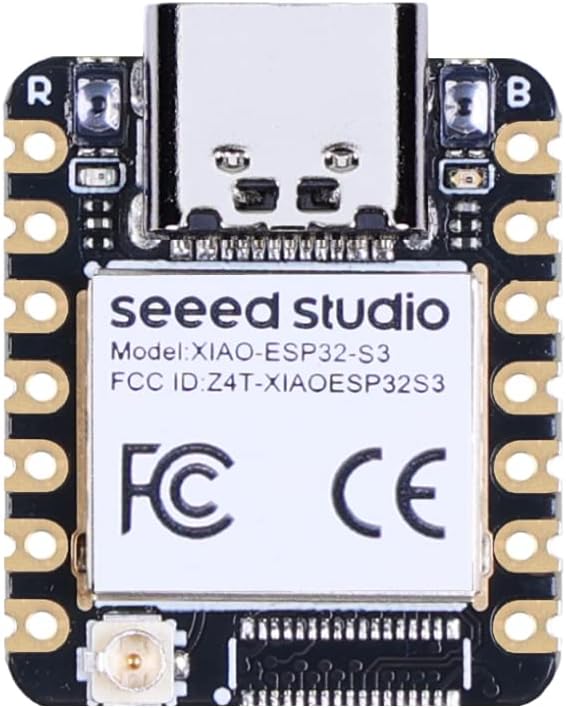
The Seeed Studio XIAO ESP32S3 is designed around a 21 by 17.5mm footprint, making it one of the most attractive choices for wearables and other space-constrained builds. Its 4.7 rating and combination of ESP32-S3 performance, Wi-Fi, BLE 5.0, battery charging, and low-power operation give it a strong profile for mobile IoT experimentation.
We may earn a commission when you buy through this link, at no additional cost to you.
The dual-core Xtensa processor reaches up to 240 MHz and supports both Arduino and MicroPython. Four power-consumption modes provide flexibility, including a deep-sleep mode listed as low as 14μA. That matters for battery-powered projects where the wireless radio and processor would otherwise make continuous operation impractical.
Its small size is simultaneously its defining benefit and main limitation. The SMD, breadboard-friendly design leaves less room for additional components than a full development board, and projects requiring many external modules may need a wiring harness or carrier. The stated 100-meter-plus communication range assumes a suitable U.FL antenna, so the onboard configuration should not be treated as guaranteeing that result in every installation.
The XIAO ESP32S3 is ideal for smart-home nodes, wearable prototypes, robotics, and compact sensor packages. If battery management and minimal footprint are priorities, it offers a more purpose-built design than a general-purpose development board without giving up modern wireless capabilities.
Integrated lithium battery charge management is a major convenience for wearables and remote sensors. Deep sleep can reduce energy use when the board is not actively processing or communicating.
At only 21 by 17.5mm, the XIAO form factor can fit into enclosures that cannot accommodate a standard Nano. Breadboard compatibility and SMD construction also support both quick testing and more permanent assemblies.
We may earn a commission when you buy through this link, at no additional cost to you.
The ESP32-P4-NANO is the advanced option in this roundup, bringing a high-performance RISC-V platform and an unusually broad set of interfaces to a Nano-style development board. Its 4.8 rating reflects a strong feature set, while onboard MIPI, Ethernet, USB OTG, and multimedia capabilities distinguish it from typical wireless sensor boards.
We may earn a commission when you buy through this link, at no additional cost to you.
The ESP32-P4 combines a 32-bit RISC-V dual-core processor with a single-core processor and 32MB of package-mounted PSRAM. Onboard 16MB flash provides local storage. A separate ESP32-C6-MINI module adds 2.4GHz Wi-Fi 6 and Bluetooth 5 or BLE over SDIO, preserving the P4's focus on high-performance processing while supplying wireless connectivity.
Image and voice interfaces include a JPEG codec, pixel processing accelerator, image signal processor, and H.264 encoder. The board also provides MIPI-CSI and MIPI-DSI, USB 2.0 OTG, Ethernet, a TF card slot, microphone and speaker headers, and an RTC battery header. Common embedded interfaces such as SPI, I2S, I2C, ADC, UART, TWAI, PWM, and RMT broaden its usefulness further.
This complexity makes the P4-Nano a better fit for advanced multimedia, edge processing, and connected products than for a first simple blinking LED project. It is the premium recommendation for developers who need camera or display pipelines, fast networking, secure boot, flash encryption, and a broad peripheral selection in one platform.
Dedicated image acceleration, an H.264 encoder, and MIPI interfaces support more ambitious camera and display projects. These are valuable capabilities when moving beyond basic environmental sensing.
Secure Boot, Flash Encryption, cryptographic accelerators, and a true random number generator improve platform security. Ethernet and USB OTG provide useful high-speed wired options for fixed installations.
We may earn a commission when you buy through this link, at no additional cost to you.
The Waveshare ESP32-S3 Mini set includes three boards based on the ESP32-S3FH4R2. At 4.4, it has the lowest rating in this list, but the rating should be weighed alongside its distinctive castellated-module construction and three-board format. It is especially relevant to users designing custom carrier boards rather than a single loose prototype.
We may earn a commission when you buy through this link, at no additional cost to you.
The dual-core Xtensa LX7 processor operates at up to 240 MHz and supports 2.4GHz Wi-Fi and Bluetooth 5 LE. Each board includes 512KB SRAM, 384KB ROM, 4MB flash, and 2MB PSRAM. These resources suit wireless controls, environmental sensors, simple automation, and embedded accessories, although the memory is more modest than the ESP32-S3-Nano alternative.
Its castellated module and onboard ceramic antenna can be soldered directly to a carrier board, which is useful for producing compact integrated assemblies. Flexible clock selection and independently configurable module power support are valuable for low-power designs. The trade-off is that it is not the most convenient board for a beginner who expects a familiar breadboard layout and abundant accessory support.
The Waveshare set is a good fit for custom electronics, multiple device builds, and prototypes that may eventually become permanent products. Buyers should confirm the exact exposed pins and carrier-board requirements against the product documentation before committing to a PCB design.
Castellated contacts allow the compact module to be mounted directly on a designed PCB. This is a major advantage for integrated products and a reason to choose multiple boards for parallel builds.
The ESP32-S3FH4R2 provides 240 MHz dual-core processing with 2.4GHz Wi-Fi and Bluetooth 5 LE. A small onboard ceramic antenna keeps the assembled footprint relatively restrained.
We may earn a commission when you buy through this link, at no additional cost to you.
The ELEGOO ESP-32 Super Starter Kit is the most education-oriented selection, combining an ESP32 board with more than 35 modules and components. Its 4.3 rating is modest relative to the specialized boards, but for a learner, a well-organized collection of sensors, displays, motors, inputs, and an online tutorial can be more valuable than additional processor memory.
We may earn a commission when you buy through this link, at no additional cost to you.
The central board has a dual-core processor, integrated Wi-Fi, and Bluetooth 4.2, and it works with the Arduino IDE. The kit includes an OLED screen, servo motor, keypad, LEDs, buttons, and other sensor and input components. That range allows students to progress from basic output and switch handling to weather stations, smart-home controllers, remote controls, and interactive devices.
The supplied materials include more than 30 projects with code, circuit diagrams, and step-by-step instructions. Technical support and an active online community are also advertised, which helps when a beginner is assembling circuits for the first time. The limitation is that this is a broad ESP32 kit rather than a purpose-built Nano ESP32, and some experienced users may own more of the included components already.
This kit is best for students, educators, new makers, and anyone who wants a guided path through embedded electronics and IoT. It reduces the need to research and buy sensors individually. For a compact production-oriented board, one of the Nano or XIAO models would be the more logical purchase.
More than 35 components give learners a broad experimental palette without requiring separate orders for every tutorial. Inputs, outputs, sensors, and actuators are all represented.
Thirty-plus projects with code and diagrams provide a structured route from fundamentals to connected applications. This makes the kit particularly approachable for students and newcomers.
We may earn a commission when you buy through this link, at no additional cost to you.
The Arduino Nano 33 IoT is an established official Arduino board for compact wireless projects, with a 4.5 rating and a strong emphasis on secure connected applications. Unlike the ESP32-S3-based options, it uses a 32-bit ARM Cortex-M0+ processor running at 48 MHz, delivering efficient embedded performance with a different hardware and software profile.
We may earn a commission when you buy through this link, at no additional cost to you.
A u-blox NINA-W102 module provides 2.4GHz Wi-Fi and Bluetooth Low Energy. The board includes 256KB flash and 32KB SRAM, which are adequate for many sensor, cloud, and real-time data projects but less generous than newer ESP32-S3 boards. Its u-blox ATECC608A secure element provides hardware-level encryption and strengthens credential and key protection.
The lower processor clock and smaller memory footprint can be disadvantages for intensive edge computation or large local applications. The Nano 33 IoT also predates the ESP32-S3 generation and does not offer the same modern connectivity combination. These limitations are reasonable for projects centered on secure messaging, low-power sensing, and conventional Arduino IoT workflows.
Choose the Nano 33 IoT for projects where official Arduino support, a secure element, and a familiar Nano form factor are central. It remains a credible choice for remote sensors and connected prototypes, especially for teams that value hardware-backed security more than raw processor or memory performance.
The ATECC608A secure element provides a stronger foundation for cryptographic key storage and encrypted communication than software-only protection. It is particularly relevant to cloud-connected sensor deployments.
The Cortex-M0+ processor is designed for efficient embedded workloads. Its 48MHz speed is adequate for sensor acquisition, control, and network tasks without emphasizing maximum computational throughput.
We may earn a commission when you buy through this link, at no additional cost to you.
The three-pack ESP-WROOM-32 development board is a versatile choice for learning, prototyping, and building multiple connected projects. It has a 4.4 rating and centers on the established ESP32 platform, which supports 2.4GHz dual-mode Wi-Fi, Bluetooth, FreeRTOS, and the LWIP network stack.
We may earn a commission when you buy through this link, at no additional cost to you.
Three operating modes broaden its networking usefulness. AP mode creates a local wireless access point, STA mode connects the board to an existing router, and AP+STA supports both simultaneously. This flexibility makes the boards useful for local control links, Internet-connected devices, and projects that must operate in different network arrangements.
The original ESP32 generation is less compelling than newer S3 boards for memory-intensive processing, modern USB, or BLE-focused work. Its older hardware also means it may need more external components to match the convenience of a USB-C board. Nevertheless, the mature ESP32 ecosystem, Arduino IDE compatibility, and low-power operation remain meaningful advantages for cost-conscious experimentation.
This three-pack is ideal for classroom exercises, home automation experiments, sensor networks, and makers who want to deploy several independent nodes. It is less suitable when a new design specifically requires the ESP32-S3 processor, modern USB-C, or a Nano footprint.
AP, STA, and combined AP+STA modes allow a board to join an existing network, create its own, or do both. That adaptability is useful in isolated demos and connected deployments.
A three-board pack makes it easier to build distributed sensor nodes, client-server demonstrations, or coordinated devices. It also provides spare boards for learning and parallel experiments.
We may earn a commission when you buy through this link, at no additional cost to you.
The ELEGOO three-pack of ESP32 development boards combines a 4.7 rating with modern USB-C convenience and the versatility of a three-board set. Each board uses the dual-core ESP32 processor and can reach 240 MHz, making it suitable for sensor processing, automation logic, wireless communication, and connected-device tasks.
We may earn a commission when you buy through this link, at no additional cost to you.
Built-in 2.4GHz Wi-Fi and Bluetooth 4.2 support common networking, remote-control, smart-home, and sensor applications. USB-C provides power, sketch uploads, and serial monitoring through a CP2102 interface, although the listing notes that a USB-C cable is not included. GPIO, UART, SPI, and I2C connections support displays, sensors, motor drivers, and other modules.
Dynamic clock scaling and low-power modes can help reduce energy use in compatible deployments. Over-the-air update support through a compatible ESP32 framework allows firmware revisions without physically reconnecting USB, which is especially useful for remote installations. The main limitations are the older Bluetooth 4.2 specification and the absence of the S3's newer memory and processing generation.
The pack is a strong choice for students, prototype teams, and makers developing several connected nodes. It is especially convenient for beginners who want USB-C without moving to a more complex ESP32-S3 or P4 platform.
A single USB-C connection handles programming, serial monitoring, and power. The lack of an included cable is minor, but buyers should keep that in mind when assembling a complete workstation.
Over-the-air update support can reduce maintenance work for installed devices. Firmware can be revised over Wi-Fi when the chosen software framework and project configuration support the process.
We may earn a commission when you buy through this link, at no additional cost to you.
The Arduino UNO R4 WiFi is not a Nano board, but it is a relevant benchmark for the compact ESP32 ecosystem. It combines a Renesas RA4M1 ARM Cortex-M4 microcontroller with an ESP32-S3 wireless chip, earning a 4.7 rating and offering a distinctive division between general-purpose processing and connectivity.
We may earn a commission when you buy through this link, at no additional cost to you.
The UNO form factor is familiar to a wide range of learners, while USB-C, Wi-Fi, and Bluetooth 5.0 modernize the traditional experience. A built-in 12-by-8 LED matrix provides immediate visual feedback for status displays, messages, sensor values, and interactive projects, reducing the need for a separate display in many demonstrations.
Its analog and industrial features go beyond a typical Wi-Fi development board. The 12-bit DAC and integrated op-amp are useful for signal generation, amplification, and sensor interfacing, while CAN support suits reliable real-time communication in industrial, automotive, and robotic contexts. The Qwiic connector simplifies attaching I2C modules.
The trade-off is size and complexity. It occupies more space than a Nano, and the dual-chip architecture requires more careful consideration of which processor handles a task. It is ideal for Arduino-oriented builders who want a familiar board with advanced communications, analog output, and an integrated display.
The 12-bit DAC, op-amp, and CAN interface support projects that extend well beyond simple digital input and output. These features make the board useful in instrumentation, control, and communication-oriented systems.
The built-in 12-by-8 LED matrix can display status information, short messages, and live project data. It also makes the board particularly engaging for interactive demonstrations.
We may earn a commission when you buy through this link, at no additional cost to you.
The best board depends on the processor demands, wireless standards, available space, power model, programming language, and expansion needs of your project. Use the following factors to narrow the field before purchasing.
The ESP32-S3 boards in this guide use dual-core Xtensa LX7 processors capable of operating at up to 240 MHz, providing strong performance for wireless control, local data handling, and real-time embedded tasks. The ESP32-P4-NANO takes a different path with RISC-V dual-core and single-core processing, advanced media hardware, and a separate wireless module. The Arduino Nano 33 IoT instead uses a 48 MHz ARM Cortex-M0+, while the UNO R4 WiFi pairs a Cortex-M4 with an ESP32-S3.
Flash stores firmware and assets, while PSRAM supports more demanding working data. The ESP32-S3-Nano provides 8MB PSRAM and 16MB flash, and the ESP32-P4-NANO provides 32MB PSRAM with 16MB flash. Other choices include 2MB PSRAM and 4MB flash on the Waveshare mini board, 256KB flash and 32KB SRAM on the Nano 33 IoT, and unspecified memory configurations on several classic ESP32 products.
Most modern options support 2.4GHz Wi-Fi and Bluetooth Low Energy, but the exact Bluetooth generation matters. The Arduino Nano ESP32 and Seeed XIAO offer Bluetooth 5.0, while several ESP32 boards use Bluetooth 4.2 or unspecified Bluetooth 5. The classic ESP-WROOM-32 supports access-point, station, and combined modes, which can be valuable when a device must operate as its own local network.
A compact footprint is essential for wearables, robotics, and constrained enclosures. The Seeed XIAO ESP32S3 measures 21 by 17.5mm and is the smallest option listed. The Arduino Nano ESP32 provides a recognizable Nano footprint, while the Waveshare ESP32-S3 Mini uses a castellated module intended for carrier-board mounting. The UNO R4 WiFi is larger but offers a familiar shield-compatible format.
Battery-operated projects benefit from integrated charging, deep sleep, dynamic clock scaling, and configurable low-power modes. The Seeed XIAO includes lithium battery charge management and a listed 14μA deep-sleep figure. Several classic ESP32 options support low-power operating modes, while the Arduino Nano ESP32 listing does not specify onboard battery charging. Portable projects should also consider regulator efficiency, current limits, and antenna demand.
Arduino compatibility makes these boards approachable for learners and anyone maintaining sketches in the Arduino IDE. The Arduino Nano ESP32, ESP32-S3-Nano, and XIAO ESP32S3 also support MicroPython, allowing Python-based development in a compact environment. The ESP32-S3-Nano is listed as compatible with Arduino IoT Cloud, which is relevant to remote device management. Larger projects may still need native ESP-IDF, but language and framework support should be checked against the intended workflow.
Standard GPIO, UART, SPI, I2C, and I2S cover many sensors and actuators, but specialized interfaces can be decisive. The ESP32-P4-NANO includes Ethernet, USB 2.0 OTG, MIPI camera and display connections, an SDIO TF card slot, and media accelerators. The UNO R4 WiFi adds CAN, Qwiic, a DAC, and an op-amp. The Arduino Nano ESP32 supports USB HID for keyboards and mice, while the Waveshare board emphasizes direct soldering to a custom carrier.
Security matters when devices exchange credentials, firmware, or sensitive sensor data. The Arduino Nano 33 IoT includes an ATECC608A secure element for hardware-level encryption. The ESP32-P4-NANO supports Secure Boot, Flash Encryption, cryptographic accelerators, a true random number generator, and hardware access-protection mechanisms. A strong software workflow also depends on protected boot configuration, unique credentials, signed updates, and disciplined key management.
Begin by identifying the board's processor, USB interface, pin labels, and operating voltage from its documentation. Install the appropriate board support in the Arduino IDE or configure the listed Arduino and MicroPython environments. Connect the board using its specified USB connection, select the correct serial port, and upload a simple sketch or script that confirms communication before attaching more complex peripherals.
Power the development board from a regulated source during early testing, especially when using Wi-Fi, displays, motors, or other power-hungry modules. Connect sensors to the appropriate voltage and ground pins, verify logic levels, and avoid driving input-only pins as outputs. For a breadboard prototype, check every jumper and component orientation before energizing the circuit. If the board supports low-power operation, test sleep behavior and wake sources before depending on it in the field.
Protect the board from moisture, conductive debris, static discharge, and accidental short circuits. Do not expose a USB-connected board to a separate supply that could back-feed its USB connection. For a soldered or wearable build, inspect castellated joints, antenna clearance, battery protection, and enclosure ventilation. Update firmware through the supported mechanism, retain recovery access, and use secure credentials before connecting a deployed device to a network or cloud service.
The Arduino Nano ESP32 combines the ESP32-S3 processor with official Arduino board support, a Nano-sized format, USB-C, Wi-Fi, Bluetooth 5.0, HID support, and MicroPython compatibility. An ordinary ESP32 development board may use an earlier ESP32 processor and offer different connectors, memory, and board layouts. The exact pin availability and features of third-party boards should always be checked before designing around them.
Yes. MicroPython compatibility is explicitly listed for the Arduino Nano ESP32, making it suitable for rapid Python-based embedded experimentation. You still need a correctly configured development environment and a suitable firmware workflow. Projects should account for MicroPython's runtime requirements and verify that the libraries and hardware functions used are available in the selected implementation.
Yes. The XIAO ESP32S3 includes lithium battery charge management, multiple power modes, and a listed deep-sleep consumption as low as 14μA. Its 21 by 17.5mm size also suits compact wearable assemblies. Actual runtime depends on the battery, radio use, sensors, regulator efficiency, and wake frequency, so those conditions should be tested in the final enclosure.
The ESP32-P4-NANO has the largest stated PSRAM configuration at 32MB and includes 16MB flash. The ESP32-S3-Nano is close behind with 8MB PSRAM and 16MB flash. Memory alone does not determine board quality, but it matters for web servers, local buffers, graphical interfaces, media workloads, and projects with multiple large libraries.
Most do, but the generations and descriptions differ. The Arduino Nano ESP32, Seeed XIAO ESP32S3, and ESP32-S3-Nano are identified with Bluetooth 5.0 or BLE support, while several classic ESP32 boards list Bluetooth 4.2 or general dual-mode Bluetooth. The exact Bluetooth roles and profiles should be confirmed in the relevant board documentation before designing a BLE peripheral.
The ELEGOO ESP-32 Super Starter Kit is the most directly oriented toward guided learning. It includes more than 35 components, a tutorial covering 30-plus projects, and examples involving sensors, displays, motors, and wireless control. A learner who already owns these modules may get better long-term value from a more capable compact board instead.
It can serve similar wireless and embedded roles, but it is physically larger and uses a Renesas Cortex-M4 with a separate ESP32-S3 for wireless functions. It also provides CAN, a Qwiic connector, a 12-bit DAC, an op-amp, and a built-in LED matrix. Choose it when those features and the familiar Uno format are useful, not solely because it is a more advanced wireless board.
Verify the exact GPIO assignments, voltage levels, current limits, USB interface, antenna arrangement, battery circuitry, and power-enable behavior. The ESP32-P4-NANO and Waveshare mini board are particularly likely to be used on custom carriers, so their pin documentation and mechanical drawings are essential. Prototype the complete power and communication path before ordering a production PCB.
The Arduino Nano ESP32 with Headers is the strongest overall pick for official Arduino support, compact construction, USB-C, Wi-Fi, Bluetooth 5.0, HID, and MicroPython. The ESP32-S3-Nano is the value-oriented alternative for developers who prioritize 8MB PSRAM and 16MB flash, while the ESP32-P4-NANO is the premium choice for advanced media, Ethernet, USB OTG, security, and extensive interfaces.
Prioritize the constraints of the actual project rather than processor specifications alone. Tiny wearables may require the XIAO's battery features, learners may benefit more from a complete starter kit, and product designs may prioritize the castellated Waveshare module or the Arduino Nano 33 IoT's secure element. Classic ESP32 packs remain practical for parallel prototypes, while the UNO R4 WiFi is attractive when analog, CAN, and display features are important.
Ratings, product configurations, and prices can change, so confirm the current listing and technical documentation before purchasing. Check the board's exact USB type, pinout, memory, antenna arrangement, and power requirements against your design. That final compatibility check can prevent the most common source of frustration when moving from a development prototype to a working embedded project.