
HiLetgo PCM5102 DAC Module
4.2Editor score
PCM5102A stereo conversion
Pre-soldered stereo jack
Direct Raspberry Pi I2S use
Our DAC for Raspberry Pi guide compares 10 expansion boards and digital audio cards for high-resolution playback, flexible outputs, compatibility, and easier
A dedicated DAC can transform a Raspberry Pi from a basic computer into a capable network music player, dedicated streamer, or compact listening system. The right expansion card adds stronger conversion, lower-noise analog output, useful connections, and control over the digital signal without requiring a separate desktop.
The products in this guide cover conventional analog DAC HATs, digital S/PDIF output boards, and compact modules designed for different Raspberry Pi generations. We compared the supplied specifications, signal formats, output options, clocking features, software support, physical compatibility, and installation requirements rather than judging sound by marketing language alone.
Each review shows why a product suits a particular type of listener, from a straightforward Pi 5 music system to a compact Zero build or a digital-only setup. Ratings and product details reflect the supplied listings, while availability and pricing can change, so readers should confirm current specifications and costs before buying.
4.2Editor score
4.5Editor score

4.5Editor score
This side-by-side comparison highlights converter performance, supported Raspberry Pi models, available outputs, and special features such as isolated digital audio, balanced connections, onboard DSP, and low-jitter clocking.


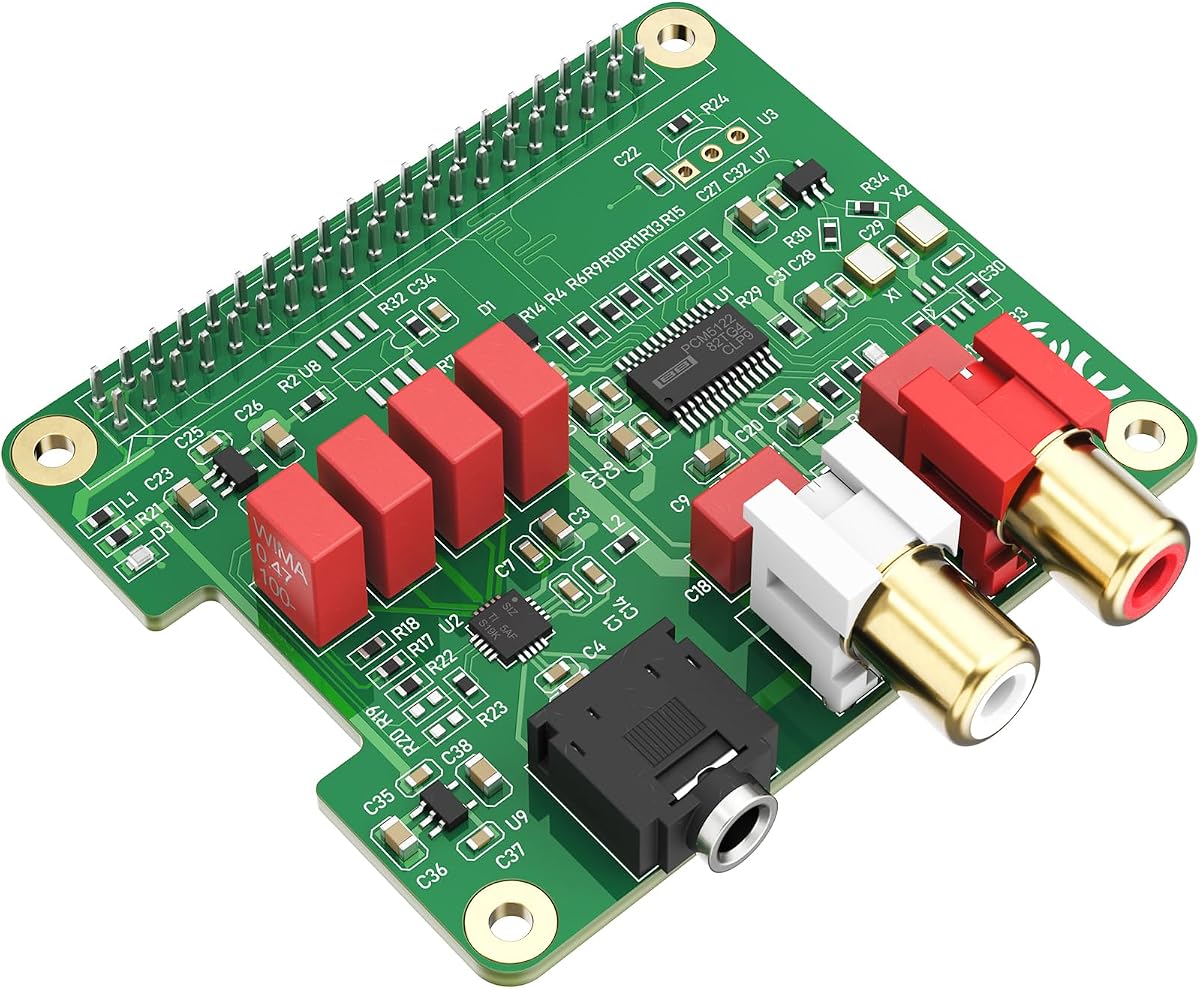
The HiFi DAC HAT is a well-rounded expansion board for listeners who want more capable analog audio without moving away from the Raspberry Pi platform. Its supplied rating is 4.5, and the strongest attraction is the combination of a PCM5122 converter, 32-bit/384kHz PCM support, dual low-jitter oscillators, and both RCA and 3.5mm outputs. That combination gives it broad usefulness for powered speakers, amplifiers, and headphones.
We may earn a commission when you buy through this link, at no additional cost to you.
The board connects through the 40-pin GPIO header and is listed as compatible with Raspberry Pi 5, 4, 3B+, Zero, and Zero W. Its master-clock mode is designed to reduce Raspberry Pi timing jitter, while support for DSD over PCM adds another route for compatible software and source material. The TPA6133 headphone amplifier supplies 138mW into a 32-ohm load, and the RCA outputs operate at 2.1Vrms for line-level equipment.
There are practical compromises. The PCM5122 is a well-regarded design, but the Pro Hat reviewed later uses a more advanced ES9038Q2M converter and offers balanced output. DSD here depends on DOP rather than a native DSD input, and the included 3.5mm amplifier is not intended to replace a serious dedicated headphone system. Despite those limitations, the feature set is unusually balanced for a general-purpose Pi DAC.
This is the strongest recommendation for a Raspberry Pi 5 or Pi 4 user building a polished living-room player, desktop streamer, or compact network audio system. It is especially appealing when the system needs both line-level and headphone connections, external clocking, and broad support for established music-player software. For readers who want the most premium converter, the HiFi DAC Pro Hat is the alternative; for basic needs, the HiLetgo module is simpler.
Dual 45.158MHz and 49.158MHz oscillators and master-clock operation address one of the most important concerns in computer audio: timing consistency. The board is listed for Volumio, Moode, RuneAudio, LibreELEC, and Raspberry Pi OS, giving users established music-player environments rather than forcing a single workflow.
Gold-plated RCA line outputs and the dedicated 3.5mm headphone connection allow the same Pi to drive powered speakers, an external amplifier, or conventional headphones. The 112dB signal-to-noise specification and independent grounding reinforce its suitability for cleaner analog output in a compact system.
We may earn a commission when you buy through this link, at no additional cost to you.
The DAC Mini Hat is built for projects where a full-size HAT would make the Raspberry Pi assembly awkward. It has a 4.2 rating and is specifically designed to fit the Raspberry Pi Zero, Zero W, Zero 2, and Zero 2W without overhanging, while remaining compatible with the 40-pin Pi 5, Pi 4, and 3B+.
We may earn a commission when you buy through this link, at no additional cost to you.
Audio conversion is handled by a PCM5122 supporting 32-bit/384kHz PCM. Gold-plated left and right RCA outputs serve powered speakers and amplifiers, while the 3.5mm jack provides a convenient headphone connection through the TPA6133 amplifier. The listing also emphasizes a low noise floor and compatibility with Volumio, Moode, RuneAudio, OSMC, PiCorePlayer, and Max2Play.
The main limitation is that it does not offer balanced output or the DSD support of the HiFi DAC Pro Hat. The supplied information also gives fewer details about external clocking, so buyers who prioritize independently referenced timing may prefer a model whose oscillators are explicitly documented. The stated 2.1Vrms output is suitable for line-level equipment but should not be treated as a specification for demanding high-current headphones.
Choose the DAC Mini Hat when enclosure space matters or when the project is built around a Raspberry Pi Zero. It offers the essential qualities of a modern dedicated player: high-resolution PCM, two analog output types, and strong player-software support. It is less compelling for a large, openly displayed Pi 4 or Pi 5 system where a full-size board would fit easily.
The defining feature is its non-overhanging footprint. That attention to the smallest common 40-pin models makes it easier to pair with Zero cases, small cabinets, or portable projects where the overhang of a conventional HAT could interfere with mounting or everyday access.
Support for major Raspberry Pi player systems means configuration should feel familiar to users of Volumio or Moode. RCA and 3.5mm outputs are also easier to work with than a single-menu digital interface, allowing quick connections to powered speakers, an amplifier, or headphones.
We may earn a commission when you buy through this link, at no additional cost to you.
The HiFi DAC Pro Hat is the premium-focused option in this roundup, with an ES9038Q2M converter, 129dB dynamic range, -120dB THD+N, and support for both 32-bit/384kHz PCM and DSD512. Its 4.5 rating reflects a board aimed at listeners who want advanced conversion without moving to a separate desktop DAC.
We may earn a commission when you buy through this link, at no additional cost to you.
Independent 45.158MHz and 49.158MHz oscillators provide dedicated clock references, while the board fits the 40-pin GPIO header of Raspberry Pi 5, 4, 3B+, 3B, Zero W, and Zero. Three Texas Instruments SoundPlus op-amps support a 2.1Vrms 3.5mm output and balanced X+ and X- connections. Supplied driver and configuration information covers Volumio, Moode Audio, RuneAudio, LibreELEC, and Raspbian.
Its principal trade-off is obvious: this is a more expensive, more specialized board. The balanced connection is only useful when the downstream amplifier or headphone system can accept it, and DSD playback requires a compatible software, source, and playback chain. A user who simply needs reliable RCA output from a Pi 5 may find the standard HiFi DAC HAT more rational.
The Pro Hat is the right recommendation for an enthusiast who values converter capability, balanced output, and native high-resolution DSD. It also suits a shared living-room system where the board will remain visible and serve as a focal point. Buyers should pair it thoughtfully, confirm configuration resources are available, and select the output type that matches the rest of their audio chain.
The ES9038Q2M supports PCM through 384kHz and DSD512, making the board relevant to high-resolution libraries and users who want a direct path from a Pi music server. The 129dB DNR and -120dB THD+N figures provide useful context when comparing it with the PCM5122 designs in this guide.
X+ and X- outputs expand the board's usefulness with compatible amplifiers and headphone equipment. Separate 45.158MHz and 49.158MHz oscillators support accurate sample-rate handling and distinguish this design from boards that rely entirely on the Pi's own clock source.
We may earn a commission when you buy through this link, at no additional cost to you.
The Digi One Hat is a digital-output solution rather than a conventional analog DAC. Its 4.8 rating is among the strongest in the group, and its focus is clean S/PDIF delivery over optical TOSLINK and electrical RCA connections. It is particularly relevant when the Raspberry Pi feeds a digital amplifier, streamer, or separate DAC.
We may earn a commission when you buy through this link, at no additional cost to you.
The IEC60958-3 interface supports sampling rates from 32kHz through 192kHz. Two external low-jitter oscillators and an I2S master-mode design are intended to improve clocking across sample rates. A 150M industrial-grade digital signal isolator and automotive-grade 1W power isolator separate the board's power and digital signals from the Raspberry Pi, reducing the chance of unwanted noise or ground-related problems.
The trade-off is structural. A separate digital-to-analog converter is required before the signal can reach ordinary speakers or analog headphones, so this is not the simplest route for a first Pi audio project. It also lacks the RCA line output and 3.5mm jack found on the analog boards. What it offers instead is a specialized route for preserving a digital signal between components.
Choose the Digi One Hat when your system already has a high-quality external DAC or digital amplifier and you want the Pi isolated from that chain. It is a strong fit for bit-conscious network players and multi-room installations. For a direct-to-speaker or headphone setup, one of the PCM5122 or ES9038Q2M analog HATs will be more convenient.
The isolators separate the board's digital signals and power from the Pi, addressing noise and ground-loop concerns in systems with multiple connected components. This design focus makes the Digi One Hat different from ordinary HAT boards that simply convert audio to analog on the Raspberry Pi.
TOSLINK offers a fiber-optic route between the Pi and an external DAC, while the electrical RCA S/PDIF connection supports compatible coaxial equipment. Supporting major Raspberry Pi music systems allows the board to fit into established player workflows rather than a restricted media environment.
We may earn a commission when you buy through this link, at no additional cost to you.
The PCM5122 DAC Module is a straightforward HiFi expansion for building a custom Raspberry Pi player. It has a 4.8 rating, uses the PCM5122 through an I2S interface, supports 16-to-32-bit audio and sampling up to 384kHz, and is described as suitable for Volumio and other playback environments.
We may earn a commission when you buy through this link, at no additional cost to you.
One distinctive detail is the pair of status indicators. A red LED shows that the DAC has power, while a green LED indicates whether it is decoding. That visual feedback can be useful during setup or troubleshooting, particularly in a board that does not have a display. The board also provides two output interface types for external amplifiers and other equipment.
The specifications list a 120dB signal-to-noise ratio, -93dB THD, and 112dB dynamic range, all of which make the module appealing for a dedicated player. However, the supplied description centers on Raspberry Pi B+ and Pi 2 compatibility, so buyers using a Pi 5, Pi 4, or Zero should verify the mechanical header arrangement and software behavior for their exact model before finalizing the purchase.
This module makes sense for a DIY build where visible operating status and straightforward I2S conversion matter more than balanced outputs or sophisticated clock documentation. It is also a sensible option for someone already familiar with Raspberry Pi GPIO expansion. For a new Pi 5 build, the newer HAT alternatives reviewed here provide more explicit current-platform and software support.
Separate power and decoding LEDs make system status visible without opening a web interface or checking logs. This is particularly helpful while testing a custom player because it can confirm whether the converter has power and whether it is actively processing audio.
The PCM5122 supports 16-to-32-bit playback at rates as high as 384kHz. Its published 120dB SNR and 112dB dynamic range make it a credible platform for a network player, while the I2S interface suits users who are comfortable configuring Raspberry Pi audio at the GPIO level.
We may earn a commission when you buy through this link, at no additional cost to you.
The RASPIAUDIO Audio DAC Hat focuses on a practical proposition: giving Raspberry Pi users a cleaner analog output with minimal configuration. Its 4.2 rating, 32-bit/384kHz PCM support, and 112dB signal-to-noise specification place it in the mainstream performance group covered by this guide.
We may earn a commission when you buy through this link, at no additional cost to you.
The board provides a 3.5mm jack and RCA outputs, making it suitable for headphones, powered speakers, and line-level amplifiers. It works with Raspberry Pi 5, Pi 4, Zero v2, and earlier versions including Pi 3, Pi 2, and Zero v1. An onboard EEPROM allows plug-and-play identification, removing the need to install drivers before the system recognizes the audio HAT.
It is less ambitious than the Pro Hat. There is no balanced output, no native DSD claim, and no detailed external-clock specification in the supplied listing. It also does not offer a digital-only S/PDIF interface. These are not necessarily problems for a conventional network player, where the main requirement is a stable, clean analog signal from a familiar software environment.
This is a good selection for users who want straightforward expansion rather than an enthusiast feature checklist. It should appeal to Pi 5 owners creating a desktop or living-room system with powered speakers, as well as builders who value automatic HAT recognition. Those seeking native DSD or balanced connectivity should examine the Pro Hat instead.
The onboard EEPROM allows the Raspberry Pi to identify the board without a separate driver installation. That simplifies first-time setup and reduces the chance of a technically capable DAC being underused because configuration was left incomplete.
Support spans current and older 40-pin models, while the combination of RCA and 3.5mm outputs covers both line-level equipment and headphones. The board is therefore well suited to common speaker-and-amplifier arrangements without requiring a separate DAC.
We may earn a commission when you buy through this link, at no additional cost to you.
The Argon BLSTR DAC is a focused accessory for Raspberry Pi 5 owners, and its listed rating of 5.0 makes it the highest-rated product here. It uses a Texas Instruments PCM5122 codec and presents a simple proposition: improve the Pi 5's audio path while reducing unwanted hum or noise through an included ground-loop isolator.
We may earn a commission when you buy through this link, at no additional cost to you.
The board is designed to install as a plug-and-play expansion and provides audio through a 3.5mm port. Its greatest technical distinction is the ground-loop isolator, which is intended to prevent unwanted noise or hum from reaching the output. That can be valuable when the Pi is connected to an amplifier, powered speakers, or a system with multiple grounding paths.
Compatibility is the decisive limitation. The product is for Raspberry Pi 5 and the ONE V3 platform, so it excludes Pi 4, Pi 3, and Zero owners. The available connection is also limited to 3.5mm audio output, with no RCA line output or balanced connectors. Users who need multiple analog outputs or broader model support will need to look elsewhere.
The Argon BLSTR DAC is an attractive recommendation for a Raspberry Pi 5 owner who values a simple setup and wants help with noise or hum. It is particularly suitable when a single amplifier or headphone connection is enough. Its platform specificity should be checked before buying, and the included isolator should be positioned according to the manufacturer's guidance.
The included isolator addresses a common source of hum in compact computer-audio systems. It may be most useful when the Raspberry Pi, amplifier, power supply, and speaker electronics create an interconnected ground network that would otherwise affect the audio output.
Restricting compatibility to Raspberry Pi 5 and the ONE V3 platform allows the board to be optimized for that ecosystem. For users of an older Pi or Zero, the narrow support is decisive, but for a compatible system it offers a simple path to a dedicated PCM5122 output.
We may earn a commission when you buy through this link, at no additional cost to you.
The HiFiBerry DAC+ DSP is the most feature-oriented conventional HiFiBerry board in this guide. Its 4.1 rating understates the range of functions described in the supplied information: a 300MHz digital signal processor, digital input and output, an asynchronous sample-rate converter, and the ability to adjust processing parameters while music is playing.
We may earn a commission when you buy through this link, at no additional cost to you.
Digital input supports rates up to 96kHz, while digital output reaches 192kHz. The processor can upsample, downsample, and mix audio sources, functions normally associated with HiFiBerry's more advanced independent-clock features. An onboard EEPROM allows the board to boot and run without the Raspberry Pi, opening the possibility of using it as a standalone DAC when the enclosure and signal path support that arrangement.
The biggest practical restriction is enclosure compatibility. The board can only be used with HiFiBerry's Universal CaseIII enclosure, so it is not a drop-in choice for an arbitrary case or an existing exposed Pi stack. Its published 192kHz digital output ceiling also trails the 384kHz PCM specifications of several PCM5122 and ES9038Q2M boards in the roundup.
This product makes the most sense for a builder planning a dedicated HiFiBerry enclosure and interested in real-time processing, room equalization, source mixing, or standalone operation. It is not the simplest recommendation for a first Pi streamer, but for a carefully planned system it offers capabilities that ordinary analog HATs do not.
The 300MHz processor can perform as many as 6144 instructions per sample and supports adjustable DSP parameters. That makes the board relevant to room equalization, source mixing, and projects where the Pi player needs more than basic software resampling.
With both digital input and digital output, the board can sit within more varied signal chains. The asynchronous sample-rate converter handles upsampling, downsampling, and mixing, while the onboard EEPROM enables standalone operation when the Pi is not present.
We may earn a commission when you buy through this link, at no additional cost to you.
The HiFiBerry Digi+ is a digital sound card for classic Raspberry Pi 2 Model B, B+, and A+ systems. It has a 4.6 rating and uses a dedicated S/PDIF interface chip with support for output up to 192kHz and 24-bit resolution.
We may earn a commission when you buy through this link, at no additional cost to you.
Optical TOSLINK and electrical coaxial outputs provide two ways to connect the Pi to an external DAC, digital amplifier, or compatible active speaker. The listed bit-perfect behavior means the audio data stream is not modified, which is valuable for users who want the player software to control the original digital data without unnecessary processing.
Its limitation is model relevance. The supplied compatibility list centers on the Pi 2 B, B+, and A+, making it a poor default recommendation for a Pi 5, Pi 4, Pi 3, or modern Zero build. It also cannot drive analog speakers or headphones by itself. A newer digital board such as the Digi One Hat provides broader Raspberry Pi support and isolation.
The HiFiBerry Digi+ remains a logical option for a classic Pi 2 music system with an external digital DAC. It is also useful for builders maintaining older hardware. For everyone starting a current project, however, compatibility should be confirmed carefully before considering this older board.
The dedicated S/PDIF chip produces a bit-perfect stream according to the supplied listing. Optical and coaxial outputs support different downstream equipment, including external converters and digital amplifiers, without adding an analog stage to the Pi.
The board's fit for Raspberry Pi 2 B, B+, and A+ makes it most relevant to established projects or maintainers of classic Pi hardware. Those using recent models should prioritize boards whose listed support explicitly includes the Pi 5, Pi 4, or their intended Zero variant.
We may earn a commission when you buy through this link, at no additional cost to you.
The HiLetgo PCM5102 Module is the simplest way in this guide to replace a Raspberry Pi's basic analog output with a dedicated stereo DAC. Its 4.2 rating reflects a practical, accessible product built around the PCM5102A and the Raspberry Pi's I2S interface.
We may earn a commission when you buy through this link, at no additional cost to you.
The stereo jack is already soldered to the board, removing one common assembly task. Users can connect headphones or an amplified input directly without paying for separate jack hardware. The module also works with Arduino, giving makers a way to experiment with digital-to-analog conversion beyond a complete music-player project.
This is a module rather than a conventional 40-pin audio HAT, so it may require jumper wires, a breakout arrangement, or a specific project enclosure. The supplied information does not document an EEPROM, external oscillators, balanced outputs, automatic player configuration, or an extensive Raspberry Pi compatibility list. Those omissions matter if the goal is a polished, configuration-free living-room system.
Choose the HiLetgo module for experimentation, education, a small custom player, or a project where minimal cost and a ready-connected jack matter more than automatic setup. For a Pi 5 or Pi 4 build that should look and operate like a finished streamer, the HiFi DAC HAT or RASPIAUDIO board offers a more integrated path.
The PCM5102A provides dedicated digital-to-analog conversion through I2S, avoiding the Pi's onboard analog path. With the stereo jack already attached, even a first digital-audio project can include a practical analog listening or test connection without additional soldering.
The module format is useful for makers who already understand GPIO wiring and enclosure planning. It offers less of a turnkey software experience than a full HAT, but it provides a flexible foundation for custom players, Arduino experiments, and compact Raspberry Pi builds.
We may earn a commission when you buy through this link, at no additional cost to you.
The right Raspberry Pi DAC depends on the Pi model, operating system, source material, downstream equipment, and tolerance for assembly. Resolution, clock quality, output flexibility, and software support should be considered together rather than treating the largest specification as the only measure of performance.
Mechanical compatibility starts with the 40-pin GPIO header used by the Pi 5, Pi 4, Pi 3B+, Pi 3B, and current Zero models, but the fit is not always identical. A conventional HAT may overhang a Zero, while a module may require wire connections or a custom mount. The Argon BLSTR is limited to Raspberry Pi 5 and ONE V3, and the HiFiBerry Digi+ is listed for older Pi 2 Model B, B+, and A+ systems. Check both electrical and physical support before ordering, especially if the board must fit inside an existing enclosure.
In short, match the board to the exact Raspberry Pi model and enclosure you own rather than assuming every HAT fits every Pi.
The DAC chip determines how the digital stream is converted, so its published performance is important. The PCM5122 designs in this guide support 32-bit/384kHz PCM, with listed signal-to-noise values around 112dB or higher depending on the model. The ES9038Q2M in the Pro Hat is specified at 129dB DNR and -120dB THD+N, while also supporting DSD512. These figures are useful comparisons, but they do not describe the complete system's perceived quality, which also depends on clocks, analog output, power, software, and the connected amplifier.
Choose a converter specification that exceeds the practical demands of your music library and downstream equipment rather than selecting solely for the largest headline number.
RCA line output, 3.5mm headphone output, balanced connections, and digital S/PDIF serve different systems. RCA is ideal for most powered speakers and amplifiers, while 3.5mm can support headphones or line inputs on compact equipment. The Pro Hat adds X+ and X- balanced outputs for compatible hardware. The Digi One Hat and HiFiBerry Digi+ output digital signals, so they require an external DAC or digital amplifier. Match the connector to the rest of the system before considering less visible features.
In short, buy the connection type your amplifier or headphones require; extra board features cannot compensate for an incompatible output.
Accurate timing helps the converter receive a stable reference for each sample rate. The HiFi DAC HAT and Pro Hat use dedicated 45.158MHz and 49.158MHz oscillators, and the Digi One Hat uses two external low-jitter oscillators with I2S master mode. Boards that rely on the Pi's clock may still work well, but users concerned about timing have fewer documented controls. Master-clock support, software configuration, and source compatibility must work together for external clocks to provide their intended benefit.
In short, prioritize documented low-jitter clocking when timing is central to your build, then confirm that the chosen player software supports the required mode.
Most listeners will be served by 24-bit material at 44.1kHz or 48kHz, even when their files are stored in a higher-resolution format. A 32-bit/384kHz board provides headroom, but the full benefit depends on the player, file format, operating system, and output configuration. DSD support is more specialized: the Pro Hat lists DSD512, while the standard HiFi DAC HAT supports DSD through PCM. The Digi One Hat provides digital S/PDIF output up to 192kHz instead of an onboard analog converter.
In short, choose format support that matches your actual library and software workflow rather than assuming the highest number will be used.
A capable DAC is only as accessible as its software. The HiFi DAC HAT, Mini Hat, Pro Hat, Digi One Hat, and RASPIAUDIO board are listed for established Raspberry Pi environments such as Volumio, Moode, RuneAudio, OSMC, LibreELEC, and Raspberry Pi OS. Compatibility with Volumio or Moode can simplify configuration considerably, while a module with an I2S interface may require more manual work. Also consider whether the board includes an EEPROM for automatic identification and whether documentation or driver resources are available.
In short, confirm support for your preferred player and automatic configuration before buying a board based only on its hardware specifications.
Not every 3.5mm output is designed to drive the same range of headphones. The HiFi DAC HAT specifies a TPA6133 amplifier with 138mW at 32 ohms, while the Mini Hat pairs the PCM5122 with a TPA6133 and states 2.1Vrms output. The Pro Hat uses three Texas Instruments SoundPlus op-amps for a 2.1Vrms headphone output. High-impedance or demanding headphones may still benefit from a separate amplifier, so the onboard jack should be treated as a convenient option rather than a guarantee of studio-headphone power.
In short, use the onboard headphone output for convenient listening, but add a dedicated amplifier when impedance, power, or control requires it.
A finished music system must also fit together cleanly. Full-size HATs can conflict with cases designed for a bare Pi, while compact modules may need jumpers or a custom board holder. The HiFiBerry DAC+ DSP specifically requires the Universal CaseIII enclosure. The HiLetgo module benefits from secure wiring and a stereo jack that is already soldered, while full HATs minimize loose connections. Consider cooling, access to the 3.5mm jack, strain relief for external cables, and whether status lights will be visible or distracting.
In short, plan the mechanical installation early so the chosen DAC remains accessible, secure, and compatible with the complete Raspberry Pi build.
Begin by shutting down the Raspberry Pi cleanly and disconnecting its power. Confirm that the selected DAC supports the exact Pi model, that any required standoffs are installed, and that the GPIO header is undamaged. Full HATs should be seated evenly without forcing the board, while module-style boards require careful I2S wiring and secure connections to prevent stress on the header.
For a conventional HAT, power the Pi and use the intended music-player or operating-system environment to configure the audio device. Select the correct output, confirm the desired sample rate, and make sure the software recognizes the converter. DSD, master-clock, balanced, and digital-output features may require additional configuration, so consult the documentation supplied with the board and the relevant player guide before changing advanced settings.
After setting the output level appropriately, connect the Raspberry Pi to an amplifier, powered speakers, headphones, or an external DAC. Test several source types and sample rates, watch for clipping or unusually low output, and avoid leaving a disconnected cable in an active audio input. For long-term use, secure the board, keep the Raspberry Pi ventilated, and use clean dry air when cleaning the enclosure or connectors.
No. Most modern HAT-style boards use the 40-pin GPIO header found on the Pi 5, Pi 4, Pi 3B+, Pi 3B, and compatible Zero models, but physical fit can still vary. Some boards are restricted to specific platforms, including the Argon BLSTR for Raspberry Pi 5 and ONE V3, while the HiFiBerry Digi+ is listed for older Pi 2 Model B, B+, and A+ systems. Always confirm both electrical and mechanical compatibility.
A dedicated DAC can provide a cleaner and more capable analog output than the Raspberry Pi's onboard audio path. The practical improvement depends on the Pi model, the selected converter, the power supply, the player software, and the connected amplifier or headphones. It is especially worthwhile for a dedicated music player or network streamer where analog noise and output quality matter.
It depends on the output. RCA line-level outputs normally feed an amplifier or powered speakers, while a 3.5mm headphone output can connect directly to many headphones. Higher-impedance or power-hungry headphones may benefit from a separate headphone amplifier. Balanced outputs require compatible downstream equipment and should not be treated as interchangeable with ordinary RCA connections.
An analog DAC converts the Raspberry Pi's digital audio into a line-level or headphone signal that can drive an amplifier, powered speakers, or headphones. A digital-output board such as the Digi One Hat or HiFiBerry Digi+ instead sends a digital S/PDIF stream to another DAC or digital amplifier. Digital-output boards can reduce analog-stage requirements but add another component to the signal chain.
Most music is available at 24-bit/44.1kHz or 24-bit/48kHz, so those capabilities handle nearly all conventional listening. Higher rates can benefit compatible source material, software, and hardware, but a stable 24-bit/48kHz path is the more relevant starting point. Native DSD support is even more specialized and should match the user's actual files and playback software.
Dedicated oscillators provide stable clock references for common sample-rate families and can reduce timing jitter compared with relying entirely on the Raspberry Pi's clock. Boards with dual 45.158MHz and 49.158MHz oscillators, such as the HiFi DAC HAT and Pro Hat, can provide more explicit clock control. The benefit still depends on compatible software, master-clock configuration, and the rest of the playback chain.
The supplied listings explicitly support Volumio and Moode for several boards, including the HiFi DAC HAT, DAC Mini Hat, HiFi DAC Pro Hat, Digi One Hat, and PCM5122 DAC Module. After installation, select the board's audio device in the player settings and configure the output device and sample rate. Advanced features such as DSD, master clock, or balanced output may require additional driver or configuration steps.
Check that the board fits the Zero without overhanging and that it supports the exact Zero revision you own. The DAC Mini Hat is specifically designed for the Zero family without overhang and also supports larger 40-pin models. The Digi One Hat is listed for the entire Raspberry Pi series, while other compact modules may require a custom mount or jumper wiring. Also verify the desired output connector and player-software support.
The HiFi DAC HAT is the most well-rounded recommendation because it combines a PCM5122 converter, high-resolution PCM, dedicated dual oscillators, RCA and headphone outputs, EEPROM support, and broad player compatibility. The HiLetgo PCM5102 module is the best budget starting point, while the HiFi DAC Pro Hat is the premium choice for users who want ES9038Q2M conversion, native DSD512, balanced output, and extensive high-end features.
Prioritize the Raspberry Pi model, enclosure, output type, and downstream equipment before chasing headline specifications. The Digi One Hat and HiFiBerry Digi+ are strong for digital-only chains, the DAC Mini Hat suits compact Zero projects, and the HiFiBerry DAC+ DSP appeals to builders seeking processing, conversion, and standalone operation. The Argon BLSTR is a focused Pi 5 solution with ground-loop isolation.
Product ratings, availability, and pricing can change over time, so check the current listing and technical documentation before purchasing. Confirm connector standards, board dimensions, required software, and sample-rate support against your intended system. With those checks completed, the right Raspberry Pi DAC can turn the small computer into a surprisingly capable and dedicated music player.

