
Wixey Mini Digital Height Gauge
4.4Editor score
Three-inch measuring range
Magnetic self-standing base
Fraction and millimeter readings
Includes CR2032 battery
A digital height gauge turns vertical measurements into fast, readable results, making it especially useful for setting saw blades, aligning router components, checking workpieces, and performing inspection tasks. The right model combines a stable base, responsive controls, readable display, adequate range, and consistent accuracy in a compact package suited to your workspace.
We compared the ten featured digital height gauges using the specifications and product information supplied for this guide. Factors included measuring range, resolution, stated accuracy, display format, magnetic-base design, scriber support, zero-reference features, portability, and suitability for woodworking, inspection, laboratory, and general shop use.
Each review identifies the strongest application for that model while noting practical trade-offs, such as limited range, manual zeroing, or a specialized form factor. Ratings and product details can change over time, as can retailer availability and prices, so shoppers should confirm current details before making a purchase.
4.4Editor score

4.6Editor score

4.6Editor score
As an Amazon Associate we earn from qualifying purchases.
The comparison below places all ten digital height gauges side by side, highlighting their measuring ranges, resolutions, base designs, and most important functional differences.



The iGaging Digital Electronic Height Gauge with Magnetic Base combines a six-inch measuring capacity with a 4.5 rating, placing it among the stronger all-around options in this roundup. Its defining feature is the magnetic base, which makes it particularly convenient when both hands need to remain near a router table, saw, or metal work surface.
We may earn a commission when you buy through this link, at no additional cost to you.
The gauge resolves measurements to 0.0005 inch and displays fractions, giving woodworkers the detail needed for fine cutter and blade adjustments. A heavy-duty construction suggests it is intended for repeated shop use, while the magnetic base provides a convenient alternative to continually holding the tool against a workpiece.
Compared with gauges offering absolute encoding, this model does not list a memorized origin-zero function. That means users may need to establish a reference position more often, particularly when moving between tasks. Its six-inch range also falls short of larger machines, but it covers many common woodworking and inspection applications.
This is a sensible selection for a shop that wants an approachable electronic gauge without investing in a premium dual-beam model. Buyers who regularly work with deeper setups should consider a twelve-inch option, while those who prioritize stable magnetic placement and fractional display will find this model especially useful.
The magnetic base lets the gauge remain attached to a compatible surface while the user adjusts surrounding equipment. That hands-free stability is particularly valuable around router tables and table saws, where maintaining the same reference point can improve workflow.
A 0.0005-inch resolution and fractional display are useful for distinguishing small changes in tool position. The combination helps users make deliberate adjustments rather than relying on visual estimation.
We may earn a commission when you buy through this link, at no additional cost to you.
The Shars 303-4460 R is a 12-inch electronic height gauge built around precise measurement and robust mechanical construction. Its 4.5 rating reflects a well-regarded balance of range, resolution, and professional materials, while the hardened steel base is intended to provide stable reference contact.
We may earn a commission when you buy through this link, at no additional cost to you.
The gauge offers switchable inch and metric modes on a high-contrast LCD, along with 0.0005-inch or 0.01-millimeter resolution. Its stated accuracy is ±0.0016 inch or 0.04 millimeter, and the fine-adjustment device makes it easier to settle on a precise position.
A carbide-tipped scriber is included, extending the tool beyond measurement into marking workpieces. The 300-millimeter range accommodates taller machine setups than most compact models, although the precision-ground and microlapped steel base may feel less convenient to carry than a smaller plastic-bodied gauge.
Shars is best suited to woodworkers, inspectors, and fabrication users who need substantial range and a stable metal reference. It is less compelling for a small workshop focused exclusively on shallow router-table measurements, where portability may matter more than maximum vertical reach.
The 12-inch or 300-millimeter capacity covers taller workholding and cutter configurations. This makes the gauge useful for applications that exceed the reach of compact three- and five-inch models.
The hardened steel base is precisely ground and microlapped to create a dependable measuring reference. A scriber also allows the user to transfer the established height directly to a workpiece.
We may earn a commission when you buy through this link, at no additional cost to you.
The Wixey WR25 stands out as the most compact and approachable option here, earning a 4.4 rating while targeting router-table and table-saw adjustments. Its mini format measures 4-3/8 inches wide by 5-1/2 inches high, so it is easier to store and move between machines than larger gauges.
We may earn a commission when you buy through this link, at no additional cost to you.
The measuring range extends from zero to 3.2 inches, or 83 millimeters, and readings can be shown with fractions or millimeters. Powerful magnetic feet allow the gauge to stand on a ferrous surface, while the locking-rule feature helps preserve repeatable positions during an adjustment.
ABS preset mode and incremental zero-set mode provide useful ways to establish a reference. The included CR2032 battery also removes the need for an immediate additional purchase. However, the relatively limited range makes it less appropriate for tall assemblies or cutters beyond its stated capacity.
For DIY woodworkers and professionals who mainly set shallow router cutters or table-saw blades, the WR25 is a practical budget-conscious choice. Its strongest advantage is not raw reach but the combination of compact dimensions, magnetic positioning, fraction support, and repeatable zeroing in an easy-to-store package.
The narrow profile can be valuable on crowded router tables where a taller gauge might interfere with fences or guards. It is also simple to move from one machine to another and store in a compact toolbox.
Users can switch between absolute preset readings and incremental zero-set measurements. This flexibility helps maintain a consistent reference when a task involves repeated positioning or transfer between tools.
We may earn a commission when you buy through this link, at no additional cost to you.
The iGAGING #35-629 combines a 4.6 rating with one of the most complete feature sets in the category. Its absolute encoding technology remembers the origin zero, allowing users to return to a known reference without repeating the setup process after moving or powering the gauge.
We may earn a commission when you buy through this link, at no additional cost to you.
The six-inch, 150-millimeter range is supported by fractional, inch, and metric readings at 0.0005-inch or 0.01-millimeter resolution. An IP54 rating adds protection against dust and moisture, while the CNC-machined magnetic base is designed for flatness and stable positioning.
A carbide-tipped scriber is included for marking workpieces, and a shop protective case improves transport and storage. The listed accuracy is 0.001 inch. While its range does not cover the tallest assemblies, the combination of absolute zero memory, environmental protection, and a stable base makes it exceptionally versatile.
This is the most attractive general-purpose choice for woodworkers, inspectors, and laboratory users who want repeatable setup and portable protection. It is also an easier recommendation for mixed-use buyers because it offers useful features without moving into the larger premium category.
Absolute encoding stores the origin, so the gauge can return to a known reference after movement. This is especially useful for repeated inspections or multiple setup tasks performed during one session.
The IP54 rating helps guard against dust and moisture encountered in shops and labs. Combined with the included case, the gauge is easier to protect between uses.
We may earn a commission when you buy through this link, at no additional cost to you.
The iGAGING EZ-Check is designed specifically around router and table-saw adjustment, and its 4.6 rating indicates strong user reception. The five-inch measuring range is tailored to common cutter-height tasks rather than broad industrial measurement.
We may earn a commission when you buy through this link, at no additional cost to you.
Its display supports readings from zero to five inches with 0.0005-inch or 0.01-millimeter resolution, while stated accuracy is 0.0015 inch. A hold function keeps the current measurement visible, which helps when the user must reposition a hand or examine the setup.
The magnetic base and anodized aluminum body make the gauge stable and durable for regular woodworking use. Reference steps for 1/2-inch, 3/8-inch, and 1/4-inch shanks, along with common router-bit diameters, add setup-specific convenience that general-purpose gauges may not provide.
The EZ-Check is best for woodworkers who regularly establish cutter heights and want a purpose-built measuring aid. It may not be the first choice for deeper assemblies, laboratory work, or users who need absolute zero memory and an IP54 protective rating.
The listed shank-center steps and router-bit diameter references help users begin from familiar positions. This reduces the need to estimate starting points before making a final measurement.
Keeping a reading on screen allows the user to move a hand away from the gauge while checking the machine. The feature is convenient when space is tight and adjustments happen around fences or hardware.
We may earn a commission when you buy through this link, at no additional cost to you.
The CME Dual Beam Digital Height Gauge is the premium choice in this roundup, combining a 4.6 rating with a rigid 12-inch format. Its dual-beam construction, cast-iron base, and chrome-plated steel beams are designed to prioritize stability and reduce the chance of measurement error.
We may earn a commission when you buy through this link, at no additional cost to you.
The gauge covers zero to 12 inches with a 0.0005-inch increment and stated accuracy of ±0.0015 inch. A built-in absolute encoder retains the zero through power cycles, removing the repeated zero-setting inconvenience associated with relative digital gauges.
The 5-3/8-inch by 3-5/8-inch base provides a substantial reference surface, which is useful on broad, flat machine surfaces. A carbide-tipped scriber and plastic storage case complete the package. These features make the tool more substantial than compact woodworking models.
CME is appropriate for serious shops, inspection environments, and users who value retention of zero and rigid construction. It may be unnecessary for quick router adjustments in a small workshop, but it is a strong choice when reliability, longer reach, and repeatability outweigh portability.
The dual-beam design provides a rigid relationship between the moving measuring element and the base. This construction is intended to limit flex and maintain stability during repeated vertical measurements.
The absolute encoder preserves the established origin when the gauge is turned off. Users can resume from the same reference without rebuilding the setup each time the instrument is powered.
We may earn a commission when you buy through this link, at no additional cost to you.
The Starrett Electronic Height Gage offers a six-inch range, 0.0005-inch resolution, and a 4.3 rating. Its most immediately useful feature is readability, with LCD characters listed at 0.932 inches high for quick interpretation in a workshop or inspection setting.
We may earn a commission when you buy through this link, at no additional cost to you.
The vertical bar is made from hardened stainless steel, while the base is hardened, ground, and lapped. Finger grooves in the base improve handling, and the bar is positioned back from the nose edge to provide better stability during a measurement.
Operation is straightforward: attach the depth attachment, adjust the thumb roll, and read the display. Manual on/off control is supplemented by an automatic five-minute shutdown after nonuse, helping conserve battery life. Unlike several magnetic-base alternatives in this list, the product information does not advertise magnetic positioning.
Starrett is a strong fit for users who prioritize a large display, traditional professional construction, and simple operation. Its lower rating and lack of documented absolute zero memory may make newer feature-rich models more attractive for complex repeatability tasks.
The oversized LCD characters make the measurement easy to see without straining. That readability is useful for older eyes, quick production checks, and work performed under uneven shop lighting.
The hardened, ground, and lapped base creates a stable measuring surface. Finger grooves offer controlled handling while repositioning the gauge.
We may earn a commission when you buy through this link, at no additional cost to you.
The Trend GAUGE/D60 is a specialized digital depth gauge that offers a 4.4 rating and a wide aperture for woodworking setups. Although it appears in a height-gauge roundup, its primary strengths are rebate and groove setting, cutter depth, backset, and related router-table measurements.
We may earn a commission when you buy through this link, at no additional cost to you.
The jaw opening spans 2-23/64 inches, allowing the gauge to bridge fence cheeks and larger router base openings. Its readout registers in 0.002-inch increments with stated accuracy to 0.003 inch, providing useful precision for common woodworking setup tasks.
Magnetic feet hold the gauge against metal surfaces, and a locking option secures readings that need to be transferred. The included pointer can check holes, mortises, or slots up to two inches deep, giving the tool more versatility than a purely single-purpose digital indicator.
Trend is most compelling for woodworkers who routinely set grooves, dados, rebates, and router cutter heights. Buyers needing laboratory-grade resolution or absolute zero memory should choose a dedicated electronic height gauge instead, but this model offers an unusually broad aperture for its class.
The 2-23/64-inch opening can bridge openings and fence components that would obstruct a narrow gauge. This makes the tool easier to position around common router-table hardware.
The simple pointer clips to the ruler and helps check holes, mortises, and slots. It gives the gauge practical value beyond setting a cutter against a table.
We may earn a commission when you buy through this link, at no additional cost to you.
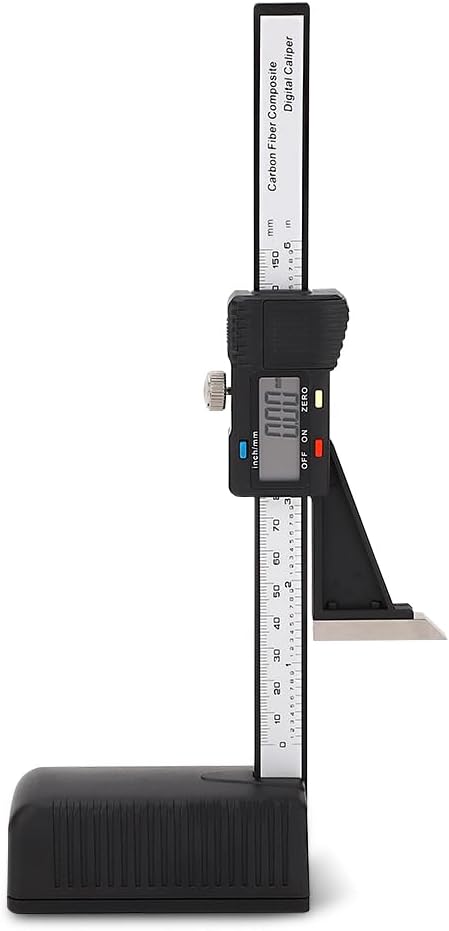
The Ejoyous Height Gauge is a compact 150-millimeter digital caliper for depth and vertical measurements. It carries a 3.8 rating and is positioned as a lightweight tool for woodwork, including setting saw-blade height.
We may earn a commission when you buy through this link, at no additional cost to you.
Its easy-to-read LCD can display inches or metric, and the reset button supports relative measuring. This allows the user to establish a temporary zero and measure changes from that reference, a useful arrangement for checking offsets and transfer measurements.
The magnetic base provides firm positioning on ferromagnetic surfaces, while the engineering-plastic body keeps the unit lightweight and easy to carry. The specified power source is a 3-volt button cell, which is not included, so buyers should plan to supply one before use.
This model makes sense for users seeking a simple, portable gauge with metric flexibility. Its lower rating and plastic construction make it less persuasive for demanding professional workflows where precise resolution, metal rigidity, environmental sealing, or absolute encoding are priorities.
The reset function establishes a convenient zero point for comparing later readings against a selected position. This is useful when checking adjustments without repeatedly referencing an absolute edge.
The stable magnetic base keeps the lightweight gauge attached to compatible metal surfaces. That allows the user to focus on the workpiece or machine setting rather than supporting the tool by hand.
We may earn a commission when you buy through this link, at no additional cost to you.
The iGAGING #35-630 offers a 12-inch range, absolute encoding, fractional readings, and a 4.8-inch-equivalent feature set for extended work. On paper, it is one of the most capable instruments in the roundup, although its 2.8 rating is the lowest listed and warrants careful buyer consideration.
We may earn a commission when you buy through this link, at no additional cost to you.
Its resolution is 0.0005 inch or 0.01 millimeter, with fractional readings available at a 128th-inch level. Absolute encoding memorizes the origin zero, and the IP54 rating protects against dust and moisture. The precision-lapped steel base and counterweight are designed to improve stability across the longer range.
A carbide-tipped scriber, protective shop case, and micro-USB data port broaden its uses. The data output requires a separate #35-630-USB kit that is not included, so buyers interested in computer connection should account for that additional accessory.
The gauge's stated accuracy varies by measurement length: 0.001 inch through six inches and 0.002 inch through twelve inches. Buyers should evaluate both its advanced feature set and the comparatively low rating before choosing it over the CME or Shars twelve-inch alternatives.
The 12-inch capacity covers applications that exceed the reach of most compact gauges. It is better suited to taller machine configurations, deep assemblies, and inspection work.
The micro-USB port can support compatible data-output equipment. Because the required kit is separate and the listed rating is low, prospective buyers should confirm current compatibility and satisfaction before purchasing.
We may earn a commission when you buy through this link, at no additional cost to you.
Choosing a digital height gauge requires balancing range, resolution, base stability, display usability, and the kind of work you expect the instrument to perform. The right model is one whose features remove friction from your normal setup routine rather than adding capabilities you will rarely use.
Begin by considering the tallest measurement you expect to make and the physical clearance available on your machine. Compact gauges commonly cover shallow router cutters, blades, and small assemblies, while twelve-inch models handle deeper frames, taller fixtures, and larger inspection work. A longer range offers flexibility but can make a gauge less convenient on crowded tables because the body may interfere with fences or guards.
Resolution indicates the smallest display increment, while accuracy describes the expected closeness of a measurement to the true value. A 0.0005-inch resolution is common among the stronger choices here, but resolution alone does not guarantee overall accuracy. Look for a stated accuracy specification and consider whether its tolerance remains consistent across the measuring range, particularly if you expect to use the upper portion of a twelve-inch scale.
The zero system determines how easily a gauge can return to a known reference. Relative or incremental models require the user to establish the origin for each new task. Absolute encoders remember the origin through movement or power cycles, making them more convenient for repeated inspections and multiple related measurements. The difference becomes especially noticeable when a shop performs many small checks in one session.
A stable base determines whether the gauge sits square and produces repeatable readings. Magnetic bases are convenient on metal machines because they can hold the tool in position without continuous hand pressure. Heavy cast iron, ground steel, and CNC-machined bases can offer a broad, rigid reference surface. In every case, inspect the workpiece and machine surface for debris, oil, burrs, or unevenness that could distort the contact.
A good digital display should be readable without forcing the user to reposition the gauge or shield it from light. Fractional readings are valuable in woodworking, while inch and metric switching is useful for mixed international work. Large characters, a high-contrast screen, and a hold function can make readings easier to capture during crowded setups. Absolute and incremental modes should also be labeled clearly so users know which reference is active.
A scriber turns a height gauge into a more versatile layout tool by allowing a measured position to be transferred to a workpiece. Carbide-tipped scribes are especially useful on hard materials and for durable reference marks. The Trend gauge also includes a pointer for checking holes, mortises, and slots. If your work involves repeated layouts, these accessories may deliver more value than a slightly higher display resolution.
Compact, lightweight gauges are easier to carry between a router table, table saw, inspection bench, and storage area. Larger metal instruments generally feel more substantial but require more storage space. An IP54 rating provides useful resistance to dust and moisture in active shops, while a protective case helps prevent damage during transport. Choose portability when tools must be moved frequently and rugged protection when the gauge stays in a demanding environment.
Some height gauges are general instruments, while others include features tailored to router and saw work. Magnetic feet, low profiles, shank-center steps, router-bit diameter references, and wide apertures can shorten setup time. A specialized gauge may be more valuable than a technically precise general model if it directly supports the machine adjustments you perform. Conversely, inspection, laboratory, and research users may prioritize zero memory, sealed construction, data output, and a precision-lapped base.
Prepare the machine and measuring surfaces before taking a reading. Disconnect power to powered equipment, move the cutter or blade to a safe position, and remove chips, dust, oil, wax, or loose debris from both the gauge base and workpiece. Confirm that the surface is flat and that the gauge is seated squarely. Magnetic bases should be attached only to a clean, stable ferrous surface so debris does not alter the reference.
Power on the gauge and select the required unit, fractional format, and zero mode. For an absolute-zero model, allow the stored origin to load before moving the measuring element. For a relative model, place the gauge in its intended reference position and use the reset or zero control. Move the carriage slowly while watching the display, stopping at the target value. Engage any hold or locking control before adjusting a machine component or transferring the reading with the scriber.
After use, return the carriage to a neutral position and switch off the gauge, particularly when its battery is not rechargeable. Keep the base clean and dry, protect the display from impact and solvent, and store the instrument in its case or away from magnetic debris and excessive heat. Replace the battery when readings become erratic, and periodically verify the gauge against a known reference to confirm that it remains accurate.
A digital height gauge measures vertical distance while providing a clear numerical readout. Woodworkers commonly use one to set router-bit height, align table-saw blades, measure fixture heights, and transfer dimensions to workpieces. Inspectors and laboratory users may also use them for vertical comparisons and controlled measurements. The best model depends on required range, accuracy, stability, and whether the work involves marking.
A magnetic base can be very useful because it holds the gauge on a compatible metal surface while both hands remain free. That stability can make machine adjustments faster and reduce movement during a reading. It does not make the gauge inherently more accurate, however, and a dirty or uneven surface can still spoil the reference. Users should clean the contact area and verify that the gauge is firmly seated.
An absolute-height gauge remembers its origin position, often even after it is moved or powered down. A relative gauge requires the user to set zero at the beginning of a new measurement. Absolute encoding is convenient for repeated tasks because the known reference returns automatically. Relative measurement can still be accurate, but it adds a setup step whenever a fresh reference is needed.
Three to five inches is generally enough for many router cutters, shallow blades, and compact fixtures. A six-inch gauge offers more flexibility for machine setup and inspection work, while a twelve-inch model suits taller assemblies and deeper measuring needs. Range should be matched to the largest expected task without ignoring clearance around the machine, where a longer body may interfere with fences or guards.
Fractional readings are particularly useful in woodworking because many familiar woodworking dimensions are expressed in sixteenths or eighths. Metric switching is valuable for international projects, imported components, or workflows already standardized around millimeters. If only one unit is used, the additional format may not be essential, but dual-unit support adds flexibility at little practical cost.
Yes, when the gauge includes an appropriate scriber or pointer. A carbide-tipped scriber can mark a measured height on a workpiece, creating a visible reference for later assembly or setup. Users should move the scriber carefully to avoid gouging the material, and they should verify that the displayed value and the physical marker correspond to the same reference position.
Store the gauge with the carriage in a neutral position, the display protected, and the base clean and dry. A protective case is preferable when the tool is moved between machines or stored near metal dust. Keep it away from strong magnets, excessive heat, moisture, and solvents that could affect the housing or display. Periodic checks against a known measurement can reveal a damaged, dirty, or inaccurately calibrated instrument.
No. Resolution is the smallest change the display can show, while accuracy is how closely a measurement should agree with the true value. A gauge can display very fine increments but still have looser accuracy. When comparing products, look at both specifications and check whether the stated accuracy changes at different points along the measuring range.
The Wixey Mini WR25 is the practical budget selection for portable, shallow woodworking measurements, while the iGAGING #35-629 stands out as the most complete general-purpose option with memorized zero, IP54 protection, a stable magnetic base, and a protective case. For buyers prioritizing rigidity, extended reach, and retained power-cycle zero, the CME Dual Beam is the premium choice.
Your priorities should determine the final selection. Choose a compact model for crowded router tables, a six-inch gauge for versatile shop and inspection work, and a twelve-inch instrument for taller assemblies. Pay close attention to accuracy, base stability, display format, and zero behavior rather than treating resolution as the only indicator of quality.
Retailer availability, ratings, and prices can change, so confirm the current product details and accessories before ordering. Also verify that the included battery, scriber, case, or optional data kit matches your intended use. A gauge that fits your work, machine clearance, and precision requirements will be more valuable than one carrying a long list of features you never need.