
PRORECK DC21
5.0Editor score
Passive transformer design
Ground lift and attenuation
Thru and balanced XLR outputs
A direct box converts an unbalanced instrument or line-level signal into a balanced, microphone-level feed that is easier for mixers, audio interfaces, and preamps to handle. The best models can reduce ground-loop noise, preserve musical detail, and make a familiar instrument sound consistent in live and recording environments.
The products in this guide span passive and active designs, mono and stereo formats, conventional XLR outputs, and USB recording connections. We compared their supplied features, focusing on transformer quality, isolation, attenuation, input options, ground lift, phase control, and usefulness across studio and stage applications.
Each review explains who the product is best suited for, along with meaningful strengths and trade-offs. Ratings reflect the listed customer feedback rather than personal testing, and specifications may vary by revision. Product prices and availability can change, so confirm current details and compatibility before ordering.
5.0Editor score

5.0Editor score
4.8Editor score
As an Amazon Associate we earn from qualifying purchases.
The comparison below organizes all ten models by format, signal routing, isolation features, and recording flexibility, making it easier to identify the right direct box for an instrument, stereo source, or dedicated USB workflow.


The Radial Pro DI is a focused mono passive direct box built for converting instrument-level or other unbalanced sources into a balanced recording feed. Its 4.7 rating reflects generally positive customer feedback, while the custom transformer and rugged I-beam construction make it a strong all-purpose choice for players who value dependable, uncomplicated signal conversion.
We may earn a commission when you buy through this link, at no additional cost to you.
The passive architecture is particularly attractive for recording because it requires no battery, mains power, or special supply. The custom transformer provides electrical isolation between the connected source and receiving equipment, helping reduce ground-loop interference. Its mono format also keeps the signal path focused, which makes sense for electric guitar, bass, or another single instrument feeding a mixer, preamp, or audio interface.
The main limitation is specialization. It does not offer the dual-channel flexibility of a stereo model, and the supplied information does not mention attenuation, a ground-lift switch, phase inversion, or a USB converter. Musicians who need those controls or want to capture a stereo keyboard directly may find a feature-rich alternative more convenient. Nevertheless, the Pro DI's core transformer design and strong construction make it easy to justify as a dependable single-channel recording tool.
This is a particularly good recommendation for musicians who want a straightforward professional passive DI without the complexity of an active unit. It also suits engineers and home recordists who prefer a dedicated box for capturing one instrument at a time. For a balanced, isolated mono recording path, the Radial Pro DI is a versatile and well-regarded first choice.
Because the unit is passive, it can be placed between an instrument and recording chain without adding another power dependency. The custom transformer handles conversion and isolation, making the box practical for rehearsal rooms, project studios, and mobile recording sessions.
The listed I-beam construction suggests a durable approach to a device likely to be transported between sessions. Its simple mono role also reduces setup complexity, allowing a player or engineer to focus on the source and destination rather than operating multiple internal circuits.
We may earn a commission when you buy through this link, at no additional cost to you.
The Pyle Premium Direct Injection Audio Box offers a practical passive route for recording guitar, bass, keyboards, effects processors, and other unbalanced sources. It carries a 4.5 rating and includes an input attenuator, impedance transformer, ground lift, quarter-inch input, and balanced XLR output, giving it more control than a basic cable adapter.
We may earn a commission when you buy through this link, at no additional cost to you.
Its transformer-based design is intended to provide cleaner conversion to a balanced microphone-level output. The ground lift can help address unwanted hum caused by interconnected ground paths, while attenuation gives the user a way to reduce a strong source before it reaches sensitive preamps. The quarter-inch input also makes the box familiar to musicians who already connect instruments directly to amplifiers or mixers.
The product is a mono unit, so recording a stereo keyboard or two separate instruments at once would require a different solution. It also does not include a USB converter, meaning the output still needs to enter an audio interface, mixer, or preamp. Despite those limits, it is broad enough for many live and recording tasks and may be especially attractive to beginners building a first useful signal chain.
Choose this model when a budget-conscious musician needs a traditional passive DI with more than basic pass-through functionality. It is well suited to home practice, rehearsal, small-stage recording, and straightforward instrument capture. For users who want a simple transformer, attenuation, and a reliable XLR destination, the Pyle Premium DI is a sensible starting point.
The attenuator gives useful control when a source is hotter than expected, while the ground lift offers a way to address hum in shared electrical systems. These controls make the box more versatile than a passive adapter with no signal-management options.
Although primarily associated with electric guitar and bass, the quarter-inch connection can also accept keyboards, submixers, effects processors, and consumer stereo line outputs. That broad source compatibility makes it convenient for project-based recording.
We may earn a commission when you buy through this link, at no additional cost to you.
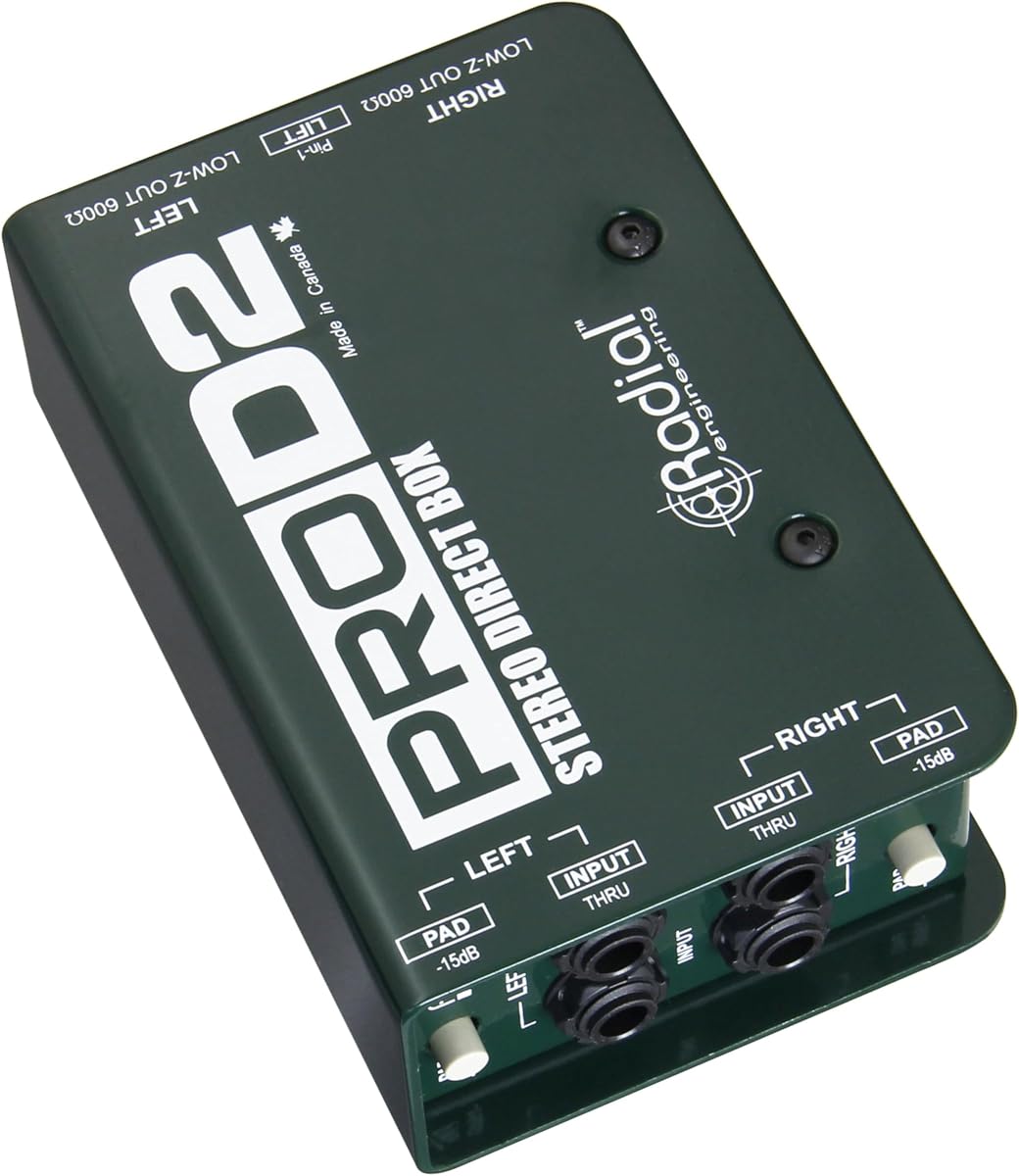
The Radial ProD2 is a premium passive stereo direct box aimed at recordists and performers who want to capture two related channels through a single professional box. Its 4.8 rating is among the strongest in this group, and the combination of an isolation transformer, lift switch, and 15dB pad gives it useful control for demanding source conditions.
We may earn a commission when you buy through this link, at no additional cost to you.
Two-channel operation makes the ProD2 well suited to stereo keyboards, dual-output synthesizers, stereo pedal sources, or paired instruments. The isolation transformer separates the source from the receiving equipment, while the lift switch can help interrupt problematic ground paths. The 15dB pad provides attenuation when a hot source needs protection or a lower recording level.
Its passive design avoids battery and power-supply concerns, but it also means the unit does not provide gain staging or conversion to USB. Users will still need a suitable preamp, mixer, or audio interface after the balanced outputs. The stereo format is more versatile than a mono box, though it occupies more space and may be unnecessary for a single guitar or bass.
The ProD2 is an excellent match for keyboardists, studio owners, and live engineers who regularly work with stereo or paired sources. It also suits anyone who considers transformer isolation, ground-loop control, and attenuation essential. For a premium passive stereo direct box with a focused set of professional controls, it stands out as one of the strongest options in the guide.
The dual-channel format keeps left and right signals separate while using one enclosure. This is especially useful for wide keyboard presets, stereo effect returns, and any setup where preserving channel identity matters during capture.
The 15dB pad is valuable when a guitar pedal, preamp, or other source presents a stronger level than the receiving preamp can handle comfortably. It adds a level-management tool that many basic passive boxes omit.
We may earn a commission when you buy through this link, at no additional cost to you.
The Whirlwind IMP 2 is a compact one-channel passive direct box designed to convert unbalanced line or instrument-level signals into low-impedance balanced microphone-level output. Its 4.8 rating indicates strong customer approval, while the small footprint and rugged transformer mounting make it appealing for mobile and space-conscious recording setups.
We may earn a commission when you buy through this link, at no additional cost to you.
At the center of the design is Whirlwind's TRHL transformer, which is riveted to the chassis instead of glued in place. That construction method supports durability and consistent mechanical positioning. Since the box converts an unbalanced source into a balanced mic-level signal, it can feed a recording console, preamp, or compatible audio interface without requiring the long unbalanced run associated with a conventional instrument cable.
The IMP 2 is intentionally focused. It is a one-channel passive unit, and the supplied feature list does not identify attenuation, phase reversal, a ground-lift switch, or USB recording. Those omissions matter if the user needs detailed signal correction, but they also keep the device conceptually simple. It can still cover the core task of clean conversion for a single instrument or other unbalanced source.
This is a strong recommendation for guitarists, bassists, and home recordists who value a compact, rugged passive box with a transformer-based signal path. It also works well for mobile sessions where rack space is limited and a straightforward connection is more important than extensive controls. For a one-channel instrument direct box, the IMP 2 combines a favorable rating with a professional construction method.
The riveted transformer mounting is a notable construction detail for a portable unit. It helps keep the signal-conversion component secure when the box is carried between rehearsal rooms, stages, studios, and other locations.
The IMP 2 accepts line-level or instrument-level material, giving it more flexibility than a box marketed only for one source type. That makes it appropriate for guitars, pedals, stereo outputs, and other conventional unbalanced feeds.
We may earn a commission when you buy through this link, at no additional cost to you.
The PYLE-PRO Premium Direct Injection Audio Box is a passive recording accessory with a 4.4 rating, a 4.4 rating that still reflects a useful set of customer feedback. It combines a quarter-inch device input, an input attenuator, an impedance transformer, a ground lift, and a steel chassis in a package aimed at instruments, effects processors, keyboards, and other unbalanced outputs.
We may earn a commission when you buy through this link, at no additional cost to you.
The transformer helps convert the incoming signal into a balanced or unbalanced recording destination while offering the potential to reduce hum and buzz. An attenuator provides some level control before the signal reaches a preamp, which is useful for active electronics and hot pedal outputs. The all-metal chassis adds durability, although it may be heavier than a lightweight plastic alternative.
Its stated multi-use intent is the primary strength. The box can be used with electric guitar, bass, keyboard, outboard processors, submixers, and even the line output of a consumer stereo when sampling or capture is required. That versatility comes without a USB converter or active gain stage, so it remains an analog routing tool rather than an all-in-one recording interface.
Users who want a sturdy passive DI with familiar quarter-inch connections should consider this model, particularly when attenuation and ground-loop management matter. It is less compelling for someone who needs stereo capture in one enclosure or a direct digital workflow. Even so, its broad source compatibility and durable construction make it a functional option for rehearsal, stage capture, and straightforward home recording.
The range of supported sources means the box can remain in a recording setup even when the project changes. A keyboard, pedalboard, submixer, or stereo output can be routed through the same quarter-inch input without moving to a different interface.
The input attenuator helps create a more suitable level for downstream equipment. It can be valuable when a source is unexpectedly assertive or when a recording chain offers limited headroom.
We may earn a commission when you buy through this link, at no additional cost to you.
The Bolanle J22 is an active stereo direct box designed for players who need flexible power and clean dual-channel routing. Its 4.6 rating reflects solid customer feedback, while three power options, isolated XLR outputs, a ground lift, and polarity reversal distinguish it from simple passive boxes.
We may earn a commission when you buy through this link, at no additional cost to you.
Power can come from 48V phantom power, a 9V battery, or 5V USB. That makes the J22 suitable for a studio where a console supplies phantom power, a stage with battery-only operation, or a mobile setup powered by a USB power bank. A USB cable is included, although batteries are not, so users relying on the 9V option must provide their own.
The J22 accepts dual unbalanced quarter-inch TRS inputs and provides dual balanced XLR outputs. It can therefore preserve left and right channels from stereo keyboards, dual-output synths, or two separate instruments. The listed ground lift is intended to break ground loops, while the polarity reversal switch offers another tool for addressing phase issues in the recording or live signal path.
This model is a good fit for keyboardists, mobile performers, and session musicians who value stereo separation and power flexibility. It can also support two independent instrument feeds when a stereo mono-sum is not desired. The main trade-off is dependence on an active power source, but the three options largely solve that concern for common stage and studio environments.
The choice of phantom, battery, and USB power means the J22 can adapt to different working environments. This is particularly useful for performers who move between powered mixers, rehearsal spaces, and locations without easy access to a conventional outlet.
The separate XLR outputs maintain the distinction between the two channels. Keyboard players can preserve a stereo spread, while a performer with two instruments may route each one independently for separate control during mixing.
We may earn a commission when you buy through this link, at no additional cost to you.
The Radial Engineering ProDI Bundle is a passive instrument direct box that pairs the ProDI with a Pig Hog microphone cable and a Liquid Audio polishing cloth. Its 5.0 rating is the highest listed score in the guide, and the included accessories make it an attractive package for a musician building a recording or live signal chain from the ground up.
We may earn a commission when you buy through this link, at no additional cost to you.
The custom-wound Radial transformer has a high 140kOhm input impedance and is designed to accommodate extreme signal levels without distortion across the frequency range. Transformer isolation helps remove ground-loop noise, while the passive circuit requires no battery. The result is a direct, predictable route from an unbalanced instrument to a balanced recording input.
The bundle remains a mono product and does not include USB conversion, attenuation, or phase controls. It is therefore more specialized than the Bolanle J22, Radial ProD2, or ART DualZDirect. For a player who needs one dependable instrument feed, however, those absent features may matter less than the quality of the central transformer and the convenience of receiving a cable with the box.
This bundle is a compelling recommendation for a guitarist, bassist, vocalist working with an instrument-level source, or home recordist who wants a professional passive DI and dependable cable in one purchase. It is also convenient as a portable stage accessory. For users who value transformer behavior, isolation, and a complete ready-to-connect package, the listed 5.0 rating makes this one of the guide's strongest confidence picks.
The stated 140kOhm input impedance gives the transformer design a high-impedance input. This is useful for a professional instrument direct box because the input can work with source signals without behaving like a heavy load on the connected equipment.
Including a tour-oriented Pig Hog cable and a polishing cloth adds convenience for a new setup. It reduces the need to source a separate cable immediately and makes the bundle easier to carry into a rehearsal, performance, or recording session.
We may earn a commission when you buy through this link, at no additional cost to you.
The PRORECK DC21 is a passive mono direct box with a 5.0 rating and a broad collection of recording controls. It includes a 50kOhm impedance transformer, input attenuation, a ground lift, a thru output, and a balanced XLR output, making it a capable option for guitar, bass, keyboards, effects processors, and submixers.
We may earn a commission when you buy through this link, at no additional cost to you.
The transformer supports impedance matching between the source and receiving mixer or amplifier, while isolation helps reduce current hum, buzz, and background noise associated with ground loops. The 50kOhm impedance specification helps position the device for instrument and line-level sources. Its XLR output leads into a recording mixer, stage amplifier, or audio interface, while the thru jack can preserve an unbalanced path for live amplification.
The simultaneous stage and recording outputs are particularly useful. A guitarist can send the transformed signal to a mixer for capture and use the thru connection to an amplifier for stage monitoring. The trade-off is that the DC21 is a one-channel device, and it does not provide a USB converter, stereo routing, phase inversion, or a low-pass filter. It is a feature-rich analog DI rather than a complete digital recording interface.
The DC21 is a strong recommendation for gigging musicians and home recordists who want a conventional passive box with useful level and ground-control options. Its listed 5.0 rating adds confidence for buyers who prioritize customer satisfaction, while the broad source compatibility makes it a practical centerpiece for a portable analog recording setup.
The thru output allows the unbalanced source to continue toward an amplifier while the balanced feed travels to a mixer or interface. That parallel routing supports both performance and capture without requiring two separate boxes.
The physical isolation transformer and ground-lift switch work together to address hum introduced by ground paths. This is particularly helpful when the instrument, amplifier, power distribution, and recording equipment share interconnected electrical environments.
We may earn a commission when you buy through this link, at no additional cost to you.
The Radial USB-Pro is an active two-channel instrument direct box with a USB connection, built-in converters, balanced outputs, and a headphone amplifier. Its 4.6 rating reflects positive customer feedback, while its 24-bit/96kHz conversion makes it distinct from the analog-only direct boxes elsewhere in this guide.
We may earn a commission when you buy through this link, at no additional cost to you.
For laptop-based recording, the key advantage is direct integration. Rather than converting an instrument to balanced analog and then sending it through a separate interface, the USB-Pro provides the conversion within the same box. Two balanced low-impedance outputs are available with switchable isolation, allowing a stereo or dual-source workflow while giving the user control over output grounding.
This greater capability also creates trade-offs. The unit is active and requires power, and its USB connection adds dependence on a computer or recording system. A built-in headphone amplifier expands monitoring options, but users who only need a passive analog path may find a simpler direct box easier to deploy. The USB-Pro is best understood as a specialized recording tool rather than a general passive stage accessory.
Choose the USB-Pro when the priority is capturing instruments directly to a computer with the least conversion chain. It is well suited to home studios, mobile production, and rehearsal rooms where a laptop is the central destination. Users wanting a simple XLR feed may prefer another model, but for direct USB capture the combination of stereo channels, isolation control, conversion, and headphone monitoring is compelling.
Integrating the USB converter into the direct box removes a separate analog-to-digital stage from the chain. For mobile recordists, this can simplify the path from instrument to computer and reduce the number of external devices requiring setup.
The integrated headphone amplifier provides a convenient monitoring option for artists recording through the same unit. It can make headphone checks more immediate while the instrument feed is being captured.
We may earn a commission when you buy through this link, at no additional cost to you.
The ART DualZDirect is a dual-channel passive direct box with one of the most comprehensive control sets in this guide. It carries a 4.6 rating and offers switchable attenuation, a low-pass filter, phase inversion, and a ground lift, all in a passive design that requires no battery.
We may earn a commission when you buy through this link, at no additional cost to you.
Its transformer design converts 50kOhm inputs into 600-ohm balanced outputs. The three selectable attenuation levels of 0, -20, and -40dB provide meaningful control over input level, while the switchable phase invert can correct polarity relationships. The low-pass filter offers tonal shaping for sources that need to be limited, and the ground lift fully isolates the inputs from the chassis and outputs.
The box is more configurable than a basic passive DI, but it remains an analog device with no USB conversion or active gain. Users who want a simple one-channel box may find the stereo controls excessive, while those recording stereo or paired sources may appreciate the added control. The passive operation is a clear advantage for stage reliability, and the broad feature set reduces the need for several separate utility boxes.
The DualZDirect is a strong choice for studio engineers, keyboardists, and serious live users who want flexible attenuation and phase treatment in a stereo passive unit. It works especially well when the source requires level reduction, tonal filtering, or careful polarity control. For those priorities, it offers more built-in utility than many competitors without introducing a power dependency.
The 0, -20, and -40dB settings make it possible to adapt the incoming signal without replacing the direct box. This is useful for passive instruments, hot electronics, and any source that would otherwise place unnecessary pressure on a recording preamp.
Phase inversion, a low-pass filter, and a ground lift provide several ways to shape the signal before it reaches the destination. The ground-lift option is particularly valuable when the box sits between equipment with different ground references.
We may earn a commission when you buy through this link, at no additional cost to you.
The right direct box depends on the source, recording destination, number of channels, and level of signal control required. These factors help distinguish a simple mono passive box from a stereo, active, or USB-equipped recording solution.
In short, choose passive for dependable analog routing and active when powered features justify the extra setup.
In short, match the channel count to the source rather than choosing stereo automatically.
In short, prioritize a proper isolation transformer when hum, buzz, or ground-related noise is a concern.
In short, select a ground lift when the recording environment has likely ground-loop problems or when flexible troubleshooting is valuable.
In short, use attenuation when the source is hot or when reliable level control before the preamp is important.
In short, verify the full route from source to destination, including thru, stereo, and digital connections.
In short, add phase or filtering controls when your sources and recording room regularly create the problems they address.
In short, choose a construction and layout that suit the places and frequency of use, not just the specification count.
Begin by identifying the source level, connector type, and desired destination. Connect an unbalanced instrument or line output to the direct box with an appropriate quarter-inch cable, then use the balanced output to reach a mixer, preamp, or audio interface. For a USB-equipped model, connect the data cable to the computer and configure the interface for the appropriate input. Before raising the recording level, set attenuation or pad controls to a conservative starting position and confirm that the receiving channel is accepting the expected signal type.
Test the complete chain quietly for hum, buzz, clipping, and polarity problems. If noise appears, check the cable, power connections, and ground relationship, then use the ground lift as a controlled troubleshooting step. A mono source should remain mono unless the recording destination is specifically configured for stereo. For a stereo source, keep left and right channels correctly matched and avoid merging them until the intended panning and balance have been evaluated in the recorded result.
After recording, disconnect the source before the destination when practical, and coil cables without sharp bends or strain at the connectors. Store the unit in a dry, padded case, protect the transformer or controls from impact, and keep moisture or debris away from input and output sockets. Active models should be powered down before changing power arrangements. Periodic checks with a known quiet source can reveal loose connectors, scratches, or developing noise before they interrupt an important session.
A direct box converts an unbalanced instrument or line-level signal into a balanced, low-impedance microphone-level output. This makes the source easier and often cleaner to feed into a mixer, preamp, or audio interface. Many models also provide transformer isolation, attenuation, a ground lift, or a thru output for live amplification.
A passive direct box can be an excellent studio choice because it requires no power and uses a straightforward transformer-based signal path. It works especially well with passive instruments and conventional line outputs. An active box may be preferable when a powered gain stage, stereo routing, or more controls are needed, so the source and workflow matter more than active versus passive alone.
A stereo direct box is useful for stereo keyboards, dual-output synthesizers, stereo pedal sources, and two separately controlled instruments. A single guitar, bass, or other mono source does not require two channels, and a mono box is often simpler to carry and operate. Check the actual output format of the instrument before deciding.
A ground lift interrupts part of the electrical ground relationship between the direct box and connected equipment. This can help eliminate hum or buzz caused by a ground loop when two devices are linked through more than one ground path. It should be used carefully because some equipment depends on a shared ground for safety and correct operation.
A guitar input is usually the simplest route for a standard electric guitar and a normal instrument cable. A direct box becomes useful when you need balanced routing, longer cable runs, transformer isolation, attenuation, a ground lift, stereo inputs, or a direct USB recording path. Choose the simplest method that reliably delivers the signal and features your recording requires.
Yes, provided the keyboard has an appropriate unbalanced output, usually through a quarter-inch connection. Stereo or dual-output keyboards may benefit from a two-channel direct box, while mono keyboards can use a mono model. The balanced output then enters a mixer or audio interface, which handles the final conversion to a computer recording.
A direct box does not automatically make an instrument sound better. Its benefit is cleaner, more compatible signal routing. Isolation can reduce ground-loop hum, balancing can lower noise over long cable runs, and attenuation can prevent overload. Source quality, amplifier choice, cables, microphone techniques, and the recording chain remain important contributors to the final result.
An XLR output provides balanced analog audio that still needs to enter a preamp, mixer, or audio interface. A USB output can provide a digital connection directly to a computer, often including built-in conversion. The Radial USB-Pro includes 24-bit/96kHz converters, while the other reviewed models rely on an external device for the final digital stage.
The Radial ProDI Bundle is the most complete starter package for a high-quality mono passive signal path, while the PRORECK DC21 provides an impressive assortment of level, isolation, and routing controls. For premium stereo passive recording, the Radial ProD2 stands out with transformer isolation, a lift switch, and a 15dB pad. The ART DualZDirect is another versatile stereo option, particularly for users who need phase inversion and filtering.
Prioritize the architecture that matches the source: choose a simple passive mono box for one instrument, a stereo model for separate channels, an active unit for flexible power and controls, or a USB model for direct computer capture. Also consider ground-loop problems, attenuation requirements, existing connectors, portability, and whether the box will also be used for live amplification. These practical considerations are more valuable than a long feature list that the recording setup will never use.
Ratings and configurations provide a useful starting point, but verify the latest product details, connector standards, and power requirements before purchasing. Product prices and availability can change over time, and manufacturer revisions may alter included components or specifications. Check the current listing carefully to ensure the selected direct box supports the intended instrument, destination, and recording workflow.