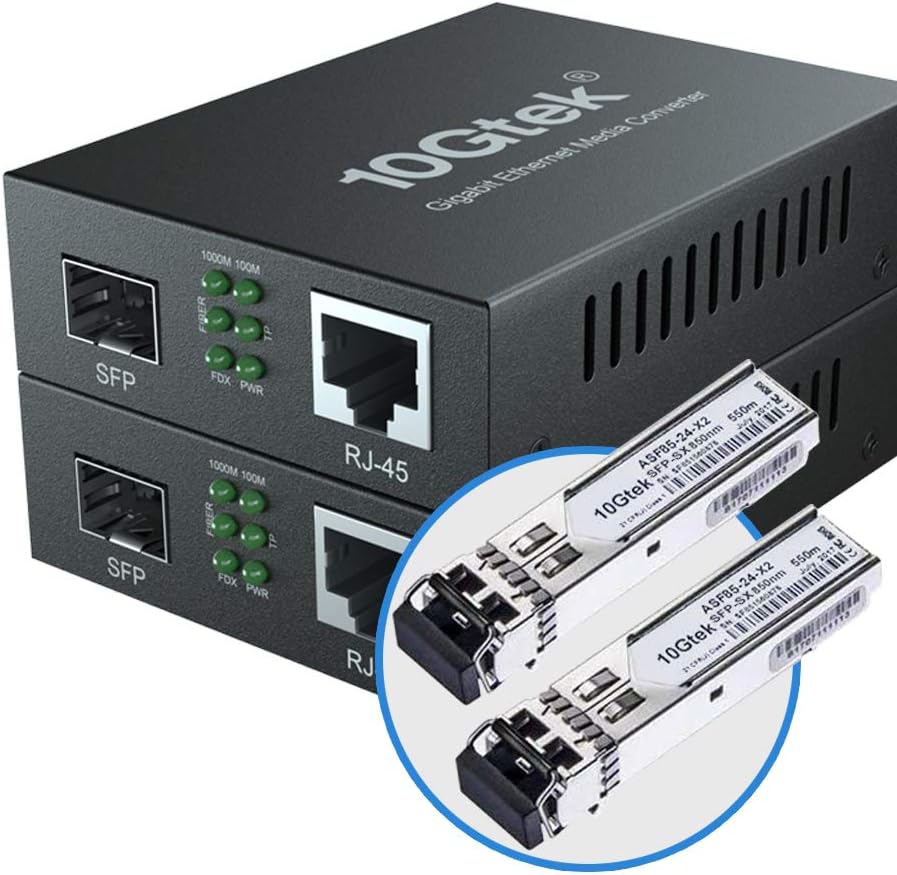
10Gtek Gigabit Multimode LC Converter
4.7Editor score
Two converters and transceivers
550-meter multimode reach
Gigabit auto-negotiating RJ45
Dual LC fiber connectors
Our Ethernet Fiber Media Converter guide compares ten models for fiber type, distance, copper speed, installation ease, monitoring, and enterprise-grade
An Ethernet fiber media converter bridges conventional RJ45 copper Ethernet and fiber optic cabling, extending a network beyond copper limits while resisting electromagnetic interference. A capable model should match the correct fiber type, optical distance, connector arrangement, and copper speed required by the equipment on both ends of the link.
We compared all ten products by examining their supported Ethernet speeds, fiber standards, included transceivers, reach, cabling, status indicators, configuration options, mounting provisions, and installation requirements. The list covers fixed-connector converters, open-SFP models, single-mode and multimode systems, and a 10-gigabit SFP+ option.
Each review identifies the role a converter is best suited to perform, from straightforward point-to-point links to managed installations and higher-capacity backbones. Ratings reflect the supplied customer feedback, while technical suitability can differ considerably. Product prices and configurations can change, so verify current details before purchasing.
4.7Editor score

4.8Editor score

5.0Editor score
The comparison highlights the differences that determine compatibility: optical reach, connector type, transceiver inclusion, Ethernet speed, diagnostic features, and deployment flexibility. Fixed-format converters offer a ready-made path, while open-SFP products allow greater freedom when network requirements may change.


This 10Gtek package combines two Gigabit Ethernet media converters with 1.25G multimode SFP modules, creating a straightforward fiber-to-copper path for a complete point-to-point link. Its 4.7 rating reflects generally positive customer feedback. The most appealing feature is the two-unit format, which supplies both ends without requiring a separate transceiver purchase.
We may earn a commission when you buy through this link, at no additional cost to you.
Each converter uses a 850 nm SFP multimode module with dual LC fiber connections and a stated reach of up to 550 meters. The copper side provides one RJ45 port that auto-negotiates among 10, 100, and 1000 Mbps and supports full- or half-duplex operation, MDI/MDIX auto-crossover, and Cat5e or better cabling. That makes it broadly compatible with switches, routers, cameras, access points, and conventional office equipment.
The limitations come from the specialized optical format. This is not an open-SFP design, so its included multimode module cannot be exchanged for a different reach or single-mode option without addressing transceiver compatibility outside the supplied package. The LC connectors must also correspond with the patch cords and installed fiber infrastructure. Buyers should not treat it as a universal converter for both fiber types.
It is a compelling choice for a new Gigabit link across an office, warehouse, or campus building where multimode LC fiber is already installed. It also makes more sense than buying one converter and a separate module when both endpoints need conversion. For users who value immediate compatibility, two matched units, and straightforward plug-in operation, it is the strongest budget-oriented package in this list.
The two included converters and matching 850 nm SFP modules eliminate a common source of installation delay. Each side can be installed with the same optical format, reducing the chance of mixing incompatible components.
Automatic speed negotiation and MDI/MDIX crossover support make the RJ45 port practical with a wide range of network devices. Cat5e-rated copper runs remain sufficient for the stated 100-meter connection distance.
We may earn a commission when you buy through this link, at no additional cost to you.
The Omada MC220L is a Gigabit SFP-to-RJ45 media converter built for installations where the optical module must be chosen separately. It carries a 4.7 rating and stands out for its open SFP approach. Rather than locking the converter to one wavelength, fiber type, or distance, it can accept compatible modules suited to the installation.
We may earn a commission when you buy through this link, at no additional cost to you.
Its RJ45 port auto-negotiates at 10, 100, or 1000 Mbps, supports half- and full-duplex transfer, and includes automatic MDI/MDIX handling. The hot-swappable FX port accepts single-mode or multimode SFP modules. With an appropriate module, the supplied data indicates reach can extend to 20 kilometers over single-mode fiber or 550 meters over multimode fiber.
The main compromise is that a transceiver is not included, so buyers must source a compatible SFP and understand the optical requirements. This is an advantage when the existing network already has a particular module, but it adds a selection step for new installations. Its plug-and-play design also means the converter requires no software installation or complex configuration.
Choose the MC220L when you want one platform to support several fiber paths, particularly in a campus, branch office, or installer toolkit. It is well suited to users who know the required wavelength, connector, and distance. For a beginner who wants a self-contained bundle, one of the fixed-format two-packs is the simpler choice.
The open SFP slot separates the converter from the optical choice, allowing compatible multimode or single-mode modules to suit the run. This is particularly useful for maintenance teams maintaining links with different reach requirements.
Automatic copper-side negotiation and plug-and-play operation reduce setup steps. Once a suitable module is installed, the converter can bridge a Gigabit network without dedicated management software.
We may earn a commission when you buy through this link, at no additional cost to you.
This two-pack provides Gigabit media converters and 1.25G bidirectional LC transceivers for a complete multimode installation. It has a 4.5 rating and differentiates itself through a BiDi optical arrangement, which allows bidirectional communication over the compatible single-fiber path. Two converters, two transceivers, two power supplies, and a manual are included.
We may earn a commission when you buy through this link, at no additional cost to you.
The copper side supports 10, 100, and 1000 Mbps auto-negotiation, full- or half-duplex modes, and MDI/MDIX auto-crossover. The optical side reaches up to 550 meters over multimode fiber. Status LEDs cover transmission, fiber link and activity, power, and full-duplex operation, while 9K-byte jumbo frames can benefit storage and backup traffic.
Its product naming mixes terms such as multimode, SMF, and 1000Base-SX, so buyers should carefully read the specifications rather than relying on the marketplace title alone. The stated physical configuration is a multimode BiDi LC setup. It is not as broadly reusable as an open-SFP converter, and the optical arrangement must align with the patch cords and fiber cabling.
This bundle is a practical choice for installers who already know they need BiDi LC multimode hardware and want both endpoints supplied together. It avoids separately sourcing a pair of matching transceivers. For a general-purpose fiber converter, an open-SFP model offers more freedom, but for this defined BiDi use case, the package is convenient and complete.
Supplying two converters and two BiDi modules reduces the risk of mismatched components. The included power supplies and manual complete the basic installation package for a point-to-point link.
Separate indicators for power, transmission, optical link and activity, and duplex status make it easier to check whether a problem exists on the copper, fiber, or power side.
We may earn a commission when you buy through this link, at no additional cost to you.
This converter is the list's clearest option for a 10-gigabit fiber path, combining a multi-speed 10GBase-T RJ45 port with a 10GBase-X SFP+ slot. Its 4.6 rating reflects solid customer feedback, and the major advantage is headroom for high-capacity links rather than a basic Gigabit bridge.
We may earn a commission when you buy through this link, at no additional cost to you.
The copper port auto-adapts to 100M, 1G, 2.5G, 5G, and 10G Base-T connections. By contrast, the fiber slot accepts only 10G SFP+ modules, such as 10GBase-SR or 10GBase-LR. LED indicators show diagnostic and DIP-switch configuration status. IEEE 802.3x flow control is supported, while link-fault pass-through, automatic laser shutdown, and fiber-speed options are selectable as applicable.
A compatible 10G SFP+ transceiver is not included, which is the principal trade-off. The buyer must match the module to the fiber type, connector, wavelength, and distance. It is also important to distinguish a 10GBase-T module from an optical 10GBase-X SFP+ module; the converter's optical slot is limited to the latter.
It makes sense for data centers, high-speed server rooms, storage links, and modern enterprise installations that need a 10G SFP+ path. Its ability to operate standalone or in a one-rack, 12-slot chassis also supports both small and structured deployments. Choose it when the optical requirement is genuinely 10 gigabits and you already know which SFP+ module the run needs.
Multi-speed auto-adaptation on the RJ45 side allows the converter to connect to equipment operating at 100 Mbps through 10 Gbps. This avoids forcing every connected device onto the same copper speed.
Support for a 12-slot chassis and standalone placement lets network teams move between a single office enclosure and a centralized rack. Visible diagnostic and configuration indicators aid troubleshooting.
We may earn a commission when you buy through this link, at no additional cost to you.
This 10Gtek two-pack creates a ready-made Gigabit link over 20 kilometers of single-mode fiber using dual SC connectors. Its 4.8 rating is among the strongest in the group. The package is particularly attractive for organizations extending a network between buildings where multimode reach is insufficient and SC-terminated fiber already exists.
We may earn a commission when you buy through this link, at no additional cost to you.
The optical interface uses a 1.25G 1310 nm single-mode module with dual SC connectors. On the copper side, one RJ45 port negotiates 10, 100, or 1000 Mbps, supports full- or half-duplex operation, and provides MDI/MDIX auto-crossover. Cat5e or better copper supports the stated 100-meter distance, and the supplied 5V 1A power supply is UL certified.
Because the fiber format is fixed, the units cannot simply be moved to a shorter-range multimode path or adapted to LC connectors without additional compatible hardware. The buyer must also use the appropriate single-mode patch cords and ensure the remote Ethernet equipment can negotiate over the link. Despite being a pack of two, the product is also suitable when one endpoint already has fiber access and only the copper side needs conversion.
This is a strong recommendation for campus, building-to-building, and long horizontal single-mode deployments with SC connectors. It balances long reach, straightforward setup, and a two-unit package without requiring a separate transceiver. Choose it when your infrastructure is known to be 1310 nm single-mode with dual SC termination and a need for Gigabit Ethernet.
The stated 20-kilometer single-mode reach makes the pair suitable for campus-scale links, building interconnects, and longer industrial runs. The optical format remains focused rather than broadly interchangeable.
Two matched converters simplify the purchase of a point-to-point installation. A separate unit can still be useful where the opposite endpoint already terminates in suitable Ethernet.
We may earn a commission when you buy through this link, at no additional cost to you.
This two-pack combines Gigabit media converters with built-in 1310 nm single-mode SFP modules and supports reach up to 20 kilometers. Its 4.9 rating is the highest among the supplied customer ratings. It is a strong option for a long LC-terminated single-mode link where a complete two-end package is convenient.
We may earn a commission when you buy through this link, at no additional cost to you.
The optical side connects through dual LC single-mode fiber. The RJ45 side provides stable Gigabit Ethernet and remains backward compatible with 10 and 100 Mbps. It supports full- and half-duplex modes, 9K-byte jumbo frames, and status monitoring through visible LEDs. The units accept a broad 100-to-240-volt input range and operate from a 5V 1A supply.
The fixed optical design is the central limitation. It is intended specifically for 1310 nm single-mode links with LC connectors and cannot cover multimode or SC-terminated installations without different equipment. Although the hardware is simple to deploy, the package does not include a copper patch cable, so that accessory may need to be sourced separately.
Choose this product for long-distance Gigabit links over existing dual LC single-mode infrastructure, especially where both endpoints need conversion. It is also a practical option for installers who prefer a bundled, uniform pair over sourcing separate modules. Confirm connector type, fiber grade, and cabling before ordering, as correct optical alignment is essential to the link.
A 20-kilometer reach supports campus, campus-adjacent, and building distribution applications. The 1310 nm single-mode format is a proven choice for longer Gigabit links.
Matching the two converters and their 1310 nm LC modules simplifies deployment. Consistent components also reduce the chance of accidentally pairing incompatible optical specifications.
We may earn a commission when you buy through this link, at no additional cost to you.
This single-mode LC Gigabit converter is a feature-rich standalone option with a 1310 nm 1000Base-LX SFP already installed. Its 4.7 rating indicates favorable customer feedback. It is especially interesting for users who want more controls than a basic fixed converter offers while retaining simple desktop or wall-mount operation.
We may earn a commission when you buy through this link, at no additional cost to you.
The RJ45 port automatically negotiates 10Base-T, 100Base-TX, and 1000Base-T and uses MDI/MDI-X auto-crossover. A rear DIP block can select 1000Base-LX or 100Base-LX fiber operation and control link-fault pass-through, broadcast storm control, and forced speeds. The supplied specifications also describe jumbo-frame support and an operating range from 0 to 70 degrees Celsius.
The unit is supplied with the converter, transceiver, power adapter, Cat6 patch cable, wall-mount ears, and a cable clip. This is a more complete accessory set than many compact converters provide. It is a single unit rather than a pair, however, and the default optical mode is Gigabit, so Fast Ethernet users must change the relevant DIP setting and use compatible fiber equipment.
It is a strong choice for a one-end conversion where the remote side already has compatible fiber hardware, or when a complete single link can be assembled with another matching unit. The link-fault pass-through feature is particularly useful for operations teams because a fiber break can drop the copper-side state instead of leaving a remote switch believing the link remains healthy.
Separate DIP options for optical speed, link-loss forwarding, storm control, and forced copper speed give technicians finer control. The default configuration remains suitable for ordinary Gigabit installations.
The included transceiver, power supply, copper patch cable, mounting ears, and cable clip cover the small but important accessories often omitted from compact media-converter listings.
We may earn a commission when you buy through this link, at no additional cost to you.
The StarTech MCM1110SFP is an open-SFP Gigabit media converter designed for professional edge, on-premises, and enterprise deployments. It carries a 4.7 rating. Rather than fixing the converter to a connector, wavelength, and distance, its open cage accepts compatible MSA-compliant multimode or single-mode transceivers.
We may earn a commission when you buy through this link, at no additional cost to you.
The RJ45 side supports 10, 100, and 1000 Mbps auto-negotiation. Link-fault pass-through helps expose fiber-side outages to the connected network equipment, while IEEE 802.1q tagged VLAN pass-through and 9K jumbo-frame support broaden its suitability for managed network traffic. The product can be placed almost anywhere and can also mount in StarTech MCM7-MEDIA-CHASSIS or MCM15-MEDIA-CHASSIS systems.
No SFP transceiver is included, which makes the total configuration depend on the selected module. TAA compliance may also matter only to certain government, defense, or regulated procurement environments. The open design is nevertheless a major operational benefit because a technician can choose the correct optical interface and reach rather than replacing an entire converter when requirements change.
Choose the MCM1110SFP for structured installations, branch networks, and professional environments where module choice, fault visibility, VLAN handling, and optional rack integration matter. It is less convenient for a first-time buyer who wants everything included, but it offers the most adaptable infrastructure approach in this group. Pair it with an appropriate MSA-compliant module after confirming the fiber path.
The open SFP slot lets administrators select optical reach, wavelength, and connector independently of the converter. That modularity supports evolving campus and branch-network requirements.
Link-fault pass-through, tagged VLAN transparency, and jumbo-frame support address common operational concerns. Optional media-chassis mounting helps create a cleaner, more centralized installation.
We may earn a commission when you buy through this link, at no additional cost to you.
This converter is a thorough indoor multimode solution, with a preinstalled 1.25G 1000Base-SX SFP and a stated 550-meter rating. Its 4.5 rating is solid, and its principal strengths are compatibility, included accessories, and detailed configuration controls for links over OM1 through OM5 fiber.
We may earn a commission when you buy through this link, at no additional cost to you.
The duplex LC optical interface works over 62.5/125 OM1 and 50/125 OM2, OM3, OM4, and OM5. The stated 550-meter distance applies to OM2 and better, while OM1 supports approximately 275 meters for Gigabit service under the cited standard. The copper port negotiates 10, 100, and 1000 Mbps with automatic MDI/MDIX, and 9K jumbo frames, QinQ, and 802.1Q transparency are supported.
Four rear DIP switches control link-loss forwarding, broadcast storm control, a forced 100Base-SX fiber mode, and a forced 100M copper mode. The package includes the converter, installed SFP, power adapter, Cat6 patch cord, wall-mount ears, rubber feet, and dust caps. External LC-to-LC multimode patch cords and the actual fiber run remain necessary, and only one converter is included.
It is a good fit for office buildings, schools, warehouses, and other indoor environments with multimode infrastructure. The wide range of supported fiber grades makes it more accommodating than a converter designed around one specific installation. Choose it when the requirement is 850 nm duplex LC rather than long single-mode reach, and confirm that your patch cords match the fiber grade and connector.
Support for OM1 through OM5 allows one optical design to serve a range of common building backbones. Distance still depends on fiber grade, with the longest specified reach applying to OM2 and better.
Link-loss forwarding, broadcast storm control, forced-speed options, and transparent VLAN handling give network administrators several ways to manage edge links. The controls are arranged on rear DIP switches.
We may earn a commission when you buy through this link, at no additional cost to you.
The StarTech ET91000SFP2 is a premium open-SFP Gigabit media converter with a 5.0 supplied rating, the highest in the group. It is designed for installations that need flexibility across single-mode and multimode fiber without replacing the converter whenever distance or connector requirements change.
We may earn a commission when you buy through this link, at no additional cost to you.
Its open SFP slot supports compatible MSA-compliant Gigabit modules. Advanced capabilities include link-loss forwarding, remote status monitoring, selectable frame lengths, and jumbo-frame support. The copper side can operate in full- or half-duplex mode, and the product is marketed for easy installation, network extension between buildings, data centers, and server rooms.
As with other open-SFP converters, the transceiver must be sourced separately. A compatible module must match the optical wavelength, connector, fiber type, and desired distance. TAA compliance can be valuable for regulated institutional and government procurement, while remote monitoring and fault forwarding are useful for managed deployments. It does not include a module or guarantee every third-party SFP will function.
This is the premium selection for network professionals who value an established enterprise format, remote status visibility, and a broad transceiver ecosystem. It works particularly well where a single converter family must support different building distances and fiber types. Choose it when module selection can be handled competently and when diagnostic features justify a more specialized platform.
Remote monitor status and link-loss forwarding make the converter more suitable for infrastructure where a distant fault must be surfaced quickly. These functions are especially valuable across building boundaries.
Compatible single-mode and multimode Gigabit SFPs can be selected for the run. The open format avoids a fixed connector and distance limitation while preserving a central converter platform.
We may earn a commission when you buy through this link, at no additional cost to you.
The correct converter depends less on brand names and more on the physical fiber already installed, the distance it must cover, the Ethernet speeds at each endpoint, and the diagnostic features required by the network.
Choose multimode for the specified 550-meter class of installation, and choose single-mode when the route extends into the kilometer range or future expansion may require it. Check the transceiver wavelength as well as the broad fiber category.
Measure the complete route rather than relying on a building floor plan. Include patch cords and service loops, then leave operating margin for the installed fiber grade and environmental conditions.
Inventory the existing connectors before buying. If a path may change, an open SFP slot offers more flexibility, but it also places responsibility for correct module selection on the installer.
For ordinary Gigabit links, auto-negotiation and auto MDI/MDIX are the most useful traits. For a 10-gigabit path, select the SFP+ model rather than assuming a nominal Gigabit converter can carry higher copper or optical throughput.
Choose fixed hardware for a known path and a self-contained installation. Choose an open SFP when the network team values modularity, operates multiple link types, or expects future changes to the optical requirements.
Prioritize fault forwarding and clear status indicators for installations that are difficult to access. A visually quiet link can otherwise leave technicians unsure whether the fault is on the copper, optical, or remote-device side.
List the components you already own before ordering. A package with the correct patch cable, mounting hardware, and transceiver can be more complete than a nominally similar bare converter.
Do not pay for enterprise functionality solely because it is listed. Select for the required compliance, management, and support features, then verify that the optical and copper specifications meet the actual network requirement.
Begin by documenting both ends of the link: the fiber type, connector, cable grade, path length, and the Ethernet speeds supported by the connected switch, router, camera, or access point. Confirm that the converter's optical format and included transceiver match the installed fiber. A fiber inspection and cleaning process should be completed before connecting the modules, because dust and contamination can prevent a reliable optical link.
Install the converter in a dry, ventilated location with access to its power adapter and status LEDs. Connect the fiber and copper cables, then apply power and observe power, link, and activity indicators. If the link does not establish, check power first, inspect both connectors, confirm the transceiver is seated, and verify that the two optical ends are using compatible modules. Avoid repeatedly unplugging the fiber when a configuration problem is more likely.
For wall-mounted or centralized installations, secure the unit and strain-relief both cables so connector stress does not accumulate. Periodically inspect the power supply, patch cords, and connector surfaces, and clean the fiber connectors with appropriate tools. Keep the vents unobstructed, record the model and module details, and review DIP settings before changing speed, link-loss forwarding, or storm-control behavior.
An Ethernet fiber media converter bridges a conventional RJ45 copper Ethernet connection with a fiber optic connection. It is useful when a network must travel farther than copper supports, cross between buildings with interference concerns, or connect equipment that already uses fiber. The converter does not replace a switch; it translates the physical Ethernet signal between copper and optical media.
A point-to-point fiber link generally needs a compatible converter or fiber interface at each end. Both ends must use compatible optical formats, wavelengths, connector arrangements, and Ethernet speeds. Some products include two units and matching transceivers, while open-SFP models require the installer to select compatible hardware for the complete path.
Not reliably without the correct optical conversion arrangement. A converter designed for 1310 nm single-mode fiber does not automatically match an 850 nm multimode link. Instead, choose a converter whose specified transceiver and wavelength support the installed fiber, or use purpose-built media converters that can translate between different optical modes.
It depends on the installation. An open SFP design offers greater flexibility because the installer can choose reach, wavelength, and connector, making it useful for changing networks. A fixed converter with an included module is usually simpler for a known link because fewer components must be selected and paired correctly.
For most office, camera, and access-point installations, a Gigabit converter that auto-negotiates 10, 100, and 1000 Mbps is the common choice. Higher-capacity server, storage, or backbone links may require a 10-gigabit SFP+ converter. The connected devices must also support the intended speed, and the optical module must match the converter's fiber slot.
The stated distance depends on the converter, transceiver wavelength, fiber type, and cable grade. Multimode products in this list generally cover up to 550 meters on suitable fiber, with some distance reduction on older OM1 runs. Single-mode products state reach up to 20 kilometers. Actual performance also depends on the installed path and its loss characteristics.
It helps propagate a fiber-side failure to the copper-side Ethernet state. Without it, a remote switch may continue to show a link even though the optical path is broken. That can make troubleshooting slower and leave network-management tools with an inaccurate view of service availability.
Check whether the package includes the required fiber transceiver, LC or SC patch cords, a copper patch cable, power adapter, and mounting hardware. Open-SFP converters do not include the optical module, and even bundled converters may not include fiber patch cords. The correct connector and fiber grade must be matched to the installed infrastructure.
The strongest overall choice for a ready single-mode deployment is the 10Gtek dual SC two-pack, which combines long reach, matched hardware, and a high customer rating. The 10Gtek multimode two-pack is the leading budget-oriented option, while the StarTech ET91000SFP2 represents the premium end with open-SFP flexibility, fault visibility, and remote monitoring.
Prioritize the physical infrastructure before comparing features. Match multimode or single-mode fiber, connector style, optical distance, transceiver wavelength, and Ethernet speed. After those requirements are settled, indicators, link-fault pass-through, VLAN support, accessories, mounting options, and vendor support can distinguish otherwise similar converters.
Finally, verify the current product listing, included components, and current price before purchasing. Fiber compatibility cannot be corrected by a generic specification, so confirm the exact cable type and endpoint requirements. A carefully matched converter should provide a dependable bridge, but only when its optical design agrees with the installed network.