
WEP 882D
4.5Editor score
Combined soldering and hot air
Dual digital temperature displays
Extensive accessory package
Our Hot Air Rework Stations guide compares ten models for temperature control, airflow, safety, accessories, and repair work, helping you choose a setup.
Hot air rework stations give electronics technicians, repair professionals, and serious hobbyists a controlled way to remove and replace surface-mount components, shrink tubing, install heat-sensitive parts, and service densely assembled circuit boards. A worthwhile station combines fast heating, stable temperature control, useful airflow adjustment, safe cooling behavior, and accessories suited to the work.
This guide compares ten hot air rework stations across temperature range, heating performance, airflow control, display design, standby features, nozzle selection, soldering capability, power requirements, and included accessories. The list includes dedicated hot air units, compact dual-purpose stations, and larger integrated workbenches, with attention to the needs of different repair environments.
Each selection highlights the reasons it stands out while also noting practical limitations. The top picks demonstrate why budget-friendly construction, dependable control, and premium features can matter in different ways. Product availability and pricing change over time, so compare the current listing details before purchasing.
4.5Editor score

4.5Editor score

4.6Editor score
The comparison below covers ten stations with different combinations of heating power, temperature range, airflow control, soldering capability, safety functions, and included tools. These distinctions help separate dedicated rework guns from compact dual stations and full professional workbenches.



The YIHUA 959D-Digital is a dedicated hot air rework station with a 4.5 rating and a strong emphasis on rapid heating, programmable temperature, and practical safety controls. Its stated output reaches 120L of hot air and a maximum stabilized temperature of 932°F, giving it enough authority for common SMD removal, connector work, heat-shrink applications, and broader electronics repair tasks. The brushed aluminum panel also gives the controls a more substantial appearance than a lightweight plastic enclosure.
We may earn a commission when you buy through this link, at no additional cost to you.
Three preset memory channels are among its most useful features for working technicians. A repairer can save temperature and airflow combinations for recurring jobs, then switch between them without navigating through a menu each time. The unit supports both Fahrenheit and Celsius, and the gun is designed to heat rapidly when removed from its holder. Airflow is emphasized as part of the heating system, while the in-holder standby function allows the hot air gun to cool when it is not being used.
The main compromise is that this is a focused hot air station rather than a combined soldering workbench. It does not include an integrated soldering iron, tips, solder, tweezers, or a desoldering pump, so buyers who perform regular through-hole soldering may need a separate iron. It is also designed for 110–127V power with a US-standard plug, which limits its direct use on 220V electrical systems without appropriate adaptation.
It is a strong choice for mobile repair, bench electronics work, and technicians who already own a quality soldering iron but want a fast, dedicated hot air tool. The three memories, broad operating range, high airflow, and cooling standby provide an unusually useful combination for the category. For a balanced, versatile dedicated station, this model is the most persuasive overall recommendation in the guide.
The three memory channels are especially valuable for users who alternate among sensitive PCB components, larger packages, and heat-shrink work. Storing proven settings can also make the process more consistent when different technicians share the same bench.
Returning the gun to its holder activates standby and helps cool the assembly before extended storage or the next task. The fail-safe function adds another layer of protection by addressing abnormal loss of airflow, a condition that can create a serious fire risk.
We may earn a commission when you buy through this link, at no additional cost to you.
The WEP 882D combines a soldering station and hot air rework station in a compact two-in-one package, earning a 4.5 rating among buyers who want essential repair capability without a large professional workbench. Separate LED displays, power switches, and temperature controls make both tools visible and manageable, while the hot air side provides variable airflow for controlling how heat reaches a component.
We may earn a commission when you buy through this link, at no additional cost to you.
PID temperature control is used for both the soldering iron and the hot air gun. The listed iron range is 392–896°F, while the hot air section covers 212–896°F. Additional functions include sleep mode for the iron, standby for the hot air gun, automatic shutdown, and Celsius-to-Fahrenheit conversion. These features make the unit more versatile than a basic temperature-controlled hot air gun and help reduce unnecessary heating while the station is idle.
The accessory bundle is unusually complete for a budget-focused choice. It includes two spools of solder wire, five soldering tips, three hot air nozzles, brass wool, a desoldering pump, and tweezers. That reduces the need to make an immediate additional purchase for basic soldering or component handling. The tradeoff is that compact construction and a two-in-one arrangement cannot offer all the ventilation, workspace separation, or high-output performance of a large professional station.
This WEP model fits beginners, students, hobbyists, and mobile repair technicians who need both soldering and hot air in one reasonably compact unit. Its 110–127V rating also makes it straightforward to use with standard North American outlets, provided the safety warning against connecting it to a 220V socket is followed. Overall, it offers one of the most useful combinations of capability and included tools for a new electronics workbench.
Combining the soldering iron and hot air gun is practical for hobby benches where tool storage is limited. It also simplifies initial setup because both functions use the same base, making the station approachable for users building their first electronics repair kit.
Solder, replacement tips, nozzles, brass wool, tweezers, and a desoldering pump cover many common setup needs. The accessories do not replace a full tool roll, but they allow a new station to be put to work on basic electronics projects sooner.
We may earn a commission when you buy through this link, at no additional cost to you.
The YIHUA 862BD+ is a dual soldering and hot air rework station with a 4.6 rating, making it one of the strongest all-around choices in the guide. Its defining advantage is the combination of a 75W soldering iron, PID temperature stabilization, an ESD-safe configuration, three digital parameter displays, and a large set of maintenance tools. The result is a station designed for both delicate SMD work and conventional through-hole soldering.
We may earn a commission when you buy through this link, at no additional cost to you.
The control system checks the actual soldering iron temperature every 20 milliseconds and uses a dual-core microprocessor to correct deviations quickly. The iron operates from 392–896°F, and the included sleep timer can be adjusted from zero to 99 minutes. Three displays show soldering temperature, hot air temperature, and simulated airflow, allowing technicians to monitor the working conditions of both tools without switching between separate readouts.
Its accessory package is particularly complete. It comes with lead-free solder, five SGS-certified soldering tips, four hot air nozzles, ESD-safe tweezers, a desoldering pump, a metallic iron holder, brass wool, a cleaning sponge, and an IC popper. Both the hot air gun and soldering assembly can be detached from their safety receptacles, which can simplify replacement. The tradeoff is that the full feature set and accessories make this a larger station to store than a dedicated compact unit.
For a technician who wants one reliable bench system for soldering, desoldering, and SMD rework, the 862BD+ offers the most convincing premium package in this roundup. It is especially suitable for education labs, professional repair counters, and experienced hobbyists who value clear information, comprehensive tools, and service support. The station is designed for 110–127V operation with a US-standard plug.
Showing the soldering temperature, hot air temperature, and simulated airflow at once reduces ambiguity during mixed repair tasks. It is easier to understand how each tool is operating when critical values do not have to be checked one at a time.
Brass wool, a sponge, replacement tips, a pump, and an IC popper support routine care and component removal. The detachable receptacles also make the station easier to service when a consumable or handheld component eventually needs attention.
We may earn a commission when you buy through this link, at no additional cost to you.
The LRT 858D is a dedicated digital hot air station for PCB, IC, and SMD repair, with a 4.5 rating. Its 700W heating system is designed for rapid warm-up and stable temperature recovery, helping technicians move between removal and replacement tasks without waiting excessively for the output to stabilize. The compact enclosure and ergonomic handle make it suitable for mobile-phone, laptop, USB-C port, and general board-level work.
We may earn a commission when you buy through this link, at no additional cost to you.
A digital LED display provides temperature monitoring, while separate controls allow the user to adjust heat and airflow. This distinction is important because the temperature alone does not determine how aggressively a component is heated. Lower airflow can create a more concentrated hot zone, while higher airflow moves heat away quickly and may suit larger assemblies or heat-shrink applications. The brushless fan is designed to produce stable airflow with lower noise and a longer service life than a traditional brushed motor.
The lead-free-compatible heating element is designed for continuous operation, but the station still requires sensible heat management and ventilation. A major limitation is that the supplied information does not state the exact temperature range, so buyers needing a guaranteed value for a particular process should verify the manual or current listing. It also lacks an integrated soldering iron and a documented sleep or standby function, which makes the LRT 858D a more specialized tool than a two-in-one station.
This model is appealing for repair technicians who already have a soldering setup and want an affordable, focused hot air addition. Its compactness, quick heating, quiet fan, and adjustable airflow cover the essentials without a crowded control panel. It is a practical pick for electronics hobbyists and professionals who value a straightforward dedicated station.
A 700W system with rapid warm-up and temperature recovery can reduce idle time between repairs. That matters in service environments where a technician may move through several component-removal and replacement jobs without a long cooldown between them.
The brushless fan is intended to provide consistent airflow with less noise than a conventional brushed motor. Lower acoustic output and fewer moving parts are helpful during long sessions at a crowded repair bench.
We may earn a commission when you buy through this link, at no additional cost to you.
The WEP 8858-V emphasizes compactness, straightforward operation, and a small physical footprint, making it an attractive choice for home laboratories and portable repair kits. It carries a 4.5 rating and includes an integrated hot air gun holder and nozzle holder. This arrangement keeps the important components close at hand without requiring separate holders, which is particularly useful when bench space is limited.
We may earn a commission when you buy through this link, at no additional cost to you.
A PID program continuously monitors temperature and adjusts power output to maintain the selected setting. The intuitive control panel provides direct temperature and airflow adjustment, including a dedicated airflow knob that avoids secondary-menu navigation. Celsius-to-Fahrenheit conversion and digital temperature calibration add flexibility, while the fail-safe feature helps protect the equipment if airflow is interrupted. The gun also heats quickly, reducing the wait before routine work can begin.
The supplied package includes straight and bent tweezers along with three additional nozzles in different sizes. Those accessories cover common gripping and concentrated-heating needs, although the package is less extensive than the multi-tool bundles offered by some two-in-one stations. Another limitation is that the 8858-V is dedicated to hot air work; it does not provide a soldering iron, which means users doing substantial through-hole assembly still need separate equipment.
The WEP 8858-V works best for users who value storage efficiency and uncomplicated controls over a large display or integrated soldering capability. Its PID regulation, calibration, direct airflow knob, and fail-safe system provide solid essentials in a small enclosure. It is particularly suitable for electronics students, hobbyists, and mobile technicians who need to preserve desk or case space.
The palm-sized base, integrated gun cradle, and attached nozzle holder make this station easy to pack or store. A small footprint also leaves more room for board holders, tools, and inspection equipment on a crowded electronics workbench.
Temperature and airflow are prominent panel functions, with airflow available through a simple knob. This design is useful when a technician needs to make frequent changes without navigating additional layers of software during a repair.
We may earn a commission when you buy through this link, at no additional cost to you.
The YIHUA 8786D I is a two-in-one hot air and soldering station with a 4.4 rating. It combines independent power switches, a dual display system, PID temperature control, and an ESD-safe design. That makes it a broad repair platform for users who need both a soldering iron and hot air gun but do not require the larger number of parameter displays or integrated bench instruments found on more elaborate workstations.
We may earn a commission when you buy through this link, at no additional cost to you.
PID control monitors and corrects actual temperatures rapidly, supporting more consistent work on sensitive components. The fail-safe system is particularly notable: if the hot air gun stops producing air during use, the station raises an alarm and cuts power to the heating element. This addresses one of the most important hazards inherent to hot air tools, where a blocked or failed airflow path could otherwise allow heat to accumulate dangerously.
The package is well equipped with ten soldering tips, four hot air nozzles, an IC extractor, a desoldering pump, and 0.8mm lead-free solder wire. It also offers cool and hot air conversion, Fahrenheit and Celsius display, and a sleep function. The tradeoff is that the unit remains a comparatively large dual station, and its 4.4 rating is slightly lower than the leading products in this roundup.
The 8786D I is a good match for electronics students and service technicians who value safety and a broad accessory set. It is especially compelling for users who will alternate between soldering and component removal. The independent controls, ESD-safe layout, and fail-safe response make it easier to justify than a basic hot air gun for mixed electronics work.
A hot air gun depends on moving air to carry heat away from the work area and prevent the nozzle from simply becoming extremely hot. The station's alarm and power cut-off behavior provide a meaningful safeguard when airflow is lost unexpectedly.
Independent power switches and dual displays allow the user to manage the soldering and hot air sides without guessing which function is active. This is useful in mixed repair work where both tools may be needed during the same service visit.
We may earn a commission when you buy through this link, at no additional cost to you.
The ATTEN ST-862D is a 1000W dedicated hot air rework station with a 4.5 rating and specifications aimed at professional PCB work. Its stated temperature range is 100–480°C, maximum airflow is 120L per minute, and temperature stability is listed at ±1.0°C or 3°F. Those figures make it a credible choice for users who need consistent output across a broad range of component sizes rather than a small general-purpose hot air tool.
We may earn a commission when you buy through this link, at no additional cost to you.
The intelligent digital interface uses menu-style operation and three quick-access keys for frequently used temperature and airflow combinations. This allows a technician to recall established settings quickly, which is valuable when moving among delicate SMD packages and larger assemblies. A four-nozzle set, bracket, ground wire, and English manual support basic setup, while the silica-gel cable is designed to retain flexibility in cold conditions better than a conventional PVC cable.
There are no clear disadvantages in the core performance specifications, but professional capability comes with trade-offs around simplicity and cost. The station is dedicated to hot air and does not include an integrated soldering iron, power supply, or measurement tools. Its menu-driven controls may also feel more complex than the direct knobs and simple displays on budget models, although experienced technicians may appreciate the additional organization.
This ATTEN model is best suited to professional repair environments, advanced electronics labs, and experienced hobbyists handling demanding boards. Its high output, specified temperature stability, quick presets, and flexible cable make it a strong specialist instrument. Buyers should confirm that the station's electrical configuration and current availability match their workspace before ordering.
A stated stability of ±1.0°C or 3°F indicates that the station is designed to maintain its selected temperature as work conditions change. Consistent output is particularly valuable when removing dense packages or working with heat-sensitive neighboring components.
Three shortcut keys provide faster access to common temperature and airflow combinations. Once a technician has established reliable recipes, those presets can shorten setup time without sacrificing the operating range of the menu.
We may earn a commission when you buy through this link, at no additional cost to you.
The SUGON 8620DX carries a 4.8 rating, the highest rating among the ten stations reviewed, and is built around rapid 1300W heating performance. Its stated temperature range is 212–845°F, and the manufacturer describes reaching 592°F in two seconds. For technicians who work on dense mobile-phone boards, laptops, SOIC and QFP packages, PLCC components, BGA assemblies, and cable connectors, the combination of high output and a brushless scroll fan is especially appealing.
We may earn a commission when you buy through this link, at no additional cost to you.
Four memory storage groups preserve frequently used settings, while an LED display, three temperature displays, automatic sleep, Celsius-to-Fahrenheit conversion, and calibration support more advanced control. Airflow can be adjusted across a range of 1–200. The quick-change high-temperature nozzle bracket is another distinctive feature, allowing a user to exchange a hot nozzle without waiting for it to cool or reaching for tweezers.
The extensive controls and memory system create a learning curve compared with a simple analog or basic digital station. Its 110V specification also means it is intended for North American-style electrical systems, and the large 1300W rating calls for a suitable outlet and responsible load management. Users should also follow the safety guidance for hot air equipment and avoid directing high heat toward combustible materials.
The SUGON 8620DX is an excellent choice for professional repair shops and advanced hobbyists who work frequently with demanding electronic assemblies. Six nozzles, high heating power, quick settings, rapid cooling, and the highest user rating in the roundup support that recommendation. It is less compelling for occasional beginners who only need a small station for simple household electronics.
The 1300W heater and 1–200 airflow range provide a broad operating envelope for different board geometries and package sizes. This range helps technicians choose an appropriate balance of concentrated heat and moving air for each job.
The high-temperature nozzle holder permits faster swaps between focused and broader airflow patterns. That convenience reduces waiting and discourages technicians from using one nozzle for every task simply to avoid the changeover.
We may earn a commission when you buy through this link, at no additional cost to you.
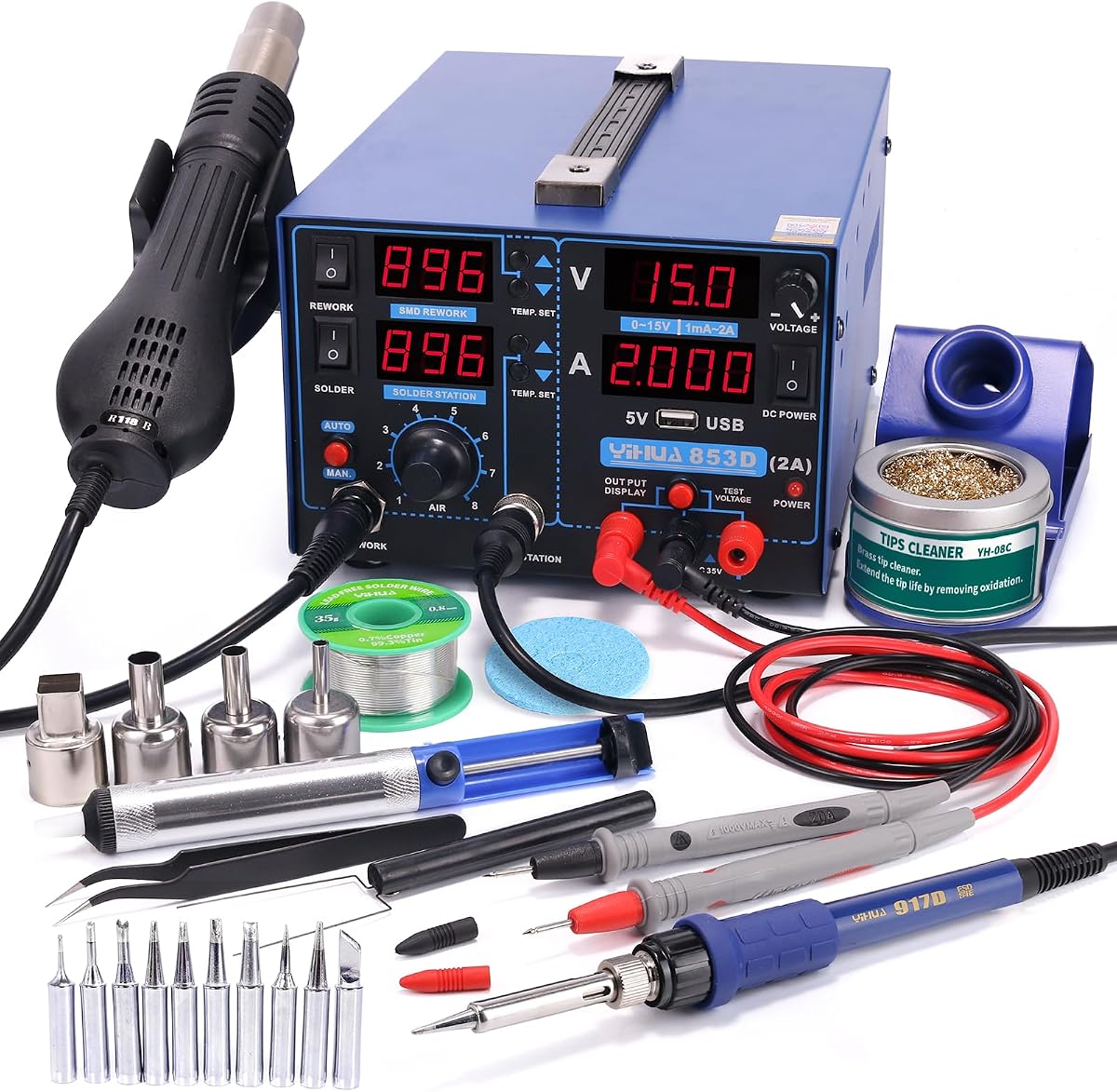
The YIHUA 853D 2A is a multi-function electronics workbench with a 4.5 rating, integrating a soldering station, hot air rework station, and adjustable DC power supply. It also provides a 5V USB charging port and a DC voltage test mode. This combination is far more versatile than a dedicated rework gun and is well suited to technicians who routinely test or power circuits while troubleshooting them.
We may earn a commission when you buy through this link, at no additional cost to you.
The soldering iron covers 392–896°F, the hot air gun covers 212–896°F with airflow up to 120L per minute, and the DC supply delivers 0–15V at up to 2A. In meter mode, it can measure DC voltage from zero to 35V. The three stations can operate simultaneously or independently, allowing a board to be heated or soldered while a controlled supply is applied for testing.
PID stabilization is used for both the soldering iron and hot air gun, and sleep mode and automatic shutdown help reduce wear and unnecessary heating. The tradeoff is size and complexity. This is a larger system with more displays and controls than a conventional rework station, so it demands more bench space and a greater willingness to learn its power-supply and measurement functions.
The 853D 2A is best for electronics labs, advanced hobby benches, and professional repair work involving live troubleshooting. It reduces the need for separate soldering, rework, and bench-power equipment while keeping the essential functions in one package. Users should read the manual and follow electrical safety guidelines before connecting or testing unfamiliar circuits.
The adjustable 0–15V DC output lets a technician supply a circuit during diagnosis without reaching for a separate bench supply. Its 0–35V measurement mode and USB charging connection broaden the ways it can support board-level work.
Soldering, hot air, and DC power can be used together or separately. This integrated approach is efficient for repair shops because it reduces duplicated connections and keeps essential instruments within one compact workstation.
We may earn a commission when you buy through this link, at no additional cost to you.
The ATTEN ST-862D Digital is a feature-rich 1000W hot air station with a 4.8 rating. Its LCD shows preset temperature, actual temperature, and airflow, providing the kind of real-time visibility that helps a technician judge whether the tool is responding correctly. Temperature is adjustable from 100–480°C, airflow ranges from 1–120, and four nozzles are included for different heat concentrations.
We may earn a commission when you buy through this link, at no additional cost to you.
Automatic sleep is triggered when the gun is placed in the dormant bracket. In addition to reducing heat during idle periods, this behavior helps protect children or pets from touching an active hot tool. Menu operation, software calibration, and temperature compensation work together to support consistent output, while three quick-access keys allow common temperature and airflow settings to be recalled more efficiently.
The station includes a timer, cold-air function, temperature presets, lock, and password protection. A brushless fan supplies strong airflow with low noise, and the quick-change nozzle holder reduces the need for tweezers when moving between nozzle types. As with other dedicated stations, it does not provide an integrated soldering iron or DC power supply, and the menu-based operation may be more than a beginner wants.
This model is a strong fit for professional technicians who work with SOIC, QFP, PLCC, and BGA assemblies and want clear operating feedback. Its 4.8 rating, automatic sleep behavior, and extensive preset and security functions make it especially attractive for organized service workflows where repeatability and safe storage matter.
Putting the gun into its holder immediately activates the dormant state. The behavior lowers the risk of leaving a hot tool active between tasks and can also reduce thermal wear during an extended repair session.
Three quick settings, a temperature lock, and password protection support standardized workflows. These controls are useful when several people share a station or when a technician wants to preserve carefully selected operating conditions.
We may earn a commission when you buy through this link, at no additional cost to you.
The right hot air rework station depends on the component types you service, the control features you need, the available electrical setup, and whether you also require soldering or bench-power functions. These factors help separate basic hot air tools from full professional workstations.
A useful rework station should cover the temperatures required by the components in your work while maintaining that setting consistently. The featured models offer ranges from lower heat for delicate work to temperatures approaching 932°F for demanding removal tasks. Stability is equally important because a display showing a selected value does not guarantee that airflow or the board will deliver consistent results. PID control can improve recovery after a cool component or nozzle is introduced into the hot air stream. Compare both the published range and the stated stability, then confirm that the station can also be calibrated against an independent temperature reference if precise work is part of your routine.
Airflow is a separate operating variable from temperature and can determine whether heat is concentrated or carried away from the work. A low-flow nozzle can help focus heat on a small package, while higher airflow is useful for larger assemblies, removing surface-mount devices, shrinking tubing, and reducing heat buildup. Stations with a direct airflow knob are faster to operate than those that place adjustment inside a menu. A useful range across several levels gives you more control when working on dense boards where neighboring components may be sensitive to heat.
Heating power affects warm-up time and the station's ability to recover after heat is drawn away by a large board or metal heat sink. Compact models around 700W may suit lighter repair loads, while 1000W to 1300W designs provide more headroom for demanding packages and repeated service work. Rapid recovery matters because a technician may need to maintain a working temperature throughout a continuous removal and replacement process. High power should still be paired with sensible airflow, appropriate nozzle selection, and regular cooling to avoid overshooting the task.
Dedicated hot air stations provide a focused tool with more bench space for other equipment. Two-in-one models add a soldering iron for a more complete general-purpose repair setup, while larger integrated systems add DC power, measurement, and USB functions. The included accessories also vary widely: some packages provide solder, tips, nozzles, tweezers, a pump, and cleaning materials, whereas others are dedicated stations. Compare the full package with the tools you already own so that you do not pay for duplicates or assume a promised accessory is included.
The most important safety feature is airflow protection. If the hot air gun stops moving air, the heater should shut down or raise an alert rather than continue increasing temperature. An in-holder standby or automatic sleep function helps cool the gun between jobs and reduces the likelihood of accidental contact with a hot nozzle. ESD-safe construction is also relevant when working with static-sensitive components. Other practical protections include automatic shutdown, temperature lock, grounded connections, stable holders, and clearly positioned controls that reduce accidental changes during handling.
A clear display should show the information needed to understand the current operating state. Basic units may show only temperature, while advanced systems can display set temperature, actual temperature, and airflow at the same time. Direct knobs offer quick manual adjustment, whereas menu-driven interfaces can organize more presets and provide locks, timers, and calibration. Neither style is universally better: direct controls are convenient for frequent small adjustments, while menu systems can be efficient for technicians who save repeatable operating profiles. Consider display size, button feedback, and whether the interface is readable under bright bench lighting.
Nozzle shape and size determine how narrowly or broadly the hot air is directed. A set of several sizes is valuable because concentrated airflow suits fine-pitch SMD work while larger openings cover broader packages, connectors, and heat-shrink tasks. Confirm whether the holder allows quick changes and whether replacements are available. Also consider whether the package includes a soldering station, iron tips, solder, tweezers, a desoldering pump, brass wool, and an IC extractor. The right accessory mix depends on whether the station is intended for occasional hobby repair or a full service workflow.
Most of the featured stations are designed for 110–127V power and include a US-standard plug, so they fit standard North American outlets. Some products explicitly warn against connecting to 220V sockets. Larger integrated workbenches and 1300W stations may require more room, ventilation, and a grounded outlet than compact models. Consider the footprint of the holder, the length and flexibility of the gun cable, noise from the cooling fan, and whether the unit can be moved between work areas. A station that fits comfortably in your existing workflow is usually more valuable than one with extra features you cannot access comfortably.
Begin by reading the station's manual, checking the voltage requirement, and inspecting the gun, cable, holder, and nozzle. Place the unit on a stable, heat-resistant surface with adequate ventilation. Before applying heat, identify the component and nearby heat-sensitive parts, select an appropriate nozzle, and establish a conservative airflow and temperature setting. The exact values should come from component documentation, board-repair guidance, or the manufacturer's recommended procedure rather than guesswork.
Allow the station to reach the selected temperature, then test the airflow and confirm that the actual display matches the intended setting. Keep the nozzle moving rather than holding it motionless over a component. Work from the underside of the board when practical, heat the intended package evenly, and use tweezers to lift the component only when the solder has reflowed. Remove the board from the heat before allowing it to cool, then inspect the pads for bridges or residue before placing replacement components.
Return the gun to its holder to activate standby or sleep when taking a break. Allow hot nozzles to cool in their designated position, avoid touching the nozzle or metal holder immediately after use, and clear dust or residue from the station's vents. Clean tips and nozzles with the appropriate tools, inspect cords for damage, and follow the supplied guidance for calibration, replacement parts, and storage. Never leave a hot tool unattended, and keep the work area free of flammable material.
The correct setting depends on the component size, package type, solder composition, and board construction. Begin with the manufacturer's recommended range and use moderate airflow so heat reaches the solder without unnecessarily heating surrounding parts. Increase heat gradually while watching the solder, and stop as soon as it reflows.
No. Higher wattage can improve warm-up time and temperature recovery, but it also gives a user more potential to overshoot a sensitive board. A well-regulated lower-power station can be sufficient for lighter work if airflow, temperature control, and nozzle selection are appropriate for the task.
It depends on the work. Hot air is ideal for removing and installing surface-mount components, but through-hole soldering, connector work, and many basic electronics repairs are more direct with a soldering iron. A two-in-one station provides both functions in a single base.
Temperature controls how hot the air is, while airflow controls how quickly heat is delivered and carried away. High airflow can remove heat from a large board quickly but may spread the effect, whereas lower airflow concentrates heat. Technicians normally adjust both to protect surrounding components.
Many stations activate standby, sleep, or cooling when the gun is returned to the holder. This reduces unnecessary energy use, cools the heater and handle, and lowers the risk of accidental contact with a hot nozzle. It also helps preserve the life of the gun and its internal components.
The products in this guide are primarily listed for 110–127V operation, with several explicitly noting use of a US-standard plug. Always confirm the label and manual for the exact model, and never connect a station to an incompatible outlet. A properly rated voltage converter may also be needed in some international locations.
A set of at least three sizes or shapes provides a better starting point than a single nozzle. Small openings concentrate airflow for fine-pitch components, while larger openings serve broader packages, connectors, and heat-shrink tasks. The quick-change holder and six-nozzle configuration on some picks are convenient for frequent work.
The correct solder depends on the board, component, and regulatory requirements rather than the station alone. Several products in the guide support lead-free work and include lead-free solder. Follow component and board documentation, use compatible solder, and ensure the chosen temperature profile is appropriate for the alloy.
The YIHUA 959D-Digital is the strongest overall dedicated choice because it combines fast heating, high airflow, three memory channels, and in-holder cooling. The WEP 882D stands out as a budget-friendly two-in-one station with an impressive accessory set, while the YIHUA 862BD+ offers a more complete premium system with multiple displays, PID stability, and maintenance-oriented tools.
Prioritize the controls and performance your work actually requires. A dedicated station may be enough for advanced hot air work, but a two-in-one model is more useful when soldering is routine. Larger workbenches make sense when you also need DC power, measurement, or USB charging, while high-wattage models provide more recovery headroom for demanding boards. Safety functions, nozzle selection, and a suitable footprint are just as important as headline specifications.
Before buying, verify the current listing, electrical rating, included accessories, warranty information, and availability for your region. Product designs and package contents can change, and prices move over time. Comparing those current details against the needs identified in this guide will help you select a hot air rework station that remains practical and efficient on your bench.
