
X99 PR9-H White
3.9Editor score
LGA 2011-3 CPU support
128GB DDR4 capacity
PCIe 3.0 NVMe slot
Explore the best Lga 3 X99 Motherboard options, comparing socket support, memory capacity, expansion, connectivity, form factors, and compatibility for every
An LGA 3 X99 motherboard is built around the LGA 2011-3 platform and can unlock access to Intel Xeon E5 V3 and V4 processors as well as several Core i7 models. A worthwhile board should provide dependable power delivery, compatible DDR4 support, modern storage options, and enough expansion connectivity for the intended system.
This guide compares ten X99 motherboards across processor compatibility, memory configuration, form factor, PCIe and M.2 support, networking, audio, SATA connectivity, and practical hardware design. The selection includes established ASUS models, compact alternatives, dual-socket boards, and models designed for flexible workstation-style expansion.
Each review explains the strongest reasons to consider a particular board while also identifying compatibility concerns or missing details worth checking. The top selections balance platform capability with useful features, and every product's listing should be reviewed again before purchase because availability and pricing can change.
3.9Editor score

4.1Editor score

3.9Editor score
The following comparison places all ten boards side by side, emphasizing processor support, memory capacity, expansion, storage, networking, and physical design. These distinctions matter because an X99 board may fit the same processor while offering a very different balance of connectors, case compatibility, and upgrade potential.



The ASUS X99-E WS/USB 3.1 is the most complete conventional option in this roundup, earning a 4.1 rating from the supplied catalog data. Its defining strength is flexibility: a four-way PCI Express Gen3 x16 link can support demanding NVIDIA SLI or AMD CrossFireX configurations, while onboard M.2 x4 storage adds a fast upgrade path.
We may earn a commission when you buy through this link, at no additional cost to you.
The board also includes two 10Gb/s USB 3.1 ports, which are twice as fast as the 5Gb/s USB 3.0 standard used by many contemporary components. ASUS PIKE II and Thunderbolt II support broaden the possibilities for high-speed adapters, while premium power components and the platform's optimized power solution focus on stable delivery to demanding processors.
Its main compromises are physical rather than functional. The extended ATX footprint requires a suitably large case, and buyers should not treat the older X99 platform as a current all-in-one upgrade path. Dedicated maintenance tools such as Q Code Logger, Dr. Power LED, and the maintenance button can make troubleshooting more convenient.
This is the strongest general recommendation for a builder who wants serious expansion, fast external storage, and multi-GPU potential. Check case clearance, graphics-card dimensions, and the exact CPU and memory configuration before purchasing, but the combination of expansion and diagnostics makes this the standout board here.
The four-way PCIe Gen3 x16 arrangement is unusual among X99 boards and makes the X99-E WS/USB 3.1 attractive for builds needing multiple graphics cards. Onboard M.2 x4 and support for PIKE II or Thunderbolt II cards provide additional high-speed storage and expansion options.
Two native 10Gb/s USB 3.1 ports offer a meaningful advantage for compatible external drives and enclosures. ASUS maintenance features also help identify unusual power states and simplify troubleshooting when a large, high-power system fails to boot.
We may earn a commission when you buy through this link, at no additional cost to you.
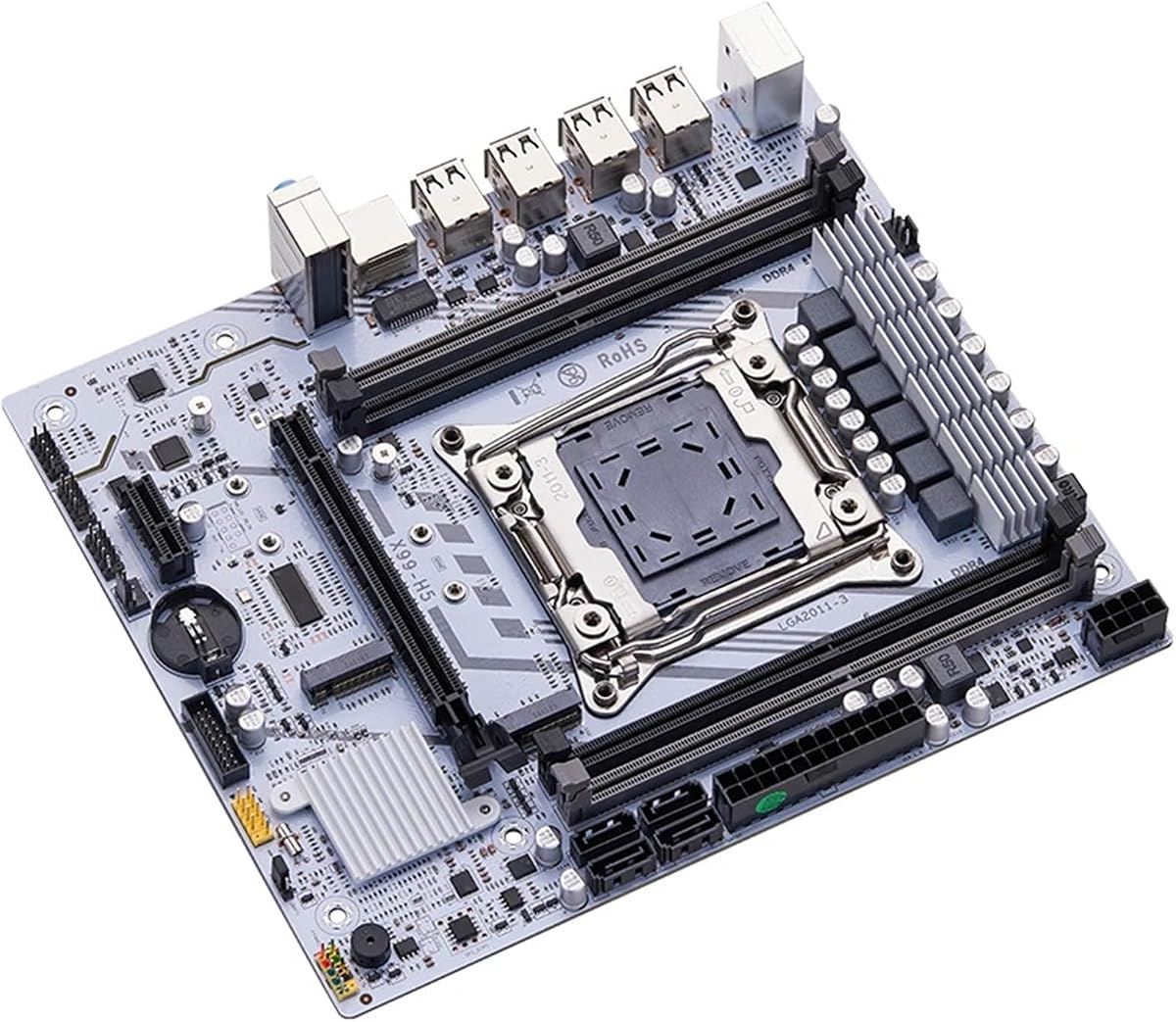
The X99 PR9-H White combines a 3.9 rating with a broad processor list and a compact micro ATX layout. It supports LGA 2011-3 processors that include Xeon E5 V3 and V4 families and several Core i7 chips, making it a practical option for a specific processor already on hand.
We may earn a commission when you buy through this link, at no additional cost to you.
Its four DDR4 slots can accommodate up to 128GB and accept ECC, RECC, or non-ECC memory, subject to the CPU's memory capabilities. A PCIe 3.0 x4 NGFF/NVMe M.2 slot supports a fast solid-state drive, while SATA 2.0, USB 2.0, PS/2, and Realtek gigabit LAN cover the essentials.
The board uses a six-layer PCB, solid capacitors, and a 24+8-pin CPU power connector. Its preassembled I/O shield, cooler bracket, and SATA cable simplify assembly, although the lack of a printed user manual and included CR2032 battery creates minor setup inconveniences.
This is a good choice for a cost-conscious compact build using a compatible Xeon or Core i7 processor and standard DDR4. Avoid assuming every memory module will work together, and check case support for micro ATX boards as well as the dimensions and power requirements of the chosen processor cooler.
The board's support for both Xeon E5 V3/V4 and multiple Core i7 processors gives it unusual flexibility for the platform. Memory behavior can still vary by processor, so confirm the exact CPU, RAM type, and channel configuration before assembling the system.
The micro ATX design can reduce the space required for a server-style build, while the PCIe 3.0 x4 M.2 connection supports a modern NVMe drive. Realtek 8111H gigabit LAN and integrated ALC897 audio provide basic wired networking and sound.
We may earn a commission when you buy through this link, at no additional cost to you.
The ASUS X99-A is a premium ATX option for builders who value established motherboard engineering and a broad feature set. Its supplied rating is 3.9, and the board centers on the Intel X99 Express chipset with support for LGA 2011-v3 Core i7 processors.
We may earn a commission when you buy through this link, at no additional cost to you.
ASUS OC Socket is designed to extract additional performance from eight-core processors and compatible DDR4 memory. Dual Intelligent Processors 5 and 5-Way Optimization combine overclocking and cooling controls in a single interface, while Crystal Sound 2 and Intel Gigabit Ethernet cover audio and networking.
Storage expansion includes a PCI Express 3.0 x4 M.2 slot and SATA Express support. As with any X99 board, the processor, memory, operating system, and graphics configuration must be considered together; a capable chipset alone does not guarantee compatibility with every modern component.
The X99-A makes sense when an established ASUS platform and its convenient optimization features are priorities. It is a strong premium pick for an enthusiast LGA 2011-3 project, provided the buyer checks the exact CPU support list and selects memory that the board can run at its stated specifications.
ASUS OC Socket, Dual Intelligent Processors 5, and 5-Way Optimization create a more refined path for tuning an X99 system. These features are particularly relevant when the goal is to pair an eight-core processor with suitably rated memory.
PCIe 3.0 x4 M.2, SATA Express, Crystal Sound 2, and Intel Gigabit Ethernet make this more than a basic server board. The mix supports a capable desktop or workstation-style configuration without requiring a dense collection of add-in cards.
We may earn a commission when you buy through this link, at no additional cost to you.
The MACHINIST X99 V9S stands out for storage density in a micro ATX design, with three NVMe-capable M.2 slots using PCIe 3.0 x4 bandwidth. Its 3.7 rating reflects a platform that offers useful server-oriented features but demands careful attention to compatibility and included components.
We may earn a commission when you buy through this link, at no additional cost to you.
The Intel C612 chipset supports Xeon E5 V3/V4 processors and selected Core i7 5th- and 6th-generation chips. Four DDR4 slots support up to 128GB, including ECC and RECC configurations, although the product details warn that server and desktop memory cannot be mixed and that some Core i7 processors do not support desktop RAM.
Other connections include a PCIe 3.0 x16 slot, a PCIe 3.0 x4 slot, gigabit LAN, SATA 3.0, USB 3.0, a TPM M.2 header, and a WiFi M.2 interface. A six-phase power design, VRM cooling fan, and heatsink armor support thermal handling.
This board is a compelling choice when storage expansion matters more than a full-size ATX footprint. The package includes a cooler bracket, SATA cable, and I/O shield, but not a user manual or CR2032 battery, so both should be addressed before the system is assembled.
Three PCIe 3.0 x4 NVMe-capable M.2 slots can support a more storage-dense build than most competing X99 boards. The additional WiFi M.2 and TPM M.2 positions add flexibility for wireless and security-oriented configurations.
ECC and RECC support is useful for Xeon-based systems, but the stated restriction against combining server and desktop memory makes RAM selection critical. Confirm processor memory support and populate the board in the intended channel arrangement.
We may earn a commission when you buy through this link, at no additional cost to you.
The 490710 Dual-CPU X99 is built for high component counts rather than compact gaming builds. It provides two LGA 2011-3 processor sockets, eight DDR4 DIMM slots, support for memory configurations listed as 8 x 32GB, two PCIe x16 slots, two PCIe x1 slots, and six SATA 3.0 connectors.
We may earn a commission when you buy through this link, at no additional cost to you.
Integrated RTL8111H gigabit networking and a six-channel audio chip cover two practical functions without requiring dedicated cards. The board also includes one group of two USB 3.0 headers and one group of two USB 2.0 headers, which is useful when additional front-panel or internal devices must be connected.
Because this is a dual-socket design, power delivery, cooler mounting, and memory population deserve particular attention. The supplied catalog entry does not publish a rating, and its listing provides less detail about power phases, VRM cooling, or exact processor pair compatibility than the better-documented models in the guide.
For a builder seeking two Xeon E5 processors and extensive memory capacity, this board can provide an uncommon amount of integration. It is less suitable for a simple gaming PC or anyone who cannot comfortably manage the thermal and electrical demands of a dual-processor system.
Two CPU sockets and eight DIMM slots create a platform for substantial parallel processing and memory capacity. The listed 8 x 32GB configuration reaches 256GB, making board clearance, operating-system support, and memory compatibility central planning considerations.
Two PCIe x16 slots support multiple full-length cards, while two x1 slots and six SATA connectors add useful expansion options. Internal USB headers can also reduce the need for a separate hub when building a densely equipped system.
We may earn a commission when you buy through this link, at no additional cost to you.
The Tangxi X99 Gaming has a 2.9 rating, the lowest numerical score in this selection, but it still presents a useful combination of processor support, four-channel memory, and compact construction. It targets LGA 2011-3 Core i7 and Xeon E5 V3/V4 processors in a micro ATX format.
We may earn a commission when you buy through this link, at no additional cost to you.
Four 240-pin DDR4 slots support unbuffered memory and configurations up to 128GB. Stated frequencies include 3200MHz, 2666MHz, 2400MHz, and 2133MHz, subject to the processor and individual memory modules. The board includes M.2 support for NVMe and NGFF drives plus SATA 3.0 connectivity.
An eight-layer PCB, six-phase power supply, and full solid-capacitor design are the main construction details provided. Rear connectivity includes two USB 3.0 ports, four USB 2.0 ports, one RJ45 port, and a three-in-one audio connection, which may be modest for a heavily equipped modern desk.
This is a reasonable entry point for a compact build using compatible Xeon E5 or Core i7 hardware, especially when its storage and memory capabilities are more important than polished rear-panel connectivity. Its lower rating calls for extra care with component compatibility and installation support.
Four memory slots and a four-channel layout offer more bandwidth-oriented configuration than a simple two-channel compact board. The micro ATX format makes the platform easier to accommodate while preserving substantial memory capacity.
The listed eight-layer PCB and full solid-capacitor design indicate attention to board construction and electrical stability. These details do not remove the need to select an appropriate power supply and CPU cooler for the chosen processor.
We may earn a commission when you buy through this link, at no additional cost to you.
The Dual-CPU X99 Board shares a core platform layout with the 490710 model, but it has a lower supplied rating of 2.4. Its headline attraction is the ability to install two LGA 2011-3 Xeon E5-series processors, supported by eight DDR4 DIMM slots and configurations listed as 8 x 32GB.
We may earn a commission when you buy through this link, at no additional cost to you.
Expansion includes two PCIe x16 slots and two PCIe x1 slots. Six SATA 3.0 interfaces support multiple hard drives or SSDs, while integrated RTL8111H gigabit networking and a six-channel audio chip provide basic connectivity without occupying additional expansion slots.
One USB 3.0 header group and one USB 2.0 header group are included for internal peripherals. However, the product information does not describe the VRM, heatsinks, onboard video, M.2 support, or detailed CPU pairing requirements, so buyers should request complete specifications before committing to a dual-processor build.
The board makes sense when two processors and eight memory modules are central to the project and its lower rating reflects a less refined product. For most single-CPU systems, a board with clearer documentation, stronger cooling provisions, and more detailed listing information will be easier to evaluate.
Supporting two Xeon E5 processors can provide additional cores and threads under suitable operating systems and workloads. The board should be evaluated as a specialized platform, not simply as a standard gaming motherboard with extra CPU capacity.
Eight DIMM slots and six SATA connectors create substantial room for memory and conventional storage. A listed 8 x 32GB arrangement reaches 256GB, though individual module qualification and operating-system limits remain important considerations.
We may earn a commission when you buy through this link, at no additional cost to you.
The Dual M.2 X99 is differentiated by its support for both DDR3 and DDR4 alongside two NVMe M.2 slots. That flexibility can be useful for a builder reusing compatible memory, although the available listing does not provide a detailed CPU list, memory-channel arrangement, or complete port inventory.
We may earn a commission when you buy through this link, at no additional cost to you.
The product description emphasizes improved data-processing speed, compatibility with high-speed solid-state drives, and durable construction. It also highlights careful trace and via routing, ground-layer optimization, a premium power layout, passive chipset cooling, and aluminum heatsinks as design features intended to support memory performance and sustained operation.
Unlike models with more explicit specifications, this board's advantages are stated at a relatively general level. The absence of a numerical rating also makes direct quality comparisons difficult. Buyers should request the full manual or manufacturer documentation and confirm which DDR3 and DDR4 modules can be used together, if any.
This board is most appropriate for a builder who values the unusual DDR3-or-DDR4 choice and dual high-speed storage positions more than a fully documented feature list. It may be particularly useful when adapting an existing platform, but careful verification is essential.
Supporting both DDR3 and DDR4 can simplify reuse of components in a carefully planned build. The listing should not be interpreted as allowing mixed DDR3 and DDR4 modules simultaneously; the exact installation requirements need confirmation.
Two M.2 NVMe positions allow a system to benefit from fast solid-state storage without occupying conventional SATA drives. The optimized trace routing and ground layers are also presented as measures intended to preserve memory signal integrity.
We may earn a commission when you buy through this link, at no additional cost to you.
The X99 16X SATA is notable for one clearly stated feature: sixteen SATA connections in a micro ATX board designed around LGA 2011-3 Xeon E5 V3 and V4 processors. It also provides NVMe M.2 and PCIe 3.0 support, covering both modern compact storage and a large number of conventional drives.
We may earn a commission when you buy through this link, at no additional cost to you.
The product title identifies DDR4 memory support, but the supplied listing does not state the number of DIMM slots, maximum memory capacity, networking solution, audio hardware, rear USB configuration, or processor power details. Its lack of a published rating also limits direct comparison with the better-documented ASUS models.
Sixteen SATA connectors could be valuable for storage-heavy projects, such as a home server, archive system, or large backup array. At the same time, such a configuration raises questions about power supply capacity, drive boot methods, airflow, operating-system support, and whether all sixteen connectors are available through the board's physical layout.
This is a specialist choice for a builder who specifically needs an unusually high SATA count in a compact LGA 2011-3 system. Obtain the full board diagram and mechanical specifications before purchasing, and avoid assuming that the headline title includes features not documented in the available product information.
Sixteen SATA connectors offer exceptional conventional storage capacity for an X99 micro ATX board. This makes the product relevant to storage-heavy users, provided the enclosure, power supply, cooling, and boot configuration can support the number of attached drives.
NVMe M.2 support adds a fast option for the operating system and active applications, while sixteen SATA ports allow slower or archival drives to remain connected. A balanced configuration could place frequently accessed data on NVMe and bulk storage on SATA devices.
We may earn a commission when you buy through this link, at no additional cost to you.
The E5 MR9A V1.0 X99 is a full-size ATX board aimed at Xeon E5 V3 and V4 systems. Its supplied information is brief, but it identifies DDR4 support, NVMe M.2 connectivity, USB 3.0, a solid power design, cooling provisions, and a claim of stable low temperatures under full load.
We may earn a commission when you buy through this link, at no additional cost to you.
The board is described as suitable for building, office, and gaming applications, with complete external interfaces intended to accommodate common peripherals. It also lists high-frequency memory support, multitasking capability, storage expandability, and multiple safety protections among its general design objectives.
Because the listing does not provide DIMM count, maximum memory capacity, networking details, audio specifications, SATA quantity, or exact power-delivery topology, compatibility planning must go beyond the headline processor support. A prospective buyer should request the manual and compare the physical board layout with the intended case and graphics card.
The MR9A V1.0 is a reasonable final recommendation for a builder seeking a conventional ATX Xeon platform with modern NVMe storage and USB 3.0. It is best suited to buyers willing to verify the missing technical details, and it should not displace a fully documented board when immediate plug-and-play certainty is the priority.
The listing emphasizes solid power components, cooling, and stable operation under full load, which are important qualities for a Xeon-based workstation or server-style PC. Independent power and cooler specifications are still needed to confirm compatibility with the selected processor.
NVMe M.2 support provides a fast route for the operating system and active data, while DDR4 accommodates the memory demanded by Xeon E5 processors. USB 3.0 connectivity supports compatible external storage, peripherals, and legacy accessories.
We may earn a commission when you buy through this link, at no additional cost to you.
Choosing an LGA 2011-3 X99 board requires matching the board to a specific processor, memory type, case, expansion plan, and workload. The platform's age makes compatibility verification more important than a general brand preference, particularly when considering ECC, desktop memory, M.2 support, or unusual form factors.
Choose a board whose published compatibility list clearly includes your processor.
Verify module type, capacity, speed, and channel layout before buying RAM.
Confirm case support and clearances before finalizing a board.
Prioritize enough M.2, SATA, and USB connections for planned storage.
Match PCIe slots and lane sharing to your graphics or accelerator plan.
Budget adequate cooling and a quality power supply for the processor.
Select networking and audio features based on how the system will be used.
Treat missing manuals and accessories as part of the compatibility check.
Begin by grounding yourself against an unpainted metal part of the case or another grounded object before handling the board. Install the processor and cooler according to the board's bracket instructions, confirm that memory modules are the correct type, and seat each DIMM firmly in the intended channel arrangement. Connect the 24-pin and CPU power cables before attempting to power the system.
For a first boot, use one approved memory configuration and connect a compatible display device directly to the board if it has integrated graphics or to the intended graphics card. If the system does not start, verify power connections, CPU seating, memory compatibility, and the selected display output. Clear CMOS only after checking the simpler installation points.
Keep the board's firmware, storage drivers, and operating-system drivers appropriate for the exact hardware. Monitor temperatures and airflow under sustained workloads, particularly with Xeon E5 processors. Avoid frequent power cycling, use a surge-protected source, and periodically reseat or clean dust from connectors and cooling hardware without using liquids directly on the motherboard.
It is a motherboard using Intel's X99 chipset with an LGA 2011-3 processor socket. Depending on the model, it may support Xeon E5 V3 and V4 processors, selected Core i7 chips, DDR4 memory, SATA devices, and M.2 NVMe storage. Compatibility is model-specific, so the processor and memory lists matter more than the broad platform name.
Usually, yes, because the primary graphics interface on these boards is PCI Express 3.0. A modern graphics card may, however, require more power or physical space than an older X99 system originally provided. Check slot dimensions, power connectors, case clearance, and whether the processor supports the desired display arrangement.
No. Some boards accept ECC or RECC, while others are designed only for non-ECC desktop memory, and the CPU also affects supported memory features. In addition, some listings warn that server and desktop modules cannot be combined. Check the exact board instructions and processor specification before purchasing memory.
A dual-socket board can benefit workloads that benefit from additional CPU cores, threads, memory capacity, or platform-specific features. It also demands more power, cooling, case space, and operating-system support. For many general-purpose systems, a well-equipped single-socket X99 board is easier to cool, power, and maintain.
Most of the four-slot models in this guide list a maximum of 128GB, while the two dual-socket boards list configurations of 8 x 32GB for 256GB. Maximum support can depend on the CPU and memory module design, and the operating system must also be able to address the installed capacity.
No. M.2 support varies across the products in this guide. The MACHINIST X99 V9S lists three NVMe-capable M.2 slots, the X99 PR9-H includes a PCIe 3.0 x4 M.2 position, and other models list M.2 support with fewer details. Verify the connector type, protocol, keying, and physical clearance before buying a drive.
First confirm that the 24-pin and CPU power cables are connected, the processor and cooler are properly mounted, and the RAM is supported by both the board and processor. Confirm that the display cable is connected to the intended output and that memory modules are seated in the correct channels. Clear CMOS after verifying these basics and reviewing the board's error indicators.
It can be a good path for someone already using compatible LGA 2011-3 Xeon E5 or Core i7 hardware and needing a particular board feature. It is less attractive as a new general-purpose platform because newer processors offer newer platforms, more efficient features, and broader contemporary support. The final choice should follow the desired upgrade rather than platform popularity alone.
The ASUS X99-E WS/USB 3.1 leads the guide with its four-way PCIe graphics support, dual 10Gb/s USB connectivity, onboard M.2 x4 storage, and useful diagnostic features. The X99 PR9-H White is the budget-oriented selection for a compact build, while the ASUS X99-A offers premium socket engineering, optimization tools, and a balanced feature set.
For high-capacity systems, the dual-socket boards provide eight memory slots and support for two Xeon processors, but they require more careful power, cooling, and operating-system planning. The MACHINIST X99 V9S is particularly attractive for dense NVMe storage, while the other boards serve narrower requirements such as sixteen SATA connections or flexible DDR3 and DDR4 support.
Before purchasing, verify the exact processor list, memory rules, board dimensions, included accessories, and current component availability. Prices and seller details can change, so compare the current listing with the specifications discussed here and choose the board that most closely matches the hardware and expansion plan already in hand.