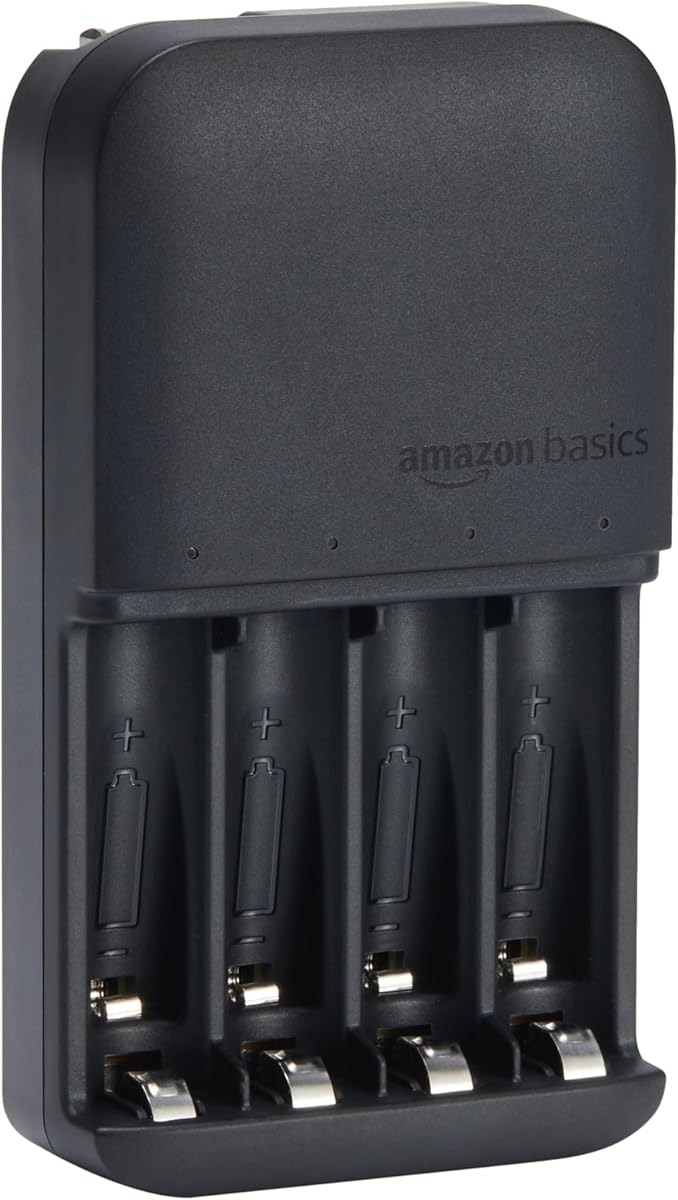
Amazon Basics 4-Bay
4.2Editor score
Four independent charging bays
Individual LED status lights
Overcharging and polarity detection
Compact folding-plug design
NIMH Smart Charger guide comparing charging speed, bay capacity, compatibility, safety features, displays, and value for everyday rechargeable batteries at
A NIMH smart charger should do more than refill a battery. It needs to recognize the cells in each bay, communicate charging status clearly, stop at the appropriate point, and protect both the batteries and the charger from common electrical faults. The right model can also save considerable time when maintaining a large collection of AA or AAA cells.
The products in this guide were compared using the information supplied for each model, including supported battery formats, bay count, charging controls, displays, connectors, protection features, voltage requirements, and intended applications. The list covers compact household chargers, high-capacity multi-bay units, analyzers with discharge functions, and specialized chargers for RC and airsoft battery packs.
Each review explains what the model is best suited to, where it stands out, and where its capabilities are limited. Ratings reflect the supplied customer feedback rather than personal testing, while prices and product availability can change. Readers should confirm current details, battery requirements, and included accessories before making a final purchase.
4.2Editor score

4.8Editor score

4.5Editor score
This side-by-side comparison highlights each charger's supported formats, capacity, control features, and ideal use case, from simple four-bay charging to detailed battery analysis and hobby-pack charging.


The EBL LCD 4-Bay is a compact charger for households that regularly maintain mixed AA and AAA rechargeable batteries. Its supplied rating is 4.6, and its strongest feature is the individual LCD display, which shows charging progress separately for every occupied bay. That visibility makes it easier to identify a cell that is taking unusually long or has been installed incorrectly.
We may earn a commission when you buy through this link, at no additional cost to you.
Each bay operates independently, so the charger can handle one, two, three, or four batteries without requiring occupied spaces to be arranged in pairs. It accepts both NiMH and NiCD rechargeable cells. An advanced MCU and negative-delta charging method support automatic cutoff, while trickle charging helps bring cells closer to full capacity after the main charging stage.
Safety features include overheat, overcurrent, short-circuit, and defective-battery detection, along with rejection of non-rechargeable cells. The LCD distinguishes charging and error states, although it does not provide the detailed voltage, current, resistance, or capacity information available from an analyzer-style charger. Its worldwide 100–240V AC input also makes it practical for international use.
This is a strong all-around choice for users who want more feedback than basic LED models provide but do not need hobby-pack connectors or a discharge cycle. It is particularly suitable for flashlights, remotes, cameras, toys, and other devices using AA or AAA cells. For anyone who values compactness, clear status reporting, and broad cell support, it remains a well-rounded option.
The LCD separates charging progress by bay and uses explicit charging and error indicators. This is useful when one battery is aged or incorrectly installed, because a single shared light would make a problem harder to isolate.
MCU control, negative-delta cutoff, trickle charging, and protections against heat, current faults, short circuits, and defective cells create a well-rounded safety package for routine household battery maintenance.
We may earn a commission when you buy through this link, at no additional cost to you.
The BONAI 16-Bay is built for households, schools, offices, or hobbyists who need to recharge numerous AA and AAA cells at once. Its 4.5 rating reflects a generally positive customer reception, while the independent bay layout allows single, double, triple, or mixed AA and AAA charging without tying a bay to a neighboring slot.
We may earn a commission when you buy through this link, at no additional cost to you.
Status is shown with LEDs. Empty ports complete a startup light cycle and then display solid green, occupied charging ports show red, and a defective cell causes the associated red indicator to flash. An attached AC power cord avoids a separate power brick, and the listed 110V-to-240V input range supports use in many regions.
The charger supplies a 1.4V DC output with a 250–500mA current range. More populated bays naturally extend total charging time, and the product does not support alkaline or lithium batteries. Safety protection covers overcharging, overvoltage, overcurrent, overheating, short circuits, and reverse polarity. Some warmth during use is normal, but the unit should remain uncovered and ventilated.
This is a practical choice for users who value capacity and straightforward LEDs more than detailed analysis. The lack of a display or discharge function means it is not as informative as the ISDT N8, yet its 16-bay arrangement can dramatically reduce the inconvenience of rotating several smaller chargers. It is best suited to routine fleet charging of compatible NiMH cells.
Sixteen independently controlled bays let users charge any number and combination of supported cells. This reduces the need for multiple outlets or repeated charging rotations when maintaining a larger battery inventory.
Solid red identifies active charging, solid green indicates completion, and flashing red signals a problematic or defective battery. The system is less detailed than an LCD but remains easy to interpret at a glance.
We may earn a commission when you buy through this link, at no additional cost to you.
The Tenergy 8.4V-9.6V Smart Charger focuses on a very specific need: recharging seven- or eight-cell NiMH battery packs used in airsoft equipment and selected RC toys. Its 4.7 rating is the second-highest among the supplied products, and the compact format makes it easier to store alongside hobby gear than a large multi-bay charging station.
We may earn a commission when you buy through this link, at no additional cost to you.
Supported packs range from 8.4V to 9.6V and from 600mAh to 2500mAh. A mini Tamiya connector is included along with an adapter to the standard Tamiya format. Green and red LEDs indicate full charge and active charging respectively, keeping operation uncomplicated even when the charger is used in a workshop or hobby area.
The universal 100–240V AC input supports use in many countries, and the stated CE and UL certifications add confidence. Importantly, this is a NiMH-only pack charger and must not be used with LiPo batteries. It also is not an AA or AAA consumer-cell charger, so buyers with mixed charging needs should consider a universal multi-bay model instead.
The charger is best for an RC or airsoft hobbyist who has a small collection of compatible Tamiya-connected NiMH packs. It simplifies battery care without adding unnecessary controls. It is less suitable for households seeking to charge loose household cells or for users who need discharge testing, cycling, and detailed battery analysis.
The included mini connector and mini-to-standard adapter cover common RC and airsoft battery setups. Users can connect compatible packs without searching for a separate adapter.
Its small footprint and simple two-light status system make the unit convenient for a workbench, drawer, or travel kit where a full-size household charger would be unnecessary.
We may earn a commission when you buy through this link, at no additional cost to you.
The EBL Batteries and Charger package is a convenient starting point for people who want both compatible cells and a charger in one purchase. It includes four 2800mAh NiMH AA batteries, four 1100mAh NiMH AAA batteries, and an upgraded eight-bay charger. The supplied rating is 4.5, reflecting positive feedback across the combined package.
We may earn a commission when you buy through this link, at no additional cost to you.
The charger can accommodate any number of AA and AAA batteries across its eight bays, making it more flexible than a basic four-bay unit. Negative-delta intelligent cutoff transitions cells into trickle charging, while heat management, short-circuit detection, and input-voltage checks add layers of protection. A stated cutoff at up to 3.4V helps prevent excessive voltage during charging.
LED indicators communicate the charging process and help distinguish non-rechargeable batteries. The upgraded gentle lighting is designed to be easier on the eyes during nighttime charging. However, there is no detailed LCD, discharge mode, resistance meter, or capacity analysis, so users who want battery-level diagnostics should choose the ISDT N8 instead.
This set works best for new users who need an immediate supply of AA and AAA cells, a remote-control application, or a simple replacement for disposable batteries in household electronics. It may not be the strongest option for a collector already equipped with many batteries. The included eight cells are useful, but the charger remains the more valuable long-term component.
The package includes both AA and AAA cells, so users can begin charging common devices immediately. This removes the need to source compatible rechargeable batteries separately.
Eight independently usable positions accommodate different quantities of AA and AAA cells. The charger is more adaptable than the four-bay Amazon Basics model while remaining simple to operate.
We may earn a commission when you buy through this link, at no additional cost to you.
The Tenergy 7.2V-12V Smart Charger is a versatile hobby-pack charger for NiMH and NiCD configurations running from six to ten cells. It supports nominal pack voltages of 7.2V, 8.4V, 9.6V, 10.8V, and 12V, giving it broader coverage than the more specialized 8.4V-to-9.6V Tenergy model.
We may earn a commission when you buy through this link, at no additional cost to you.
Automatic voltage detection simplifies setup, while selectable 0.9A and 1.8A charging currents let users match output to pack capacity. The 0.9A option is recommended for 900mAh-to-1800mAh packs, and the 1.8A option is intended for 1800mAh-to-5000mAh packs. Red and green LEDs communicate charging and completion status.
Connector support includes standard Tamiya, a standard-to-mini Tamiya adapter, and an adapter for alligator clips. This expands compatibility with different RC cars, airplanes, and airsoft batteries. The unit carries stated UL 60950-1 and CE standards and includes a 12-month warranty.
This model is a good fit for hobbyists who own several generations of compatible battery packs and want one charger to cover them. It is less appropriate for ordinary AA and AAA cells or modern LiPo packs. Matching the chemistry, cell count, connector, and capacity is essential, and the automatic detection should not be treated as permission to charge an unsupported battery.
Voltage detection reduces the need to select a pack setting manually. Users still need to connect the correct adapter and confirm that the battery chemistry and cell count are supported.
A lower 0.9A setting suits smaller packs, while the 1.8A option supports larger units. Matching the current to capacity helps users avoid charging a small pack at an unnecessarily high rate.
We may earn a commission when you buy through this link, at no additional cost to you.
The EBL Universal Smart Charger is designed for users whose battery collection is not limited to AA and AAA cells. It supports one to four AA, AAA, C, or D NiMH/NiCD batteries and one to two rechargeable 9V batteries. The supplied 4.5 rating reflects a favorable response to this unusually broad range of supported formats.
We may earn a commission when you buy through this link, at no additional cost to you.
Independent slots allow mixed sizes to be charged simultaneously, although the stated two-amp capacity is a total output rather than a dedicated two-amp supply for every bay. Charging times are listed at no more than three hours for AA and AAA, and no more than ten hours for C, D, and 9V cells when operating within the stated conditions.
The blue button activates discharge mode for one to four NiMH or NiCD cells. The LCD shows the discharge state, and the charger returns to charging after completion, which can help condition cells whose stored voltage needs reducing. Constant-current technology is intended to limit power fluctuations, while the safety system detects invalid voltage, faulty cells, short circuits, and non-rechargeable batteries.
This model is the most versatile conventional charger in the group for mixed household and high-drain battery formats. It suits users who also maintain C or D cells, 9V batteries, or a combination of several types. Its display is less detailed than the ISDT N8, and the discharge function is limited to smaller cylindrical cells rather than the full range of formats.
Compatibility with AA, AAA, C, D, and 9V cells reduces the need for separate equipment. Independent slots make it practical to charge several sizes during the same session.
The blue-button discharge cycle can reduce stored charge in one to four supported cells before returning the charger to charge mode. It adds utility beyond straightforward top-up charging.
We may earn a commission when you buy through this link, at no additional cost to you.
The MIEKLALE 20+2 Bay Charger is built for heavy household battery rotation, with twenty individual AA or AAA positions and two additional 9V positions. Its 4.6 rating and unusually large capacity make it attractive to people who maintain dozens of rechargeable cells across remotes, flashlights, clocks, cameras, toys, and other frequently used devices.
We may earn a commission when you buy through this link, at no additional cost to you.
Users can charge any supported number of batteries without filling every bay. AA, AAA, NiMH, NiCD, and rechargeable 9V formats are supported, but the display is not paired with a discharge function. Importantly, the charger cannot be used with 3.7V lithium batteries or 1.5V lithium AA and AAA cells.
The smart LCD provides visual charging information without requiring users to interpret a bank of individual LEDs. Intelligent protection covers overcharging, overcurrent, overvoltage, overheating, and short circuits. These safeguards are particularly relevant when many cells are connected simultaneously and some may be older, mismatched, or in poor condition.
This is a strong choice for a large collection, a shared household charger, or a workplace with many battery-powered peripherals. Its footprint will naturally be larger than that of a four- or eight-bay unit. Users who need detailed electrical measurements or battery-health analysis should choose the ISDT N8, while those primarily charging loose AA and AAA cells may find the extra 9V positions unnecessary.
Every AA or AAA position operates independently, so one cell can be charged without filling the other nineteen. This makes the charger practical even for irregular daily demand.
The charger is designed for NiMH, NiCD, and compatible rechargeable 9V cells. Its inability to handle lithium formats is an important limitation, not a minor compatibility note.
We may earn a commission when you buy through this link, at no additional cost to you.
The ISDT N8 is the most technically capable charger in this guide and holds the highest supplied rating at 4.8. It combines eight independent AA and AAA charging positions with a full-color touch display, manual and automatic setup, and detailed reporting for voltage, current, charging time, mode, battery type, internal resistance, and charged capacity.
We may earn a commission when you buy through this link, at no additional cost to you.
Its intelligent analyzer functions include charging, cycling, activation, and discharge. The charger automatically stops when cells reach full charge, while trickle-charge technology is stated to bring them to as much as 99%. Up to 15A output is listed for each slot, and the unit can complete a charge in approximately 90 minutes, although actual timing varies with battery capacity and other conditions.
USB-C power input accepts 5–12V and 18W, making the N8 more flexible than a charger requiring a proprietary wall plug or bulky power adapter. It supports AA, AAA, Li-ion, LiHV, NiMH, and NiCD cells, but explicitly cannot charge 1.5V lithium AA or AAA batteries. Auto mode can help users identify an appropriate configuration when the battery type is uncertain.
The N8 is the strongest recommendation for enthusiasts, collectors, RC users, and anyone who wants to understand battery condition rather than merely wait for a green light. Its advanced menu and analyzer functions may be excessive for occasional users, but the eight-bay format, compact USB-C design, and detailed diagnostics justify the premium positioning.
The display reports voltage, current, elapsed time, mode, chemistry, internal resistance, and charged capacity. These readings make it possible to compare cells and identify inconsistent performance.
Charging, cycling, activation, and discharge functions go beyond a basic refill cycle. These tools make the N8 useful for preparing cells, comparing performance, and maintaining rechargeable batteries over time.
We may earn a commission when you buy through this link, at no additional cost to you.
The EBL 8-Bay is a straightforward charging station for AA and AAA NiMH or NiCD cells. It handles one to eight batteries, with each bay operating independently, and uses red, green, and flashing red LEDs to report charging, completion, and faulty or non-rechargeable cells. Its supplied rating is 4.5.
We may earn a commission when you buy through this link, at no additional cost to you.
An MCU controls the charging process and can stop when it detects improper input voltage, a defective cell, a short circuit, or a non-rechargeable battery. The product description notes the use of fire-resistant material, negative-delta cutoff, trickle charging, constant-current charging, and protection against overvoltage, overcurrent, and overheating.
The charger is specifically designed for NiMH batteries. The supplied information warns that attempting to charge other battery types or incompatible equipment could cause cracking or leakage, making careful label reading essential. It also does not include an LCD, discharge function, or battery capacity analysis, so its interface is intentionally basic.
This model is a sensible choice for users who want more capacity than a four-bay charger but do not need a touch display or extensive diagnostics. It suits homes, classrooms, and offices where a single unit must service several AA and AAA batteries. The ISDT N8 offers greater insight, while the BONAI 16-Bay handles a larger routine inventory.
Any combination from one to eight compatible cells can be charged. This flexibility makes the unit convenient for both occasional top-ups and shared battery maintenance.
Red means charging, green means complete, and flashing red warns of a bad or non-rechargeable cell. The simple color language makes the charger easy to use without a menu.
We may earn a commission when you buy through this link, at no additional cost to you.
The Amazon Basics 4-Bay Charger is the simplest and most compact option here, intended specifically for AA and AAA NiMH rechargeable batteries. Its supplied rating of 4.2 is the lowest in the group, but it provides the essential functions many casual users need: four independent bays, LED indicators, battery detection, and overcharging protection.
We may earn a commission when you buy through this link, at no additional cost to you.
The charging times listed are 3.5 hours for two AA cells, seven hours for four AA cells, two hours for two AAA cells, and four hours for four AAA cells. Individual charging means a single battery can occupy any bay rather than being forced to charge in pairs. Detection technology indicates incorrect polarity, and the charger turns to trickle charging when a cell is full.
Its slim body and folding Type A plug make it especially convenient for travel or compact storage. A switching power design supports 100–240V AC input, although users outside regions with Type A sockets may need a plug converter. No separate cable is required, and the package contains the charger with its integrated plug.
This model is best for a small household, travel kit, or occasional user who maintains only a few AA and AAA cells. It does not support NiCD, lithium, C, D, or 9V formats according to the supplied specification, and it lacks an LCD, discharge analysis, and a large collection of safety circuitry beyond its stated detection and cutoff functions.
The slim profile, lightweight construction, and retractable plug reduce cabinet and luggage space. The charger is ready to use without an attached power cord.
Polarity detection, overcharge cutoff, and trickle charging cover the key needs of routine NiMH maintenance. The limited bay count keeps the design simple but restricts larger charging sessions.
We may earn a commission when you buy through this link, at no additional cost to you.
The right NIMH smart charger depends on the battery formats, quantity, charging visibility, and diagnostic features you need. Start by matching the charger to your existing cells, then consider capacity, safety behavior, power requirements, and any hobby-specific connectors.
Confirm whether your rechargeable cells are NiMH, NiCD, or another chemistry before selecting a charger. Most household models in this guide support NiMH, and several also accept NiCD, but the Amazon Basics 4-Bay is specified for NiMH only. Some advanced models support additional rechargeable formats, although 1.5V lithium AA and AAA cells remain explicitly excluded from the ISDT N8. Lithium-ion pack chargers and NiMH chargers are not interchangeable, and attempting to charge the wrong type can create serious safety risks.
Choose only a charger that explicitly supports every battery format you own. Pay close attention to chemistry, cell count, voltage, and connector compatibility rather than relying on a generic rechargeable label.
Bay count determines how conveniently you can rotate a collection of batteries. Four-bay models suit a small household, eight-bay units work well for regular shared use, and sixteen- or twenty-two-bay positions suit collectors and larger device inventories. Independent control is especially valuable because it allows any supported number of cells to be charged without filling adjacent bays or pairing them. Large-capacity chargers take up more desk or shelf space, so the highest bay count is not automatically the most convenient choice.
Estimate how many batteries you typically need ready at once, then add enough flexibility for occasional overflow. Independent bays are more useful than a high total count if the charger only operates in fixed pairs.
LED indicators offer the simplest way to see whether a cell is charging, complete, or faulty. LCD screens can provide clearer per-bay status, while touch displays may also show voltage, current, elapsed time, internal resistance, and capacity. The ISDT N8 goes furthest with detailed analyzer data and manual or automatic modes. More information does not automatically make a charger better, but it can be valuable for users who compare cells or need to know why one battery behaves differently from another.
Choose color-coded LEDs for uncomplicated routine charging, or a detailed display if you actively test, compare, and maintain batteries. Avoid paying for complexity that you will never use.
Fast charging is useful when batteries need to be ready quickly, but speed should be matched to the cells and charger design. Listed completion times vary by battery format, capacity, bay population, and charging method. The ISDT N8 supports high output and a 90-minute stated charge time, while the EBL Universal and Amazon Basics models publish longer time ranges. For hobby packs, selectable current options are important: the Tenergy 7.2V-12V model recommends 0.9A for smaller packs and 1.8A for larger packs.
Do not choose a charger solely by the fastest stated time. Cell age, chemistry, capacity, heat, and the number of batteries being charged can all affect real-world results.
Look for automatic cutoff, overcharge, overcurrent, overvoltage, overheating, short-circuit, reverse-polarity, and defective-battery protection. Independent cutoff is particularly helpful when several cells are charging at once, since an aged or damaged cell should not compromise the rest. Some models identify non-rechargeable cells through an error indication or flashing LED, while others stop charging when invalid voltage or a fault is detected. These features matter most when batteries are left unattended or charged overnight.
A good smart charger should not rely on the user to notice every abnormal condition. Independent status, automatic termination, and fault detection provide a safer baseline for regular use.
A discharge function reduces stored voltage in selected cells and can help assess their condition or prepare them for a charge cycle. The EBL Universal supports discharge for one to four NiMH or NiCD cells, while the ISDT N8 adds cycling and activation functions and displays a broad range of measurements. The BONAI, EBL 8-Bay, Amazon Basics, and MIEKLALE units focus on charging rather than analysis, and the MIEKLALE explicitly lacks discharge functionality.
Choose a discharge-capable model for battery testing or deliberate maintenance. For simple top-ups, the added complexity and controls of a full analyzer may not be necessary.
Some models use a standard AC plug or attached power cord, while the ISDT N8 accepts USB-C power. Universal 100–240V switching input makes a charger more convenient across regions, but plug shape still matters. The Amazon Basics charger includes a folding Type A plug and may require an adapter elsewhere. USB-C power can be useful for travel because a suitable phone charger or power bank may already be available. A larger multi-bay unit may require more stable power and more ventilation during extended sessions.
Match the power arrangement to where the charger will live. Portability is valuable for travel, while a permanently installed multi-bay charger benefits from a straightforward wall-powered design.
RC and airsoft users need to consider cell count, pack voltage, chemistry, capacity, and connector type rather than focusing only on AA and AAA bays. The Tenergy 8.4V-9.6V model includes a mini Tamiya connector and a mini-to-standard adapter. The Tenergy 7.2V-12V model supports more pack voltages and adds alligator clips, while also offering 0.9A and 1.8A current choices. Neither hobby charger should be used with LiPo packs.
Match the connector and voltage precisely, and never force an unfamiliar connector. Household chargers and hobby-pack chargers serve different categories of batteries and should not be treated as interchangeable.
Before charging, inspect each cell for swelling, leakage, corrosion, cracks, or other visible damage. Do not place a damaged battery in any charger. Remove any packaging according to the battery manufacturer's instructions, identify the chemistry and voltage, and verify that the charger explicitly supports those cells. Position the charger on a stable, hard, ventilated surface rather than on soft fabric or beneath papers.
Insert batteries with the positive and negative terminals aligned with the markings in each bay. For models with independent channels, use any available bay and avoid forcing a cell into an occupied position. Connect the charger to the appropriate power source, select a suitable mode if the charger offers one, and leave the unit undisturbed while it operates. The LCD or LEDs should show charging, analysis, completion, or an error state. Do not leave the charger covered while batteries are charging.
Remove cells when charging is complete unless the manufacturer specifically recommends leaving them connected. For chargers with a display, review voltage, current, elapsed time, internal resistance, or capacity readings when relevant. Keep the charging area dry, clean the contacts gently when needed, and store batteries separately from metal objects. Unplug the charger during long periods of non-use and inspect it for physical or electrical damage before returning it to service.
No. A NIMH smart charger should only charge compatible rechargeable cells unless its documentation explicitly states otherwise. Trying to charge alkaline batteries can cause leakage, rupture, or other damage. Several chargers in this guide are designed for NiMH only, while some also support NiCD or specific rechargeable 9V formats. Always check the battery label and charger instructions before insertion.
NiMH and NiCD cells share a nominal voltage but have different discharge and charging characteristics. A smart charger that supports both can identify the appropriate termination behavior, while a NiMH-only model is unsuitable for NiCD packs. For loose AA and AAA cells, verify whether both chemistries are listed. Hobby-pack chargers should also be matched to the pack's cell count and nominal voltage.
No. Most household models do, but the two Tenergy hobby chargers are designed for connected battery packs rather than loose consumer cells. The EBL Universal also supports C, D, and 9V formats, while the MIEKLALE includes two 9V positions. Check the supported formats carefully if your collection extends beyond standard AA and AAA cells.
No. Charging speed matters when batteries are needed quickly, but battery age, chemistry, capacity, heat, and the number of cells in use can change real charging times. A charger that maintains stable current and has reliable fault detection may be more valuable than one advertising the shortest possible completion time. For hobby packs, the recommended current should also match the pack capacity.
Only when the charger is designed for unattended operation and the batteries are compatible, undamaged, and correctly inserted. Smart cutoff, trickle charging, and fault detection reduce the risk, but they do not replace sensible placement or inspection. Keep the charger uncovered on a hard, ventilated surface, and follow the specific manufacturer's guidance.
A discharge function drains stored energy from supported cells before returning them to the charging process. It can help prepare a battery for a full charge or allow users to compare cell behavior. The EBL Universal supports this for up to four AA, AAA, C, or D cells, depending on the format, while the ISDT N8 provides broader charging, cycling, activation, and discharge analysis.
An error indication may mean the cell is installed in the wrong polarity, is not rechargeable, is defective, or has a voltage the charger cannot safely accept. Stop using that bay and inspect the battery and charger contacts. Do not repeatedly force a battery into operation. If the issue continues with a known-good cell, consult the charger manufacturer's support and discontinue use.
Only if its specifications explicitly cover both categories and every battery's chemistry, voltage, cell count, capacity, and connector. The Tenergy hobby chargers are specialized for compatible Tamiya-connected or alligator-clip packs and do not serve as AA or AAA household chargers. Consumer multi-bay chargers likewise should not be assumed to support RC packs.
The ISDT N8 is the strongest all-around choice for readers who value detailed battery information, multiple analyzer modes, independent eight-bay control, and flexible USB-C power. The EBL LCD 4-Bay is a more compact household option with per-bay LCD feedback, while the EBL Universal stands out for mixed battery formats and a built-in discharge function. Together, these choices cover different definitions of smart, from clear status reporting to deeper diagnostics.
Prioritize exact chemistry and format compatibility first, followed by the number of cells you need to charge regularly. Then consider safety behavior, display detail, discharge capability, power arrangement, and connector type. A large multi-bay charger is useful for collections, a travel model is better for occasional use, and hobby owners should choose a charger built for the specific pack voltage and connector rather than adapting a household model.
Customer ratings and product availability can change, and current prices should be checked before ordering. Review the latest listing, compare the supplied specifications with the batteries already owned, and confirm what accessories are included. That final compatibility check can prevent wasted money, damaged cells, or the purchase of a charger that does not support the formats you need.