
Vallejo Surface Primer Black 60 ml
4.8Editor score
Matte black acrylic primer
Designed primarily for airbrushing
Quick-drying successive application
Can be diluted or used directly
Resin and plastic model preparation
Primer for 3D Prints buying guide compares ten acrylic surface primers, multipacks, and finishing sprays for adhesion, coverage, and model preparation today.
A reliable primer gives a 3D print a stable base for paint, helping colors adhere more consistently while reducing the visual prominence of print lines and surface irregularities. The right choice depends on whether you airbrush, brush, layer colors, or simply want a smoother finished appearance.
This guide compares ten primer and surface-finishing products based on their stated colors, container sizes, application methods, adhesion properties, finish, drying behavior, material compatibility, and suitability for printed models. It covers complete airbrush medium sets, individual acrylic primers, multi-color surface primers, and clear gloss sprays.
Each numbered review explains the strongest reasons to consider a product while also noting limitations or questions worth checking before purchase. The three featured picks highlight especially versatile options, and product details and current pricing can change, so readers should verify the latest listing information before buying.
4.8Editor score

4.8Editor score
4.8Editor score
The comparison below organizes all ten options by primer type, color, finish, application method, and practical role in a 3D-print finishing workflow.


The Roizefar Airbrush Medium Set is the broadest all-in-one option in this guide, combining primers, airbrush adjustment products, and two varnish choices. It holds a 4.8 rating, placing it alongside the strongest-rated products here. Its appeal comes from covering several distinct stages of the painting process rather than supplying only a single can of surface primer.
We may earn a commission when you buy through this link, at no additional cost to you.
The set includes two white primers, one black primer, one gray primer, airbrush thinner, flow improver, gloss acrylic varnish, and matte acrylic varnish. Each listed container is 120 ml, or 4.05 fluid ounces. Multiple primer colors give users a practical base-coat choice, while the thinner and flow improver address two common airbrush concerns: adjusting paint consistency and reducing tip drying.
Its main trade-off is redundancy. A hobbyist who only needs a basic gray or black base may find that a single-bottle primer more convenient. The selection of colors and auxiliary products also requires some planning to avoid buying more materials than the project will use. Even so, the kit's preparation-to-finish coverage makes it appealing for airbrush users who want a coordinated setup.
This is the strongest recommendation for 3D-print hobbyists who airbrush models and want more than a basic primer. It is particularly relevant for painters working on plastic, resin, or metal models, including tabletop miniatures. Those who primarily brush-paint one small object may find a smaller single-color option easier to manage, but the complete workflow makes this set our Editor's Choice.
Priming, thinning, flow control, and varnish are all represented, reducing the need to source separate products for a standard airbrush setup. The included white, black, and gray primers also provide useful choices for different color schemes and base-coat strategies.
The dedicated thinner and flow improver are valuable because viscosity and tip drying can affect coverage. Together, they give users tools to refine spraying behavior rather than forcing a single application method onto every paint or surface.
We may earn a commission when you buy through this link, at no additional cost to you.
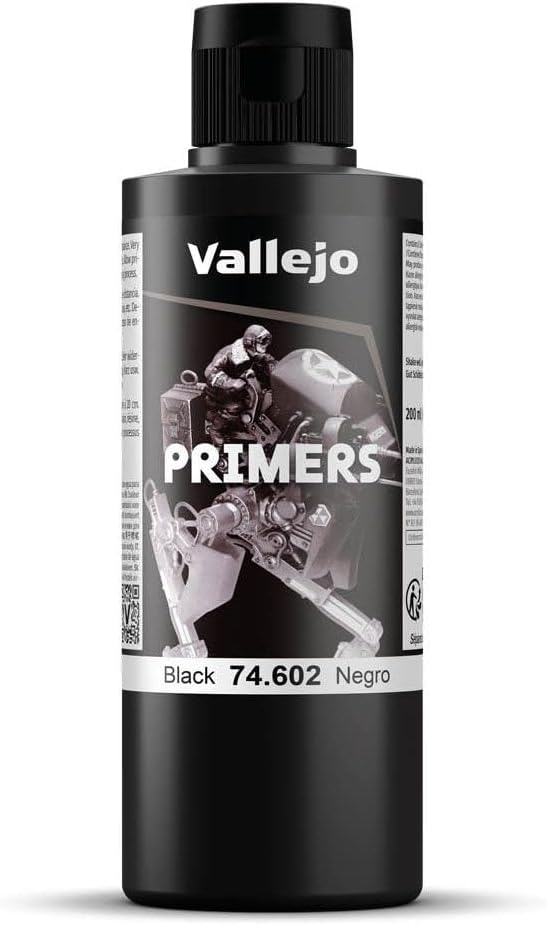
This 60 ml Vallejo Surface Primer is a straightforward black acrylic primer made for model preparation, especially when an airbrush is available. Its 4.8 rating and consistent presence among highly rated options make it a practical choice for hobbyists who want an established primer rather than a broad finishing kit.
We may earn a commission when you buy through this link, at no additional cost to you.
The product dries quickly and is intended for successive coats that build a homogeneous film with strong hardness and resistance. It can be sprayed as supplied or combined with the manufacturer's separately sold Airbrush Thinner or Flow Improver. The listing recommends compressor settings around 15–20 PSI, or 0.5–1 kg, giving users a useful starting reference.
The limitation is specialization. A black-only primer does not offer the neutral base options found in gray or white products, and a user painting a light model may need additional coats to create an opaque foundation. The manufacturer also advises degreasing the model before priming to remove release-agent residue, which adds a preparation step that can improve adhesion.
This option is well suited to scale-model painters, miniature builders, and anyone already equipped to airbrush. The 60 ml format is also more manageable than the 200 ml version when working on a limited number of models. For a single-purpose black base primer with a strong rating, it is a sensible and economical selection.
Quick drying is especially helpful when a painting session involves several primer passes or multiple models. Successive coats can create the stated hard, resistant film while reducing the amount of time the project remains in preparation.
Although designed for airbrushing, the primer can be used directly or diluted with the stated Vallejo adjustment products. That gives experienced painters more control over spray consistency, while beginners still have a defined compressor range to begin with.
We may earn a commission when you buy through this link, at no additional cost to you.
The 200 ml Vallejo Surface Primer delivers the same stated matte black, fast-drying, airbrush-focused characteristics as the smaller format but in a larger container. Its 4.8 rating reinforces its position as one of the strongest-rated products in this comparison. It is a logical choice for builders who regularly prime prints, miniatures, or scale models.
We may earn a commission when you buy through this link, at no additional cost to you.
The large volume is the defining advantage. Repeated thin coats can consume more material than users expect, especially when a print has extensive texture or when a lighter model requires a dark foundation. Successive applications dry quickly and form a homogeneous, hard, resistant film according to the product information, which supports a controlled multi-coat workflow.
Its trade-off is storage and commitment. Someone making one small print may not use the full container before it becomes less convenient to store. The product also remains black-only, so users working across light, neutral, and dark schemes may prefer a multi-color set or buy separate base colors for the intended paint job.
For regular airbrush painters, this is the premium-capacity pick because it reduces repeated replenishment without changing the core application approach. Choose the smaller bottle for occasional models and the larger one for an established hobby routine or collection of prints that will all need primer.
A 200 ml bottle provides ample material for a stream of models, allowing the user to establish a consistent black base-coat process. It is especially helpful for detailed prints that need multiple primer passes to achieve even coverage.
The matte black finish provides a neutral-looking dark foundation for colorful paint schemes. Its quick-drying behavior also makes it easier to stage several pieces without leaving every primed model waiting for a prolonged curing period.
We may earn a commission when you buy through this link, at no additional cost to you.
The U.S. Art Supply Three-Color Set is built for hobbyists who want black, white, and gray surface primers in one coordinated purchase. It carries a 4.2 rating, placing it below the highest-rated primers in the guide but still within the established airbrush-paint category. Its defining feature is choice across three useful base colors.
We may earn a commission when you buy through this link, at no additional cost to you.
Each bottle contains four ounces of ready-to-spray, water-based acrylic polyurethane primer. The formula is described as self-leveling, which supports smoother coverage, and it dries to a durable, hard matte finish. Although primarily intended for an airbrush, each color can also be applied by brush. The stated compatibility includes plastics, metals, resin, fiberglass, ceramic, wood, fabric, leather, paper, and canvas.
A possible drawback is that the four-ounce containers may not suit a very large project. Another is the product family's inconsistent listing descriptions, with some color-specific pages referring to black even when the title identifies another color. Buyers should therefore verify that they receive the intended bottle and should judge performance from the actual contents rather than the title alone.
This set is a good choice for artists who want a single purchase to cover dark, light, and neutral bases. It also works for mixed-media projects beyond 3D printing. It is less compelling for someone who only needs one small bottle, but for a varied painting bench, the three-color format offers useful flexibility.
Black, white, and gray cover the most common primer decisions: a dark foundation, a bright foundation, or a neutral transition between light and dark colors. That makes the set practical for builders whose paint schemes change from project to project.
The listed material range includes resin, plastic, metal, fiberglass, ceramic, wood, and several craft surfaces. That makes the set useful for a shared workbench, although users should still confirm compatibility and prepare each material properly.
We may earn a commission when you buy through this link, at no additional cost to you.
This two-bottle gloss spray is designed for the final stage of preparing 3D-printed models rather than for providing a colored primer base. It has a 1.0 rating, the lowest in this group, so it should be considered with more caution than the higher-rated products. Its appeal lies in quick-drying gloss and its stated ability to reduce visible layer lines.
We may earn a commission when you buy through this link, at no additional cost to you.
The package contains two 60 ml bottles, and the listing describes an easy spray application intended to create a smooth, high-gloss finish. It specifically targets printed models and is presented as useful for reducing surface texture and creating a more polished appearance. Two bottles can be useful for separate clear-coating stages or for multiple models.
The low rating is the clearest reason for caution. The supplied information also provides less detail about adhesion, exact material compatibility, drying time, and the effect of repeated coats than the descriptions of the conventional primers. Since it is a clear finishing spray, it also does not replace a base primer when the user intends to apply opaque paint.
The product is most appropriate for someone whose priority is a glossy, smoother-looking printed model rather than a paintable acrylic foundation. It may work well after careful preparation, but the limited specification and low customer rating make it a less confident recommendation than the multi-rated primers in the guide.
This product belongs near the end of the finishing workflow because its function is to add gloss and reduce the appearance of texture. Buyers seeking an adhesion-promoting base coat should look first at one of the named acrylic surface primers.
The twin-bottle configuration may help when a model needs more than one finishing pass. Because the listing emphasizes even coating without obvious sagging or uneven accumulation, thin applications and controlled spraying remain important.
We may earn a commission when you buy through this link, at no additional cost to you.
The U.S. Art Supply Gray Surface Primer is a single-color option for builders who prefer a neutral foundation between black and white. It has a 4.2 rating and belongs to the same product family as the multi-color and white versions. Its self-leveling, ready-to-spray formula is intended for hobbyists and artists at different experience levels.
We may earn a commission when you buy through this link, at no additional cost to you.
The eight-ounce container offers a useful middle ground between small trial quantities and larger project supplies. The primer is designed primarily for airbrushing but can also be applied with a brush. Once dry, it is described as producing strong adhesion and a durable, hard matte finish. Its listed surface compatibility covers plastic, resin, metal, fiberglass, ceramic, wood, fabric, leather, paper, and canvas.
The listing's bullet text includes an apparent wording error by describing the gray primer as black. That does not change the product title or stated color, but it is an important reminder to check the package and actual contents carefully. The gray color is beneficial for both light and dark topcoats, though very pale paints may still need enough passes to create full opacity.
Choose this primer when a neutral, single-color foundation is all you need and you work on several kinds of craft surfaces. It is less suitable for a painter who wants all three base colors from one order, in which case the corresponding three-color set offers clearer value and broader flexibility.
Gray is often useful because it can sit between a black and white base, helping users evaluate color accuracy without the extreme contrast of a black primer. It is also a common choice when the final scheme contains both lighter and darker colors.
The stated compatibility list extends well beyond plastic and resin. This makes the eight-ounce bottle attractive for a general-purpose craft bench, though the printed object still needs appropriate cleaning and preparation before coating.
We may earn a commission when you buy through this link, at no additional cost to you.
The U.S. Art Supply White Surface Primer provides a bright base coat for 3D prints and other craft objects. It carries a 4.2 rating and shares the self-leveling, water-based acrylic polyurethane formula used across this product family. White is especially relevant when the final paint scheme is light, pastel, or highly dependent on accurate color rendering.
We may earn a commission when you buy through this link, at no additional cost to you.
The eight-ounce bottle is ready to spray and can also be applied by brush. The stated self-leveling characteristic is intended to help the surface settle into a consistent coating, while the formula dries to a durable, hard matte finish. Compatibility includes plastics, metals, resin, fiberglass, ceramic, wood, fabric, leather, paper, and canvas, making it useful beyond modeling.
As with the gray version, the bullet description contains an apparent copy inconsistency by calling the product black. Buyers should confirm the label and color before use. Another consideration is that white primer may require more than one coat to become fully opaque, particularly over dark or strongly contrasting prints. The self-leveling formula helps, but spray distance, passes, and surface texture still influence coverage.
This product is a sensible choice for light-colored schemes and anyone who wants a strong, bright foundation under pastel paint. It is less necessary when the model will receive several dark topcoats, although a white base can still improve color accuracy when the final finish includes highlights or fine details.
A white foundation can make subtle color differences easier to judge and can reduce the influence of the print's underlying color. It is a sensible base for pale schemes where dark primer would require extensive coverage before colors appear true.
The ready-to-spray format suits airbrush users, while brush compatibility gives the same bottle broader utility. Users should select thin, even passes rather than trying to correct poor coverage with one heavy coat.
We may earn a commission when you buy through this link, at no additional cost to you.
The 3D Printer Model Gloss Spray is a clear finishing product built to improve the appearance of printed models. It has a 5.0 rating, making it the highest-rated item in this comparison, though the much smaller number of ratings behind that score should be considered when interpreting the result. It is intended for a polished final appearance rather than a colored adhesion base.
We may earn a commission when you buy through this link, at no additional cost to you.
Its listing emphasizes an instant high-shine finish, one-coat gloss, reduced layer lines, and filling of micro-gaps. It dries to the touch in minutes and is described as resisting fingerprints and dust. The stated compatibility includes resin, PLA, ABS, PETG, and other prints, covering common miniatures, prototypes, cosplay props, and functional parts.
The distinction between marketing language and independently documented testing is important. The claims of mirror-like gloss, dust repellency, and broad material compatibility come from the supplied product information rather than a documented test in this guide. As a clear spray, it also cannot create the same foundation as a black, gray, or white acrylic primer and may not replace one when subsequent paint adhesion is the primary concern.
This spray is most attractive to users who want a quick glossy presentation finish and have already dealt with the print's underlying texture. It is a compelling companion to, rather than a substitute for, a proper primer. Check the can's directions and compatibility details before applying it to a valuable or functional print.
The listed mechanism is a clear coating that fills small gaps and reduces the appearance of rough texture. Combined with a high-gloss result, this can make a print look more uniform when a smooth decorative finish matters more than a paintable foundation.
A quick-drying surface is useful when models need to move quickly between spraying, handling, and display. The stated fingerprint and dust resistance also adds practical value for collectible pieces that may be handled after finishing.
We may earn a commission when you buy through this link, at no additional cost to you.
The Micro-Mark Gray Acrylic Primer is a neutral gray primer intended for models, miniatures, and craft projects. Its 4.5 rating places it behind the three 4.8-rated Vallejo products and the 5.0-rated gloss spray, but it remains a strong option for painters who want a single versatile base color. The eight-ounce bottle offers a generous amount for repeated work.
We may earn a commission when you buy through this link, at no additional cost to you.
The professional-grade acrylic formula is presented as providing excellent adhesion and coverage. Its stated uses include plastic, resin, and metal surfaces, making it particularly relevant to 3D-printed models. The neutral gray color is described as an effective middle tone that works beneath both light and dark schemes and may reduce the number of topcoat layers needed.
The main drawback is that the listing provides fewer technical details than the airbrush-focused products. It does not offer specific compressor settings, thinning instructions, or detailed drying guidance in the supplied information. Users who require those parameters may need to consult the manufacturer's own instructions before beginning. The single gray color also cannot replace a complete base-coat assortment.
Choose this primer when you want a straightforward acrylic product for plastic, resin, or metal models, prefer gray as your standard base, and work on enough projects to use a substantial container. It is a practical middle ground between a compact specialty primer and a full multi-product airbrush kit.
Gray provides a less extreme starting point than black and a darker foundation than white. The listing specifically highlights its usefulness with both light and dark paint schemes, making it a common choice for varied model collections.
The stated plastic, resin, and metal compatibility makes this primer directly relevant to common 3D-print workflows. Surface preparation is still essential, and users should follow the product's instructions for cleaning and application.
We may earn a commission when you buy through this link, at no additional cost to you.
The Vallejo USN Light Ghost Grey is a light matte primer for builders who want a neutral foundation without the starkness of pure white. It holds a 4.8 rating and offers the same fast-drying, airbrush-oriented formulation associated with Vallejo's surface primer range. The 200 ml container targets regular users and larger collections of figures or models.
We may earn a commission when you buy through this link, at no additional cost to you.
One notable feature is the stated absence of solvents. The primer is not flammable and does not contain solvents according to the product information. It can be applied directly or diluted with the stated Vallejo Airbrush Thinner or Flow Improver. Successive coats form a homogeneous, hard, resistant film within a few hours, while the recommended compressor range is approximately 15–20 PSI.
As a light gray primer, it will require enough coverage to become fully opaque over a dark print. That is not necessarily a disadvantage; the color is intended to sit between white and darker gray bases and should make final color evaluation easier. The bottle also has a hinged cap and eyedropper arrangement, which supports controlled dispensing near an airbrush.
This is a good match for scale-model painters seeking a light neutral base and a large working quantity. It combines one of the guide's strongest ratings with useful dispensing hardware and a solvent-free formula. Buyers who want maximum simplicity, however, may prefer a brush-ready single primer with less application-specific guidance.
Light Ghost Grey offers a softer alternative to white while still providing a pale base. That middle tone can help painters judge their final colors and can be useful when a pure white foundation would be stronger than necessary.
The hinged cap and eyedropper make measured dispensing convenient for airbrush work. Quick drying allows users to build the film in successive coats without committing to one thick application that could behave unevenly on textured prints.
We may earn a commission when you buy through this link, at no additional cost to you.
The most useful primer is one that matches your print material, painting method, color scheme, and desired finish. Reviewing the formula, color, coverage, compatibility, and application details will help narrow the field before you buy.
Primer color affects how easily you can judge and build the final paint scheme. White is useful beneath pale, pastel, and high-visibility colors, while black or dark gray can provide strong contrast for vivid schemes. Neutral gray sits between the extremes and is often useful when a project includes both light and dark colors. A multipack offers more flexibility but may include colors you will never use.
Choose the color according to the final model, not simply by appearance in the bottle. Light primers may need several passes over dark prints, while dark primers can conceal bright underlayers. Gray is often the easiest all-purpose starting point when the color scheme is undecided.
Check whether the primer explicitly supports the material printed. The products in this guide commonly name plastic, resin, and metal, with some also listing fiberglass, ceramic, wood, fabric, leather, paper, and canvas. Compatibility indicates intended use, but it does not eliminate the need to remove oils, dust, release agent, or loose powder before application.
For resin prints, clean the surface thoroughly and allow it to dry. For FDM prints, remove or smooth visible artifacts as appropriate, then clean away sanding residue. For metal parts, remove oils and contaminants. Always follow the primer manufacturer's preparation and safety instructions.
Airbrush primers are designed for thin, controlled passes that can settle into textured print lines and create an even base. Brush-applied primers are more convenient for small details and can still work on plastic or resin when applied consistently. Some options explicitly support both methods, while others focus on airbrush use and provide compressor and dilution guidance.
If you own an airbrush, look for a formula intended for spraying and check whether thinner or flow improver is recommended. If you prefer hand painting, select a product that explicitly mentions brush compatibility. Never assume a heavily pigmented, viscous primer will spray well simply because the container says airbrush paint.
A primer is intended to create a stable foundation for subsequent coatings, so adhesion matters more than the color alone. Products with strong adhesion claims should still be applied to clean, dry surfaces in thin passes. Vallejo's guidance specifically notes that degreasing the model before priming helps remove release-agent residue and supports better adherence.
Give each coat time to dry as directed and avoid handling primed areas unnecessarily. If a coat looks uneven or powdery, address that issue before applying the next layer. Good preparation improves the result more reliably than trying to fix adhesion after the topcoat has already been applied.
Coverage refers to how evenly the primer hides the underlying print and creates a uniform painting surface. Self-leveling products are designed to settle into irregularities, while clear finishing sprays may fill micro-gaps and reduce the visible appearance of layer lines without providing an opaque base. These are different jobs and should not be treated as interchangeable.
For painting, use an opaque acrylic primer and allow multiple thin passes. For a display-only glossy result, a clear spray may be sufficient after the print has been smoothed or cleaned. A combined workflow can use both: primer for adhesion and a clear coat for the final sheen.
Fast-drying primers are useful when modeling several objects in one session. Vallejo products are described as drying quickly and forming their homogeneous film within a few hours, while dedicated gloss sprays emphasize rapid handling times. Actual drying can vary with humidity, coating thickness, airflow, material, and the number of passes.
Plan around the product's instructions rather than relying only on a general quick-dry claim. A surface may feel dry before it has fully hardened, so avoid immediately stacking, masking, rubbing, or placing the model in a sealed container. Allowing sensible curing time protects the finish.
A matte primer provides a subdued foundation that rarely competes with the colors placed over it. A gloss primer or clear varnish creates shine and can make colors appear more vivid, but it also highlights surface flaws. The Roizefar set includes both gloss and matte varnish, allowing the primer and finishing stages to be coordinated.
Decide whether you want the final model to look painted and natural or sleek and reflective. If you are uncertain, a matte primer is usually the less distracting choice for a paint job. Add a separate protective finish only after the color scheme is complete and fully dry.
Container size should reflect how often you print and how many coats each model requires. Small containers are convenient for occasional builders, while large bottles are more useful for regular model painters. Sets that include thinner, flow improver, and varnish can reduce the need for several additional purchases, but they may also introduce unused products.
Estimate material use by considering the model's size, texture, base color, and number of passes. A large, pale model may consume more primer than its footprint suggests. Buy for the workflow you actually have rather than simply choosing the largest container, and confirm that every component in a kit has a clear place in your process.
Begin by cleaning the print thoroughly. Remove loose powder, sanding dust, oils, and any release-agent residue, then allow the surface to become completely dry. For resin prints, follow the manufacturer's cleaning and curing instructions before sanding or coating. For FDM prints, address any severe layer-line defects before primer is applied because the coating will reproduce prominent imperfections.
Shake or stir the primer according to the product instructions and test the spray pattern on a separate surface. Apply several thin, even coats, allowing each to dry as directed. Keep a consistent distance and movement while spraying, and avoid flooding recesses or flooding large flat areas. Brush-applied primer should also be spread in thin layers rather than one heavy coat.
After the primer is cured, inspect the surface for gaps, texture, dust, or uneven coverage before applying color. Add another primer pass where necessary, lightly smooth problematic areas when the product instructions allow, and clean the surface again. Once painting is complete, use a compatible varnish or protective clear coat for handling and dust resistance, then let the model cure before display or transport.
Priming is highly recommended when you want consistent paint adhesion and predictable color. It can also create a more uniform surface that reveals imperfections before the topcoat is applied. Some simple projects may not require a separate primer, but a suitable base coat generally improves control, especially on textured FDM prints, glossy resin surfaces, and detailed models.
White is useful for pale and pastel schemes, black provides strong contrast for bright colors, and gray is a versatile middle tone. The best choice also depends on the underlying print color because a light primer may need more passes to become fully opaque over a dark model. Gray often works well when the final scheme includes both light and dark colors.
Many of the listed acrylic primers are intended for plastic, resin, and metal surfaces, but users should confirm the specific product's directions. Resin prints generally need thorough washing, curing, and drying, while FDM prints may need sanding and removal of powder. Clean, dry surfaces are essential regardless of the filament or resin used.
Primer can soften the appearance of layer lines and produce a more uniform painting surface, but it may not eliminate deep grooves. Self-leveling and clear filling sprays may reduce visible texture, while thin primer coats can reveal rather than conceal severe defects. Major lines often need sanding, filling, or other physical preparation before priming.
Not always. The U.S. Art Supply products are primarily intended for airbrushing but are also compatible with brush application. Vallejo products focus on airbrushing and provide dilution and compressor guidance, although they can be used directly. A clear gloss spray is designed for conventional spray application and is intended as a finishing coat rather than a paintable primer.
An acrylic primer creates a colored, adhesion-promoting foundation for subsequent paint. A clear gloss spray adds shine, can reduce the appearance of micro-gaps and layer lines, and may add dust or fingerprint resistance. Some builders use both, but a clear finisher should not automatically be treated as a substitute for primer when paint adhesion is the priority.
The required number depends on color, print texture, material, and application method. Thin, successive coats are generally preferable to one heavy coat, and a light primer over a dark print may need several passes for full opacity. Stop when the surface has an even, consistent appearance and follows the manufacturer's coverage guidance.
Wait for the primer to dry and harden according to the product instructions. Quick-drying formulas may feel ready relatively soon, but full curing can take longer and may vary with humidity, airflow, material, and coating thickness. Avoid sanding, rubbing, masking, or stacking the model until it has cured sufficiently.
The Roizefar Airbrush Medium Set stands out as the most complete option because it includes multiple primer colors, thinning and flow-control products, and both gloss and matte varnish. For a focused airbrush workflow, the 60 ml Vallejo black primer is a simpler choice, while the 200 ml version supports builders who regularly prime models.
Prioritize compatibility with the print material, the application method you actually use, and the color required by the final paint scheme. Clean preparation and thin, even coats matter as much as the primer choice itself. If appearance is the only goal, a clear gloss spray can reduce the look of fine texture, but it should complement rather than replace a proper base coat.
Product availability, packaging details, customer feedback, and pricing can change over time, so check the current listing before ordering. Read the manufacturer's directions, verify the color and volume shown on the package, and choose the product that best matches both your current project and the amount of painting you expect to do.