
SOLUPUP 30W Foldable Solar Panel
4.4Editor score
USB-A and USB-C outputs
23% cell conversion efficiency
Includes adjustable stand
Compare the best solar charger for fishing electronics, including portable panels, battery maintainers, outputs, durability, and ideal angling setups safely.
Solar charging can keep phones, GPS units, cameras, fish finders, and other angling electronics ready when a remote shoreline offers no conventional power. A useful charger must match the device, generate dependable output in direct sun, tolerate damp conditions, and fit safely into a fishing kit or on a boat.
This guide compares ten solar charging products across portable folding panels and fixed 12-volt battery-maintainer kits. We considered rated output, connector types, conversion efficiency, weather resistance, portability, storage capability, mounting options, and practical relevance for anglers who camp, fish from shore, or travel by boat.
Each review explains the strongest use case and the compromises to consider. The top selections highlight a versatile direct charger, a compact dual-output option, and a premium boat-and-battery installation. Product specifications can change, and current prices always vary, so verify the latest listing details before purchasing.
4.4Editor score

4.5Editor score

4.5Editor score
The comparison separates direct USB charging panels from solar battery-maintainer systems, making it easier to match a charger to a bank of phones, a small electronics package, or the battery bank aboard a boat.




The GEYOTO 45W Solar Panel Charger is the most versatile direct-charging option in this guide, combining a relatively high panel rating with three USB outputs and a compact folding format. Its 4.5 rating reflects a balanced design for anglers who want to support a phone, GPS unit, power bank, or several smaller devices without carrying a large fixed installation.
We may earn a commission when you buy through this link, at no additional cost to you.
The standout feature is the port arrangement. One USB-C connection supports Power Delivery up to 25W, a second USB-C port and one USB-A port permit simultaneous charging, and the panel is listed for phones, tablets, power banks, and other compatible USB devices. Advanced monocrystalline cells convert up to 26% of incoming sunlight, while a smart controller is not required for direct use with compatible devices.
There are important practical limits. This is a direct solar panel with no internal battery, so it cannot collect energy for later use unless paired with a compatible power bank. Output also changes with sunlight, weather, panel angle, and device conditions. Although the laminated panel surface carries an IP68 water-and-dust rating, the instructions specifically say to keep the charging ports dry and wipe the panel before storage.
This is the strongest general choice for shore anglers, campers, and boaters who want one panel to cover multiple electronics. Its 45W rating provides more headroom than most compact alternatives, and the included extension cable, pouch, and carabiners simplify packing. It is less appropriate for someone expecting overnight power from an integrated battery or for a permanently exposed installation where exposed USB connections could be vulnerable.
Three outputs let an angler charge more than one device directly from the panel, which is useful when a phone, handheld GPS, action camera, and power bank all need attention. Pairing the panel with a power bank also creates a practical day-versus-night workflow.
The IP68-rated laminated surface and compact 1.65-pound design suit damp environments better than an unprotected panel. The key storage habit is simple: let the panel dry, keep the ports covered, and avoid wrapping moisture into the case.
We may earn a commission when you buy through this link, at no additional cost to you.
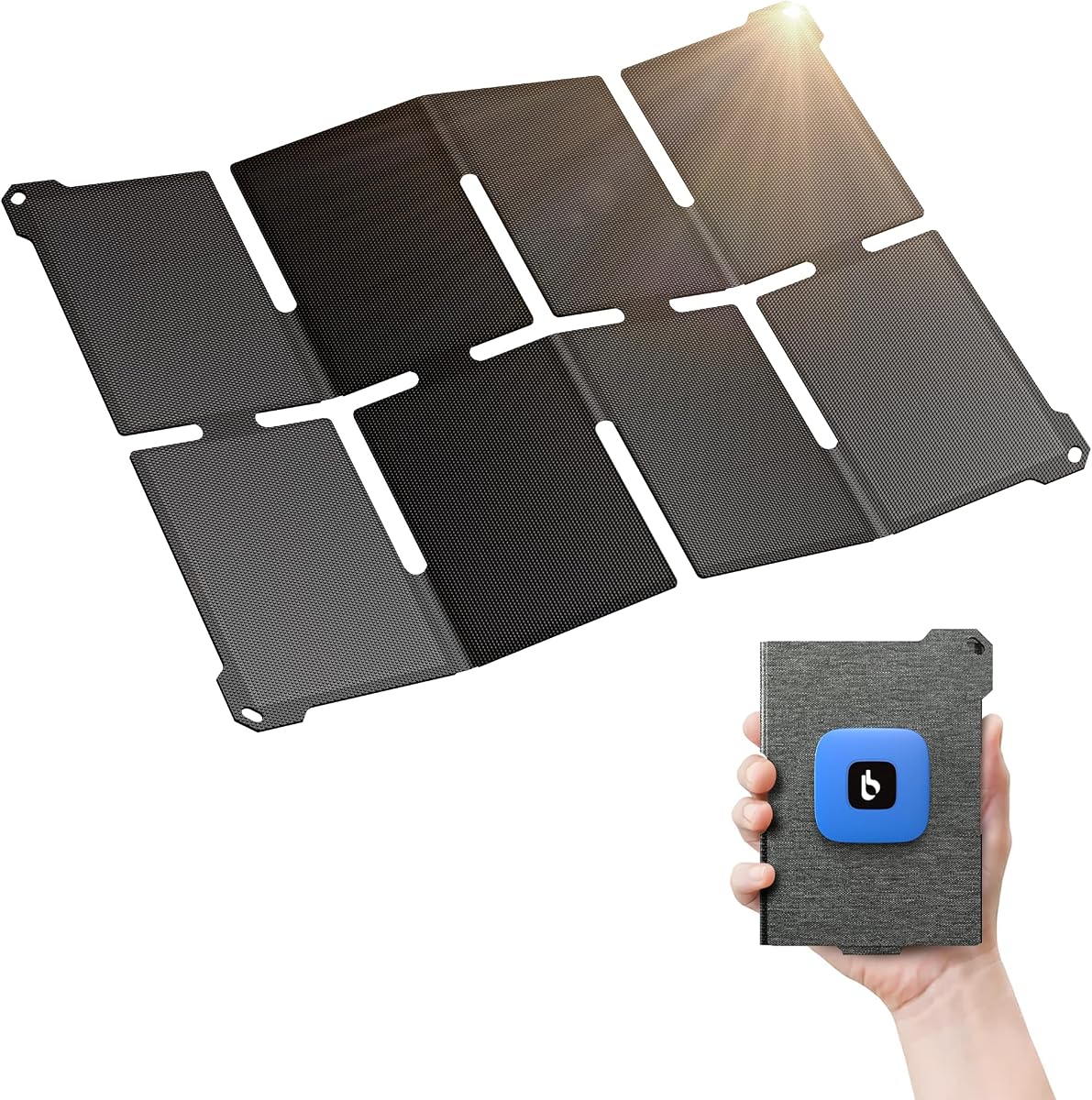
The SOLUPUP 30W Foldable Solar Charger offers a balanced combination of portability, weather resistance, and straightforward USB charging. Its 4.4 rating and 23%-plus monocrystalline conversion figure make it a practical option for anglers who need reliable charging for two smaller devices without moving up to a larger multi-port panel.
We may earn a commission when you buy through this link, at no additional cost to you.
The charging interface includes USB-A and USB-C outputs rated at 5V/3A with a 15W maximum. A smart chip identifies connected devices, optimizes charging, and provides protection against overcurrent, overvoltage, and short circuits. The panel can charge two devices at once, including compatible phones and power banks, while an automatic optimization function reconnects when sunlight returns after an interruption.
Its 2.4-pound weight is heavier than some ultraportable alternatives, but the folding design and 10.63-inch packed size remain manageable for a shore-fishing pack. The IPX5 rating supports use around rain and dust, though that rating should not be interpreted as permission to submerge the panel. Actual output varies with season, temperature, angle, and cloud cover.
This is a strong pick for anglers who carry a phone and a smaller USB device, especially those who value an integrated stand and automatic reconnection. It is not designed to power large electronics directly, and those needing overnight energy should bring a separate power bank. For its balance of capacity and convenience, it stands out as the best budget-oriented option here.
The listed auto-optimization function reconnects charging when sunlight returns following an interruption. That makes the panel better suited to variable shore conditions where passing clouds can repeatedly change available solar input.
USB-A and USB-C outputs support simultaneous charging of two compatible devices. The 15W maximum per the stated output specifications is more relevant for phones, cameras, and GPS accessories than for demanding power-station charging.
We may earn a commission when you buy through this link, at no additional cost to you.
The Flashfish 100W Foldable Solar Panel is built for anglers who need more charging headroom than a small direct charger provides. Its 4.4 rating reflects a capable three-output design that includes USB-C Power Delivery up to 65W, USB-A QC3.0 up to 18W, and a direct 5521 DC port.
We may earn a commission when you buy through this link, at no additional cost to you.
The panel can support two USB-powered devices simultaneously and is listed for a laptop, tablet, smartphone, drone, and camera. Its monocrystalline cells are rated at up to 22–23% conversion efficiency. Four integrated kickstands provide stability on uneven ground, which is particularly helpful when placing the panel on a shoreline picnic table or open boat deck.
The trade-off is size. A 100W folding panel is less convenient for a lightweight day-hike kit than a 25W–45W model and will consume more pack space. Actual delivered output remains dependent on sunlight, orientation, and device behavior, and the broad USB-C capability should not be confused with guaranteed 65W output under every condition.
Choose this model when a fishing trip includes a laptop, larger navigation device, drone batteries, or several electronics that need substantial input. It can also feed suitable power stations through the DC connection. For a solo angler carrying only a phone and a small GPS unit, a lighter panel is usually easier to manage.
A 100W rating creates useful flexibility for boaters, anglers traveling by RV, and anyone carrying more than one energy-hungry device. The USB-C and direct DC connections offer several ways to connect compatible equipment.
Four fold-out kickstands help hold the panel at a productive angle without requiring a separate stand. Anchor the lower edge when wind is strong, and never place the panel where reflective water or intense heat can raise device temperature.
We may earn a commission when you buy through this link, at no additional cost to you.
The POWOXI 7.5W 12V Solar Battery Charger is a compact maintenance solution rather than a direct phone charger. Its 4.4 rating and simple installation are useful for anglers who want to reduce battery drain in a car, small boat, tractor, ATV, or other 12V-powered machine during extended periods away from shore power.
We may earn a commission when you buy through this link, at no additional cost to you.
Installation is straightforward: the panel can plug into a vehicle cigar-lighter socket or connect to a battery using alligator clips. A smart internal protection system and blocking-diode structure are intended to guard against overvoltage, short circuits, and battery damage. The red and green indicators communicate whether the panel is receiving sunlight and whether it is connected for charging.
The rigid ABS-and-PC frame avoids the bent-panel problem associated with flexible solar sheets, while the high-transparency tempered glass surface is described as impact-, wind-, and snow-resistant. A listed 25–30% conversion efficiency is attractive in concept, but real charging performance is still governed by sunlight and installation angle. This is a maintainer and trickle charger, not a high-output source for phones or electronics.
It makes the most sense for preserving a battery rather than directly charging a fish finder. Pair it with a compatible power bank or battery system if the objective is to keep small electronics powered. It is a sensible low-impact addition for anglers who leave gear in a vehicle or boat and want a panel that can sit unattended in the sun.
The cigar-lighter plug and alligator clips provide two straightforward connection methods. Confirm battery polarity and select a location with unobstructed sunlight before leaving the panel in place.
The built-in protection system and rigid frame make the panel better suited to unattended maintenance than a thin flexible sheet. It is still important to check the connection periodically and clean the surface when dirt or salt accumulates.
We may earn a commission when you buy through this link, at no additional cost to you.
The FlexSolar 40W Foldable Solar Panel offers an appealing mix of low weight, multiple outputs, and outdoor durability. Its 4.4 rating aligns with its purpose as a portable charger for phones, tablets, power banks, and compatible small power stations during camping, hiking, boating, and off-grid travel.
We may earn a commission when you buy through this link, at no additional cost to you.
USB-A QC3.0 and USB-C PD2.0 ports are each rated up to 18W, while a 19V DC connection can provide up to 40W to a suitable small station. An integrated chip detects connected devices and optimizes delivery, with an LED status light. At 1.76 pounds and folded dimensions of 8.0 by 11.1 by 1.8 inches, it is lighter and smaller than the higher-output folding alternative.
The panel uses monocrystalline cells with up to 24% conversion efficiency and an ETFE laminate for abrasion resistance. Its IP67 rating covers dust and water resistance, but the junction box is explicitly not fully waterproof and should be stored indoors during heavy rain. The manufacturer also notes that partial shade can reduce performance by as much as 70%, making an unobstructed position essential.
This is a versatile middle option for anglers who want more output than a mini panel without carrying the largest setup. It works particularly well for charging a phone and power bank while the boat or campsite is exposed to sun. Avoid relying on the DC output unless the connected station has matching requirements, and keep the electronics themselves shaded from direct heat.
USB-A, USB-C, and 19V DC outputs cover common direct-charging and small-station setups. The smart load-distribution recommendation favors single-port use when maximum efficiency is the priority.
The folding, featherlight format is easy to carry, but the unit stores no energy. Collect sunlight with a compatible power bank during the day if electronics will be needed after sunset or during poor weather.
We may earn a commission when you buy through this link, at no additional cost to you.
The SOLPERK 20W Solar Panel Kit is the premium choice for anglers who want a permanent solar-maintenance system for a boat, RV, trailer, or other 12V battery setup. Its 4.5 rating reflects the complete package: a 20W monocrystalline panel, smart MPPT controller, adjustable bracket, alligator clip, O-ring, and mounting hardware.
We may earn a commission when you buy through this link, at no additional cost to you.
The controller is rated at 10A and uses a three-stage charging design to help prevent overcharging, overvoltage, and short circuits. The panel can maintain 12V rechargeable battery types including LiFePO4, lithium-ion, AGM, SLA, GEL, EFB, and MF. Its low-iron tempered glass and corrosion-resistant aluminum frame are designed to withstand demanding outdoor conditions.
Installation requires more thought than plugging a panel into a phone. Pre-drilled holes, included screws, plug-and-play connections, and a 360-degree adjustable bracket make the setup accessible, but the panel must be placed where it receives consistent sunlight without obstructing navigation, lines, or access to the vessel. It is a battery-maintainer kit, not a direct USB charging panel.
For a serious angler with a boat electronics battery bank, this is the most complete and adaptable installation in the guide. The controller and bracket make it easier to maintain than a bare trickle panel, while the stated cell-efficiency range supports meaningful charging performance in suitable conditions. The premium choice is best justified by long-term, permanent use.
The integrated MPPT controller helps optimize solar input and manages the battery through bulk, absorption, and float stages. Indicator lights make the system easier to monitor after installation.
The adjustable bracket changes the panel angle throughout the day or season. Position it clear of rigging and obstructions, and use suitable hardware to prevent movement in wind or rough water.
We may earn a commission when you buy through this link, at no additional cost to you.
The BigBlue 28W High-Efficiency Solar Panel Charger combines a well-established folding format with three USB outputs and a listed 25.4% conversion efficiency. Its 4.3 rating makes it a strong option for anglers who need to top up multiple compact electronics rather than power a large device.
We may earn a commission when you buy through this link, at no additional cost to you.
The port arrangement includes two USB-C connections and one USB-A port, each listed at a maximum of 5V/3A, with collective output up to 5V/4.8A. The panel is specifically mentioned for smartphones, power banks, GPS units, flashlights, and small electronics. A shadow-free front surface without metal lines helps the N-type cells capture sunlight and remain cooler.
The IP44 rating helps resist rain, fog, and wear, but the USB junction box is not waterproof. That distinction matters on a boat or in a wet shore kit: the panel can handle damp conditions better than the connection housing. The unit also has no internal battery and is not intended to charge laptops or large power stations.
This panel is well suited to a day-fishing kit containing a phone, GPS, flashlight, and compact power bank. Its 11-by-6-by-1.4-inch folded size and 1.5-pound weight are easy to manage. For users who need full water exposure at the connection point, choose a model whose ports are explicitly protected, and keep connected devices shaded to avoid heat-related charging slowdowns.
Removing metal lines from the front reduces visual shading and helps the cells retain more available light and lower heat. The result is especially relevant during long periods of direct exposure.
The three-port layout can serve a phone, GPS unit, flashlight, or power bank simultaneously. Since the panel stores no energy, bring a power bank for hours when the sun is unavailable.
We may earn a commission when you buy through this link, at no additional cost to you.
The BigBlue 25W Solar Panel Charger is built around portability, weighing only 0.84 pounds and folding to 4.65 by 6.42 by 1.38 inches. Its 4.2 rating makes it a sensible choice for anglers who value low carry weight and a protected panel surface over the higher output offered by larger models.
We may earn a commission when you buy through this link, at no additional cost to you.
USB-A and USB-C ports allow two devices to charge simultaneously, with listed outputs of 5V/2.4A and 5V/3A. The panel uses N-type cells without front-side metal lines and is rated for conversion efficiency up to 25.4%. Its ETFE coating, UV-resistant EVA, and solid baseplate are intended to resist outdoor wear and hidden cracking.
The IP68 rating makes this one of the more weather-conscious direct panels in the comparison. Even so, it has no battery and cannot reserve energy for later. The smaller surface also means that output can fall more quickly when conditions deteriorate or when the panel is only partially illuminated. It is best viewed as a supplementary charger rather than the sole energy source for a demanding electronics load.
This model fits neatly into a small tackle backpack or hanging gear pouch, making it ideal for solo shore anglers, kayak fishers, and lightweight campers. It can maintain a phone, compact GPS, or power bank when sun exposure is reliable. Choose a larger panel if several devices must recharge simultaneously or if faster recovery after cloudy periods is important.
At 0.84 pounds, the panel adds little bulk to a day pack. Included carabiners and an elastic strap make it easy to hang from a backpack or tent where direct sun is available.
The IP68 rating adds confidence around spray, splashes, and changing weather. As with any direct charger, keep ports clean and dry and allow the folded unit to dry before storage.
We may earn a commission when you buy through this link, at no additional cost to you.
The SUNER POWER 12W Solar Battery Charger and Maintainer Pro is a smart charging system for 12V batteries rather than a direct USB panel. Its 4.4 rating and built-in MPPT technology make it a useful choice for preserving boat, trailer, RV, vehicle, and outdoor-equipment batteries between fishing trips.
We may earn a commission when you buy through this link, at no additional cost to you.
The listed MPPT tracking efficiency reaches up to 99%, with peak conversion efficiency stated at 98%. A three-stage algorithm uses bulk, absorption, and float charging to manage the battery. The system stops charging when the battery is full and resumes after discharge, while reverse-polarity, overcharge, overdischarge, overvoltage, overcurrent, overload, short-circuit, and overtemperature protections improve operational safety.
Compatibility is broad, covering sealed lead-acid, flooded, gel, AGM, SLA, maintenance-free, deep-cycle, and LiFePO4 batteries. The panel uses Grade A+ monocrystalline cells, tempered glass, and a corrosion-resistant frame designed to tolerate UV, erosion, hail, rust, and sandstorm conditions. Plug-and-play wiring and predrilled holes simplify attachment.
Choose this maintainer when keeping a battery healthy is the primary objective. It can support a boat's electronics battery indirectly through a power system, but it will not charge a phone directly. It is particularly suitable for anglers who leave a vessel at a marina or storage site and want a compact panel that begins charging automatically when sunlight and battery conditions permit.
The charger detects a connected battery and begins operating without complicated manual controls. Automatic stopping and resumption make it useful for long unattended storage periods.
The broad set of electrical protections is a meaningful advantage for marine and outdoor installations. Confirm polarity, use the proper battery type, and inspect connections after severe weather.
We may earn a commission when you buy through this link, at no additional cost to you.
The Portable 15W Small Solar Panel Charger is the lightest direct-charging option in this guide and distinguishes itself with a built-in digital display. Its 4.2 rating reflects a straightforward design aimed at phones, power banks, cameras, GPS units, mini fans, and other small USB-powered devices.
We may earn a commission when you buy through this link, at no additional cost to you.
The screen displays power, voltage, and current, allowing anglers to see how panel placement affects real-time performance. That feedback is useful on a boat or shoreline where a small change in angle can materially affect available sunlight. The panel uses 23.5% monocrystalline cells with an ETFE coating, while USB-A and USB-C outputs support everyday devices.
At 0.82 pounds, it is exceptionally easy to carry, but the 15W rating offers limited recovery speed and less margin for multiple demanding devices. It also has no internal battery, so the display reflects current generation rather than stored energy. The smart protection system is described as guarding against overcharging, overheating, and short circuits.
This model is best for a minimal kit or emergency supplement: a phone, small GPS, and a power bank that will be recharged when sunlight is available. It is less suitable as the main charger for a tablet, camera battery system, or multiple devices. Its strongest selling point is the real-time display, which helps users optimize a small panel instead of guessing whether it is producing useful power.
Watching power, voltage, and current makes it easier to identify an angle with stronger solar exposure. The display is especially useful when a panel must share a small boat deck with other gear.
The low weight and dual USB outputs suit a compact phone-and-GPS kit. For consistent all-day charging, pair it with a power bank and avoid expecting the 15W panel to power several large electronics at once.
We may earn a commission when you buy through this link, at no additional cost to you.
The right solar charger depends on whether you need direct USB power, stored energy, or maintenance of a boat battery. Match the charger to your electronics, expected sun exposure, pack constraints, and exposure to water before comparing headline wattage.
Direct charging panels connect phones, cameras, GPS units, and power banks through USB outputs. They are portable and do not require a separate battery, but they generally work only while receiving adequate sunlight. Battery-maintainer kits instead charge a 12V rechargeable battery through a controller, making them better for boat electronics, trolling-motor batteries, trailers, and vehicles that remain unoccupied for extended periods. A third practical approach combines a portable panel with a power bank: the panel collects energy during daylight, and the bank powers devices later.
Choose a direct panel for a packed day-fishing kit, and choose a maintainer for a fixed installation. Do not expect a trickle charger with alligator clips to supply enough current for a phone or action camera.
Panel wattage describes the panel's nominal solar capacity, while USB output limits describe what can be delivered through a particular port. A 25W–45W folding panel is usually more appropriate for phones, compact navigation units, cameras, and one or two power banks. A 100W panel offers more headroom for tablets, laptops, drones, or compatible power stations, but is bulkier. USB-C Power Delivery can support higher device input when the panel, cable, and connected equipment all agree on the required protocol.
List your electronics first, then check connector type, required input, and simultaneous-load needs. Do not choose solely by the largest wattage printed on the package.
Solar charging is fundamentally different from wall charging. Output changes with cloud cover, season, temperature, panel angle, surface cleanliness, and partial shade. For morning fishing, position the panel to face the early sun. For all-day use, adjust its orientation as the sun moves. A digital monitoring display can help reveal whether a placement is productive, but it cannot compensate for genuinely weak sunlight.
Choose a panel with enough rated output to recover lost energy during the available daylight window. Treat published wattage and conversion efficiency as comparative indicators rather than guaranteed real-time delivery.
A charger that is too large may be left at home, while a panel that is too small may not keep pace with the electronics load. Folded weight and dimensions matter for backpacks, kayak kits, and small boats. Included carabiners, extension cables, straps, pouches, and kickstands improve usability, especially when the angler must position the panel quickly. A 30W–45W folding model balances capacity and pack volume for most anglers.
Check the complete packed size rather than only the unfolded surface area. A panel with multiple folds may need a large carrying area even when it weighs relatively little.
Fishing gear is exposed to spray, rain, sand, mud, and accidental knocks. Higher IP ratings indicate stronger protection against dust and water, but the rating may apply only to the panel rather than the USB junction box or ports. Some manufacturers explicitly state that the connection housing is not waterproof. Read the limitations carefully and keep exposed sockets covered when possible. ETFE surfaces and tempered glass can improve durability, while rigid frames reduce the risk of creasing.
Salt residue should be wiped away after use. Allow wet panels to dry fully before folding them into a storage pouch, and never charge a damp electronic device.
Smart chips can identify connected devices, distribute output, reconnect after interruptions, and guard against overcurrent, overheating, overvoltage, and short circuits. For battery-maintainer systems, MPPT control and staged charging are especially important because the panel and battery are continuously exposed to variable conditions. Reverse-polarity protection adds another layer of safety during installation. Indicator lights are useful for checking whether the panel sees sunlight and whether the battery is connected.
For direct USB models, verify compatibility with your phone or GPS unit. For maintainer kits, verify battery chemistry and confirm that the listed charging stages are appropriate for it.
Most panels in this comparison are direct chargers without an internal battery. If power may be needed after sunset, during rain, or early in the morning, bring a compatible power bank and charge it during the day. Keep the phone, tablet, or GPS unit in the shade while the panel faces direct sun; heat can trigger a device's thermal protection and reduce charging speed. Do not leave a device baking under a dark panel while expecting full output.
Store energy in a power bank rather than assuming the solar panel will continue delivering after sunset. Use quality cables and avoid leaving water, sand, or fishing residue on connectors.
Begin by identifying whether the product directly charges USB devices or maintains a 12V battery. Unfold or mount the panel where it receives unobstructed direct sunlight, and clean the surface with a soft cloth before use. For direct charging, connect the device through the appropriate USB-A or USB-C port and place the device in the shade so it does not overheat. Keep the panel aimed toward the sun and adjust the angle as conditions change.
For a battery-maintainer system, switch off the equipment, confirm battery chemistry and polarity, and follow the controller's wiring instructions. Mount the panel securely with the included bracket or hardware, angle it toward the sun, and avoid locations where rigging, lines, canopy edges, or equipment may obstruct it. Check the indicator lights after connection and periodically inspect the wiring, especially after rough weather or prolonged marine exposure.
After the trip, disconnect direct devices, unplug the battery connections, and wipe away salt, mud, and sand. Let the panel dry completely before folding or storing it, and never submerge a junction box or USB port. Store the unit in its pouch away from sharp tools and excessive heat. If output declines, check for shade, dirt, incorrect positioning, a loose cable, and device-side thermal protection before assuming the panel has failed.
It depends on the fish finder's power requirements and how the solar system is connected. A small USB fish finder may work with a sufficiently strong direct panel or through a power bank, but a larger marine unit normally needs a dedicated 12V battery system. The SOLPERK MPPT kit and SUNER POWER maintainer are more appropriate for battery-based installations. Check the device's input voltage, current, connector, and operating instructions before connecting it.
They may still provide reduced output, but charging will usually be slower and less consistent. Solar output depends heavily on direct sunlight, and some devices may repeatedly connect and disconnect as conditions change. A compatible power bank is the most reliable way to preserve usable energy for cloudy periods. The SOLUPUP panel includes an automatic reconnection feature, which can help after sunlight returns.
No. A higher rating provides more potential output, but portability and actual sunlight are equally important. A compact 25W panel may be ideal for a phone and small GPS unit, while a 100W panel makes more sense for laptops, drones, or a larger power station. Choose the lightest panel capable of meeting your device needs and plan for realistic sunlight exposure.
A built-in battery is helpful when power is needed after sunset, but most models in this guide are direct chargers without internal storage. They work only while sunlight is available, unless energy is collected in a separate power bank. For fishing trips that extend into the evening, carrying a compatible power bank is generally more practical than relying on a panel alone.
A fixed 12V solar-maintainer kit with an MPPT controller and adjustable mounting bracket is usually the most appropriate choice. The SOLPERK 20W kit includes a controller, bracket, and installation hardware, while the SUNER POWER 12W model offers automatic staged charging and extensive protections. Confirm voltage, battery chemistry, grounding requirements, and the manufacturer's connection instructions.
Yes, with a model that has the required simultaneous outputs. The GEYOTO 45W, SOLUPUP 30W, FlexSolar 40W, and BigBlue 28W models provide multiple USB connections. Actual charging speed still depends on sunlight and device acceptance. Shading one connected device may also affect available panel output, so keep devices cool and uncovered.
Use the panel's mounting options to prevent it from sliding or catching rigging, and keep USB ports elevated above splashes. After the trip, rinse away salt with fresh water where appropriate, wipe the surface dry, and allow the connection box to dry before storage. A panel may have a strong water-resistance rating while its junction box does not, so check both specifications.
These products are primarily solar trickle chargers and maintainers, not substitutes for a full alternator, shore-power charger, or properly sized power system. Solar maintenance can offset small standby drains and help keep a battery conditioned, but deep recovery after heavy use may require a more powerful charger. Use the solar system as a supplementary layer unless a qualified marine electrician confirms otherwise.
The GEYOTO 45W panel is the strongest all-around option for anglers who want three USB connections, useful PD charging, and a compact weather-resistant design. The SOLUPUP 30W panel is a cost-conscious balanced choice with dual outputs, an integrated stand, and automatic reconnection, while the SOLPERK 20W MPPT kit stands out as the premium permanent installation for a boat or other 12V battery system.
Prioritize the power architecture your trip actually requires. Use a direct folding panel for phones, GPS units, cameras, and power banks, and choose a maintainer with MPPT control for a boat battery or storage application. Match output to device requirements, consider how much sunlight the setup will receive, and make sure the charger and its connection points can tolerate the expected spray and weather.
Ratings and product specifications provide a useful starting point, but current prices, device compatibility, and available features can change. Review the latest listing and manufacturer instructions before buying, particularly for charging protocols, battery types, waterproofing limitations, and included mounting accessories. The right choice is the one that fits your electronics, your boat or shore setup, and the way you actually fish.
