
ZOUPW 100W Portable Solar Panel
4.6Editor score
23.5% monocrystalline efficiency
Five-connector power-station cable
IP67 waterproof construction
Best solar panels for buses compared by output, efficiency, portability, weather resistance, and compatibility, with clear guidance for RV, coach, and fleet
Solar panels for buses can transform a coach, shuttle, converted van, or service vehicle into a more independent power platform. The most useful systems balance usable output, low-light performance, rugged construction, manageable weight, and compatibility with the batteries or portable power stations already aboard.
This guide compares ten solar-panel products across output, cell efficiency, connector coverage, environmental ratings, portability, and installation considerations. It includes foldable power-station panels, fixed RV-style kits, a drill-free mounting system, and a small wiring kit for custom solar builds rather than treating every product as a complete bus installation.
Each review explains the strongest use case and the compromises involved, from output limitations and voltage requirements to permanent-mounting hardware. Ratings and specifications reflect the supplied product information, while current prices and availability can change. Always verify the electrical limits of your bus before buying.
4.6Editor score

4.5Editor score

4.6Editor score
The comparison below places all ten products according to their intended role, from portable power-station charging and fixed RV installations to mounting hardware and custom-build wiring. The key differences are output, efficiency, connector support, weather protection, deployment method, and compatibility with higher-voltage bus electrical systems.


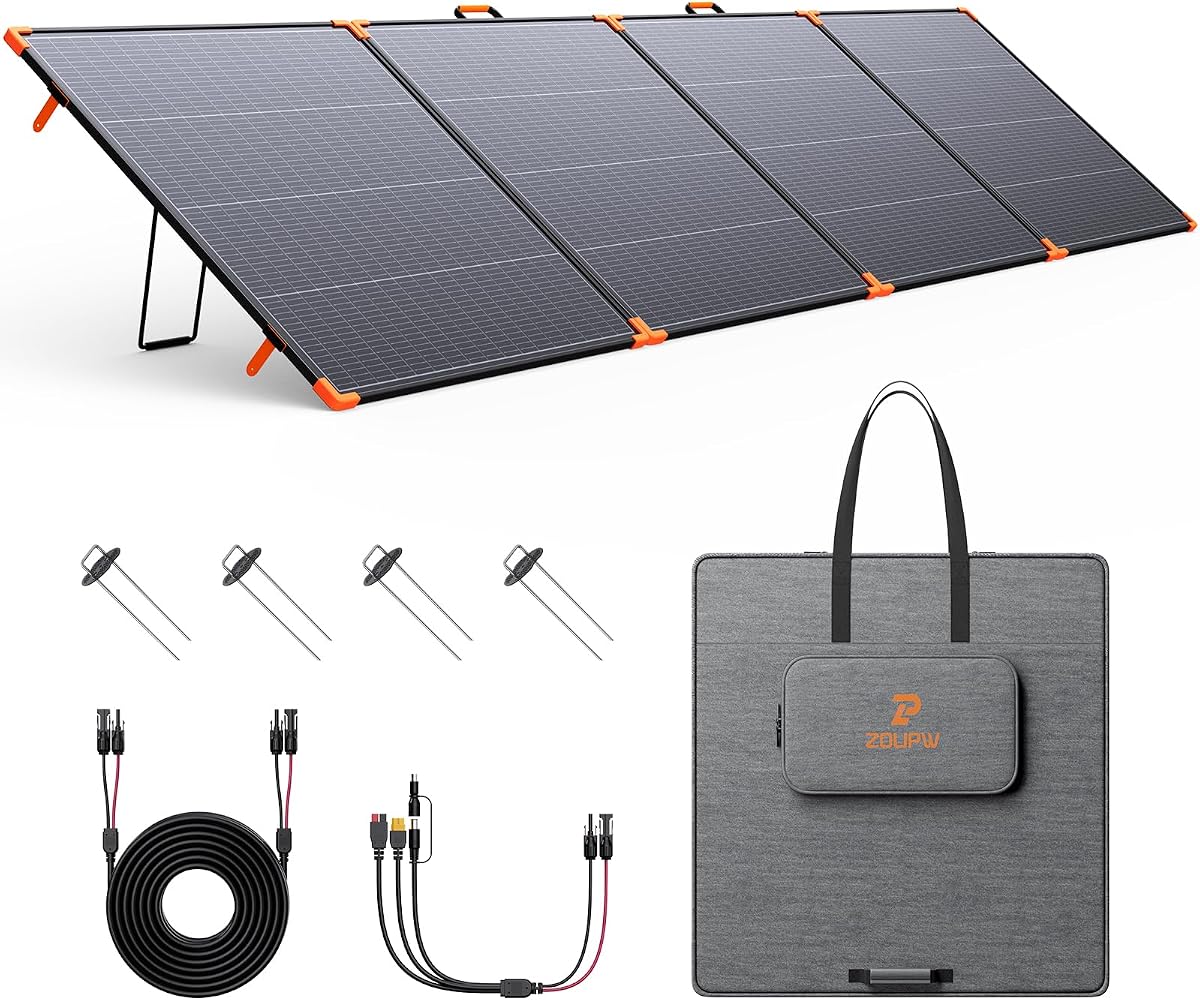


This ZOUPW portable panel combines a 100W rating with 23.5% monocrystalline efficiency and a 4.6 customer rating. It is a practical choice for smaller buses, converted vans, and travelers who want a panel that can move between a campsite and a power station rather than remain permanently mounted on the roof.
We may earn a commission when you buy through this link, at no additional cost to you.
Its strongest feature is the upgraded five-connector cable, which includes DC8020, XT60, Anderson, DC7909 or 8mm, and DC5521 connections. The panel also includes a built-in controller with one USB-C port and two USB-A ports, allowing phones, tablets, cameras, and navigation devices to charge without routing energy through a portable power station.
The 9.48-pound weight and compact folded dimensions make the panel more manageable than many larger portable models. IP67 waterproofing and a protected controller pocket suit rain and outdoor use, although the charging rate remains constrained by the receiving power station's input limit. A unit with a 60W limit cannot draw the panel's full 100W output.
This is a good budget-oriented choice for a bus owner with modest daily energy needs, especially someone who values connector flexibility and direct device charging. It is less appropriate as the sole solar source for a heavily equipped coach, but its portability, feature set, and accessible panel size make it an adaptable starting point.
The five-in-one connection cable covers several popular power-station families and generic 12-volt battery setups. That breadth makes the panel easier to introduce to an existing bus electrical plan without immediately replacing adapters or building a custom cable.
The USB-C and USB-A outputs make the panel useful for smaller electronics during travel. These outputs add flexibility, but continuous bus loads should still be connected through a properly sized charge controller and electrical system.
We may earn a commission when you buy through this link, at no additional cost to you.
This 400W foldable panel offers a substantial capacity increase over portable 100W and 200W models. Its 4.5 rating, 23.4% monocrystalline efficiency, and 40-volt power delivery make it relevant to bus travelers who need to recharge a substantial power station without permanently installing a roof array.
We may earn a commission when you buy through this link, at no additional cost to you.
The package supports common portable power stations through MC4 connections and a supplied cable with DC, XT60, and Anderson options. A QC3.0 USB output also provides a direct charging path, while adjustable kickstands allow the panel to be positioned away from a horizontal surface where possible.
Its trade-off is system complexity. A 400W panel needs a compatible power station with an adequate solar-input window; a lower-input model can slow charging significantly. The IP65 rating, ETFE lamination, and dust and high-temperature resistance support outdoor deployment, but connectors should still be protected from standing water.
Bus owners traveling frequently or running appliances from a large power station will appreciate the higher output and broad charging options. It is less attractive for a small electrical system, a lightweight conversion, or anyone who needs a panel easy to carry by hand. Confirm both voltage and maximum input before purchase.
A 400W nameplate output can significantly reduce replenishment time when paired with a high-input power station. The actual benefit depends on sunlight, panel orientation, temperature, and whether the receiving unit accepts the panel's voltage and current.
The folding body and kickstands make this a practical choice for travelers who alternate between road, campsite, and storage. It offers meaningful energy capacity without requiring the early commitment of drilling into a bus roof.
We may earn a commission when you buy through this link, at no additional cost to you.
The Renogy 200W portable panel is a balanced middle ground between compact 100W models and large 400W or 450W arrays. It has a 4.5 rating, uses 16-busbar N-Type cells rated at 25% efficiency, and weighs 13.89 pounds, making it realistic to carry and deploy around a campsite.
We may earn a commission when you buy through this link, at no additional cost to you.
Three charging paths distinguish it from simpler panels. In addition to MC4 output for compatible power stations, it provides USB-C PD up to 45W and two USB-A ports for phones, tablets, laptops, GPS units, and cameras. The MC4-only panel output means the separately sold four-in-one adapter is important for owners using other connector formats.
Renogy includes four kickstands with 40-, 50-, and 60-degree positioning options, reinforced grommets, and an accessory pouch. The panel is listed to UL 61730 with additional CE, RoHS, FCC, CA65, PSE, and ISO 9001 claims, giving bus builders useful certification information during equipment selection.
This is the strongest general-purpose recommendation for a bus conversion because it balances output, portability, efficiency, and direct charging. It can support a reasonably equipped travel setup while remaining manageable at campsites. Owners with smaller power stations should verify their input voltage, while larger systems may need multiple panels or a higher-output option.
The 25% N-Type cell rating is particularly relevant to buses because usable roof area is often limited. Efficient cells can contribute more power from the same available surface, although real output still varies with weather, orientation, and system losses.
USB-C PD and dual USB-A outputs allow essential navigation and communication devices to operate without passing through the main battery bank. That makes the panel useful even on days when the bus power station does not require a full recharge cycle.
We may earn a commission when you buy through this link, at no additional cost to you.
This foldable 100W panel combines a 4.8 customer rating with a 23.7% efficiency claim and an 18-volt-class output design. It is especially relevant to smaller bus conversions using 12-volt battery banks or compatible portable power stations rather than large high-voltage systems.
We may earn a commission when you buy through this link, at no additional cost to you.
The panel supplies steady 19.8-volt, 100-watt power through an XT60 connection and can support 12-volt batteries up to 12 amps. A built-in smart controller provides reverse-charge, overcharge, and overload protection. Series and parallel support also gives owners a path toward increasing array output as their electrical needs grow.
Its bifold format, adjustable kickstands, and reinforced loops make it convenient to deploy on a tent, vehicle surface, or campsite. The product information describes a temperature range of minus 10 to 70 degrees Celsius and a water-resistant ETFE-laminated design. As with any panel, moisture protection does not make exposed electrical connections safe to submerge.
The panel is best for a modest bus installation, weekend travel, emergency lighting, or maintaining a smaller battery reserve. Its compactness and high customer rating make it appealing, but the 100W ceiling and XT60-centered connection mean it should not be selected as a primary high-demand system for a fully equipped coach.
Series and parallel connection options can help a bus owner scale the system over time. Expansion still requires matching panels, calculating voltage and current correctly, and installing suitable protection rather than simply joining cables.
The 19.8-volt output and 12-amp battery limit suit many conventional 12-volt systems. This makes the panel more approachable for a small conversion, though actual charge current must be regulated to protect the battery.
We may earn a commission when you buy through this link, at no additional cost to you.
The Spartan Power four-piece mount is an installation accessory rather than a solar panel, but it directly addresses a common bus-building concern: mounting hardware without permanently drilling through a roof or exterior surface. It carries a 4.2 customer rating and is designed for a wide range of vehicles, including buses and Skoolies.
We may earn a commission when you buy through this link, at no additional cost to you.
The set uses surface mounting and includes self-tapping screws intended to attach the mount to an aluminum-framed solar panel. Its high-quality ABS construction is described as non-corrosive, long lasting, and recyclable, which makes it suitable for exposed automotive and marine environments when properly positioned.
Because it is a drill-free system, structural security depends on surface preparation, the chosen adhesive or attachment method, wind loading, and the panel's position. The manufacturer offers support for recommended tapes and glues, but a bus owner should still assess whether adhesive mounting is appropriate for the panel size, road speed, and local conditions.
This product is best for a removable portable-panel arrangement, temporary installation, or a bus owner reluctant to create permanent roof penetrations. It should not be considered a complete solar system, and it is less suitable for a large fixed array unless the attachment method has been properly engineered for the load.
A surface-mounted arrangement can be valuable for removable panels, seasonal additions, or prototype builds. It allows a bus owner to evaluate an installation before committing to permanent roof modifications.
The included self-tapping screws connect the panel to the mount, while the bus attachment method must be selected independently. Surface cleanliness, compatible materials, curing time, and wind load all affect long-term security.
We may earn a commission when you buy through this link, at no additional cost to you.
This ZOUPW 480W bifacial panel leads the group in nominal output and carries a 4.7 customer rating. Its 25% N-Type 16BB cells and bifacial construction make it aimed at owners who need considerable portable generation, particularly in high-albedo surroundings such as snow or light sand.
We may earn a commission when you buy through this link, at no additional cost to you.
The panel is advertised to gain as much as 30% from reflected light on suitable surfaces. At 22.5 pounds, it is lighter than many glass-based portable alternatives of similar output, and the folding design is intended for one-person deployment. Integrated bypass diodes help limit the effect of partial shading.
Its 42.5-volt high-voltage architecture means it is intended for large power stations and professional off-grid equipment, not every bus battery bank. The safety information specifically advises against long-term fixed, series, or parallel use and warns against connecting panels with different ages or lifespans. Its IP68 construction handles severe weather, but the composite surface still requires care.
This is a compelling choice for an expedition coach with a high-capacity power station, a mobile work bus, or a vehicle that needs substantial portable energy. It is less suitable for a compact conversion where weight, voltage, and setup complexity would be disproportionate. The included storage bag, extension cable, four-in-one connector, and ground stakes support field deployment.
A bifacial panel can collect light on its rear surface, adding energy from the ground or surrounding environment. The benefit varies with reflectivity, mounting height, orientation, and ambient light, so it should not be treated as guaranteed extra output in every campsite.
The 42.5-volt architecture and 480W output call for a capable receiving system with the correct input window. Checking the power station's maximum solar input and connector polarity before deployment helps prevent poor charging performance or equipment issues.
We may earn a commission when you buy through this link, at no additional cost to you.
The ECO-WORTHY kit is a more conventional fixed-installation package, including two 100-watt monocrystalline panels, a 30A PWM charge controller, Z-mounting brackets, solar cables, connectors, and a tray cable. Its 4.6 rating and broad RV-oriented feature set make it a logical option for a bus conversion with a dedicated battery bank.
We may earn a commission when you buy through this link, at no additional cost to you.
The panels are listed at up to 21.5% efficiency, with dimensions of 35.2 by 23.1 by 1.37 inches. Their aluminum-alloy frames are described as corrosion resistant, with wind resistance of 2,400 pascals and snow-load resistance of 5,400 pascals. The IP65 junction box provides protection against environmental particles and low-pressure water jets.
The kit can be configured for 12-volt or 24-volt systems, giving owners flexibility during the design stage. Its daily output is stated as up to 800 watt-hours under four hours of full sunshine, a useful planning figure that should be treated as ideal-condition guidance rather than guaranteed real-world production.
This package is best for bus owners who want permanent roof panels and a complete basic charging chain rather than one portable folding panel. It is less convenient for temporary deployments and requires careful drilling, sealing, grounding, wiring, and load calculations. The included one-year support period is shorter than the warranty coverage described for several ZOUPW products.
Panels, controller, brackets, and connecting cables reduce the number of separate purchases required. A bus builder still needs to select appropriately sized fusing, grounding, disconnects, strain relief, and roof-sealing materials based on the final wiring design.
Series or parallel configuration allows the same basic panel pair to suit 12-volt or 24-volt battery architectures. The correct arrangement should be calculated and checked against the charge controller before installation.
We may earn a commission when you buy through this link, at no additional cost to you.
The Renogy 50W panel is a compact fixed solar option with a 4.7 customer rating and a stated 25% N-Type efficiency. It is not large enough to carry a bus's entire energy demand, but it can support a smaller battery bank, maintain essential systems, or supplement a larger array.
We may earn a commission when you buy through this link, at no additional cost to you.
Its multi-layered encapsulation and low-iron tempered glass are designed for cell protection, stiffness, and impact resistance. A corrosion-resistant aluminum frame, EL testing, and bypass diodes support long-term outdoor performance. The junction box has an IP65 rating, while the panel is rated for 2,400 pascals of wind pressure and 5,400 pascals of snow load.
Pre-drilled holes make it compatible with Renogy Z-brackets, pole mounts, and tilt mounts. These options allow a bus owner to create a compact fixed installation on a roof rack or suitable frame. A controller and appropriate battery protection are still required, and the panel's modest output should be matched to a correspondingly sized energy budget.
This is a good selection for a smaller converted van, a lightweight bus build, a backup lighting system, or a maintenance vehicle where simplicity and low weight matter more than rapid charging. It is best when its modest contribution is intentionally designed into the overall electrical plan rather than treated as a high-output touring system.
A 50W panel can maintain a smaller battery reserve and slowly recover daytime consumption. It works especially well when paired with a low-draw load set, an efficient charge controller, and realistic expectations about overnight and cloudy conditions.
Pre-drilled mounting points and compatibility with several Renogy mounting products simplify the physical installation. The electrical system still requires proper grounding, regulation, and overcurrent protection.
We may earn a commission when you buy through this link, at no additional cost to you.
This wiring kit is a specialized component for people constructing or repairing solar-cell panels rather than a finished panel for direct bus installation. It includes 20 meters of tab wire, 2 meters of DIY solar bus-bar wire ribbon, and a 10ml soldering flux pen.
We may earn a commission when you buy through this link, at no additional cost to you.
Tab wire and bus-bar ribbon are used to create connections between solar cells or circuit-board components. Their usefulness is greatest for custom panel layouts, prototype electrical assemblies, and repair work where standard connectorized products do not match the required geometry.
Because the package is a fabrication aid, it does not provide a frame, cells, junction box, junction leads, or a charge controller. A bus owner also needs electrical design knowledge, soldering equipment, insulation, strain relief, and environmental sealing. Incorrect cell connections can damage cells or create unsafe operating conditions.
This accessory is best for an experienced solar builder, educational project, repair technician, or custom bus energy system. For a typical traveler seeking a usable rooftop or portable panel, a complete panel package will be simpler and safer. Its role is specialized, so it should complement rather than replace a complete solar product.
Flexible tab wire and bus-bar ribbon can help builders create connections that fit a nonstandard panel shape or repair a damaged cell run. Precise layout planning is important because long or poorly supported conductors can complicate the finished installation.
The included flux pen assists soldering, but it does not replace proper iron temperature, joint inspection, insulation, and electrical testing. Novice installers should use a preassembled panel and follow a proven wiring diagram instead.
We may earn a commission when you buy through this link, at no additional cost to you.
The ZOUPW 450W portable panel delivers a 450-watt nameplate output, 25% efficiency, and a 4.6 customer rating. It is a high-capacity option for buses with large power stations, demanding appliances, or serious off-grid travel requirements.
We may earn a commission when you buy through this link, at no additional cost to you.
Its N-Type monocrystalline cells use a 16-busbar design intended to reduce internal resistance and micro-crack risks. The open-circuit voltage is listed at 45.9 volts, placing it in a class intended for large solar generators. It is explicitly not compatible with low-voltage units below 30 volts, including several common Jackery and Bluetti models.
The 29.5-pound fiberglass-based structure and four kickstands offer a better weight-to-output balance than many rigid glass alternatives. An IP68-rated ETFE coating resists rain, dust, and marine spray, while smart bypass diodes help with partial shade. The included four-in-one cable covers XT60, Anderson, DC7909, and DC8020 connections.
This is the premium recommendation for an expedition bus or coach equipped with a 2-kWh-class or larger power station. It is less suitable for a compact bus with a small battery bank, and the voltage restrictions rule out many entry-level stations. The included 36-month warranty and customer support add confidence, but matching remains the decisive factor.
A 450W panel can restore meaningful energy during a limited camping day when the attached power station accepts its high-voltage output. This makes it useful for coaches running refrigerators, networking equipment, lighting, and other sustained loads.
The IP68 enclosure and sealed lamination suit buses that remain parked outdoors through rain or dust. Connectors should still remain dry, and the surface should be kept clear of debris that could cause localized heating.
We may earn a commission when you buy through this link, at no additional cost to you.
Choosing solar panels for a bus requires balancing available roof space, electrical architecture, travel pattern, weight limits, and realistic daily energy use. The most suitable choice is not always the panel with the largest advertised output, because voltage, mounting method, and system compatibility determine whether it can safely and effectively charge the equipment aboard.
Choose a panel that matches the bus system rather than simply maximizing output.
Size the array around realistic daily demand, not a single appliance's peak wattage.
High cell efficiency is valuable, but clean and unshaded placement is equally important.
Select portable or fixed construction according to travel frequency, storage, and maintenance priorities.
Verify connectors and include complete electrical protection, not only the panel.
Include panel weight, mounting hardware, batteries, and road-wind forces in the installation plan.
Choose durable sealing, then maintain connectors and keep the active surface clean.
Prioritize labeled, accessible, and documented wiring over a minimal-looking installation.
Before deployment, identify the bus battery voltage, charge-controller limits, connector polarity, and maximum input current. Inspect the panel, cable, junction box, and mounting points for damage. Position the panel in direct sunlight, away from vents and stored items, and use the kickstands or approved roof structure to establish the intended angle. Connect the system while following the controller or power-station instructions, and do not assume a higher advertised panel wattage overrides a lower receiving-device input limit.
For a fixed bus installation, use an approved mounting system, secure all cables away from hinges, doors, fans, and sharp edges, and provide strain relief where movement occurs. Protect cable entries against moisture and ultraviolet exposure. Check grounding and overcurrent protection, then measure charging behavior before relying on the system for essential loads. Keep the panel surface clean and inspect it after severe weather, branches, or road work that may have deposited dirt or caused impact damage.
For portable panels, fold and store the unit fully dry, protect connectors from dirt, and avoid placing heavy objects on the cells. When operating several panels, use matched units with compatible voltage ratings and the manufacturer's recommended series or parallel configuration. Do not mix panels of different ages, outputs, or architectures without a properly engineered combiner and controller. Periodically check fasteners, seals, cable insulation, battery condition, and charge-controller readings so small issues do not become major electrical failures.
The correct wattage depends on your battery bank, power station, and daily electrical load. A small system maintaining essential devices may need far less than a 100W panel, while an expedition coach running refrigeration, tools, and high-power appliances may need several hundred watts. Calculate the energy required each day, account for available sunlight, and verify that the charge controller and battery bank can accept the array safely.
Only when the panel's voltage, current, and connector match the charging system. Most panels need a properly configured charge controller between the solar input and the battery bank, and some may charge a power station instead of a battery directly. Do not connect a high-voltage portable panel to a 12-volt battery bank unless the manufacturer explicitly supports that configuration and a suitable regulator is used.
A 100W panel can maintain a modest battery bank or support essential low-draw equipment, particularly with good sunlight and efficient power management. It will recharge a large battery bank or power-station reserve much more slowly than a 200W to 450W panel. For full-time travel with frequent appliance use, multiple panels or a larger permanent array may be more appropriate.
A permanent array provides convenient daily charging and frees portable equipment for other uses, but it adds weight, wind load, roof penetrations, and maintenance demands. A portable foldable panel is easier to test, reposition, and remove. Choose based on travel frequency, roof availability, desired output, and willingness to seal and secure the installation.
MC4 is common among portable and fixed solar panels, while popular power stations may use XT60, DC8020, DC7909, Anderson, or other proprietary connections. Some panels include a multi-connector cable, and others require a separate adapter. Match both the physical plug and the electrical requirements, including voltage, current, and polarity, rather than focusing on appearance alone.
They still generate power in many cloudy conditions, but output generally falls below rated values. Higher-efficiency N-Type cells can perform better in low light, but a shaded panel may produce very little. Positioning the array where it receives the broadest available sky and maintaining a clean surface helps preserve output when conditions are less than ideal.
A drill-free mount can be useful for removable or temporary installations when the surface and attachment method are appropriate. Long-term safety depends on panel size, wind loading, adhesive compatibility, surface preparation, curing time, and the bus's road vibration. A small portable panel generally presents a different load profile from a large fixed array, so attachment strength should be evaluated accordingly.
A power station with a regulated solar input may include the necessary control internally, while a direct battery connection generally requires a suitable charge controller. The controller regulates charging, prevents excessive battery voltage, and manages current appropriately. It should be matched to the panel's voltage and current and to the battery chemistry and configuration used in the bus.
The ZOUPW 100W portable panel is the best budget-oriented option for smaller systems, with broad connector support, direct USB charging, and a manageable 9.48-pound weight. The Renogy 200W portable panel is the strongest all-around choice for a typical bus conversion because it combines 25% N-Type efficiency, useful direct charging, strong certification information, and a reasonable deployment format. The ZOUPW 450W panel leads the premium group for buses with large, high-voltage power stations.
The most important buying decision is not wattage alone. Match the panel to the bus's battery architecture, verify every connector, and calculate realistic daily energy needs. Portable foldable panels suit flexible travel, while fixed kits and low-drill mounts suit vehicles that already have a defined roof layout and electrical design. Higher-output models add capability only when the controller, power station, and downstream system can use that power effectively.
Product prices, ratings, and availability can change, so review the current listing and verify the latest specifications before ordering. Check the supplied compatibility chart, connector details, warranty terms, and input limits. For a complex electrical installation, use appropriately sized fusing, grounding, disconnects, and professional advice whenever the bus design exceeds ordinary low-voltage experience.