
M-VAVE Wireless Portable FM Synthesizer
4.4Editor score
Portable battery-powered design
Six-operator FM synthesis engine
Built-in arpeggiator and sequencer
Compare 10 Synthesizer for Synthwave, with key specifications, product ratings, pros and cons to help you choose.
A synthesizer for synthwave should make it easy to shape the genre's blend of warm analog character, bright digital edges, sequenced basslines, shimmering pads, and expressive leads. The right instrument combines a versatile sound engine with an interface that supports fast preset editing, reliable performance control, and practical integration with a home studio or live setup.
This guide compares ten synthesizers selected for their usefulness across that broad set of requirements. We considered synthesis type, voice architecture, oscillator and filter flexibility, effects, arpeggiation, sequencing, keyboard feel, modulation options, portability, and connectivity, with particular attention to the sounds and workflows commonly associated with synthwave production.
Each review explains where a model stands out, where its compromises matter, and which kind of musician is likely to benefit from it. The list includes conventional polyphonic keyboards, hybrid instruments, portable FM units, and a monophonic analog model. As with all audio gear, product availability, features, and pricing can change, so confirm current details before buying.
4.4Editor score

4.8Editor score

4.9Editor score
The comparison below highlights the principal differences in sound architecture, performance control, sequencing, and connectivity. Rather than treating every instrument as a dedicated retro machine, it identifies which models are most practical for broad synthwave work, focused sound design, portable sequencing, or live control.



The ASM Hydrasynth Explorer earns a 4.8 rating and stands out as the most versatile instrument in this guide for creating the broad palette associated with modern synthwave. Its eight-voice polyphonic digital wave-morphing architecture can move from soft analog-like textures toward more synthetic and complex timbres without requiring a collection of separate instruments.
We may earn a commission when you buy through this link, at no additional cost to you.
The centerpiece is a flexible signal path with three oscillators per voice and four Mutators in total. That combination makes it practical for constructing moving pads, glassy plucks, animated basses, and unusual transitional textures. Polyphonic aftertouch adds an important expressive dimension, while MPE compatibility opens the door to more detailed per-note control from compatible controllers and software.
Its 37 mid-sized keys are the main practical compromise. Players who routinely use a large controller may find the layout less expansive, and those wanting full-size keys could prefer a different model. In return, the Explorer provides microtuning support, a focused portable format, and an unusually capable set of real-time sound-design controls.
This is our top general recommendation for a musician who wants one synthesizer to cover melodic leads, atmospheric layers, basses, plucks, and experimental details. It is particularly convincing when the goal is to develop a personal sound rather than reproduce one fixed vintage machine. For synthwave production, its morphing and modulation tools make it an especially effective centerpiece.
Three oscillators and multiple Mutators give the Explorer more than a single fixed waveform palette. That flexibility is valuable when a track needs both a clean melodic layer and a more unstable or processed counterpart.
Polyphonic aftertouch, velocity, MPE, and microtuning can all contribute to more dimensional performances. These features are particularly useful for slow pads, sustained leads, and evolving textures where subtle changes matter.
We may earn a commission when you buy through this link, at no additional cost to you.
The 49-key ASM Hydrasynth holds a 5.0 rating and is built around a clear advantage for synthwave producers: a workflow designed to minimize paging and accelerate patch editing. Its interface places important parameters within reach, allowing performers and sound designers to move from a basic idea to a more complex sound without navigating a deep menu for every adjustment.
We may earn a commission when you buy through this link, at no additional cost to you.
The advanced wavetable engine uses three oscillators, dual Wave Mutators, and two filters that can be configured in series or parallel. Series routing can add depth and bite, while parallel routing can produce a different kind of blend. A four-octave ribbon controller, proprietary Polytouch keybed, and ergonomic pitch and modulation wheels make the instrument particularly engaging for hands-on sound shaping.
The 49-key format is the central limitation. It is appropriate for melodic and bass-oriented playing, but performers who regularly need a second octave or a larger low-end range may feel constrained. The instrument also centers on a digital synthesis workflow, so those who prefer immediately recognizable analog controls may need time to adapt.
Despite those qualifications, this Hydrasynth is an excellent choice for producers who value speed, expressive touch, and detailed modulation in a playable keyboard. It can serve as a primary sound-design controller, a performance instrument, or a compact centerpiece for a project driven by custom patches, unusual timbres, and layered synthwave arrangements.
The streamlined editing design and workflow shortcuts are especially valuable when rough ideas need to become structured sounds quickly. It reduces the friction between hearing a possibility and saving a usable patch.
The ability to route two filters in series or parallel gives the instrument more than one route to a focused tone. It can support subtle movement, sharper melodic presence, or more dramatic filtered textures.
We may earn a commission when you buy through this link, at no additional cost to you.
The Yamaha MODX M6 has a 5.0 rating and is a compelling choice for synthwave musicians who want a capable performance keyboard with a balance of modern editing and hands-on control. Its three synthesis engines recreate classic analog-style sounds, modern FM voices, and realistic instruments, allowing a single instrument to cover much of a broad arrangement.
We may earn a commission when you buy through this link, at no additional cost to you.
The 61 semi-weighted keys offer a larger playable range than many compact models in the guide. Eight physical faders, a Super Knob, six dedicated display knobs, and a color touch screen make real-time adjustment possible without relying exclusively on menus. For live performers, that combination offers a useful balance between immediate access and deeper editing.
Yamaha's workflow is more structured than that of a minimal analog synthesizer. Users who enjoy browsing, organizing, and refining sounds will find that structure productive, while players seeking a handful of direct knobs may prefer a more compact model. The expanded ESP softsynth integration is also a major advantage for users who want to continue working with MODX M sounds inside a DAW.
The M6 is best suited to musicians who want one substantial keyboard for writing, rehearsing, performing, and producing. It is less dependent on a retro aesthetic than some alternatives, but that breadth makes it a dependable centerpiece for synthwave tracks that combine melodic leads, electronic keys, basses, pads, and realistic supporting tones.
The combination of analog-style, FM, and realistic-instrument engines is useful when one track calls for several different types of tone. It reduces the need to switch to a separate synthesizer for every layer.
Faders, dedicated knobs, and the Super Knob make the M6 practical for live sound changes. The large display can then provide deeper information without removing the tactile controls from the performance.
We may earn a commission when you buy through this link, at no additional cost to you.
The black M-VALE Wireless Portable FM Synthesizer has a 4.4 rating and is the most mobile option in the guide. A battery, built-in speaker, compact housing, and 27 full-range silicone keys allow it to function without a separate amplifier, making it useful for sketching away from a desk or carrying between rehearsal and performance spaces.
We may earn a commission when you buy through this link, at no additional cost to you.
Its six-operator, 32-algorithm FM engine provides a substantial foundation for bright bells, electric keys, basses, strings, and synthetic textures. The supplied factory bank includes 128 presets, while standard FM SYSEX decoding can bring compatible sound banks into the instrument. Six effects, seven arpeggiator modes, and a 16-step sequencer add enough tools for immediate melodic and rhythmic experiments.
The silicone keyboard is the biggest limitation for players accustomed to weighted action. The 16-step sequencer is also modest compared with more expansive systems, though its independence of speed and length can still support useful patterns. On the other hand, three simultaneous MIDI interfaces—USB, Bluetooth MIDI, and 3.5 mm MIDI input—add genuine workflow flexibility for a compact unit.
This M-VALE is a strong pick for a portable synthwave sketchbook, a travel instrument, or a focused sequencing controller. It is less suitable for someone who needs a serious weighted keyboard, but it offers an unusually complete portable package with sound generation, effects, rhythm tools, and multiple connection methods in one device.
The built-in speaker and battery operation remove two common obstacles to spontaneous music making. A producer can connect headphones or an amplifier, power the unit, and begin shaping sounds without a dedicated studio interface.
The arpeggiator and 16-step sequencer provide quick ways to test rhythmic concepts. LED playback feedback and real-time parameter control help make the instrument feel responsive during short creative sessions.
We may earn a commission when you buy through this link, at no additional cost to you.
The MOOG Messenger earns a 4.9 rating and is the strongest choice here for musicians who want an expressive, hands-on instrument dedicated to bass, leads, and sequenced monophonic parts. Its design draws on MOOG's recognizable monosynth heritage while adding modern features such as wavefolding, 256 presets, USB-C MIDI, and a substantial internal sequencer.
We may earn a commission when you buy through this link, at no additional cost to you.
Two continuously variable-shape VCOs offer sync and frequency modulation, while a sub-oscillator adds weight to lower-register sounds. The next-generation ladder filter includes 2-pole and 4-pole low-pass, band-pass, and high-pass responses, along with resonance bass compensation to preserve body as resonance increases. These are central tools for the forceful, animated basses associated with synthwave.
Its monophonic format is the defining constraint. The instrument is not intended to cover the same sustained polyphonic chord work as the Hydrasynth, MODX M6, or MiniFreak. For users who only need one note at a time, however, that limitation can sharpen the workflow rather than hinder it. The 64-step sequencer, probability-based behavior, parameter recording, and multiple arpeggiator modes offer considerable depth.
The Messenger is ideal for the producer who values a direct analog signal path, expressive sequencing, and a memorable interface. Six analog CV patch points, external audio input, expression and sustain connections, and 5-pin DIN plus USB-C MIDI also make it ready for studio, stage, and modular-adjacent workflows.
A monophonic architecture concentrates attention on one expressive line at a time. That makes the Messenger well suited to basses, plucks, and leads where articulation and filter movement are more important than simultaneous polyphonic notes.
The 64-step sequencer supports independent track behavior, probability, and parameter recording. These tools can create repeating patterns that evolve instead of becoming rigid loops, which is valuable for energetic synthwave arrangements.
We may earn a commission when you buy through this link, at no additional cost to you.
The Behringer POLY D has a 4.5 rating and offers a direct route into traditional analog-style sound design. Its four-voice architecture can operate in mono, unison, or polyphonic modes, while the four VCOs provide the raw material for broad, layered timbres commonly used in synthwave basses, pads, and brassy leads.
We may earn a commission when you buy through this link, at no additional cost to you.
The instrument is described as a reproduction of original D-type circuitry using matched transistors and JFETs, along with high-precision thin-film resistors and polyphenylene sulfide capacitors. Its classic ladder filter, BBD stereo chorus, distortion, LFO, 32-step sequencer, and arpeggiator give the player both tonal and rhythmic tools without requiring a large collection of outboard devices.
Four voices is a modest limit for a polyphonic synthesizer. A producer arranging dense chord stacks may quickly need another layer, while the POLY D remains effective for focused riffs, arpeggios, and carefully arranged pads. The 37 semi-weighted full-size keys are unusually practical at this size, although the instrument is not the lightest option for mobile use.
This is a compelling choice for musicians who want a recognizable analog workflow and strong oscillator depth. It suits producers building synthwave tracks around bold basses, animated sequences, and slightly aggressive textures, provided they are comfortable designing sounds directly with the instrument's controls and can work within its polyphony.
Multiple VCOs make it possible to build broad unison textures and layered bass sounds. This architecture can provide the apparent thickness that a single simpler oscillator may not deliver on its own.
The arpeggiator and 32-step sequencer support immediate pattern creation, while chorus and distortion add color at the signal-processing stage. Together, they shorten the path from a basic patch to a more finished synthwave voice.
We may earn a commission when you buy through this link, at no additional cost to you.
The Arturia MiniFreak carries a 4.7 rating and is designed for musicians who enjoy treating synthesis as an experimental instrument. Its six-voice hybrid architecture is explicitly positioned as a space between familiar sonic categories, making it well suited to unusual pads, animated textures, melodic effects, and the less predictable layers that can give a synthwave arrangement personality.
We may earn a commission when you buy through this link, at no additional cost to you.
A conventional preset-and-filter workflow is not the only attraction. The instrument's appeal lies in moving between different synthesis approaches, exploring unexpected interactions, and treating each sound as a starting point rather than a fixed endpoint. The 37-key format keeps it compact enough for a focused workspace without reducing it to a tiny novelty controller.
The supplied product information does not detail every oscillator, filter, effect, or connectivity option, so buyers should verify the current specification list for exact requirements. The instrument's experimental positioning can also be less attractive to musicians who want immediate access to a small set of familiar analog controls. Its value emerges through exploration.
For a synthwave producer willing to spend time searching, the MiniFreak is a strong alternative to a conventional subtractive instrument. It is especially valuable when a track needs distinctive layers, evolving atmospheres, or sounds that sit between familiar categories. Its creative potential is the main reason to choose it.
Hybrid architectures are useful when familiar subtractive timbres are not enough. The MiniFreak's experimental emphasis makes it a natural choice for cinematic layers, unusual transitions, and melodic textures.
Six voices and 37 keys provide a practical middle ground between a minimal sound module and a large stage keyboard. The format supports focused playing while leaving room for experimentation in a compact setup.
We may earn a commission when you buy through this link, at no additional cost to you.
The Arturia MicroFreak has a 4.6 rating and is a compact experimentation platform with an unusually broad set of synthesis methods. Seventeen paraphonic oscillator modes include physical modeling, wavetable synthesis, seven bespoke Arturia engines, seven Mutable Instruments modes, and three Noise Engineering modes, all feeding a resonant analog filter.
We may earn a commission when you buy through this link, at no additional cost to you.
Its flat 25-key printed-circuit-board keyboard is distinctive. It has no moving parts but detects note position, individual pressure, and aftertouch. That unconventional interface makes the instrument feel experimental in a literal sense while also supporting subtle dynamic control that conventional mini keybeds may not provide.
Sequencing is another strength. The instrument can record up to four automations, edit notes per step, use Spice and Dice functions, and introduce randomization for evolving patterns. A five-by-seven modulation matrix with assignable destinations allows extensive routing, while CV outputs, USB, and included MIDI break-out cables support integration with a DAW or modular equipment.
The MicroFreak is a poor match for someone seeking conventional weighted keys or a broad polyphonic chord instrument. It is highly effective for a musician who wants unusual sounds, compact sequencing, and a hands-on modulation workflow. For synthwave, it can provide strange melodic fragments, bright digital layers, and animated textures that would take more effort to create on a conventional monosynth.
Physical modeling, wavetable, noise, and other engine types create a broader palette than a conventional single-architecture synthesizer. The resonant analog filter adds a shared point of control across these varied sources.
The modulation matrix and automation features let relationships between parameters become part of the composition. Randomization and sequencer tools can make patterns less predictable while remaining musically controlled.
We may earn a commission when you buy through this link, at no additional cost to you.
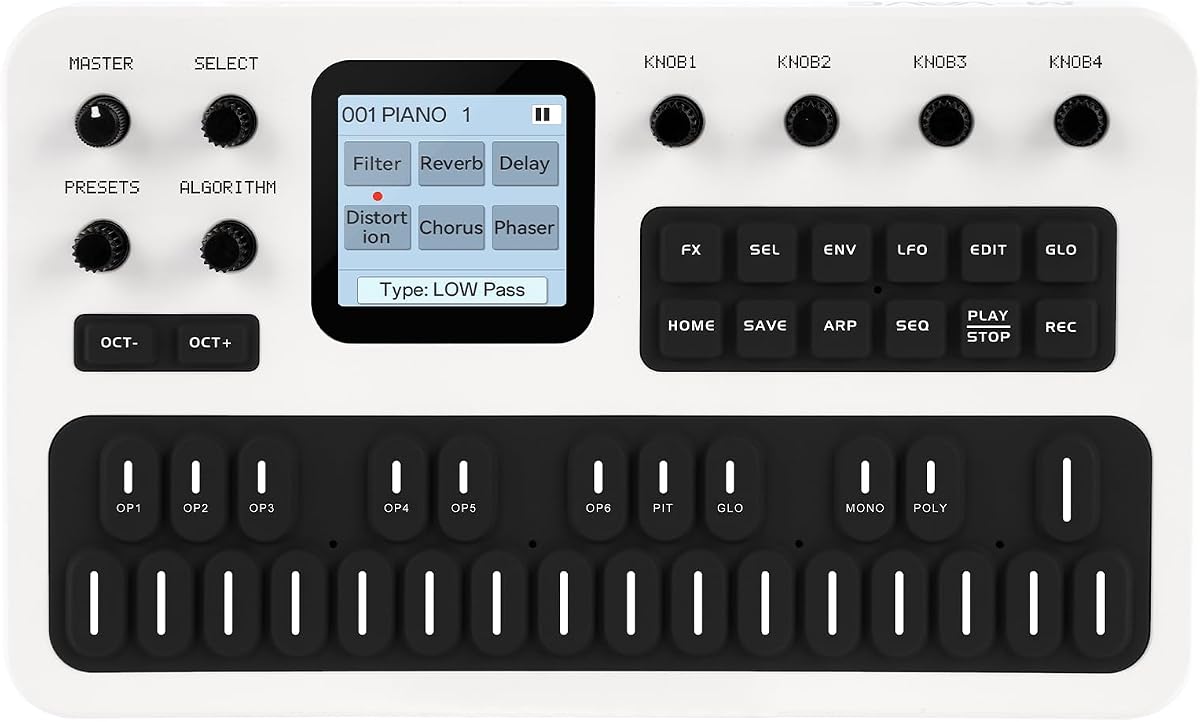
The white M-VALE Wireless Portable FM Synthesizer shares the same core feature set as the black edition and earns a 4.4 rating. Its appeal lies in combining a six-operator FM engine, 32 algorithms, 128 factory sounds, a TFT display, built-in effects, an arpeggiator, and a 16-step sequencer in a battery-powered unit with a built-in speaker.
We may earn a commission when you buy through this link, at no additional cost to you.
FM synthesis can be especially useful for the bright, glassy, and slightly synthetic timbres that sit comfortably within a synthwave aesthetic. Each of the six operators can act as a carrier or modulator and offers frequency, level, and feedback control. The result is enough depth to move beyond simple bell presets into more layered basses, keys, strings, and experimental sounds.
The 27 silicone keys are comfortable but do not reproduce the feel of a weighted stage keyboard. The compact screen is better for quick parameter checks than prolonged visual editing. Even so, the built-in speaker, battery, and four real-time arpeggiator knobs make the instrument pleasant for quick melodic work, pattern experiments, and portable sound design.
This version is a compelling choice for a musician who wants FM character without a large keyboard or complicated signal chain. USB MIDI, Bluetooth MIDI, and 3.5 mm MIDI input allow it to fit into several kinds of setup. The primary distinction from the black model is cosmetic, so buyers should consider which finish fits their workspace rather than expecting a different sound engine.
Six operators and multiple algorithms bring more timbral range than a simple preset-driven portable instrument. That makes the unit useful for both familiar patches and experimental FM combinations.
USB, wireless Bluetooth, and 3.5 mm MIDI interfaces can be used together according to the workflow. The instrument can function as a controller, a sound module, or part of a more connected setup.
We may earn a commission when you buy through this link, at no additional cost to you.
The teenage engineering OP–XY has a 4.1 rating but offers the most complete integrated sequencer concept among these products. It combines synthesis, sampling, effects, CV, audio input, MIDI, Bluetooth, and a 64-step workflow in a portable instrument with a built-in speaker and microphone. The result is closer to a portable production system than a conventional performance synthesizer.
We may earn a commission when you buy through this link, at no additional cost to you.
Eight individual instrument tracks and eight auxiliary tracks provide considerable arrangement potential. Each track can operate at a different speed and length, creating polyrhythmic relationships. Punch-in effects, step components, randomized timing, velocity and pitch variation, live automation, and chord-generation tools add ways to develop patterns beyond a simple fixed loop.
Connectivity is the standout feature. The main output, four-in-one multi-output jack, audio input, built-in microphone, MIDI input, USB-C MIDI, and Bluetooth LE create a hub for connecting pedals, synthesizers, drum machines, Eurorack systems, computers, and controllers. Built-in CV and effect sends expand the possibilities further.
This is not a conventional keyboard for learning chord progressions or performing a full piano part, and its specialized format comes with a substantial financial commitment. For producers interested in portable composition, resampling, external-device control, and ambitious step sequencing, however, it is remarkably capable. It is the most specialized recommendation here and the most rewarding for users who value the complete workflow.
Independent instrument tracks can each hold their own sequence and run at different rates. This structure supports arrangements that develop vertically without requiring a large collection of synchronized external devices.
Audio, CV, MIDI, USB, and wireless connections make the OP–XY useful beyond its internal sounds. It can monitor samples, control external instruments, distribute outputs, and serve as the center of a compact mobile production setup.
We may earn a commission when you buy through this link, at no additional cost to you.
The most useful synthwave synthesizer is not necessarily the one with the longest feature list. Start with the roles your music requires, then balance tonal flexibility, performance feel, sequencing depth, connectivity, and the amount of time you want to spend editing sounds.
Different synthesis methods serve different parts of a synthwave arrangement. Analog and ladder-filter instruments are natural choices for forceful basses, expressive leads, and familiar subtractive movement. Digital wave-morphing and wavetable systems excel at complex, evolving timbres and rapid experimentation. FM can provide sharp bells, electric keys, glassy textures, and pronounced metallic character, while hybrid instruments let a producer combine digital oscillators with analog filtering. Choosing by architecture is more useful than choosing by era alone because the same genre can contain both vintage-inspired parts and futuristic layers.
Prioritize the architecture that supports the majority of your intended sounds. If you want a traditional analog workflow, focus on models with clear oscillator and filter controls. If you want broad timbral exploration, a digital or hybrid system may be more rewarding.
Polyphony determines how many notes can sound simultaneously. A monophonic instrument is excellent for a single bassline, lead, or arpeggio, but it cannot reproduce the same sustained chord textures as a polyphonic synthesizer. Four voices can be sufficient for focused riffs and simple arrangements, while six or eight voices provide more room for layered pads and melody. The Yamaha MODX M6 and Arturia MiniFreak offer larger polyphonic palettes, and the ASM Hydrasynth Explorer provides eight voices. Producers working on dense arrangements should also consider how many external layers they already have.
Match voice count to the arrangement rather than the largest available number. More voices are useful only if the workflow makes them easy to control and layer.
Oscillators, filters, envelopes, LFOs, and modulation determine how a basic note can become a finished voice. Multiple oscillators support broad unison sounds and layered movement, while a filter provides the familiar sculpting controls used to adjust brightness and resonance. Digital instruments may offer wave Mutators instead of conventional oscillator shapes, and FM instruments build timbres through the interaction between carriers and modulators. Look for control access as well as feature count: a direct knob, fader, or well-placed encoder can be more valuable than an inaccessible menu option.
Choose a signal path that matches your favorite way of making sound. The result should invite experimentation without making routine edits unnecessarily difficult.
A keyboard should suit how you actually play. Semi-weighted keys offer a middle ground between a lightweight action and a heavier stage instrument, while the 61-key Yamaha MODX M6 is the only model here with a full 61-note span. The MOOG Messenger and Behringer POLY D use 32 or 37 semi-weighted full-size keys. The Arturia MicroFreak and both M-VALE units use unconventional low-profile keybeds that prioritize portability over traditional feel. Polyphonic aftertouch, ribbon control, and MPE can be particularly valuable for subtle melodic expression and evolving pads.
Try the action or examine detailed user feedback before buying, especially if finger technique or long sessions are important. More tactile controls are not automatically better, but they can make live adjustments more predictable.
Synthwave often grows from repeating patterns, so the internal sequencer deserves close attention. The M-VALE instruments provide 16-step recording, playback, and looping. The Behringer POLY D includes a 32-step sequencer and arpeggiator. The MOOG Messenger provides a much deeper 64-step system with probability behavior and parameter recording, while the Arturia MicroFreak supports step editing, four automations, randomization, Spice, and Dice functions. The teenage engineering OP–XY goes furthest with eight instrument tracks, eight auxiliary tracks, 64 steps, independent lengths, and polyrhythmic possibilities.
Look beyond step count. A modest sequencer that is easy to program may be more useful than a complex system that demands a steep learning curve.
A modern synthesizer should work comfortably inside a DAW and with other hardware. USB MIDI and computer connectivity appear across the guide, while the M-VALE units also provide Bluetooth MIDI and 3.5 mm MIDI input. The MicroFreak can send pitch, gate, and pressure through CV outputs. The Messenger adds six analog CV patch points, external audio input, 5-pin DIN MIDI, and USB-C MIDI. The OP–XY goes further with audio input, built-in microphone, CV, effect sends, a multi-output jack, and Bluetooth LE. Check the exact ports required by your setup rather than assuming all connectivity is interchangeable.
Prioritize a connection scheme that reduces friction. A reliable basic workflow is more valuable than several advanced ports that do not fit the intended studio or stage.
A portable instrument can change how often you practice and create. The M-VALE models are the clearest travel-friendly options because they include batteries and speakers, while the OP–XY integrates a substantial sequencer, microphone, and outputs into a portable format. The ASM Hydrasynth Explorer and Arturia MicroFreak are also relatively compact, although the MicroFreak's unusual keybed is designed around experimentation rather than conventional playing. Larger 49- and 61-key instruments generally make more sense when the workspace is fixed and stage stability is important. Consider speaker size, headphone needs, and the amount of desk space available before settling on a format.
Choose portability when it supports regular use, not simply when it appears convenient. A smaller instrument that sits unused will not help a finished track any more than a larger one.
A synthwave collection benefits from instruments that can be learned quickly while still providing deeper tools when needed. The ASM Hydrasynth 49 Key emphasizes minimal paging and workflow shortcuts, while the MODX M6 uses a structured interface with a color touch screen, faders, and dedicated knobs. The OP–XY integrates sequencing and sampling into a single portable workflow. Presets are useful for immediate inspiration, but an instrument should also allow the user to reach important parameters quickly. Budget time for basic sound-design training, especially with deep analog panels, modulation matrices, or complex step editors.
Favor a workflow you understand. The most advanced instrument is not automatically the most productive one for your musical habits.
Begin by learning the instrument's signal path rather than changing many controls at once. Identify the oscillator or engine source, filter, envelope, amplifier, effects, and modulation sources. On the Hydrasynth, explore the relationship among the three oscillators and four Mutators; on FM instruments, start with a simple algorithm before changing operator levels; and on analog models, balance the oscillators and filter before adjusting effects. A short, repeatable patch-building routine makes it easier to turn a promising sound into a consistent part of a track.
Build arrangements around roles. Use one sound for the central bass or lead, another for harmonic movement, and a third for atmospheric or rhythmic detail. Save variations rather than continually overwriting the same patch, and make deliberate filter and modulation moves that support the track's energy. Use the internal arpeggiator and sequencer to test rhythm ideas, then decide whether to keep the generated pattern or perform and edit the notes manually for greater control.
Protect the instrument by following its power and connection instructions, using suitable headphones or amplified speakers at appropriate levels, and avoiding force on unusual key surfaces such as the MicroFreak printed circuit board. Save important sounds and sequences, particularly on portable devices used away from a stable workspace. Keep the unit away from moisture, excessive heat, and unsecured transport conditions, and check firmware or sound-bank compatibility before importing external files. Before a performance, test power, cables, MIDI connections, and every sound that will be used.
The most useful type depends on the musical role and personal preferences. Analog-style instruments are strong for basses and expressive leads, while digital, FM, and hybrid systems provide broader timbral choices for pads, plucks, and experimental layers. Many producers benefit from combining a monophonic or paraphonic instrument with a polyphonic one rather than expecting one model to cover every role.
No. Most of the recommended instruments have 37 keys or fewer, and portable 27-key models can be highly effective for bass lines, melodies, and sequenced parts. A 61-key layout such as the MODX M6 is advantageous when composing with a large range in one instrument or performing arrangements that require wider keyboard access. The best choice is the one that fits your playing and production style.
Choose monophonic if your focus is on expressive bass lines, leads, and traditional arpeggios, as with the MOOG Messenger. Choose polyphonic if you want sustained chords, wide pads, and multiple simultaneous melodic parts, as with the Hydrasynth Explorer or Yamaha MODX M6. A hybrid setup can provide greater range, but it is not essential for every musician.
Yes, especially when they include a sequencer, effects, MIDI, and computer connectivity. The M-VALE units and teenage engineering OP–XY can function as more than simple practice keyboards, although their compact formats focus on sequencing, sound design, and arrangement rather than expansive two-handed playing. Their portability can also make spontaneous idea capture more practical.
FM synthesis creates timbres through the interaction between sine-wave operators, with some acting as carriers and others as modulators. Analog synthesis uses continuously varying electrical signals, commonly through oscillators and filters, to shape a tone. FM often produces bright bells and complex digital textures, while analog-style instruments are often favored for direct control, movement, and familiar subtractive workflows.
The easiest choice depends on whether you prefer guided workflows or free exploration. The M-VALE units provide 128 factory sounds, familiar key layouts, and plug-and-play operation, while the Yamaha MODX M6 combines presets with organized controls. Experimental players may find the Arturia MicroFreak more approachable because it rewards curiosity rather than requiring a fixed vintage sound.
A built-in sequencer is highly useful but not mandatory. It can capture bass riffs, arpeggios, and variations before they are transferred to a DAW, and instruments such as the MOOG Messenger and OP–XY provide especially deep sequencing tools. If you already work primarily inside a DAW, a strong sound engine, keyboard feel, and MIDI connectivity may matter more than an internal sequencer.
Consider the range you regularly play, available desk space, and whether the larger model offers controls you will use. A 49-key instrument can provide a more comfortable span than a compact model, but 37 keys are often sufficient for focused melodic and bass work. The ASM Hydrasynth 49 Key is especially attractive for producers who prioritize both expression and a streamlined editing workflow.
The ASM Hydrasynth Explorer is the strongest all-round recommendation because its wave-morphing architecture, polyphonic aftertouch, MPE support, and broad modulation capabilities suit everything from basses to evolving pads. The MOOG Messenger is the premium choice for expressive monophonic bass and lead work, while the M-VALE Portable FM Synthesizer offers the most approachable portable package with FM synthesis, effects, and sequencing built in.
Your priorities should determine the rest of the shortlist. Choose the Hydrasynth 49 Key for efficient editing and hands-on expression, the MODX M6 for a large performance keyboard and multiple engines, the POLY D for classic analog polyphony, and the Arturia models for experimental hybrid design. Consider keyboard feel, voice architecture, sequencer depth, and connectivity together rather than treating specifications as isolated numbers.
Before purchasing, verify the current product details, included accessories, software requirements, and connection options, and compare the instrument with the sounds and workflow you actually want to make. Product features and prices can change over time, so checking current listings ensures that your final choice remains suitable for both your setup and your musical ambitions.