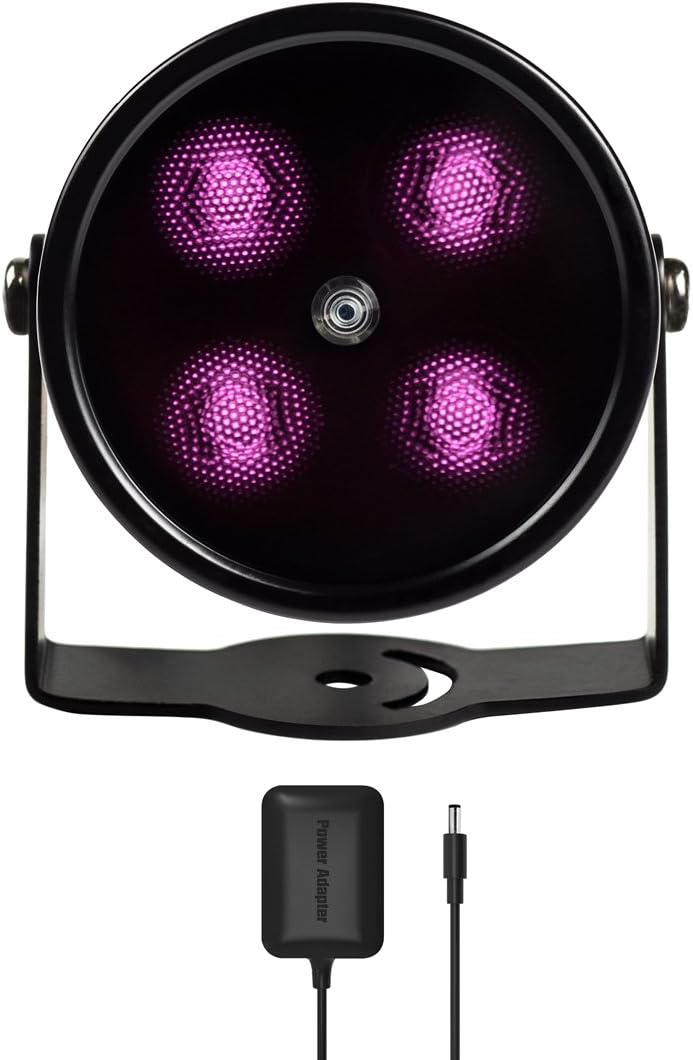
80ft AI4 IR Illuminator
4.4Editor score
80-foot advertised range
90-degree flood coverage
Automatic photocell switching
IP65 weather resistance
Compare ten IR Illuminator Flood Light options in an expert guide, evaluating 850nm range, beam coverage, waterproofing, mounting ease, and camera compatibility
An IR illuminator flood light adds invisible or faintly red 850nm infrared lighting so compatible security cameras can capture clearer scenes after dark. The best unit balances useful reach, even illumination, compact construction, weather resistance, automatic day-and-night operation, and a mounting system that allows precise alignment with the camera.
This guide compares ten illuminators using the supplied specifications, customer ratings, advertised ranges, beam widths, LED counts, power options, housing materials, and installation features. It covers compact residential choices, long-range outdoor models, wide-angle units, and high-output options for cameras, while noting important compatibility considerations.
Each pick reveals how the products differ in practical coverage, construction, and installation, helping shoppers match an illuminator to their camera lens and monitoring area. Ratings and product details reflect the available listings at the time of research, while prices and availability can change, so confirm current listing information before purchasing.
4.4Editor score

4.4Editor score

4.2Editor score
The comparison below highlights the major differences in advertised reach, beam angle, LED configuration, housing protection, automatic operation, and installation support, making it easier to identify the right model for a particular camera and location.





The Tendelux 80ft AI4 combines four high-power 850nm LEDs with a compact housing and a customer rating of 4.4. Its most attractive qualities are the 90-degree flood spread, up-to-80-foot advertised range, and an IR band-pass filter intended to reduce hot spots and foreground overexposure. It is a sensible entry point for compatible CCTV cameras that need supplemental infrared light without a large fixture.
We may earn a commission when you buy through this link, at no additional cost to you.
The included photocell provides automatic switching, turning the unit on in darkness and off in daylight so the owner does not have to manage it manually. An IP65 rating makes it suitable for outdoor use, while the CE, RoHS, and FCC certifications indicate attention to relevant standards. The 12VDC power adapter, screws, and manual simplify setup for a camera mounted near a wall, soffit, or exterior post.
Its limitations are straightforward: the advertised reach is modest compared with the 120-foot BI8, the 150–240-foot JCHENG, and longer-range models in this guide. The four-LED configuration may also be insufficient for very large properties or distant subjects. Even with those limitations, the filter, compact construction, and automatic operation make the AI4 a balanced choice for porches, driveways, gates, and small yards.
Choose this model if your camera uses 850nm infrared and the monitored area is close to the fixture. It is particularly appealing to buyers seeking an uncomplicated, compact illuminator with a complete accessory set and two-year warranty. For a wider property or longer sightline, move up to a higher-output unit; otherwise, the AI4 offers a useful and economical balance.
The band-pass filter is designed to spread the emitted infrared energy more evenly across the camera's field of view. That helps reduce the bright central patch and washed-out foreground that can appear when an unfiltered flood is aimed too close to a lens.
A built-in CdS photocell switches the illuminator on and off according to ambient light. This makes the unit practical for continuous installations where manually controlling the light would be inconvenient.
We may earn a commission when you buy through this link, at no additional cost to you.
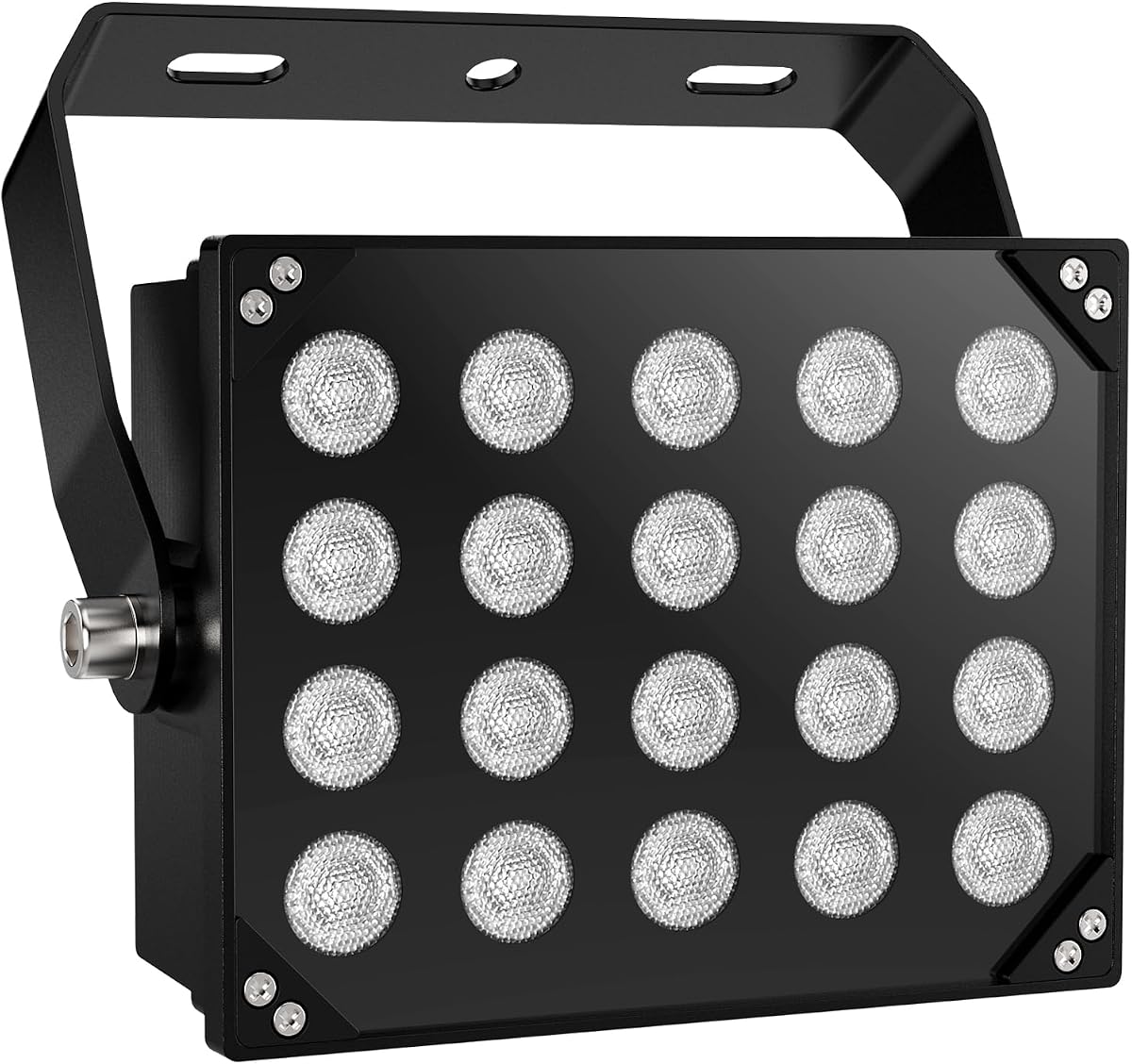
The JCHENG 20-LED IR illuminator earns a 4.4 rating and stands out for its combination of substantial output, broad 90-degree coverage, and an advertised effective range of 150–240 feet. It is a strong all-around choice for security cameras, hunting cameras, vehicles, warehouses, farms, museums, and other installations where the scene may be large or difficult to light.
We may earn a commission when you buy through this link, at no additional cost to you.
Twenty high-power EPISTAR LEDs are supported by air convection heat dissipation, a constant-current and constant-voltage drive circuit, and a secondary optical-angle design. The die-cast aluminum casing, black rubber filling, and thickened waterproof ring support an IP66 rating for outdoor operation. A 180-degree adjustable bracket and included 12V 2A adapter make it easier to position the light close to the camera and direct it across the intended field.
The photosensitive controller is another practical feature. The listed thresholds switch the light on at 15 lux or less and off above 30 lux, with a 15-second delay intended to reduce flickering. A user can also cover the sensor with black tape when automatic operation is inconvenient. The claimed compatibility extends beyond security cameras to infrared-equipped VR headsets, although camera support still depends on 850nm infrared sensitivity.
This is a good choice for users who need more reach than a compact yard light can deliver but prefer a more manageable fixture than the largest 198-LED unit. It may consume more power and require more careful heat management than lower-output models, but the added coverage can improve visibility, motion recognition, and image clarity. For broad outdoor coverage, it is one of the strongest recommendations in the guide.
The combination of 20 LEDs, a 90-degree field of view, and a listed range of 150–240 feet makes this unit more appropriate for driveways, yards, agricultural areas, and large outdoor compounds than a compact illuminator intended for a porch or doorway.
Air convection heat dissipation and the dedicated drive circuit are designed to support consistent output and LED life. The aluminum enclosure also helps move heat away from the light source, which is particularly relevant during extended nighttime operation.
We may earn a commission when you buy through this link, at no additional cost to you.
The Tendelux DI20 is a compact, premium-style long-range illuminator with a 4.2 customer rating. It is positioned as a small alternative to the maker's 18W BI18 model, while emphasizing even light distribution, a modern housing, and precise bracket adjustment. That combination makes it attractive for owners who want a high-output fixture without the visual bulk of a much larger array.
We may earn a commission when you buy through this link, at no additional cost to you.
Its tailored integrated lens is intended to spread illumination efficiently across the camera's field of view, reducing hot spots and washed-out areas. The 360-degree swivel and 90-degree tilting bracket allow the light to be aligned around a corner or adjusted alongside a camera with fewer awkward installation angles. Premium aluminum and a unibody design are used to improve structural stability and resist the aging associated with plastic housings.
The DI20 is not the simplest possible installation. It includes a 110–240V AC to 24V DC 1.5A adapter, installation screws, and a manual, but users who extend the low-voltage run should account for possible voltage drop. The supplied listing does not provide one exact range figure, so buyers should not interpret the product name as a guaranteed numerical reach. Instead, consider its output class and optical design when comparing it with explicitly ranged models.
The DI20 is best for a knowledgeable installer who values compact construction, even illumination, and fine mounting control. It is also a sensible premium alternative to a large exposed LED panel. Those who need a simple, numeric range target may prefer the JCHENG, while the DI20 appeals to users who prioritize lens design, housing quality, and flexible positioning.
The integrated lens is designed around even distribution rather than a narrow central hotspot. This can make the fixture more suitable for cameras that need broad, consistent infrared coverage across a yard, entrance, or side passage.
A 360-degree swivel and 90-degree tilt provide considerable freedom when the light must sit beside, above, or slightly behind the camera. That flexibility is valuable where a fixed-angle bracket would force an impractical installation.
We may earn a commission when you buy through this link, at no additional cost to you.
The Univivi 8-LED model is a wide-angle 850nm illuminator for compatible night-vision cameras, carrying a 4.1 rating. Its construction is a major selling point: EPISTAR LEDs, a heavy-duty aluminum housing, thick heat sink, reinforced glass window, and stainless steel screws are combined with an IP67 waterproof rating.
We may earn a commission when you buy through this link, at no additional cost to you.
The built-in photocell automatically activates the unit around dusk and deactivates it around dawn. A 90-degree flood pattern is intended to cover a broad camera view rather than creating one concentrated spot, making it appropriate for wide-angle security cameras. The package includes a 12V 1A adapter, installation screws, and a user manual.
The listing appropriately emphasizes that this is supplementary infrared lighting, not a conventional visible-light lamp. A compatible camera must have night-vision capability and detect 850nm infrared. The red glow visible around the LEDs is normal, while the main infrared beam is invisible to the unaided eye. Without a compatible camera, the fixture will not improve recorded footage.
This illuminator is a reasonable middle option for users who prioritize rugged materials and wide coverage but do not need the long reach of the JCHENG or IR130. Its rating is lower than several alternatives, and no specific distance is provided, so expectations should be based on camera sensitivity and scene size. It is best suited to robust residential or light-commercial installations using a wide-angle night-vision camera.
The thick aluminum heat sink, reinforced glass, and stainless steel screws create a more robust package than a basic plastic-bodied light. An IP67 rating adds confidence for exposed installations where rain and dust are concerns.
The fixture only improves footage when the paired camera can detect 850nm infrared and operate in night-vision mode. Checking this requirement before installation prevents disappointment and unnecessary mounting work.
We may earn a commission when you buy through this link, at no additional cost to you.
The Tendelux DI10 fills the middle ground between compact household illuminators and longer-range professional fixtures. It has a 4.0 rating, an integrated tailored lens, and a housing described as half the size of the maker's BI8 while providing more illumination for compatible CCTV cameras.
We may earn a commission when you buy through this link, at no additional cost to you.
Its 360-degree swivel and 90-degree tilting bracket make it easy to align the light with a camera's field of view. The aluminum construction is intended to age better under sunlight than plastic alternatives, while the unibody housing combines a modern appearance with an integrated cooling design. These qualities are especially useful for permanently mounted outdoor cameras.
A 110–240V AC to 24V DC 1A adapter is included, and the listing states that the power supply was updated to avoid pressure drop and brightness loss after using a long extension cable. That is useful information for installers, although cable length and quality still deserve attention. As with the DI20, the DI10 does not provide a clear numerical range, making direct comparison based on reach difficult.
Choose the DI10 when a moderate-area scene needs more consistency than a basic four-LED light but not the output or reach of a long-range unit. Its 4.0 rating is lower than most alternatives, so buyers should give extra weight to camera compatibility, placement, and the included 24V power supply. It is a focused mid-range option rather than the guide's most universally compelling purchase.
The DI10 is designed for medium-range applications, making it a practical bridge between compact porch lights and long-range fixtures. It suits users who need broader, more even output without carrying the size or power demands of a high-LED panel.
The updated 24V DC adapter is intended to reduce brightness loss and pressure drop associated with long extension runs. It gives installers a more appropriate starting point for installations where the light must sit away from the camera.
We may earn a commission when you buy through this link, at no additional cost to you.
The black Univivi 20-LED illuminator combines a 4.4 rating with 20 high-power 850nm LEDs and a 90-degree wide-angle output. It is designed for cameras that need substantial infrared illumination without a visible flood beam, making it suitable for exterior surveillance areas where conventional lighting would be undesirable.
We may earn a commission when you buy through this link, at no additional cost to you.
A thick aluminum housing and large heat sink are used to manage the 24-watt output class. The listing states that the surface temperature remains below 120 degrees Fahrenheit during continuous operation, supporting a longer service life. Reinforced glass, stainless steel screws, and an IP67 waterproof rating add outdoor durability.
The photocell turns the light on at dusk and off at dawn. The recommended orientation places the sensor head downward to avoid direct sun exposure, which helps the ambient sensor respond properly. The included 12V 2A adapter, screws, and manual make the package relatively complete, but a fixed low-voltage power arrangement may limit where the fixture can be installed.
This model is most appropriate for a broad, dark monitoring zone where a compact illuminator would not provide enough light. It is larger and potentially excessive for a doorbell, small porch, or camera focused on a nearby gate. Compared with the JCHENG 20-LED option, it has a similar LED count and beam width, but the Univivi emphasizes its heat-sink design and stated surface-temperature control.
The large heat sink and thick aluminum enclosure help dissipate heat from 20 high-power LEDs. A listed surface temperature below 120 degrees Fahrenheit during continuous use indicates attention to thermal control and component longevity.
The 850nm beam is invisible to the unaided eye apart from a faint red glow around the LEDs. This allows a security area to receive infrared support without producing the bright visible appearance of a conventional outdoor floodlight.
We may earn a commission when you buy through this link, at no additional cost to you.
The Tendelux BI8 delivers up to 120 feet of advertised night-vision support using eight one-watt 850nm LEDs. Its 4.3 rating and combination of broad flood coverage, weather resistance, and an IR filter make it a dependable middle-range option for compatible CCTV cameras.
We may earn a commission when you buy through this link, at no additional cost to you.
The 90-degree spread is designed for cameras with 2.8mm, 3.6mm, or 4mm lenses, and an anti-UV IR pass filter is intended to reduce hot spots and prevent the foreground from becoming overexposed. A U-bracket provides rotational adjustment, while the built-in CdS photocell enables automatic day-and-night operation. CE, RoHS, and FCC certifications support confidence in the product's stated compliance.
The included 12VDC 1A power adapter makes initial setup straightforward, and the package provides installation screws and a manual. As with any fixed security accessory, however, the quality of the result depends on camera sensitivity, lens choice, ambient reflection, and whether the light is mounted close enough to share the camera's field of view. The BI8 cannot correct a camera that does not detect 850nm infrared.
Choose the BI8 when you want more reach than the AI4 without moving to the much higher output of the JCHENG or DMetric. It is well suited to yards, driveways, gates, and medium outdoor areas. Buyers needing extreme distance should consider a long-range model, but for many residential installations, 120 feet of advertised coverage provides a useful balance of reach and manageable size.
The anti-UV IR pass filter is intended to keep the illuminated foreground from becoming excessively bright. This helps maintain more usable image detail when the illuminator and camera are positioned close together.
The listed lens compatibility and 90-degree spread provide guidance when matching the light to a wide security camera. The rotatable U-bracket then allows fine alignment after the camera's final position is set.
We may earn a commission when you buy through this link, at no additional cost to you.
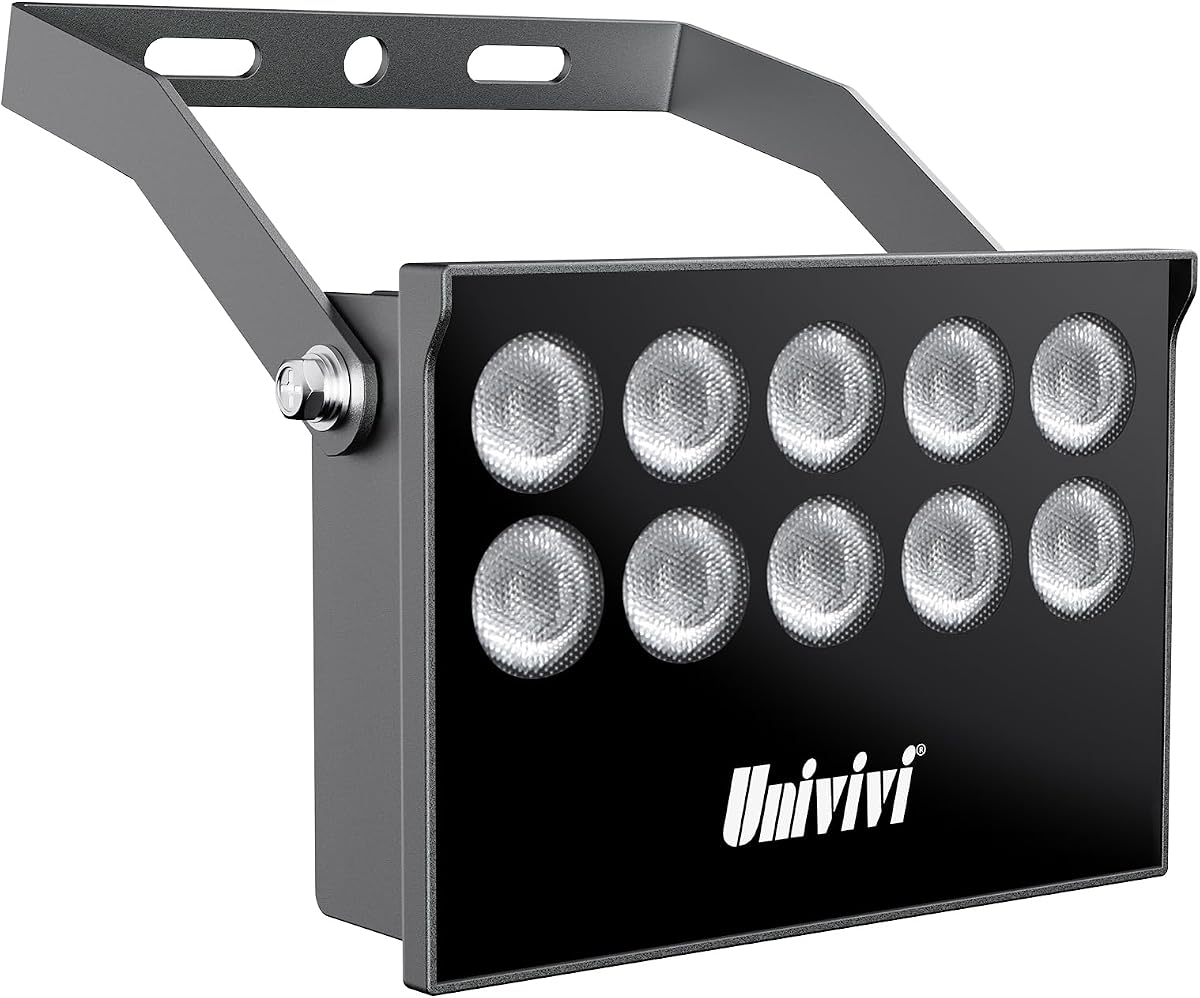
The grey Univivi 10-LED illuminator is a 10-watt, 90-degree 850nm floodlight designed to improve CCTV night vision. Its 4.2 rating reflects a balanced feature set, including automatic operation, a full-size heat sink, an IP67 waterproof housing, and a bracket designed to simplify adjustment.
We may earn a commission when you buy through this link, at no additional cost to you.
The upgraded heat sink is intended to keep the surface below 120 degrees Fahrenheit during continuous use, supporting more stable long-term operation. The housing uses unibody die-cast aluminum, reinforced glass, and stainless steel screws. These construction details make it a credible choice for exterior walls, eaves, posts, and other exposed positions.
A built-in photocell switches the illuminator on at dusk and off at dawn. The longer and wider bracket is specifically designed to avoid screwdriver interference, making it easier to change the light's orientation. It is particularly useful where space is tight and the light must be moved around a bracket or mounting surface.
The product does not specify an exact numerical range, so camera matching and real-world distance should guide the decision. It sits between the Univivi 8-LED and 20-LED options, offering a convenient middle output without the bulk of the larger fixture. This makes it useful for standard residential and small commercial scenes where a broad 90-degree beam and robust outdoor housing are the priorities.
Ten LEDs provide more capacity than an eight-LED fixture while remaining less substantial than a 20-LED model. The result is a practical middle option for broad, medium-size monitoring areas.
The wider bracket creates clearance from nearby screws and mounting hardware. That design makes directional changes less frustrating, particularly when the light is mounted close to a wall, eave, or camera housing.
We may earn a commission when you buy through this link, at no additional cost to you.
The DMetric 96-LED illuminator offers a different approach from the smaller bracket-mounted models. It uses a large array of 850nm infrared LEDs, an aluminum case, reinforced glass, and an advertised range of 263 feet. Its 3.9 rating is the lowest in this guide, but the specification set may appeal to users who prioritize reach over compactness.
We may earn a commission when you buy through this link, at no additional cost to you.
A 60-degree beam is narrower than the 90-degree spread of many alternatives, allowing the light to concentrate infrared energy over a longer target. The U-stand provides straightforward attachment to rods or mounting surfaces. A built-in CDS sensor turns the unit on when ambient light falls below 10 lux and off when it rises above that threshold.
The fixture is described as accepting 110V–220V AC, which differs from the low-voltage DC models that need an external adapter. Buyers should still confirm the current electrical configuration and follow the supplied instructions. The aluminum housing and IP65 rating support indoor and outdoor use, while low power dissipation and long-life LEDs are intended to reduce maintenance.
This model is most suitable for a large outdoor property, long driveway, farm area, warehouse, or other setting where substantial distance is important. Its 60-degree spread requires careful aiming, and the 96-LED panel will be visually and physically bulkier than the compact options. Because its rating is lower, buyers should carefully review current customer feedback and ensure the installation can accommodate its size and power arrangement.
The advertised 263-foot range and 60-degree angle show that this unit prioritizes distance rather than maximum flood width. It is a stronger consideration for straight approaches and open areas than for compact scenes surrounding a camera.
The integrated CDS light sensor operates at a stated 10-lux threshold, activating in darkness and deactivating in brighter conditions. This reduces the need for manual control and supports unattended overnight monitoring.
We may earn a commission when you buy through this link, at no additional cost to you.
The IR130 198-LED illuminator is the long-range specialist in this guide, with a 4.3 rating and an advertised range of 300–400 feet. Its 198 infrared LEDs, 45–60-degree beam angle, and 12V DC input make it suited to large properties, long driveways, agricultural areas, and other demanding outdoor environments.
We may earn a commission when you buy through this link, at no additional cost to you.
The IP66 case supports indoor and outdoor use, while 360-degree tilt allows the light to be aimed across a broad vertical plane. A CDS sensor automatically switches the unit on when available light is below 10 lux. The new version also includes a photo-sensor on and off switch, giving users direct control when automatic operation is not desired.
A three-amp 12VDC adapter is included, which is appropriate for the high LED count. The supplied information notes low operating costs, although the large array and long advertised reach make this more of a specialist installation than a simple household accessory. Exact brightness and clarity still depend on the camera's infrared sensitivity, lens, and the area's reflective surfaces.
Choose the IR130 when distant subjects genuinely need illumination and the installation area can support a substantial fixture. It is not a sensible first choice for a doorbell, small porch, or nearby driveway, where a compact 90-degree unit would be easier to position. For large-scale coverage, however, its 300–400-foot target and 198-LED array make it the most specialized option among these ten picks.
The 300–400-foot advertised range is the key reason to consider this model. It is aimed at large outdoor environments where standard compact illuminators cannot adequately support a camera's long-distance view.
The CDS sensor provides automatic nighttime activation, while the added photo-sensor switch offers manual control. That combination is useful for installations with unusual ambient lighting or specialized operating schedules.
We may earn a commission when you buy through this link, at no additional cost to you.
Choosing an IR illuminator involves balancing camera compatibility, infrared output, beam width, reach, electrical requirements, and outdoor durability. The right fixture illuminates the camera's intended field without wasting output or creating difficult bright areas in the foreground.
Choose an illuminator that matches the camera's supported wavelength and intended application. For standard night-vision CCTV, the 850nm units shown here are the relevant group, but the exact model still needs to support the camera's power and switching behavior.
Short-range units suit porches and small yards, mid-range models cover standard driveways, and high-output fixtures suit long approaches. Always treat advertised distance as a product characteristic, not a guarantee of image quality.
Match the beam to the lens and viewing area. Use a wide flood for broad camera views, but do not cover a small scene with an unnecessarily powerful array.
Choose enough output for the scene without ignoring the optical system. Even illumination, proper cooling, and a lens compatible with the camera are more valuable than LED count alone.
Use the supplied or explicitly specified power supply, and account for extension-cable length. Electrical compatibility is as important as light output for reliable performance.
For exposed installations, favor a suitable IP rating, robust housing, and effective heat sink. Secure the fixture and protect cable connections from standing water.
Automatic day-night switching adds convenience, while broad adjustment makes correct aiming easier. Confirm both before installation and position the sensor away from direct sunlight.
Prefer a complete package with appropriate power, hardware, documentation, and warranty. Confirm all camera and electrical requirements before ordering.
Begin by confirming that the camera supports 850nm infrared and that the illuminator's electrical input matches the supplied power adapter or approved supply. Mount the light close to the camera, preferably on the same wall or bracket plane, so both devices share a similar viewing direction. Secure the housing, connect the power wiring, and aim the beam across the area of interest rather than directly at a reflective wall, window, or nearby object.
Allow the photocell to switch the unit on at dusk and evaluate the image after darkness. If the foreground looks overly bright or the center appears washed out, adjust the illuminator's angle and distance from the camera. Tighten the bracket after any change, and make incremental adjustments because a small movement can noticeably alter the near and far portions of the scene. Do not stare directly into the LEDs or assume the faint red glow represents the full infrared output.
For care, periodically inspect the bracket, fasteners, glass window, cable connections, and power supply. Clean the reinforced glass with a soft, lint-free cloth and avoid abrasive or harsh chemical cleaners. Keep the heat sink unobstructed, preserve airflow around the housing, and ensure the photocell is not shaded in a way that prevents proper nighttime activation. If illumination declines, check the power connection and placement before assuming the LEDs have failed.
No. The camera must have night-vision capability and sensitivity to the illuminator's infrared wavelength. Most products reviewed here use 850nm infrared, so check the camera specifications before installing a light. A visible-light-only camera may show little or no benefit even when illuminated correctly.
The main 850nm infrared beam is generally invisible to the unaided eye, although the LED array may show a faint red glow. Cameras with infrared-sensitive sensors can detect the illumination. The glow is normal and does not necessarily mean the unit is malfunctioning.
Close placement often produces more even illumination because the light and camera cover similar areas. The light should normally be mounted beside or near the camera and pointed in the same general direction. Exact separation depends on the lens, beam angle, scene depth, and the tendency of nearby surfaces to reflect infrared light.
A 90-degree beam suits wide security-camera views and broad areas, while a 45–60-degree beam concentrates output for longer approaches. Narrower beams require more accurate aiming but can be effective for driveways, gates, and long boundaries. Choose based on the camera's field of view rather than beam width alone.
The reviewed products have IP65, IP66, or IP67 weather-resistance ratings, making them suitable for outdoor use subject to proper installation. Keep electrical connections dry and secure, do not block the housing vents or heat sink, and avoid directing the photocell at sunlight. Rating labels are not substitutes for careful mounting.
It is convenient but not strictly essential. A built-in photocell activates the illuminator in darkness and switches it off in daylight, reducing energy use and manual effort. Several models also provide a manual sensor switch or adjustable threshold, which is useful when nearby artificial light repeatedly triggers the sensor.
The camera may be receiving excessive reflected infrared from a nearby wall, roof, walkway, or other surface. Move the illuminator closer to the camera, change its angle, or reduce the output by choosing a lower-powered model. Integrated lenses and IR pass filters can improve uniformity, but correct placement remains essential.
Long cable runs can cause voltage drop and reduced brightness, especially when using a low-current adapter. Follow the specified power supply and the manufacturer's guidance on cable length and gauge. The DI10 and DI20 include updated 24V DC adapters specifically to reduce brightness loss associated with long extension runs.
Before choosing, confirm that the camera supports 850nm infrared, then match beam angle and advertised range to the actual scene. Consider outdoor protection, cooling, power requirements, and bracket adjustment alongside output. A smaller fixture is usually easier to place around a doorway, whereas a long-range array is valuable for large properties, straight driveways, and distant subjects.
Finally, check the current listing, included accessories, warranty, and availability before ordering, because prices and product details can change. Comparing the camera specifications with the illuminator's operating requirements is just as important as comparing range, and it offers the best chance of obtaining consistent nighttime images.
