
ARCTIC P12 Pro A-RGB
4.7Editor score
Wide 4-pin PWM range
Up to 3000 RPM
High static pressure
FDB bearing design
ARGB illumination
Our Addressable RGB Fans guide compares ten 120mm PWM options for airflow, noise, lighting, bearing design, radiator support, and easy PC installation.
Addressable RGB fans combine individually controlled lighting with the airflow needed to keep a PC cool and well ventilated. A strong choice should deliver convincing performance, controllable PWM speeds, reliable bearings, tidy connections, and lighting that can coordinate with the rest of a finished system. Those details matter more than RGB appearance alone.
We compared all ten products using their stated specifications, including fan size, maximum speed, airflow, static pressure, noise, bearing construction, lighting controls, daisy-chain support, and intended placement. The list covers budget-focused options, premium feature sets, high-speed radiator fans, and mixed-direction kits designed for complete case airflow.
Each review explains where the fan stands out, where practical compromises may appear, and which type of builder it best suits. Ratings reflect the supplied customer feedback rather than personal testing. Product availability, bundle contents, and prices can change, so verify current listings before making a final purchase.
4.7Editor score

4.8Editor score
4.8Editor score
The comparison below places all ten fans side by side, emphasizing the specifications that most affect cooling, acoustics, installation, and ARGB control. Pack size is separated from core performance so buyers can compare fans of the same physical size without overlooking what each set includes.




The Thermalright TL-C12C-S 5-Pack is a 120mm ARGB cooling set built around a straightforward 4-pin PWM platform. Its supplied rating is 4.7, and the practical appeal comes from combining five identical fans with a stated maximum speed of 1550 RPM, 66.17 CFM airflow, and noise of no more than 25.6 dBA. It is a credible option for builders who want a coordinated group of case fans rather than a single decorative replacement.
We may earn a commission when you buy through this link, at no additional cost to you.
Automatic motherboard control is one of the most useful features. Through the 4-pin PWM connection, the fans can respond to temperature feedback and vary their speed automatically. The specification also lists cables up to 55cm for PWM series control, while the S-FDB bearing is intended to reduce blade vibration and maintain smooth operation. Lighting comes from high-brightness ARGB elements on the blades, with up to 17 modes available through a compatible motherboard connection.
The main trade-off is that the set focuses on straightforward cooling and illumination rather than elaborate wiring or premium visual effects. The listed airflow and static pressure are moderate compared with several higher-speed options in this guide, so it may not be the first choice for unusually restrictive radiators or demanding high-static-pressure installations. Its appeal is better understood as dependable, balanced performance across a complete group of standard 120mm positions.
This pack is best for a new build that needs several intake or exhaust fans, a quiet everyday desktop, or a system where temperature-responsive PWM control and ARGB synchronization matter more than aggressive maximum speed. It also suits compatible air coolers and radiators. For most builders, the combination of five fans, established dimensions, and controlled acoustics makes it an easy recommendation.
Connecting the fans to a compatible motherboard through 4-pin PWM allows the system to adjust their speed with temperature feedback. Builders who prefer a consistent setting can also use a fixed-speed mode, making the set flexible for both automatic and manual control.
Each fan measures 120 by 120 by 25mm and can serve as a case intake or exhaust, work with a CPU air cooler, or support a radiator. The stated 66.17 CFM airflow and 1.53 mm-H2O pressure provide a versatile foundation for balanced internal airflow.
We may earn a commission when you buy through this link, at no additional cost to you.
The CORSAIR RS120 ARGB triple pack combines a 2100 RPM ceiling with a stated airflow of 72.8 CFM. Its 4.6 supplied rating reflects a well-rounded specification sheet with particular strength in high-speed cooling and radiator use. The fans use magnetic dome bearings and are designed to support both case airflow and more demanding positions such as heatsinks and radiators.
We may earn a commission when you buy through this link, at no additional cost to you.
Connection management is a central advantage. Multiple RS fans can be daisy-chained and controlled through one 4-pin PWM connector and one +5V ARGB connector, reducing the number of headers required. Each fan carries eight addressable LEDs that can be customized through compatible motherboard ARGB software. That makes the set practical for builders who want coordinated lighting without scattering separate RGB connections throughout the case.
Performance details separate the RS120 from more conventional 120mm options. AirGuide anti-vortex vanes are intended to concentrate airflow toward hot components, while the stated 2.8 mm-H2O static pressure supports use against radiator fins and other obstructions. The faster speed ceiling also gives users more range than many competing products. As with any high-speed fan, the additional performance may produce more sound than a slower, quieter model during demanding loads.
The RS120 is best suited to a gaming or performance build with a radiator, a case designed around high airflow, or a builder who values both lighting and fast speed adjustment. It is less essential for a small office system where low noise matters more than maximum output. For a radiator-oriented ARGB build, its strong pressure and airflow figures make it one of the most compelling selections here.
A stated static pressure of 2.8 mm-H2O gives the RS120 useful resistance against radiator fins and tight obstructions. This specification supports the product's positioning for radiators and heatsinks rather than limiting it to open case positions.
The daisy-chain arrangement lets several fans share one PWM and one ARGB connection. Compatible motherboards can then manage their speed and lighting, reducing cable clutter while preserving synchronized illumination across the set.
We may earn a commission when you buy through this link, at no additional cost to you.
The ARCTIC P12 Pro A-RGB stands out because it combines addressable lighting with a very wide performance envelope. Its 4.7 supplied rating is backed by a maximum speed of 3000 RPM, progressive 4-pin PWM adjustment, and a fan that can stop completely at less than 5% PWM. Those characteristics make it especially useful for builders who want precise control over both quiet idle operation and aggressive cooling.
We may earn a commission when you buy through this link, at no additional cost to you.
The fan is engineered around high static pressure, allowing it to move air through dense radiators, narrow perforated panels, and mesh structures. Precision manufacturing, automatic balancing, and minimal rotor gaps are intended to reduce vibration. A self-lubricating fluid dynamic bearing supports smooth running and long service life, while the revised blades are designed to balance output with low noise, particularly at lower speeds.
The unusual 3000 RPM ceiling is a double-edged feature. It offers considerable headroom for restrictive positions and demanding radiators, but users who leave the fan at maximum may hear more noise than they would from a model capped near 1500 or 2000 RPM. The unusually broad PWM range provides an easy remedy: installers can use a refined fan curve to keep low loads quiet and permit high airflow only when temperatures rise.
For a budget-conscious builder, this is one of the strongest options in the guide because it does not require sacrificing smart control or obstacle performance for ARGB. It is particularly suitable for radiator mounting, compact systems with limited airflow paths, and users who want an exceptionally broad speed range. Verify the current package quantity before ordering, as the supplied listing identifies a single 120mm fan without stating a multi-pack quantity.
The fan adjusts progressively through the 4-pin PWM connection and can stop completely below 5%. That range allows a motherboard curve to balance near-silent idle cooling against maximum output when internal temperatures climb.
High static pressure helps the fan push air through dense radiator fins, perforated panels, and mesh. This makes it useful when a case has limited clearance or when a radiator requires more focused airflow than an open intake position.
We may earn a commission when you buy through this link, at no additional cost to you.
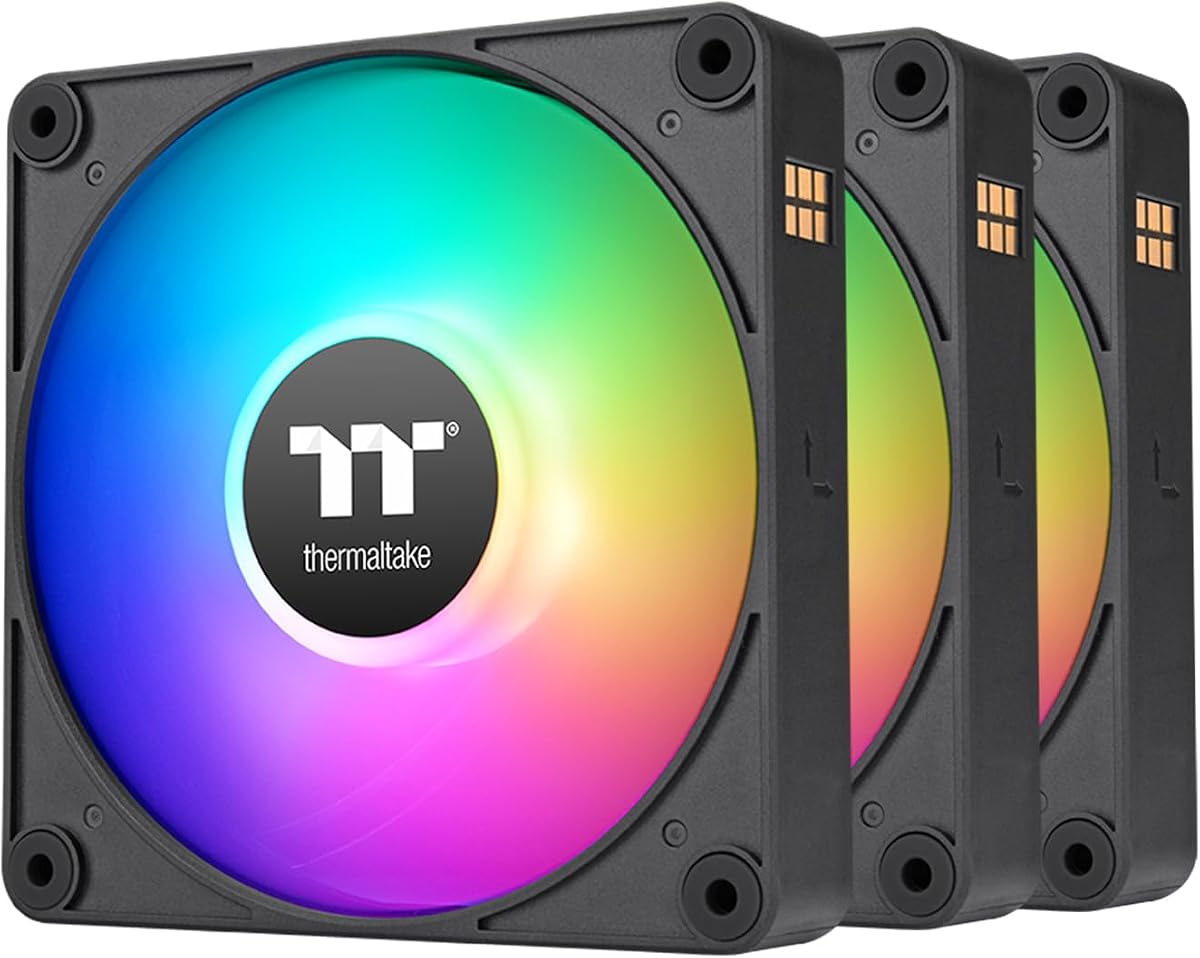
The Thermaltake CT120 EX ARGB is a three-fan set centered on simple physical connections and coordinated 5V lighting. It has a supplied rating of 4.6 and is aimed at builders who want a polished group of 120mm case or radiator fans without assembling a complicated network of individual cables. Nine addressable LEDs on each fan provide the basis for motherboard-controlled effects.
We may earn a commission when you buy through this link, at no additional cost to you.
The MagForce 2.0 magnetic connection design is the most distinctive feature. It allows multiple fans to be daisy-chained with one cable, reducing the number of separate connections that must run to the motherboard or controller. The set uses an optimized hydraulic bearing for smooth, quiet operation, and an anti-vibration mounting system is embedded into the frame to help reduce vibration transfer into the chassis.
Compared with fans that publish extensive airflow and pressure numbers, the supplied information for the CT120 EX ARGB focuses more heavily on connection design, lighting, and mounting. It does not state a maximum RPM figure, airflow volume, or static-pressure value. That makes it harder to position directly against specification-heavy alternatives, although its stated radiator and case compatibility broadens its intended uses.
This Thermaltake set is best for a themed gaming build in which visual consistency and clean installation are priorities. It works particularly well for users with a compatible 5V motherboard lighting system who want three matching fans. Those who need to compare maximum cooling output or plan an unusually restrictive radiator setup should examine the complete current listing and consider a model with more explicit performance specifications.
MagForce 2.0 connections let multiple fans join with one cable rather than requiring a separate cable run for each unit. The magnetic approach can simplify both installation and later removal when the case layout is tight.
Each fan includes nine addressable LEDs controlled through compatible 5V motherboard software. That allows the CT120 EX trio to join a wider lighting scheme instead of operating as an isolated set.
We may earn a commission when you buy through this link, at no additional cost to you.
This six-fan bundle is built around a practical goal: creating a balanced three-dimensional intake-and-exhaust layout while maintaining visible lighting from more than one direction. It includes four forward fans and two reverse fans, with the reverse blades intended for bottom or side intake positions where their illuminated faces remain visible. The supplied rating is 4.4, which is the lowest in this roundup but still reflects a useful overall package.
We may earn a commission when you buy through this link, at no additional cost to you.
Each fan reaches a stated 1550 RPM and uses nine high-pressure blades with an HDB bearing. PWM control can respond to CPU or motherboard case-temperature feedback, allowing quieter behavior at low load and increased airflow under demand. The combined ARGB and PWM hub connects the case fans and other ARGB devices while centralizing speed and lighting management. That controller is particularly useful in compact cases where separate cables for every fan would become difficult to route.
The three-sided prism design and 28 LEDs per fan create a more involved appearance than a conventional single-ring fan. The specification states that the lighting is 25% denser than typical examples, while motherboard synchronization allows the set to match a broader case theme. The physical design is more complex than a basic 120mm model, but it also creates a stronger visual identity for builders who regard the lighting as a central part of the build.
The set is best for a new system that needs numerous fans, particularly when the builder wants reverse-blade intake fans and a controller-based wiring approach. It can also fit standard 120mm air-cooler and 120, 240, or 360mm liquid-cooling radiator positions. Buyers should ensure their case has room for six 120mm fans and that the controller can be mounted without obstructing airflow.
Four forward and two reverse fans support a deliberate three-dimensional airflow arrangement. Reverse blades are particularly useful where a normal intake fan would hide most of its lighting from outside the case.
The included 2-in-1 ARGB and PWM hub links the lighting and fan-control requirements of the set. It reduces wiring complexity and supports multiple lighting modes through a central point.
We may earn a commission when you buy through this link, at no additional cost to you.
The Thermalright TL-C12C-S X3 is a three-fan version of a design that also appears in larger bundles. It carries a 4.6 supplied rating and offers a practical middle ground for builders who want coordinated ARGB fans without installing a five-fan group. Its 120 by 120 by 25mm dimensions and standard 4-pin PWM connection make it familiar to work with in conventional ATX and MATX cases.
We may earn a commission when you buy through this link, at no additional cost to you.
The listed operating range runs up to 1550 RPM, with airflow of 66.17 CFM and static pressure of 1.53 mm-H2O. Noise is listed at no more than 25.6 dBA, and the S-FDB bearing is intended to limit blade shaking and preserve smooth operation. Automatic motherboard speed adjustment allows the fans to respond to temperature feedback, while the ARGB illumination offers up to 17 modes and synchronization through a compatible motherboard port.
The core trade-off is not a weakness in the specification but a question of bundle strategy. A larger pack of the same model may be more economical for a build that needs five positions, while this three-pack is more focused and potentially more convenient when two additional fans are unnecessary. The listing also repeats the same size and performance description twice, but the usable information remains consistent.
This set is a sensible option for a small gaming desktop, a fresh case with three obvious fan positions, or a builder replacing a CPU cooler and one or two case fans with matching ARGB units. It can also serve compatible radiators and air coolers. Prioritize it when the three-pack format fits the planned layout better than a larger bundle.
The S-FDB bearing is designed to prevent the blade-shaking behavior associated with some inexpensive fan designs. Its stated noise ceiling of 25.6 dBA makes the set appropriate for builders balancing cooling with restrained acoustics.
Three matching fans are enough to establish a coordinated intake or exhaust group in a modest case. PWM speed control and motherboard ARGB synchronization allow the set to function as part of a broader automated cooling and lighting setup.
We may earn a commission when you buy through this link, at no additional cost to you.
The Thermalright TL-C12C-S X5 is another five-fan option built on the same 1550 RPM platform, with a 4.7 supplied rating and a listed maximum noise level of 25.6 dBA. It is a direct alternative for builders who want a five-fan group and especially for those who appreciate the ability to choose between automatic PWM behavior and a fixed speed.
We may earn a commission when you buy through this link, at no additional cost to you.
Automatic temperature control is the standout operational feature. Once the 4-pin connection reaches a compatible motherboard, the fans can automatically vary their speed with temperature feedback. A fixed-speed mode is also available for users who do not want automatic adjustments. The lighting system uses a 5V 3-pin ARGB interface, supports up to 17 effects, and can be managed through a compatible motherboard port.
Performance figures are moderate but broadly useful: 66.17 CFM airflow, 1.53 mm-H2O static pressure, and a maximum speed of 1550 RPM. This makes the fans suitable for cases, radiators, and CPU coolers, although they may be less convincing than high-speed models in severely restrictive locations. Like any grouped set controlled through PWM series wiring, all connected fans generally follow the same speed command rather than receiving independent profiles.
This pack is best for a complete five-position build, a system that favors stable moderate airflow, or a builder who wants temperature automation with an optional fixed-speed mode. It is also a logical choice for a quiet workstation that uses ARGB as a subtle visual accent. Those needing more pressure against dense radiator fins should compare the static-pressure figures with the CORSAIR, ARCTIC, or AsiaHorse options.
Intelligent PWM control can automatically respond to motherboard temperature feedback after connection. Builders who want a predictable setting can instead select DC mode and maintain a fixed speed.
The bundle supplies enough matching 120mm units for a substantial case refresh while keeping the core feature set focused on cooling, low noise, and ARGB synchronization. It avoids the need for separate mixed-direction hardware when standard intake or exhaust placement is sufficient.
We may earn a commission when you buy through this link, at no additional cost to you.
The Thermaltake CT120 ARGB two-fan pack is a compact option for builders who want to introduce addressable lighting and PWM control without replacing an entire fan group. It has a 4.6 supplied rating and includes two 120mm fans with a redesigned seven-blade rotor. Both can function as case or radiator fans according to the supplied listing.
We may earn a commission when you buy through this link, at no additional cost to you.
The fans reach speeds of up to 2000 RPM and use a daisy-chain cable design that reduces the number of ports and cables needed. Each fan contains nine addressable LEDs controlled through compatible 5V motherboard synchronization software. A solid structural frame and anti-vibration mounting system are included to help manage vibration, while a hydraulic bearing supports smooth operation.
The most obvious limitation is the size of the bundle. Two fans are ideal for replacing a pair of stock units, adding visible lighting to a modest case, or creating a small matching pair around a compact cooler. They will not independently furnish a large case with a complete multi-position arrangement. As with the other Thermaltake lighting products in this guide, the visual and lighting integration relies on compatible motherboard software and a proper 5V connection.
This pack is best for a targeted upgrade rather than a full system refresh. It suits small-form-factor builds, a two-position airflow improvement, or a builder who wants a low-commitment way to test addressable lighting in a case. Those building a larger multi-fan configuration may find the three-fan LE120 or CT120 EX more convenient.
Two matching fans can quickly improve airflow and lighting in a case with two obvious upgrade positions. The bundle is particularly convenient when replacing compatible stock fans rather than rebuilding an entire ventilation layout.
The revised seven-blade design is intended to optimize airflow and pressure while supporting a maximum speed of 2000 RPM. It gives the pair more performance headroom than slower, quieter alternatives.
We may earn a commission when you buy through this link, at no additional cost to you.
The Thermaltake LE120 ARGB combines a 4.8 supplied rating with a balanced set of specifications and straightforward installation features. The three-pack includes 120mm PWM fans with a stated speed range of 500 to 1500 RPM, airflow up to 66.1 CFM, and static pressure of 1.41 mm-H2O. These figures position it as a versatile case-fan solution rather than an extreme static-pressure product.
We may earn a commission when you buy through this link, at no additional cost to you.
Each fan uses nine LEDs powered through a 3-pin 5V ARGB connector, allowing compatible motherboard software to control the lighting. Daisy-chain ARGB cables reduce wiring complexity, while the included three-way PWM splitter supports quick connection of the group. A hydraulic bearing and standard 120mm format make the set familiar for installation in a wide range of PC cases.
One consideration is the narrower performance envelope compared with the ARCTIC P12 Pro A-RGB, which reaches 3000 RPM, or the CORSAIR RS120, which offers 2.8 mm-H2O static pressure. The LE120 prioritizes balanced everyday cooling and straightforward integration over maximum output. Its 1500 RPM ceiling may also be less suitable for unusually restrictive radiators, although 66.1 CFM remains a substantial stated airflow figure.
The LE120 is best for a three-fan gaming build, a clean case refresh, or a system where a coordinated set and simple wiring are the priorities. The three-pack format, PWM splitter, and daisy-chain lighting make setup straightforward, while the 4.8 supplied rating indicates strong customer feedback. It is a balanced all-around recommendation for most builders.
The specified 500 to 1500 RPM range gives users clear control over the balance between airflow and sound. It is wide enough for temperature-based curves without requiring a fan that continually operates at an extreme speed.
Daisy-chain ARGB wiring and the included three-way PWM splitter streamline setup. These features reduce the number of loose connections and help a matching trio function as a coordinated group.
We may earn a commission when you buy through this link, at no additional cost to you.
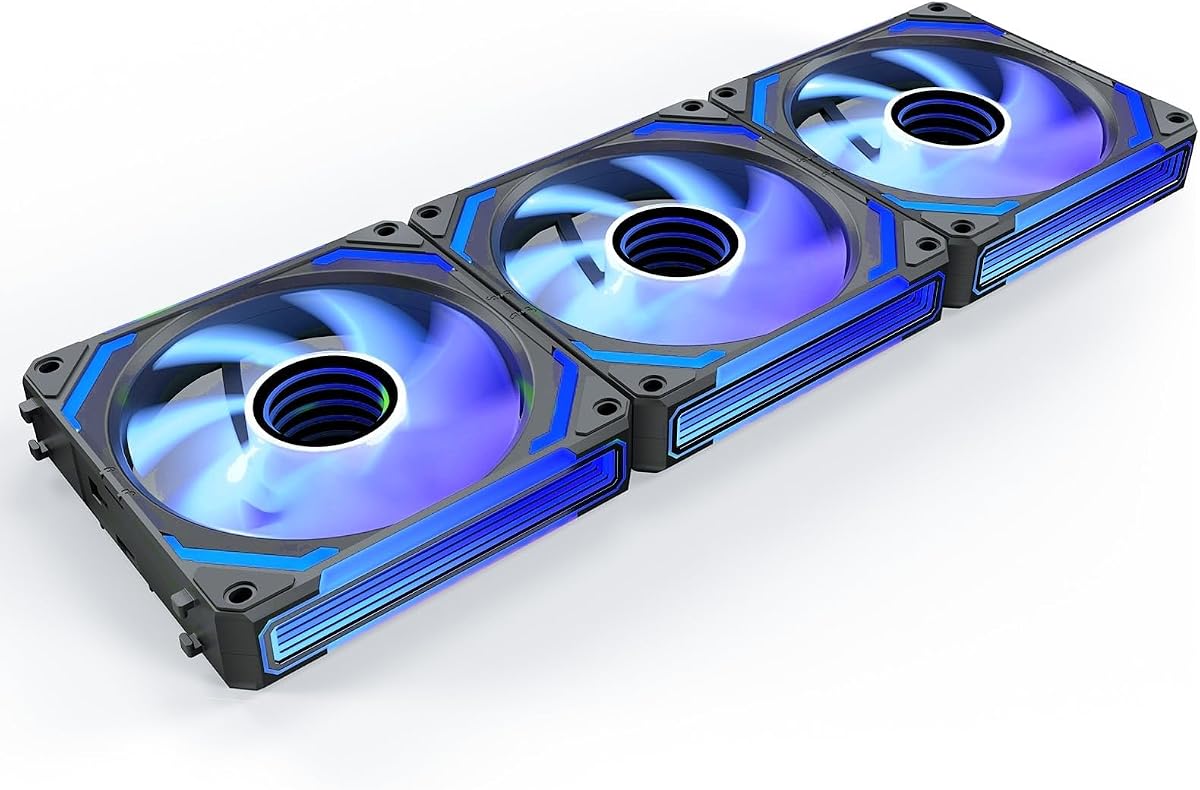
The AsiaHorse COSMIQ 120mm is the most visually elaborate option in the guide, combining an infinity mirror design, reverse fan blades, music-responsive lighting, and a dedicated controller. It also holds a 4.8 supplied rating. Performance is strong for a case fan, with a stated maximum of 68.5 CFM airflow, 2.05 mm-H2O static pressure, and a speed ceiling of 2000 RPM.
We may earn a commission when you buy through this link, at no additional cost to you.
Its interlocking daisy-chain design is intended to reduce scattered wiring and keep the case interior tidy. A 5V 3-pin ARGB connection allows synchronization with compatible motherboards, while the small controller offers independent lighting control. The built-in sound pickup supports eight music-rhythm modes, allowing the lighting to respond to game sounds, music, and ambient audio. Those features create a more interactive result than standard static synchronization.
The reverse blade orientation needs careful planning. Reverse fans are particularly attractive as bottom or side intakes because the illuminated face remains visible, but they are not interchangeable with forward fans in every mounting position. The infinity mirror, 29.2 dBA stated maximum noise, controller, and extensive lighting features also make the package more involved than a basic ARGB fan set. Users should confirm case orientation and connector placement before installation.
This is the best choice for a showcase build where lighting is a major part of the design and a conventional ring of LEDs will not be enough. It is also suitable for compatible 120mm liquid-cooling radiators, CPU liquid coolers, ATX and MATX gaming chassis, and office systems that want a more expressive visual treatment. For pure cooling simplicity, a lower-cost standard model would be easier to integrate.
A built-in sound pickup supports eight music-rhythm modes, allowing the RGB effects to react to game audio, music, or ambient sound. The included controller also provides independent lighting control when motherboard synchronization is not the preferred route.
The 68.5 CFM airflow and 2.05 mm-H2O static pressure provide useful performance headroom, while reverse blades keep the illuminated face visible in suitable intake positions. Correct orientation is important for achieving the intended appearance and airflow path.
We may earn a commission when you buy through this link, at no additional cost to you.
Selecting addressable RGB fans means balancing physical cooling requirements with lighting compatibility, wiring, acoustics, and case layout. Review these factors before choosing a model or bundle so the final set handles its intended positions without creating installation problems.
Airflow indicates how much air a fan can move, while static pressure describes its ability to push air against resistance. These figures should be considered together. A fan with high airflow may still perform poorly through dense radiator fins or restrictive mesh, whereas a higher-pressure fan is better suited to those obstructed paths. Open case intake positions generally place less demand on static pressure, while radiators, heatsinks, and narrow filters require a more focused airflow profile.
Choose according to the placement rather than chasing the largest headline number. Match the stated capacity to the cooling job and allow room in the case for unobstructed airflow.
PWM control lets the motherboard vary a fan's speed according to a configured curve. A wide range is useful because it allows low or stopped operation during light workloads and higher speed under heat. Fans that stop below a very low PWM percentage can be especially effective in quiet builds, although the exact profile also depends on the motherboard and the chosen operating mode.
For automated cooling, look for 4-pin PWM support and a range broad enough to accommodate both quiet and high-load settings. A fixed-speed mode can be useful for testing or for users who prefer consistent noise.
Addressable RGB lighting typically uses a 5V connection, while ordinary RGB lighting often uses a 12V connection. These are not interchangeable. The case, fan, and motherboard must support the same lighting standard for synchronization, and some controllers or proprietary systems may not communicate with every fan package. Always confirm the connector type rather than relying on the shared RGB label.
If a motherboard lacks a suitable 5V header, a bundled controller can provide an alternative. Mixed ecosystems may still require separate lighting zones, so plan the wiring before deciding on a particular fan.
Daisy chaining allows several fans to connect in sequence, reducing the number of cables and headers required. This is especially helpful in cases with limited routing space. Magnetic connections can further simplify attachment, while a PWM splitter can organize speed control from a single source. A combined ARGB and PWM hub can consolidate both functions, although it adds another component that must be mounted securely.
Prioritize a connection layout that matches the number of available motherboard headers. Cleaner wiring is not only visually appealing; it can also make airflow routing and future maintenance easier.
Noise specifications are most useful when interpreted alongside maximum speed. A fan capable of 3000 RPM may be capable of considerable airflow but also produce more sound at its upper limit. Fluid dynamic bearings and hydraulic bearings are designed to support smooth operation and reduce vibration over time. Anti-vibration mounting materials or frames can further reduce transferred vibration.
For office use and quiet gaming, favor lower practical operating speeds and create a motherboard curve that keeps the fans quiet during light tasks. For a radiator or performance case, a higher ceiling provides more useful headroom.
Standard forward fans and reverse fans serve different visual and airflow purposes. A reverse fan installed as an intake can display its illuminated side from outside the case, while forward fans are often used as exhaust. Some mixed bundles include only forward fans, so a builder planning visible side or bottom intake lighting may need a different product. Check screw-hole orientation and case airflow recommendations before ordering.
Match every fan to the location where it will be installed. A mixed-direction kit is useful for a complete build, but specialized orientation is unnecessary when all selected positions accept standard forward fans.
The number of fans in a set should correspond to the available mounting positions and the scope of the upgrade. Two fans suit a focused replacement, three fans create a compact matching group, and five or six fans support a broader case refresh. Mixed-direction bundles may include a controller, splitter, screws, or ARGB cables that are not included with standard single-fan models.
Before purchasing, count the intended locations and note the connectors already present in the case. This prevents an attractive bundle from becoming incomplete or incompatible with the planned layout.
All ten products use the standard 120mm format, but physical dimensions alone do not guarantee a clean installation. Review radiator thickness, mounting screws, filter positions, cable clearance, and the recommended intake and exhaust arrangement. High static pressure becomes more valuable when air must travel through radiator fins or a restrictive panel.
Use the cooling component's mounting requirements as the starting point, then confirm that the case provides enough depth and screw access. A fan that performs well on paper can still perform poorly if it is mounted awkwardly or forces cables into the airflow.
Before installation, compare the fan connector layout with the available motherboard headers and case mounting positions. Identify whether each unit will be an intake or exhaust fan, confirm the required screw pattern, and arrange the cables before fastening everything in place. Connecting compatible 5V ARGB headers and a 4-pin PWM header allows coordinated lighting and automatic speed control.
After mounting, connect the power and lighting cables, select the appropriate CPU or case-temperature fan curve in the motherboard software, and increase the PWM setting gradually. Start with a moderate speed, listen for changes in airflow and vibration, and confirm that the direction of each fan supports the planned intake-and-exhaust pattern. Configure ARGB effects only after the physical installation and cooling behavior are working as intended.
During routine care, keep the intake paths and radiator surfaces free of dust, inspect cables for pinching or connector strain, and confirm that vibration mounts remain properly seated. If a fan becomes noisy or its speed no longer responds to the configured curve, check mounting pressure, bearing condition, and software settings. Unusual grinding or persistent rubbing can indicate that the fan should be replaced rather than adjusted.
Usually not. Addressable RGB lighting generally uses a 5V connection, while standard RGB lighting commonly uses 12V, and the pin layouts are different. Connecting the wrong type can damage a header or fan. Check the motherboard and fan documentation, and use a correctly designed ARGB controller when no compatible 5V header is available.
No. Fans that use a standard 5V ARGB connection are often controlled through software supplied with compatible motherboards, but support can vary by brand and model. Some products include their own controller or proprietary lighting functions. Verify which control methods the listing and motherboard manual support before relying on synchronization or music-reactive effects.
No. A higher maximum RPM provides more potential airflow and can help against restrictive resistance, but it also gives the fan more opportunity to become loud. The best choice depends on the fan's noise design, case restrictions, radiator requirements, and the user's tolerance for sound. A well-tuned lower-speed curve can be better for everyday cooling.
Most of the listed 120mm fans are suitable for standard 120mm radiator and CPU air-cooler positions. The exception would be any cooler whose mounting hardware or depth is incompatible with a 120mm fan. Confirm mounting dimensions, screw positions, and the manufacturer's recommended fan orientation before installation.
A forward fan moves air in one direction and shows its illuminated face inward, while a reverse fan presents that face toward the opposite side of the airflow. Reverse fans are commonly used for bottom or side intakes so their lighting remains visible. Installation must follow the case's intended airflow path, and reverse and forward fans should not be placed without considering pressure and balance.
It depends on the role of each fan. Intake and exhaust fans can share a curve when their load is similar, but a radiator fan may need a higher speed than a front intake. Building separate curves for different headers or groups provides more precise control over noise and cooling. Ensure the overall balance still moves air through the case in a coherent direction.
Connect the PWM leads to a compatible 4-pin motherboard header or the supplied splitter, then connect the 5V ARGB leads to a compatible header or controller. Compatible motherboard software generally controls speed curves and lighting effects separately. Products with a dedicated controller may add independent lighting options beyond basic synchronization.
Use unobstructed intake filters, avoid placing cables directly in front of a fan, and verify that each fan is oriented correctly. Adjust the PWM curve to maintain adequate airflow without running every fan at maximum. Dust can also restrict performance, so periodic cleaning of filters and radiator fins helps the system maintain its designed airflow.
The ARCTIC P12 Pro A-RGB is the strongest budget-oriented recommendation because it combines ARGB illumination, a very broad PWM range, and a 3000 RPM ceiling. The Thermaltake LE120 ARGB is the best-balanced choice, offering a three-fan bundle, strong supplied rating, clear airflow figures, and uncomplicated daisy-chain wiring. For a premium visual build, the AsiaHorse COSMIQ 120mm adds infinity mirror lighting, sound-reactive modes, a dedicated controller, and substantial stated cooling performance.
The right fan set depends on the actual case layout. Match airflow and static pressure to radiator, heatsink, intake, or exhaust requirements; verify 5V ARGB compatibility; and account for the number of available PWM and lighting headers. Fans with reverse blades need deliberate orientation, while larger bundles should be selected only when every included unit has a suitable position. A smaller matched set can often produce a cleaner installation than an oversized collection with unused fans.
Customer ratings, bundle contents, product designs, and prices can change, so check the current listing before ordering. Confirm the package quantity, included cables or controller, connector type, fan dimensions, and mounting hardware. Most importantly, compare the final product against the case's airflow needs and the amount of lighting synchronization you actually intend to use.