
Aveek TPA3255 Stereo Amplifier
4.5Editor score
Up to 240 watts per channel
RCA and 3.5 mm inputs
Supports 2–8 ohm speakers
Our amps for passive speakers guide compares 10 models for power, connectivity, sound quality, flexibility, and ease of use, helping you choose the right
An amplifier for passive speakers supplies the power that passive bookshelf, floorstanding, or studio speakers cannot generate on their own. A worthwhile unit should deliver clean output at useful listening levels, match the speakers’ impedance, provide the connections you actually need, and fit naturally into your room or equipment shelf without complicating setup.
We compared these ten amplifiers across output power, speaker compatibility, signal-to-noise ratio, distortion, connectivity, control options, physical design, and intended use. The list includes compact Class D models, traditional-style power amplifiers, a streaming amplifier, and units with features such as balanced inputs, trigger control, pre-outs, bass and treble adjustment, and replaceable op-amps.
Each selection highlights the circumstances in which that amplifier makes the most sense, while also noting meaningful limitations. Ratings and specifications reflect the supplied product information, and availability, firmware, accessories, and pricing can change, so readers should verify current product details and retailer listings before purchasing.
4.5Editor score

4.6Editor score

4.5Editor score
The table below compares each amplifier by channel power, signal-to-noise performance, connection options, and practical role, making it easier to identify the model that fits a particular passive-speaker system.


The Aveek TPA3255 is a compact two-channel Class D amplifier designed specifically for passive bookshelf and tower speakers. Its supplied rating is 4.5 out of 5, and the product information emphasizes a TI TPA3255 amplification chip, support for 2–8 ohm loads, and up to 240 watts per channel when used with the specified higher-output power configuration. That combination makes it a strong candidate for anyone building a capable stereo system without using a full-size rack amplifier.
We may earn a commission when you buy through this link, at no additional cost to you.
Its headline specifications are unusually attractive for a budget-oriented model. The listed signal-to-noise ratio of at least 110 dB and total harmonic distortion below 0.01 percent suggest that the design prioritizes a clean background and low distortion, useful qualities for preserving detail in vocals, acoustic instruments, and quiet passages. The included 32V 5A adapter supports up to 100 watts per channel at 4 ohms, while accepting a compatible 48V 5A supply allows access to the stated 240-watt-per-channel maximum.
Connectivity is straightforward and appropriate for a passive-speaker amplifier. RCA and 3.5 mm analog inputs allow a phone, computer, DAC, preamp, television, CD player, or another line-level source to be connected without requiring a network. The compact aluminum chassis assists with heat dissipation and should be easier to place than a large traditional amplifier. However, the product is for passive speakers only, and it has no dedicated subwoofer output, so a separate powered subwoofer would be needed for bass management or a dedicated low-frequency channel.
This is an appealing choice for a first stereo, a secondary listening area, a desktop system, or an inexpensive upgrade for existing passive speakers. The included adapter makes the initial setup straightforward, and the 48V input flexibility offers a useful route to more output later. Buyers should use only a compatible passive-speaker power supply, as the product information specifically cautions against unsuitable industrial adapters, and should check amplifier and speaker impedance requirements before finalizing the system.
The advertised 110 dB signal-to-noise ratio and sub-0.01 percent distortion are especially useful for listeners who want a low-noise signal path. They indicate a design intended to keep the amplifier’s contribution out of the way, particularly during quiet or dynamically detailed music.
The supplied adapter provides a ready-made baseline, while the amplifier supports 24–48V DC input for compatible upgrades. Higher output depends on the power supply, speaker impedance, and the manufacturer’s specified test conditions.
We may earn a commission when you buy through this link, at no additional cost to you.
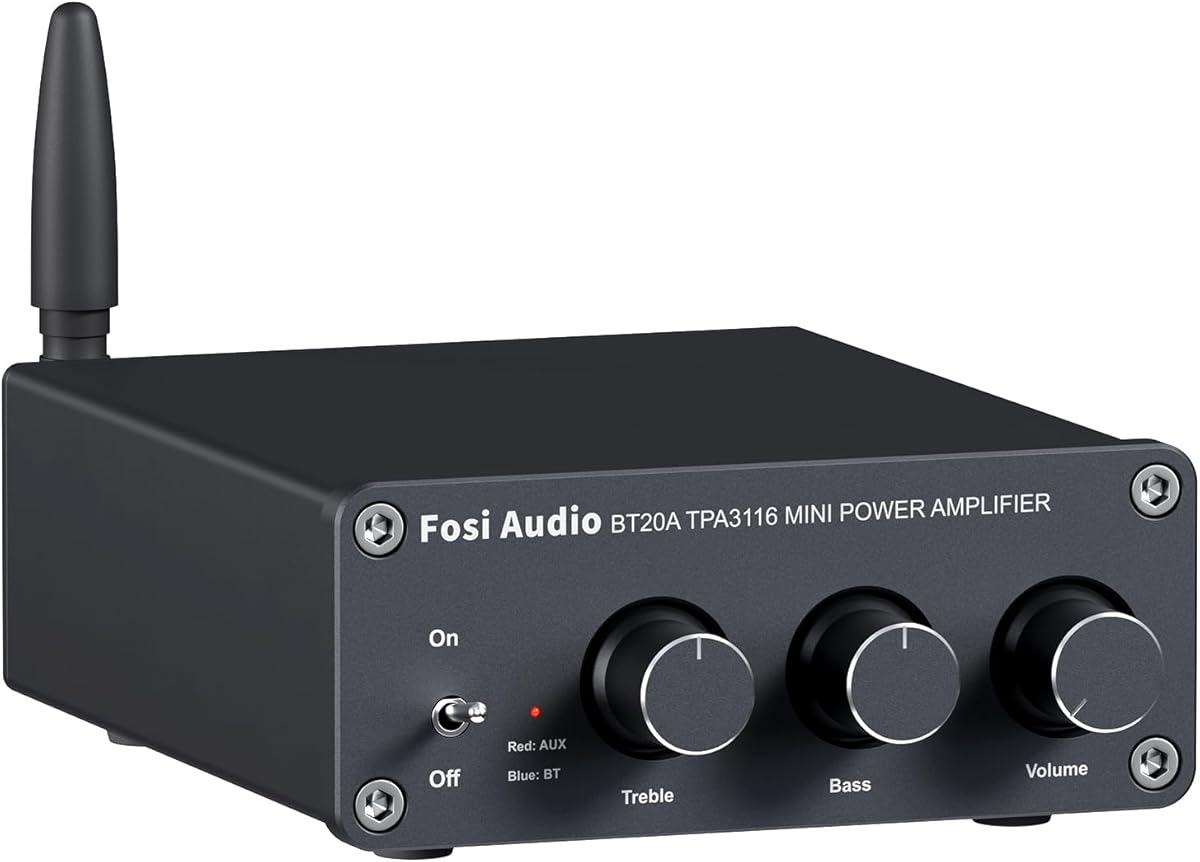
The Fosi Audio BT20A is a straightforward mini Class D amplifier for passive speakers, with a 4.5-out-of-5 rating and a maximum output of 100 watts per channel. It is designed for listeners who want a simple central amplifier for bookshelf or ceiling speakers, a small patio system, a garage setup, or a compact office. The all-black housing and integrated form make it easy to place on a shelf without the visual bulk of conventional hi-fi separates.
We may earn a commission when you buy through this link, at no additional cost to you.
The amplifier’s most useful feature is direct Bluetooth streaming. A phone can serve as the source without an intervening DAC or preamplifier, while the RCA input preserves a wired path for a turntable with a built-in phono preamp, a CD player, a television, or another line-level component. Bass and treble controls allow basic tonal adjustment without adding a separate preamp. The product information describes a straightforward installation and a one-touch power switch, reinforcing its appeal as an approachable component.
There are important limits to consider. The 100-watt-per-channel maximum is modest beside several higher-current designs in this guide, and maximum amplifier ratings do not by themselves guarantee clean output at every volume with every speaker. The BT20A is also more focused on basic listening than advanced system control: it does not offer the balanced inputs, trigger control, pre-out, or advanced streaming features found in some alternatives. Its appeal therefore rests on simplicity, compact size, and a combination of wireless and wired sources.
Choose the BT20A when you need an uncomplicated amplifier for a modest passive system and want the freedom to stream from a phone. It is a sensible match for secondary rooms, casual listening, workshop audio, and similar applications. For demanding speakers, a large room, professional installation, or a system requiring multi-room control, a model with more output or broader connectivity would be a better fit.
Direct wireless streaming removes the need for a separate Bluetooth receiver or streamer. Once paired, the amplifier offers a convenient route from a phone to a pair of passive speakers, while RCA remains available for wired sources.
The integrated housing works well in compact rooms and on shelves where a full-size receiver would be intrusive. It is particularly suitable for casual background listening rather than a specialized installation.
We may earn a commission when you buy through this link, at no additional cost to you.
The Fosi Audio BT20A Pro raises the bar for a compact wireless amplifier by combining a TPA3255 Class D design, Bluetooth 5.0, a maximum output of 300 watts per channel, and replaceable op-amps. Its supplied rating is 4.4 out of 5. This combination makes it appealing for listeners who want more power and internal flexibility than a basic mini amplifier while retaining a relatively small form factor.
We may earn a commission when you buy through this link, at no additional cost to you.
The amplifier’s replaceable op-amps are the distinguishing feature. The supplied information identifies the stock units as plug-in NE5532 dual op-amps and lists compatibility with options including LME49720HA, MUSES02, OPA2604AP, OPA2134PA, LM4562, and NJM4556AD. That allows owners to explore different sound characteristics, although experimentation requires compatible components, correct orientation, and a general understanding of the modification process. The stated signal-to-noise ratio of at least 108 dB and distortion of no more than 0.005 percent support a high-fidelity positioning.
Bluetooth 5.0 includes useful conveniences such as a pairing-removal procedure and pairing memory. Bass and treble controls sit at a neutral center for an unaffected starting point, while the package includes an antenna, 32V 5A power adapter, AC cord, and manual. As with other amplifiers, the headline maximum output reflects specific conditions rather than a promise of identical performance with every speaker, room, or volume setting.
The BT20A Pro is a strong fit for a compact outdoor or secondary-room stereo, provided the enclosure can be protected from moisture and weather. It also appeals to technically curious listeners who value replaceable components. Those seeking only basic Bluetooth streaming can find a simpler design, while those needing balanced input, multi-room synchronization, or a television-focused streaming hub should choose a more specialized amplifier.
Swappable dual op-amps make the BT20A Pro more configurable than a conventional fixed-component mini amplifier. The stock configuration remains accessible, while compatible alternatives can provide a different tonal starting point.
Bluetooth pairing memory reduces the need to re-pair the same source in daily use. The ability to remove a stored pairing also makes the amplifier easier to manage when moving between different phones or locations.
We may earn a commission when you buy through this link, at no additional cost to you.
The Fosi Audio TB10D is a two-channel Class D amplifier for passive speakers with a listed maximum output of 300 watts per channel and a 4.5-out-of-5 rating. Its principal advantage over a conventional stereo amp is versatility: the product information identifies compatibility with passive speakers and a bass shaker, allowing it to serve traditional listening while also supporting a practical 2.1-style low-frequency addition.
We may earn a commission when you buy through this link, at no additional cost to you.
The TPA3255-based design is intended to drive bookshelf speakers rated from 2 to 8 ohms. RCA input and passive speaker outputs keep the signal chain uncomplicated, and separate bass and treble knobs provide basic tonal control. A dedicated power switch adds convenience, while built-in protection circuits are designed to promote stable operation. Its compatibility with phones, computers, DVDs, CD players, personal computers, laptops, and televisions depends on the source providing a suitable analog output.
The 600-watt total figure should be interpreted carefully because maximum amplifier wattage is not identical to the clean, continuous power available to every speaker. Room size, speaker sensitivity, impedance, power-supply conditions, and listening expectations all affect the result. The TB10D also lacks a balanced input and integrated network streaming, so users with advanced source components or a desire to control multiple rooms may need another product.
This amplifier is a compelling option for a compact gaming stereo, a living-room system, a turntable setup with a phono preamp, or a conventional two-channel installation with a bass shaker. It is particularly attractive for buyers who want substantial headline power and a subwoofer-related use case without moving to a large rack component. It is less suited to someone seeking polished wireless integration from a single app.
Bass shaker support gives the TB10D a distinct path into compact 2.1-style arrangements. A compatible shaker can add low-frequency effects while the main passive speakers continue to reproduce the primary stereo program.
RCA input and conventional speaker terminals make the amplifier approachable for a range of analog sources. The dedicated power switch and integrated protection add everyday convenience without requiring a complicated control system.
We may earn a commission when you buy through this link, at no additional cost to you.
The Fosi Audio V3 is a compact stereo Class D amplifier designed for listeners who care about internal component quality, clean measurements, and the ability to adjust the amplifier’s signal path. It has a 4.5-out-of-5 rating, a maximum output of 300 watts per channel, and support for 2–8 ohm speakers. Its stated applications include bookshelves, desktop systems, and home theater setups.
We may earn a commission when you buy through this link, at no additional cost to you.
The component selection is a major selling point. The product information identifies Japanese NCC, ELNA, and German WIMA capacitors, Japanese Sumida inductors, and a TPA3255 amplification chip. It lists a signal-to-noise ratio up to 110 dB, SINAD up to 88 dB, and a low noise floor of 140 microvolts. These figures support an audiophile-oriented design philosophy, although real-world results also depend on the source, speakers, room, and system configuration.
Thermal design receives unusual attention. Vents in the top and bottom, combined with a whole-body heatsink, are intended to dissipate heat and protect internal components during operation. The V3 also supports replaceable 8-pin dual op-amps, including Sparkos SS3602, MUSES02, OPA2604, OPA2134PA, OP249, AD827, RM4559, LM4562, and LME49720HA. Its pre-out level is controlled by the main volume, making it easier to connect to another amplifier or powered device.
Choose the V3 for a compact but carefully specified two-channel system in which component quality, low noise, cooling, and pre-out flexibility matter. It is less convenient for users who want built-in Wi-Fi, Bluetooth, automatic room correction, or television control without adding separate equipment. Because op-amp modification and pre-out use add complexity, newcomers should treat those features as optional rather than necessary for normal operation.
A listed 110 dB signal-to-noise ratio and 88 dB SINAD are strong foundations for a compact hi-fi amplifier. The benefit is a quiet signal path that can help listeners hear more detail in recordings.
Replaceable op-amps offer a gradual way to explore different amplifier characteristics. Buyers should confirm pin compatibility, use careful handling, and understand that the supplied component configuration remains the safe baseline.
We may earn a commission when you buy through this link, at no additional cost to you.
The AIYIMA A07 Premium is a compact two-channel Class D amplifier built around the TI TPA3255 and NE5532 dual op-amp chips. Its 4.4-out-of-5 rating reflects a product aimed at hi-fi listeners who want high headline power, replaceable components, and a pre-out in a small enclosure. It is marketed for passive bookshelf speakers and other home audio systems.
We may earn a commission when you buy through this link, at no additional cost to you.
The amplifier’s 3.5 mm AUX pre-out is especially useful. It provides a full-range output whose level is controlled by the main volume, allowing it to feed an active speaker, another power amplifier, or a powered subwoofer amplifier. This makes it easier to build a compact 2.1 system without a separate preamp. The full-metal housing and upgraded component set are also intended to support durability and consistent operation.
The supplied information states a maximum output of 300 watts per channel and support for 2–8 ohm passive speakers. A 32V 5A adapter is included, while the product information notes that a compatible 48V 10A supply is required to reach the maximum 300-watt-per-channel output. The NE5532 op-amps are replaceable with compatible OPA-, LM-, and MUSES-series alternatives, giving owners room to experiment. No Wi-Fi support is included, and the product has a new internal cooling system in the 2025-upgraded version.
The A07 Premium makes the most sense for a desktop or living-room stereo where a line-level source, passive speakers, and possibly a powered subwoofer are involved. Its pre-out adds useful flexibility, but the absence of wireless streaming means another device may be needed for convenient network music. Anyone considering a power-supply upgrade should follow the stated voltage and current guidance and avoid industrial supplies.
The full-range, volume-controlled pre-out can feed a powered subwoofer amplifier, allowing the main amplifier to handle the passive stereo channels. This creates a straightforward path to deeper low-end performance.
A full-metal housing provides a more substantial enclosure, while replaceable NE5532 op-amps make the internal design approachable for experimentation. The included supply is suitable for normal operation, with higher output tied to the specified stronger adapter.
We may earn a commission when you buy through this link, at no additional cost to you.
The Fosi Audio ZA3 is the most specialized premium amplifier in this group, offering a balanced input, trigger control, flexible operating modes, and a 48V power supply. Its 4.5-out-of-5 rating reflects a product designed for listeners who want professional-style connectivity in a compact Class D unit. It can operate as a stereo amplifier or a more powerful mono amplifier for specialized passive-speaker arrangements.
We may earn a commission when you buy through this link, at no additional cost to you.
In stereo mode, the listed maximum output is 180 watts, while mono mode can reach 235 watts. Pairing two ZA3 units in mono configuration creates a flexible way to power demanding or multi-room systems. The balanced combination input accepts XLR and quarter-inch TRS plugs, offering a lower-noise connection for compatible sources. A 12-volt trigger input allows synchronized power control with other equipment, eliminating the need to switch the amplifier on separately.
Internally, the ZA3 uses a TPA3255 chip alongside Japanese NCC and ELNA capacitors, German WIMA capacitors, and Japanese Sumida inductors. The listed SINAD reaches 89 dB, signal-to-noise ratio reaches 106 dB, and noise floor is 150 microvolts. Its enlarged chassis, side vents, and dust covers improve sustained heat dissipation. Multiple op-amp positions—including the balanced input and subwoofer output—support extensive customization with compatible DIP8 dual op-amps.
The ZA3 is best suited to serious compact hi-fi, professional reference, or multi-unit installations where balanced signal paths, trigger control, and flexible modes justify added complexity. It can also serve as a subwoofer or single-channel amplifier. The amplifier does not offer the built-in streaming functions of the WiiM Amp Pro, so users will still need a separate source. For anyone building such a system, checking connector compatibility and planning the operating mode before installation is essential.
The XLR and TRS combination input provides a professional connection option and can reduce interference over longer signal runs. Source equipment must support a compatible balanced output for the feature to be fully utilized.
Switching between stereo and mono operation makes the ZA3 useful in two-channel systems, single-channel installations, and paired-mono arrangements. The trigger input further simplifies coordinated control of multiple components.
We may earn a commission when you buy through this link, at no additional cost to you.
The Peavey IPR2 2000 is a lightweight, two-channel power amplifier aimed at professional-style speaker driving rather than compact living-room convenience. Its 4.2-out-of-5 rating is the lowest among the products listed, but the supplied features show a focused design with independent fourth-order Linkwitz-Riley crossovers, DDT, detented input controls, and Speakon output connectors.
We may earn a commission when you buy through this link, at no additional cost to you.
Its class D topology and portable format distinguish it from mini consumer amplifiers built around analog inputs and Bluetooth. Speakon outputs provide a secure professional connection method for compatible passive speakers, while independent crossover controls on the two channels allow the amplifier to serve conventional stereo or crossover-managed installations. DDT is included as a protective feature intended to manage distortion-related behavior during demanding operation.
The product is most relevant in contexts such as live sound reinforcement, mobile audio, installations, or a serious home system using professional speaker cabinets. The supplied information does not mention built-in Bluetooth, Wi-Fi, balanced inputs, room correction, or HDMI support, so it should be viewed as a foundational power amplifier rather than an all-in-one entertainment receiver. A preamp, source, and potentially a crossover or additional signal processing may be required to build a complete system.
The IPR2 2000 is a sensible option for users who already understand professional power-amplifier workflows and need a portable, robust way to drive passive speakers. It is less appropriate for someone expecting a simple way to stream from a phone or connect a television. Its independent crossover and Speakon connections may offer more value in the right installation than a feature-rich mini amp, provided the rest of the system is designed accordingly.
Speakon output connectors offer a secure option for compatible professional passive speakers. The format is particularly useful for mobile and installed systems where dependable connections are important.
Independent fourth-order Linkwitz-Riley crossovers on each channel can help shape system frequency response. The feature is most useful when the amplifier is part of a carefully planned speaker configuration rather than a casual desktop setup.
We may earn a commission when you buy through this link, at no additional cost to you.
The Peavey IPR2 3000 is a two-channel lightweight power amplifier with a 4.3-out-of-5 rating. Compared with the IPR2 2000, the supplied information highlights combined XLR and quarter-inch inputs, making it a more flexible professional installation option. Independent fourth-order Linkwitz-Riley crossovers, DDT, class D topology, and Speakon outputs complete a feature set centered on robust speaker control.
We may earn a commission when you buy through this link, at no additional cost to you.
The balanced and unbalanced input choices are valuable in professional environments where long cable runs, stage boxes, and installed equipment can make noise and grounding important. Speakon outputs support secure passive-speaker connections, while detented-style physical control is in keeping with a power amplifier intended for practical deployment. The amplifier can be used for live performance, rehearsal, mobile audio, or a permanently installed passive system.
This model is not an integrated receiver. It does not provide the wireless streaming, television integration, app-based room correction, or automatic source selection found in consumer-focused streaming amplifiers. A preamplifier or mixer is therefore likely necessary, along with any additional crossover or processing equipment demanded by the speaker design. As with all power amplifiers, compatible input selection, output wiring, and speaker impedance should be verified before use.
The IPR2 3000 is best for buyers who prioritize professional input options and speaker connections over convenience. It gives a passive-speaker setup a scalable foundation for demanding environments, but it asks the user to assemble the rest of the signal chain. For a compact home stereo, a mini amplifier with RCA, Bluetooth, and streaming functions will usually be easier, while the IPR2 3000 shines in installations where reliable balanced connections matter.
The combined XLR and quarter-inch input arrangement accepts balanced and unbalanced sources. This makes it easier to integrate the amplifier with mixers, preamplifiers, and professional playback equipment.
Crossovers, DDT, and Speakon outputs place the focus on driving and managing passive speakers. The approach is well suited to professional use but leaves entertainment features to separate components.
We may earn a commission when you buy through this link, at no additional cost to you.
The WiiM Amp Pro is the most complete connected amplifier in the group, offering Wi-Fi 6, Bluetooth 5.3, HDMI ARC, multi-room control, a premium DAC, and room-correction tools in a single component. It has the highest supplied rating at 4.6 out of 5. For a listener seeking one box to handle music streaming, television audio, passive speakers, and household voice-control integration, it offers the strongest all-round convenience.
We may earn a commission when you buy through this link, at no additional cost to you.
Its output is rated at 60 watts per channel into 8 ohms and 120 watts per channel into 4 ohms, making it suitable for many bookshelf and compact floorstanding speaker systems. The included application supports streaming services, volume control, favorites, alarms, speaker synchronization, and independent settings. Up to 24-bit/192 kHz playback is supported from compatible services, and the supplied information lists Spotify, Amazon Music, TIDAL, Qobuz, and local libraries among the available sources.
HDMI ARC makes the amplifier a convenient central hub for a television, while a powered subwoofer can be added for greater low-frequency impact. The app also supports room correction and independent EQ, and the product can join existing Amazon Echo, Google Home, and WiiM ecosystems for multiroom audio. The device includes a voice remote and supports Alexa and Google Assistant. A significant limitation is that it is incompatible with AirPlay and cannot function as an AirPlay receiver, which matters for households centered on that ecosystem.
Choose the WiiM Amp Pro when convenience, streaming breadth, television integration, and network features are more important than internal modification. It is an excellent match for a modern living room, office, or bedroom where one amplifier must handle several roles. Buyers who require a fully open, component-level design, balanced professional input, or large-scale speaker deployment may prefer the Fosi Audio ZA3 or Peavey models instead. Within the connected category, however, the Amp Pro is the most complete.
The WiiM Home App centralizes streaming, volume, room synchronization, favorites, alarms, and equalization. That level of integration is the Amp Pro’s main advantage over simple mini amplifiers with only Bluetooth and analog inputs.
HDMI ARC provides a direct route for television audio, while multi-room support can combine the amplifier with compatible ecosystem devices. The lack of AirPlay compatibility is the main ecosystem limitation to verify before buying.
We may earn a commission when you buy through this link, at no additional cost to you.
Choosing an amplifier for passive speakers requires balancing electrical capability, source connections, control features, and practical placement. The most important starting point is the speaker system itself, followed by the listening environment and the way audio will enter the amplifier.
Passive speakers must be electrically compatible with the amplifier. Check each speaker’s rated impedance and the manufacturer’s minimum and maximum impedance guidance before selecting a unit. The amplifiers here support various passive loads, commonly from 2 to 8 ohms, but supported does not mean every speaker is a good match. Speaker sensitivity, room size, preferred volume, and musical dynamics determine how much power is actually useful.
Large maximum-wattage figures can be misleading when they do not distinguish peak output from clean continuous power. Class D amplifiers may advertise an ambitious total or per-channel maximum under specified conditions, and the supplied power supply can materially affect the result. Compare maximum power only when impedance, test conditions, and supply requirements are equivalent. For most home systems, clean headroom at moderate volume is more useful than a dramatic number that does not apply to the planned configuration.
A passive-speaker amplifier needs a source signal. Bluetooth is convenient for casual streaming, RCA handles many line-level components, 3.5 mm inputs suit phones and computers, HDMI ARC suits televisions, and balanced XLR or TRS inputs can support professional equipment. Wi-Fi streaming adds service access, app control, and multi-room capability. Choosing the connections first prevents an otherwise capable amplifier from becoming inconvenient in daily use.
Signal-to-noise ratio and distortion provide useful indications of amplifier cleanliness. A higher signal-to-noise figure generally means less amplifier-generated noise, while lower total harmonic distortion suggests cleaner output under the tested conditions. SINAD combines signal quality and noise into a broader measure. These specifications are most meaningful when compared on similar terms, since test conditions and load levels can differ. Room acoustics, speakers, source quality, and correct setup remain influential in the final result.
Bass and treble controls offer quick tonal adjustment but cannot correct major room problems or speaker placement issues. Digital room correction, available in the WiiM Amp Pro, can analyze frequency response and apply filters when measurement and microphones are used properly. For a compact Class D amp, a flat starting point is often the most transparent. More elaborate tone-shaping hardware and replaceable op-amps can provide flexibility, although they also add complexity and should be approached deliberately.
A two-channel amplifier can often be purchased as part of a larger plan. Stereo mode is the most straightforward choice for a conventional pair of passive speakers. Mono operation may suit a subwoofer, a high-output channel, or a paired-mono system using two amplifiers. Pre-outs can feed a powered subwoofer or another power amplifier, while 12-volt trigger support can synchronize power behavior. Plan the final channel layout before installing equipment to avoid unnecessary adapters or rewiring.
Compact amplifiers save space but require attention to ventilation. Aluminum enclosures, heatsinks, top and bottom vents, side vents, and dust covers can help manage heat during sustained use. Avoid placing an amplifier in a fully enclosed cabinet unless the manufacturer expressly allows it. Larger professional-style units are usually easier to cool and rack or place, while streaming models need reliable network access and unobstructed wireless coverage. Cable quality and speaker-wire gauge also influence a practical installation.
Bluetooth is simple but limited to nearby wireless sources and often offers less control. Wi-Fi streaming supports broader music services, higher-resolution playback, app-based adjustment, alarms, favorites, and multi-room synchronization. HDMI ARC allows a television to act as a source and can support convenient volume control. Before choosing a network amplifier, verify service support, required apps, voice-assistant compatibility, firmware support, and any ecosystem exclusions such as AirPlay incompatibility.
Begin by identifying each speaker’s impedance and confirming that it falls within the amplifier’s supported range. Connect the power adapter before attaching speaker wires, then connect the audio source with all units powered off. Observe correct left and right polarity, use suitable wire for the cable run, and tighten connectors firmly without forcing them. For balanced or trigger connections, consult the manual and ensure every cable matches the intended input or function.
After checking every connection, turn the amplifier volume down before applying power. Select the correct source, raise the amplifier to a moderate level, and set the source volume lower for testing. Begin with tone controls centered, then make small adjustments while playing familiar material. If using room correction, measure in the listening position and follow the calibration instructions rather than applying several overlapping filters. For streaming amplifiers, complete the app setup and firmware updates before making detailed EQ changes.
Provide ventilation around the amplifier, particularly during sustained high-volume use. Keep it away from moisture, direct sunlight, and unstable surfaces, and do not cover top or side vents. Clean the enclosure with a dry or lightly damp soft cloth rather than abrasive cleaners. Periodically inspect cables and connectors, especially in portable professional setups. If you hear unusual noise, notice clipping, or encounter erratic behavior, lower the volume, power down, and check the source, impedance, wiring, and protection-related conditions.
Yes. Passive speakers contain drivers but generally do not include the power amplification required to move them at normal listening levels. An amplifier supplies power and a line-level signal to the speakers. Active speakers, by contrast, include their own amplification, so they can be connected directly to a source in many applications.
The correct impedance is the one supported by both the speakers and amplifier, commonly within a 2–8 ohm range for the mini Class D models in this guide. Check the speaker manual or label and the amplifier specifications before connecting them. Lower-impedance speakers can demand more current, so power ratings alone should not determine compatibility.
No. More power can provide additional headroom for demanding speakers and large rooms, but it does not automatically produce better sound. A correctly matched amplifier with clean output, appropriate connections, and good speakers may satisfy a smaller system better than an oversized unit. Consider sensitivity, impedance, room size, and the volume you realistically listen at.
Passive speakers need an external amplifier to provide power, while active speakers contain built-in amplifiers. A passive pair connects to speaker outputs on an amplifier, whereas active speakers usually connect to line-level outputs through a preamp, streamer, or powered source. The WiiM Amp Pro is an amplifier designed to drive passive speakers, not an active-speaker product.
It depends on the amplifier’s pre-out or subwoofer output and the subwoofer’s design. The AIYIMA A07 includes a full-range 3.5 mm pre-out whose level follows the main volume, and the Fosi Audio ZA3 is also described with subwoofer-related functionality. A passive subwoofer generally needs a dedicated amplifier, while a powered subwoofer can usually be connected separately without loading the main amplifier channel.
Bluetooth is useful for quick phone streaming, while Wi-Fi provides access to more services, app control, higher-resolution playback, and multiroom features. HDMI ARC is valuable when the amplifier will also provide television sound. Choose based on the sources you actually use; paying for network features that will remain unused adds little practical value.
No. Replaceable op-amps are an enthusiast-oriented feature that allows experimentation, not a requirement for a good system. The amplifier should still be evaluated using its supplied configuration, which is the supported baseline. If modifying it, confirm electrical compatibility, follow the manufacturer’s instructions, and make changes only when the amplifier is disconnected from power.
Place it on a stable surface with airflow around all vents and enough room to reach the controls and connections. Avoid closed cabinets unless the manufacturer explicitly permits operation there. Good ventilation supports stable output and component life, particularly during extended use at high volume.
The Aveek TPA3255 stands out as the best budget option because it combines strong maximum output, a low-noise specification, analog inputs, and broad passive-speaker compatibility in a compact enclosure. The WiiM Amp Pro is the most capable all-in-one choice, combining Wi-Fi 6 streaming, Bluetooth 5.3, HDMI ARC, app control, room correction, and multiroom features. For premium specialist performance and installation flexibility, the Fosi Audio ZA3 offers balanced input, trigger control, stereo and mono modes, and a substantial 48V design.
The remaining products serve more focused needs. The BT20A is a simple wireless option for secondary rooms, the BT20A Pro adds stronger specifications and replaceable op-amps, the TB10D supports bass-shaker-based 2.1 arrangements, and the V3 emphasizes component quality, cooling, and compact audiophile-style design. The AIYIMA A07 offers a useful pre-out and serviceable internals, while the Peavey IPR2 models target professional speaker installation with crossover controls and Speakon connections.
Prioritize speaker compatibility, clean output, required inputs, and the intended room over headline wattage or feature count. Confirm current specifications, included accessories, software support, and retailer listing details before ordering, since product configurations and pricing can change. The right amplifier is the one that integrates cleanly with your speakers, sources, space, and listening habits.