
Southwire P700 Phone Outlet Tester
4.5Editor score
Identifies Line 1 and Line 2
Detects AC ring voltage
Flags dead and reversed lines
Our Analog Telephone Line Tester guide compares ten tools for line identification, dialing, monitoring, fault finding, clip connections, and field use.
An analog telephone line tester helps technicians identify wiring conditions, check dial tone and polarity, place test calls, and investigate service faults. A useful model should connect securely, provide clear indicators, and suit the type of line access available at the work site.
We compared the ten products using their stated capabilities, connection methods, functions, included accessories, and suitability for field work. The list covers dedicated telephone butt sets, outlet wiring testers, and an analog tone generator and probe for broader low-voltage cable tracing.
Each review explains the tool’s strongest use case, practical limitations, and ideal buyer, while the comparison table makes the differences easier to scan. Product availability, features, and prices can change, so verify the current listing before purchasing.
4.5Editor score
4.6Editor score

5.0Editor score
The table below compares all ten options by core function, line access, dialing support, and practical field features, helping technicians identify the most suitable tool for each job.




This analog telephone line tester is designed as a butt-style lineman tool for checking a telephone line and working with incoming call information. It carries a 4.4 rating and distinguishes itself through its three external line-plug options, allowing the user to match the tool to different connection arrangements rather than relying on a single interface.
We may earn a commission when you buy through this link, at no additional cost to you.
Its central features include automatic identification of FSK and DTMF call information, a visible incoming-call number, and controls for answering, hanging up, dialing, and receiving a line. The supplied instructions describe using the on/off control, hearing a dial tone, entering a number, and using the receiving-line and reply buttons when a busy tone is encountered.
The most valuable element is the connector selection. A technician working across customers, installations, or service locations may encounter more than one exterior plug format, and carrying a tester with three options can reduce the need for separate adapters. The limitation is that the printed guidance is difficult to interpret because of wording and formatting, while caller ID may also depend on local telephone-office activation.
Choose this model if connector versatility is your priority and the basic telephone functions meet your service workflow. It is especially relevant for field workers who want to identify incoming numbers, test dial tone, and make or answer calls through a dedicated analog butt-set format rather than relying on a general-purpose outlet checker.
The three included exterior line-plug choices are the defining advantage. They make the tool more adaptable across installations with different connection styles, reducing the likelihood that an unavailable interface will prevent a basic line check.
Automatic FSK and DTMF call-information identification allows incoming caller data to appear on the tester. This can help verify that a line reaches the intended endpoint, subject to the line provider enabling the required caller ID service.
We may earn a commission when you buy through this link, at no additional cost to you.
The C019 is a dedicated telephone butt set built around routine analog line checks, including fault finding, call placement, and caller information. Its 4.3 rating reflects a practical combination of dual-system caller ID, easy line access, and familiar controls for technicians who regularly work with analog telephone wiring.
We may earn a commission when you buy through this link, at no additional cost to you.
The stated functions include FSK and DTMF caller ID, last-number redial, on/off and hangup controls, and a set that connects through three types of line plug. These features focus on the core work performed with a butt set: identifying a live line, checking caller information, dialing a destination, and confirming that the telephone path behaves as expected.
Its simplicity is both a strength and a limitation. Technicians who need straightforward line testing may appreciate the compact set of controls, but those who require detailed voltage analysis, tone injection, or multi-mode monitoring will need a more specialized instrument. The listing mentions a joiner, although its exact role is not defined in the supplied information.
This is a sensible option for installers, repair technicians, and cable professionals who want a dedicated analog line tester with familiar dialing functions and multiple connectors. It is less compelling for advanced network analysis, but it should meet the needs of users who want a practical butt set rather than a general cable tracer.
Supporting both FSK and DTMF gives the C019 broader compatibility with the signaling approaches used across analog telephone lines. Automatic caller-information support can also confirm that the line is delivering expected call data.
On, off, hangup, and redial functions mirror common telephone operation. Technicians can move through basic line checks without navigating a complex interface, although the product does not advertise the deeper measurement features of professional test sets.
We may earn a commission when you buy through this link, at no additional cost to you.
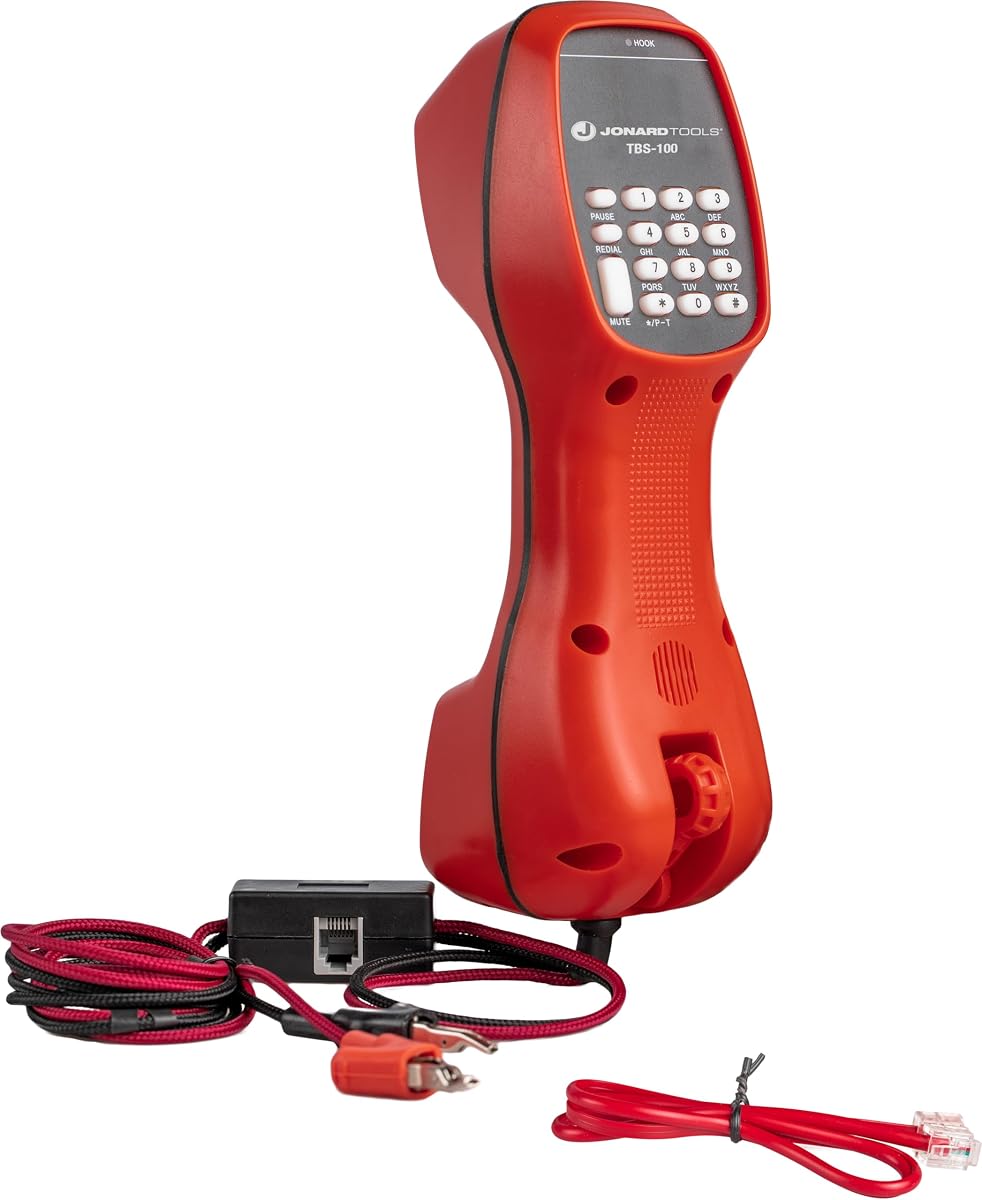
The Jonard Tools TBS-100 is an analog telephone line tester intended for technicians who need a portable butt set with direct line access. It has a 3.9 rating and emphasizes practical essentials: dial-tone detection, making or receiving calls, and operating in either tone or pulse modes.
We may earn a commission when you buy through this link, at no additional cost to you.
Its connection system is a major strength for field work. Angled Bed-of-Nails clips provide a secure grip on exposed conductors, while an RJ11 switchbox allows direct testing through a modular connection. The package also includes an RJ11 test cord and an extra fuse, giving users several ways to access a line.
The waterproof housing adds confidence when the work location is damp or exposed to inclement weather. However, the product information does not specify high-impedance monitoring, so users who need to listen without potentially affecting data or conversations should consider one of the explicitly high-impedance models instead.
Buy the TBS-100 if you want a rugged, straightforward analog butt set with both clip and modular access. It is well suited to general installation and repair work where tone, pulse, and call functions are more important than sophisticated monitoring or exact electrical analysis.
Angled Bed-of-Nails clips are intended to clamp securely to wiring terminals and conductors. They are especially valuable at distribution points where the technician must make dependable contact in a compact work area.
The listed waterproof housing is valuable for technicians entering closets, exterior junctions, or other environments where moisture may be present. It adds resilience without changing the tester’s core focus on essential analog line functions.
We may earn a commission when you buy through this link, at no additional cost to you.
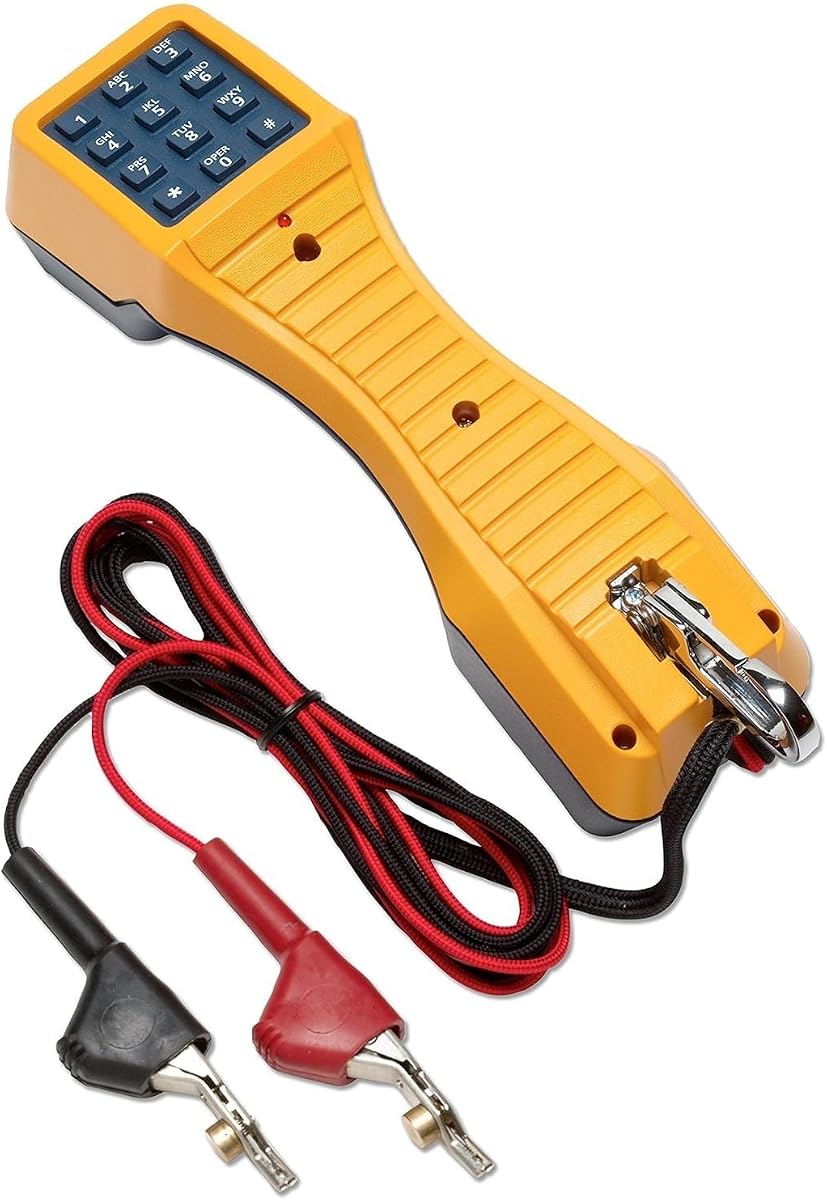
The Fluke Networks TS19 is a professional telephone test set that balances essential analog functions with safe line monitoring. Its 4.6 rating reflects a well-rounded tool capable of detecting dial tone and polarity, placing or receiving calls, and supporting both tone and pulse operation.
We may earn a commission when you buy through this link, at no additional cost to you.
High-impedance DataSafe operation is the standout feature. Monitoring in this manner helps a technician listen to a line without unnecessarily disturbing data, conversations, or signals. Angled Bed-of-Nails clips make direct access to exposed terminals more dependable, while dial-tone and polarity detection cover two of the earliest questions encountered during a fault investigation.
The trade-off is that this is not a general-purpose electrical meter or full cable analyzer. It focuses on telephone line behavior, so users who also need continuity measurement, wire mapping, or tone-based tracing across mixed cable systems may need another instrument. Even so, it delivers the core capabilities expected from a dedicated professional test set.
The TS19 is the strongest all-around recommendation in this guide for technicians who need more than basic outlet identification. It is a good fit for installers, maintenance staff, and field technicians who monitor live lines, place test calls, and want a recognized professional format with secure clip connections.
DataSafe monitoring is particularly useful when observing an active analog line. High impedance lets the technician hear line activity while reducing the likelihood of interfering with conversations or signals already present on the circuit.
Polarity detection helps determine whether line voltage is oriented correctly. Combined with dial-tone detection, it provides an efficient first stage in separating wiring problems from more distant service issues.
We may earn a commission when you buy through this link, at no additional cost to you.
This Landline Test Phone Line Set is a compact analog tester aimed at telephone-line survey and fault-check tasks. It has a 4.2 rating and provides a useful combination of caller ID recognition, call controls, a time display, and a clear operating indicator.
We may earn a commission when you buy through this link, at no additional cost to you.
Automatic FSK and DTMF identification allows the tester to recognize caller information without separate decoding equipment. Flash and redial functions accelerate common call-control tasks, while the real-time date display provides useful context when documenting or comparing incoming call records.
The smart, lightweight construction is particularly appealing for technicians who move between locations. Its primary limitation is that the supplied information says less about terminal options and detailed electrical diagnostics. It therefore looks more like a focused service and survey instrument than a complete professional analysis set.
Choose this model for routine analog line checks where caller information and call controls matter most. It may suit field service teams needing a light, approachable telephone tester, but professionals who need explicit polarity, high-impedance, or detailed connection specifications should examine those requirements against a more specialized model.
A lightweight design makes the tester easier to carry between customer sites and work areas. For users who perform frequent line surveys rather than prolonged bench work, portability can be as important as the number of supported functions.
Flash, redial, automatic caller ID, and an in-use LED cover several common actions during a line check. These focused controls can shorten basic workflows while the clock display helps place calls in context.
We may earn a commission when you buy through this link, at no additional cost to you.
The Southwire P700 is a focused analog telephone outlet tester for identifying Line 1 and Line 2, checking voltage and connection status, and diagnosing common wiring errors. Its 4.5 rating and compact format make it an efficient option for technicians who need quick answers at the outlet.
We may earn a commission when you buy through this link, at no additional cost to you.
The tester can verify which pair corresponds to each line, detect AC ring voltage, identify dead lines, and recognize reversed wiring. These are highly relevant checks during installation, troubleshooting, and service verification because they address the kinds of faults that commonly appear at a telephone outlet.
Its limitation is scope. The P700 is not presented as a butt set for placing and receiving calls, tone or pulse dialing, or live-line monitoring. It therefore complements rather than replaces a full telephone test set for professionals who need to communicate through the line after identifying a wiring problem.
This is the best budget choice for electricians, installers, and maintenance technicians who primarily need outlet-level fault detection. Its straightforward focus makes it particularly useful when the main question is which line is present, whether it is active, and whether the pair has been connected in reverse.
Labeling or separating Line 1 and Line 2 can be confusing at an outlet that serves multiple extensions or services. The P700 provides a direct way to identify the two pairs, helping prevent a technician from working on the wrong circuit.
Dead-line and reversed-line detection targets two faults that can disable service or create confusing behavior. Ring-voltage detection adds another quick indication of whether the line is receiving an active signaling condition.
We may earn a commission when you buy through this link, at no additional cost to you.
The S4 Telephone Butt Test Tester is an information-focused analog line tester with a 4.8 rating, the highest among the conventional butt sets in this comparison. It is designed to identify call information automatically, display incoming caller data, and support telephone line detection through familiar call-related controls.
We may earn a commission when you buy through this link, at no additional cost to you.
Its FSK and DTMF identification functions include specific group and bit figures in the supplied specifications, suggesting that the display is designed to present decoded call information in detail. Last-number replay, a real-time clock, and a date display further distinguish it from simpler tools that only indicate basic line status.
The main uncertainty is measurement depth. The product information emphasizes call information, display functions, and automatic identification rather than polarity, voltage ranges, high-impedance monitoring, or exact fault measurements. A buyer who needs those technical diagnostics should choose a dedicated professional test set instead.
The S4 is a compelling option for technicians who verify caller ID, identify line signals, and want a more informative display during service calls. Its high user rating, automatic operation, and replay features make it especially attractive for field workflows centered on call information rather than advanced electrical measurement.
The tester recognizes FSK and DTMF call information automatically and presents it on screen. This reduces manual interpretation and can speed verification of incoming calls through an analog line.
A real-time date and time display can help technicians document when a call or line event occurred. Replay of the last dialed group also reduces repetitive entry during related service checks.
We may earn a commission when you buy through this link, at no additional cost to you.
The Klein Tools VDV500-705 is not a conventional telephone butt set; it is an analog tone generator and probe kit for tracing and mapping low-voltage wires. Its 4.4 rating reflects a versatile package for identifying conductors across telephone, Ethernet, coax, video, speaker, and data cables.
We may earn a commission when you buy through this link, at no additional cost to you.
The generator sends an analog tone through a selected conductor, and the probe helps the technician follow that signal. Pin-to-pin mapping provides a second useful function by identifying connections between cable ends. Alligator clips support unterminated wires, and the included RJ45-to-RJ45 cable makes the kit practical for structured cabling work.
The essential safety limitation is that it is intended for open-ended, non-active low-voltage wires below the stated threshold. It should not be treated as a substitute for a dial-tone, polarity, or live-line telephone tester. It also does not place or receive calls, making its role fundamentally different from the dedicated butt sets listed here.
Choose the VDV500-705 when the job involves following cables inside walls, identifying unknown conductors, or mapping telephone and data wiring. It is an excellent companion to an analog telephone line tester for broad installation work, especially for technicians who handle several low-voltage cable systems.
The generator and probe work together to follow a tone through an installed cable. This is particularly useful when the physical route of a conductor is uncertain or when multiple similar wires occupy the same pathway.
Pin-to-pin wire mapping identifies how conductors correspond between ends of a cable. For telephone and data installations, that makes the kit useful beyond simply finding a route through a wall or ceiling.
We may earn a commission when you buy through this link, at no additional cost to you.
This Fluke Networks TS19 variant combines the core capabilities of the professional TS19 test set with banana-jack-to-alligator-clip leads. It carries a 4.6 rating and supports dial-tone and polarity detection, call placement and reception, high-impedance monitoring, tone and pulse dialing, and last-number redial.
We may earn a commission when you buy through this link, at no additional cost to you.
One notable difference is polarity indication in talk mode. While basic polarity detection helps diagnose line orientation, showing polarity during an active call gives the technician additional confirmation while the line is in use. The redial function also reduces repetitive keypad entry when testing the same destination repeatedly.
Banana-jack connections to alligator clips offer a different access method from an integrated ABN-style tool. That can be useful when working with panels, adapters, or exposed terminals, although users must maintain secure and correct connections. As with other butt sets, it does not replace a dedicated multimeter for comprehensive electrical analysis.
This version is well suited to professional technicians who want the TS19 feature set along with flexible clip leads and rapid redial access. It is an excellent option for routine installation, troubleshooting, and monitored call testing where a proven telephone-test-set workflow is preferred.
Polarity indication during talk mode lets the technician verify line orientation while the connection is active. That extra visibility can help distinguish a wiring problem from an issue occurring farther along the telephone network.
Banana-jack-to-alligator-clip leads make it possible to reach a range of exposed contacts. The connection method is particularly relevant in field environments where technicians need adaptable access to line terminals.
We may earn a commission when you buy through this link, at no additional cost to you.
The Jonard Tools TBS-200 is the most feature-focused professional analog telephone butt set in the list, earning a 5.0 rating. It detects dial tone, makes and receives calls, supports tone and pulse dialing, and separates its main operations into clearly defined talk, ring, and monitor modes.
We may earn a commission when you buy through this link, at no additional cost to you.
High-impedance monitoring is the key technical advantage. The tester can monitor a line without disturbing data, conversations, or signals, while built-in voltage protection guards against excess voltage and transient ringer conditions. Angled Bed-of-Nails clips provide a stable connection to exposed line terminals.
The trade-off is that its advanced capabilities may exceed the needs of someone checking a single outlet. A simpler tester can handle basic dead-line or reversed-pair diagnosis, but the TBS-200 is better suited to technicians who work on live analog circuits, investigate faults, and need controlled monitoring and call functions in one instrument.
This is the top premium recommendation for professionals who need a comprehensive analog line tester rather than only an outlet checker or wire tracer. Its combination of monitoring safety, call control, dialing modes, and secure connections makes it particularly compelling for telecommunications and field service work.
Talk, ring, and monitor modes let the technician choose the appropriate operating state without changing tools. The separation makes the instrument adaptable to active-line observation, incoming-signal checks, and direct conversation testing.
Built-in guards against excess voltage and transient ringer signals add an important layer of protection. Coupled with high-impedance monitoring, these safeguards help the instrument fit professional workflows where line conditions can vary.
We may earn a commission when you buy through this link, at no additional cost to you.
The right analog telephone line tester depends on whether you need outlet diagnostics, live-line monitoring, call testing, or general conductor tracing. Match the instrument’s functions and connection methods to the work rather than choosing solely on the broadest specification sheet.
Dedicated butt sets are intended to connect to an analog telephone line, check dial tone, place calls, and sometimes receive caller information. Outlet testers focus on wiring conditions such as Line 1, Line 2, dead pairs, ring voltage, and reversed connections. Tone generators and probes serve a different purpose by identifying or mapping individual conductors. Choosing the correct category prevents a buyer from expecting call functions from an outlet checker or continuity features from a telephone-only butt set.
Choose a dedicated telephone test set for line diagnosis and live service checks, an outlet tester for quick wiring identification, or a tone-and-probe kit for tracing cables.
A true line test set should be judged by how it supports the technician’s workflow. Dial-tone detection, polarity detection, tone dialing, pulse dialing, call placement, call reception, redial, and caller ID may all be relevant. Tone and pulse support is especially useful across different analog central-office or customer equipment configurations, while caller ID can help verify that incoming information reaches the correct line. Not every function is necessary for a simple installation, so match the controls to the services you actually maintain.
Prioritize dial tone, polarity, and the dialing modes required by your equipment; add caller ID or redial only when they improve your normal workflow.
When working on a live line, monitoring behavior matters. High-impedance operation is designed to observe signals with less chance of disturbing active data, conversations, or other signals. Some products offer dedicated monitor modes, while others only place or receive calls. For shared or data-bearing circuits, high-impedance monitoring is the safer and more appropriate feature. Also look for protection against excess voltage and transient ringer signals, particularly when connecting to unfamiliar or externally exposed lines.
Choose high-impedance monitoring and voltage protection for live circuits; a basic call-only tester is better reserved for controlled line-testing situations.
The way a tester reaches the line can determine whether it is useful in the field. RJ11 switchboxes and test cords provide quick modular access. Angled Bed-of-Nails clips create secure contact with exposed terminals, while banana-to-alligator leads offer adaptable panel access. Dedicated butt sets may also include multiple exterior plug styles. The best choice is the one that matches the service locations and access points you encounter most often, without requiring a separate adapter for every task.
Include both modular and clip access if you work across outlets and terminal blocks; otherwise select the connection type used at your normal service locations.
Telephone testers are often carried between homes, closets, communications rooms, and outdoor distribution points. Weight, control layout, housing, and display readability can affect daily use. A waterproof housing adds resilience in damp or exposed environments, while a light, compact design is easier to manage during repeated calls. A large display may be helpful for reading caller information, but interface clarity and dedicated buttons are often more valuable than extra screen information. Consider where the tool will be stored and how frequently it will be moved.
Choose a durable, easily carried housing for field work and prioritize readable controls over functions you will never use.
Analog caller information can use FSK or DTMF signaling, and a field tester may need to recognize the method used by a particular service. Automatic identification makes repeated checks easier and reduces interpretation errors. Some listings provide detailed group and bit specifications, while others simply state dual-system support. If caller ID verification is central to your work, confirm both the supported signaling systems and whether a local telephone provider must activate the service. A tester’s display cannot create or guarantee caller ID functionality where the line itself lacks it.
Check for automatic FSK and DTMF support when verifying incoming calls, and confirm that any required telephone service is active.
Included accessories can determine whether a tester is ready for the job. A useful package may include an RJ11 test cord, alligator clips, angled Bed-of-Nails clips, extra fuses, multiple line plugs, or a joiner. These parts should have a clear purpose and compatible sizing. Extra clip styles provide flexibility, while spare fuses can prevent a minor line issue from ending a field call. Conversely, a large collection of unidentified adapters can add clutter, so inspect the package and confirm that each included item is necessary for the connections you use.
Prioritize complete, clearly identified connection accessories and make sure every lead matches the tester’s intended terminals.
The most feature-rich telephone tester is not automatically the right tool for every user. Electricians verifying a two-line outlet may need only line identification, dead-wire detection, and polarity results. Telecommunications technicians may require live monitoring, caller information, pulse dialing, and secure terminal clips. Cable installers may primarily need tone generation, conductor mapping, and work-light-assisted tracing. List the faults you encounter, the line types you support, and the connections you use before deciding which advanced functions justify the added complexity.
Buy only the functions that solve a recurring task, and choose a specialized companion tool when one job requires broader capabilities.
Begin by identifying the service, line, and access point before attaching the tester. Review the line’s expected condition, identify the correct pair, and verify that the tester’s connection method is appropriate. For clip-based models, inspect the clips and leads for damage, then make a secure connection without bridging unintended contacts. For modular models, fully seat the RJ11 connection before checking dial tone or display information.
Follow the tester’s own sequence for detecting dial tone, checking polarity, placing a call, receiving a call, or entering a monitor mode. When using high-impedance monitoring, confirm that the instrument is in monitor rather than talk mode before listening to an active circuit. For tone tracing, connect the generator only to an open-ended, non-active low-voltage wire, separate conductors when possible, and improve detection by establishing proper grounding.
After each job, disconnect the tester before moving to another line. Wipe the housing and contact surfaces with a dry or lightly damp cloth, remove grit from clips, and inspect cords for flex damage. Do not immerse the tool, expose it to charging liquid, or clean connectors with corrosive material. Store it in a dry case or pouch, protect the display and leads from impact, and replace fuses only with the type specified by the manufacturer.
An analog telephone line tester checks whether a traditional telephone line is active and helps identify wiring or service problems. Depending on the model, it may detect dial tone and polarity, place or receive calls, display caller information, monitor a live line, identify Line 1 and Line 2, or reveal dead and reversed connections. It is primarily a diagnostic instrument rather than a replacement for the telephone itself.
No. A telephone outlet tester is designed mainly to inspect wiring at an outlet, often identifying active pairs, ring voltage, dead lines, and reversed connections. A butt set connects to a line so a technician can check dial tone, place calls, receive calls, and sometimes monitor signals. The outlet tester is simpler and ideal for quick wiring checks, while the butt set supports broader service testing.
High-impedance monitoring allows a technician to observe a line while minimizing interference with active data, conversations, and signals. It is especially useful on circuits that may already be in use. Products that advertise DataSafe or high-impedance operation are generally better suited to live-line work than a simple tester designed only to place a call on an idle line.
It depends on the telephone equipment and service environment you support. Tone and pulse support gives the tester broader compatibility across older and newer analog dialing arrangements. If you maintain varied customer equipment, both modes can be useful, while a technician working only with modern tone-compatible systems may not need pulse operation.
A dedicated telephone tester can identify many faults at accessible terminals, but finding a concealed break usually requires tracing the conductors. A tone generator and probe can follow a wire through a pathway or help map end-to-end connections, while continuity testing may be needed to confirm a physical break. In complex installations, combining a tone tracer with a line tester provides the most complete diagnosis.
The line, telephone service, and tester must all support compatible caller ID signaling. A tester may support both FSK and DTMF, but the local telephone provider may still need to activate caller ID service. Incorrect settings, unsupported signaling, line faults, or a connection made to the wrong pair can also prevent information from appearing.
RJ11 access is quicker and ideal for standard modular outlets, while angled Bed-of-Nails clips are more useful on exposed terminals and distribution points. Field technicians often benefit from a tester that supports both because service locations vary. The right choice depends on where you usually access telephone wiring and whether adapters or modular plugs are readily available.
First verify that the tester is attached to the intended line and that the expected service is active. Check the provider’s account status and whether ring voltage reaches the test point, then inspect the pair for reversed or intermittent wiring. If the line works normally with a known telephone, the issue may involve the tester’s connection or settings; otherwise, continue tracing the line toward the service termination point.
The Southwire P700 is the best budget option for quick identification of two-line outlets, dead wiring, ring voltage, and reversed pairs. The Fluke Networks TS19 is the editor’s choice for a balanced professional tool with dial-tone and polarity detection, tone and pulse operation, and high-impedance monitoring. The Jonard Tools TBS-200 stands as the best premium pick, adding distinct talk, ring, and monitor modes, protective circuitry, and secure ABN connections.
Prioritize the job rather than the longest feature list. Outlet-level diagnostics call for the Southwire P700, live-line work benefits from the Fluke TS19 or Jonard TBS-200, and conductor tracing is best handled with the Klein Tools VDV500-705. If you need multiple capabilities, remember that an analog tone tracer and a dedicated telephone butt set solve different problems and can work well as complementary tools.
Before purchasing, verify the current listing, included accessories, connector styles, signaling support, and compatibility with the telephone equipment you service. Ratings, product configurations, and prices can change, so the live product page is the best source for current details and availability.